Level 10 Meeting Format: The Secret Sauce for Productive Teams

What is a Level 10 Meeting and Why It Works
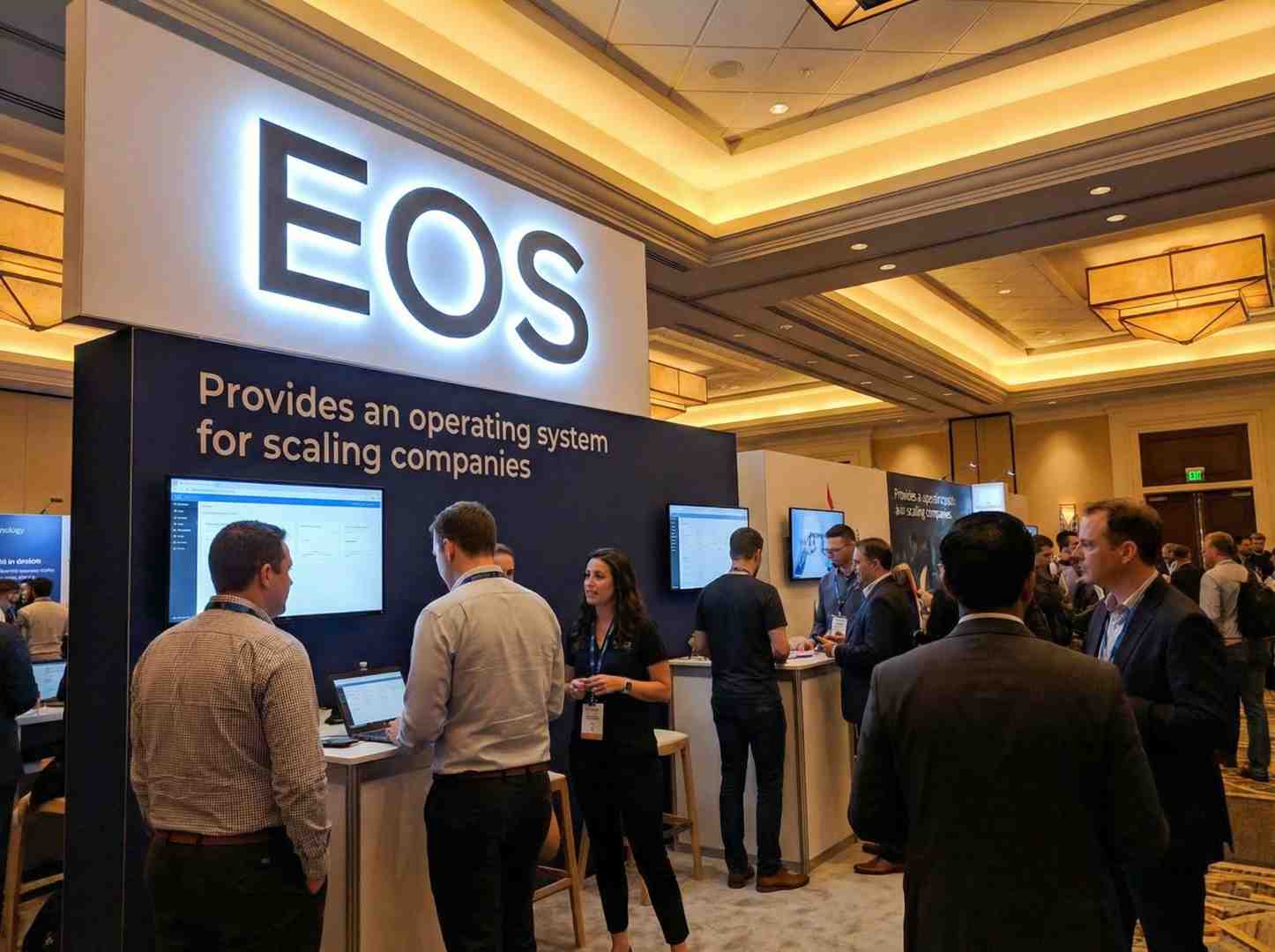
The Level 10 Meeting is a core component of the Entrepreneurial Operating System (EOS), a business management framework popularized by Gino Wickman in his book Traction. While many businesses operate on founder instinct, the Level 10 Meeting shifts the culture toward hard data and institutional discipline.
The Level 10 name is aspirational. On a scale of 1 to 10, most business meetings rank at a dismal 4 or 5. This format is designed to help your team consistently hit a 10. It works because it leverages human psychology—specifically the need for rhythm, the power of public accountability, and the relief of actually solving a problem rather than just talking about it.
The Core Principles
To make this work, we follow five strict earmarks:
- Same Day: The meeting happens on the same day every week (e.g., every Tuesday).
- Same Time: It starts at the same time without fail.
- Same Agenda: We never change the Level 10 meeting agenda structure.
- Start on Time: We don’t wait for latecomers.
- End on Time: We respect the 90-minute boundary religiously.
By sticking to this rhythm, we eliminate the meeting about the meeting and the anxiety of the unknown. The team knows exactly what to expect, which allows them to show up prepared to do the real work.
The Anatomy of a High-Performance Level 10 Meeting Agenda
The magic of the Level 10 format lies in its rigid separation of reporting and solving. In traditional meetings, someone mentions a metric is down, and the team immediately dives into a 20-minute tangent. In a Level 10 Meeting, we note the metric is off-track and drop it to the Issues List to be handled later.
| Feature | Traditional Meeting | Level 10 Meeting |
|---|---|---|
| Duration | Until the agenda is finished (often 2+ hours) | Strictly 90 minutes |
| Focus | Status updates and stories | Problem-solving (IDS) |
| Accountability | Vague next steps | 90% completion of weekly To-Dos |
| Structure | Dynamic/Random | Fixed and Repeatable |
| Feedback | Complaining in the hallway | Real-time 1-10 rating |
The Standard Level 10 Meeting Agenda Breakdown
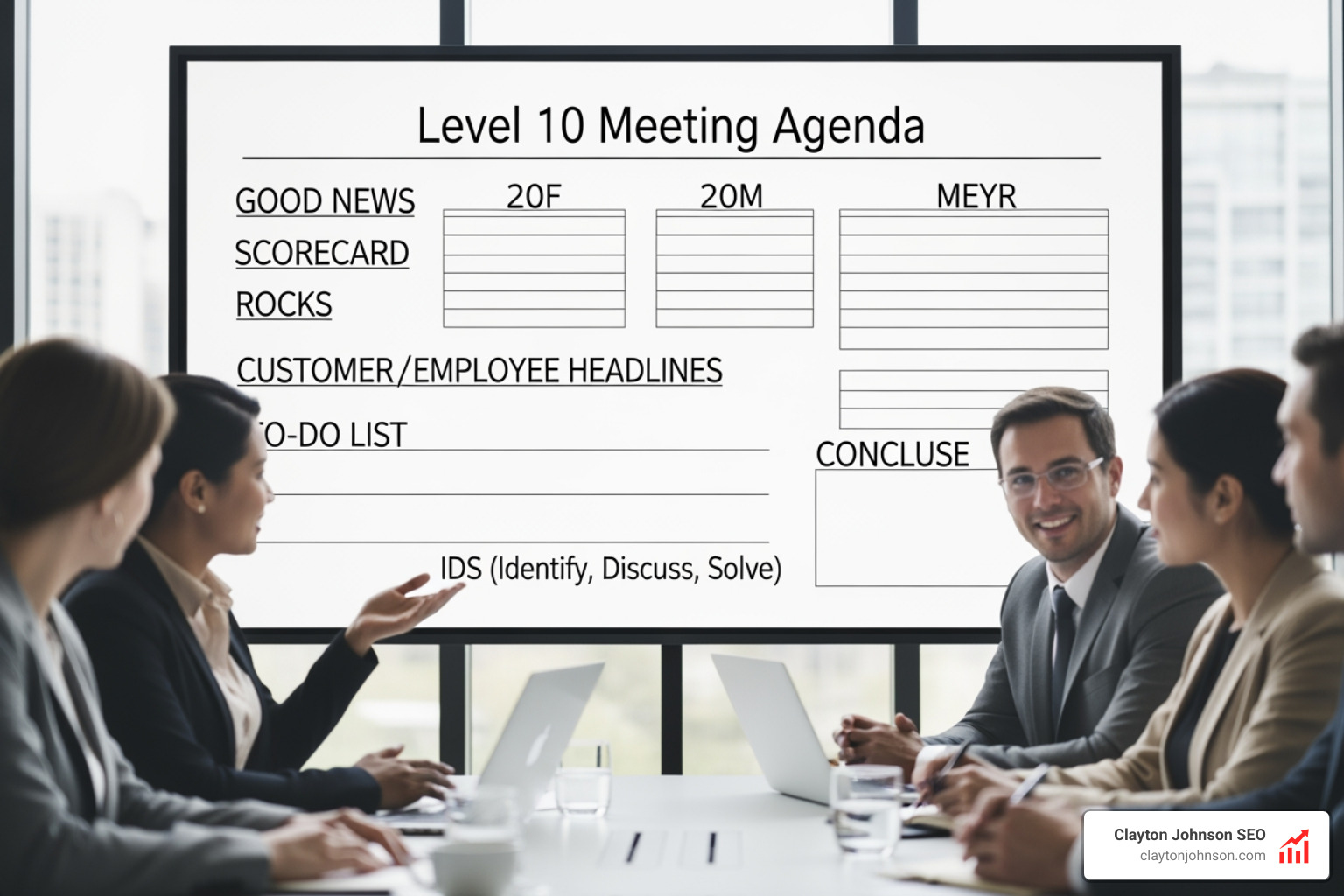
To master the Level 10 meeting agenda, you must respect the clock. The first five segments are reporting only—no backstory, no excuses, just the facts.
- Segue (5 Mins): We start with Good News. Each person shares one personal and one professional win. This transitions the brain from fighting fires to working on the business.
- Scorecard (5 Mins): We review 5-15 high-level metrics. We only want to hear on track or off track. If it’s off track, we drop it to the Issues List.
- Rock Review (5 Mins): Rocks are your 3-7 quarterly goals. Again, it’s just on track or off track. No explanations allowed yet.
- Headlines (5 Mins): These are 10-second updates about customers or employees, such as a team member going on leave or a major client win. If it requires a discussion, it goes to the Issues List.
- To-Do List (5 Mins): We review last week’s commitments. The expectation is that 90% of to-do items from the previous meeting should be completed.
- IDS (60 Mins): This is the heart of the meeting. We identify, discuss, and solve the most pressing issues.
- Conclude (5 Mins): We recap the new To-Do list, decide if any Cascading Messages need to be sent to the rest of the company, and rate the meeting.
Customizing the Level 10 Meeting Agenda for Scaling Teams
As companies grow beyond 60 employees, they often evolve from the tactical Level 10 format to more strategic frameworks like Scaling Up. However, the Level 10 remains incredibly effective for 1:1 meetings between managers and direct reports.
For remote teams, we recommend slightly longer Segues to build the social capital that usually happens at the water cooler. We also suggest using async preparation—team members should add their issues to the list throughout the week so the meeting doesn’t start with a blank page. If you are looking to refine your digital strategy alongside your internal operations, our SEO Consultant Services can help align your external growth with your internal efficiency.

Mastering the IDS Process: Identify, Discuss, Solve
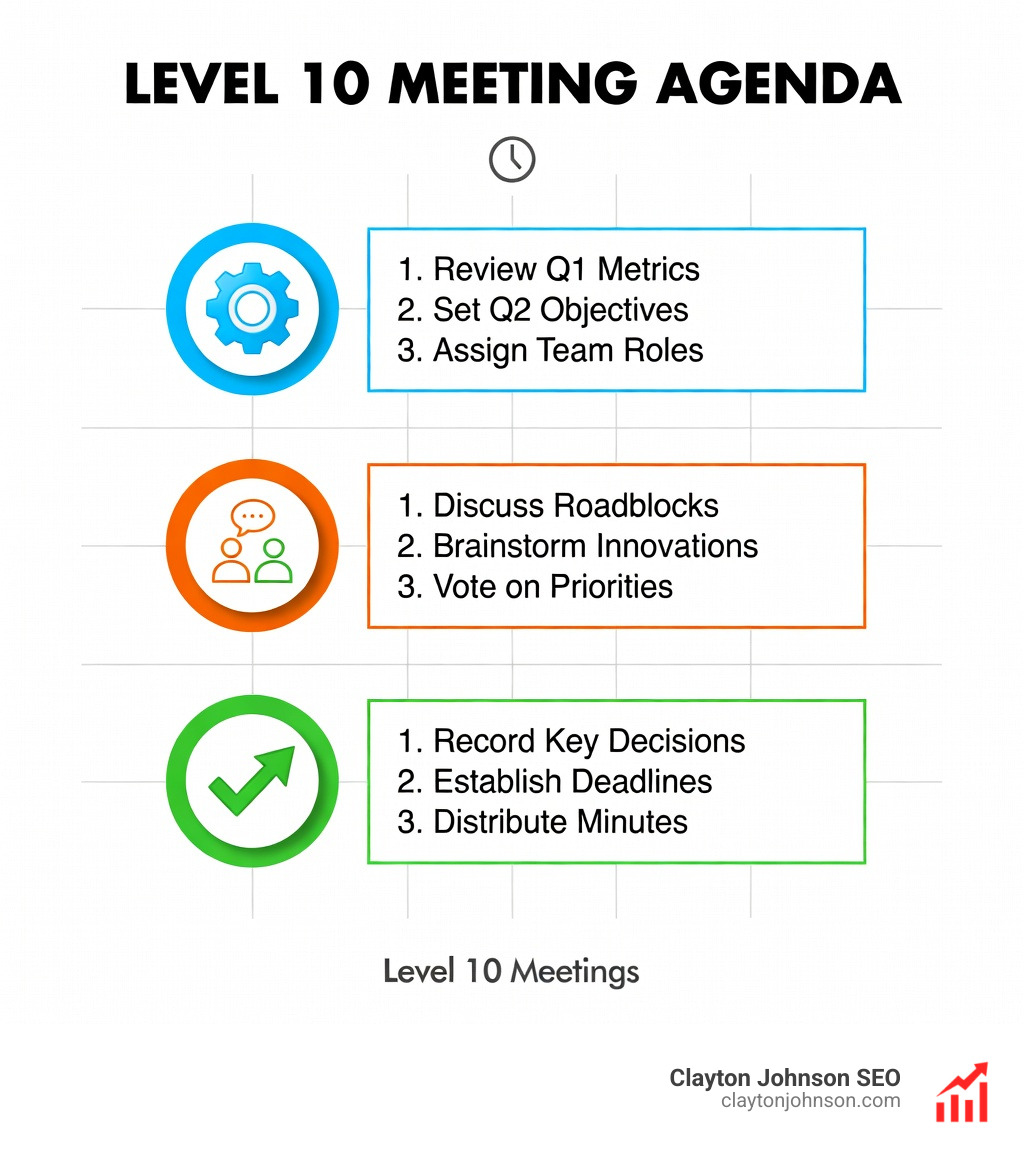
The IDS process is where the Secret Sauce is made. Most teams spend their lives in the Discussing phase, circling a problem without ever reaching a resolution.
1. Identify
We look at the Issues List and prioritize. We don’t start at the top; we pick the top 3 most important issues. Once those are chosen, the Facilitator asks about the real issue. Often, the first thing mentioned is just a symptom. We dig until we find the root cause.
2. Discuss
Everyone gets their say, but we keep it tight. We avoid Executive Liar’s Club behavior—where people nod along to avoid conflict. We want healthy, honest debate. To help with this, you can Download the Issues Solving Track™ to keep your team disciplined.
3. Solve
An issue is solved when it results in an action item. This usually means a To-Do is added to the list for next week. A solution might be a decision made, a plan created, or a task assigned. Our goal is to solve 3-5 issues per meeting so they never come back. This creates an institutional brain where the company learns how to overcome obstacles systematically.
Roles, Best Practices, and Overcoming Challenges
A Level 10 Meeting is a team sport. To keep it from devolving into status update theatre, we assign specific roles:
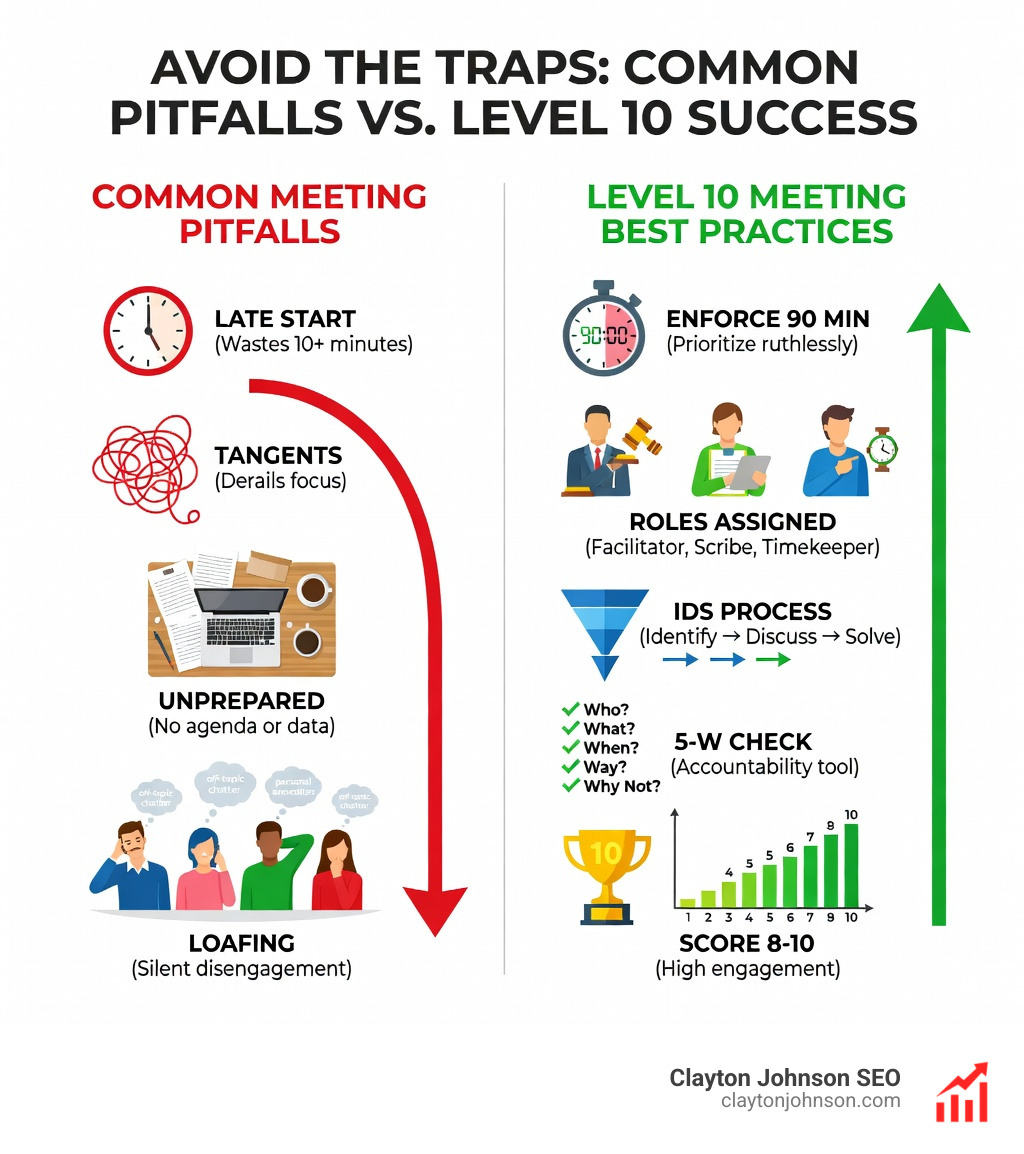
- The Facilitator: Keeps the meeting moving. They are the policeman of the agenda, stopping tangents and pushing the team toward the S in IDS.
- The Scribe: Records the To-Dos and updates the Issues List in real-time.
- The Timekeeper: Ensures we don’t spend 20 minutes on a 5-minute segment.
Best Practices for High Scores
Ideally, you should have 6-7 people in the meeting. Research on meeting effectiveness suggests that once you exceed 7 people, social loafing kicks in, and the quality of debate drops.
One of our favorite tools for accountability is the 5-W Diagnostic:
- Who is doing it?
- What exactly are they doing?
- When will it be done?
- Way: How will we know it’s done?
- Why Not: If it’s not done next week, what stopped us?
If your meeting score is consistently below an 8, it’s a sign of a deeper issue. Usually, it means the team is being polite instead of honest, or the Facilitator is letting people go on tangents. Don’t be afraid to call out disruptive behavior. The goal is a perfect 10, and you can’t get there without self-correction.
Frequently Asked Questions about Level 10 Meetings
Why is the 90-minute duration strictly enforced?
The 90-minute limit creates a scarcity of time that forces prioritization. If you have all day, you’ll talk all day. By capping the meeting, the team is forced to tackle the most important issues first. Furthermore, it ensures that leadership is only out of commission for a predictable block of time each week.
How many people should ideally attend a Level 10 Meeting?
The sweet spot is 6 to 7 people. Fewer than 4 often results in a lack of diverse perspectives and healthy debate. More than 7 makes it difficult for everyone to be heard within the 60-minute IDS window, leading to inefficiency and disengagement.
What should we do if our meeting score is below an 8?
If the score is low, the Facilitator must ask why and what would make it a 10. Common reasons include starting late, getting stuck in Discuss mode without Solving, or people bringing backstory into the reporting segments. Use the low score as an IDS item for the next week to fix the meeting itself.
Conclusion
At Clayton Johnson, we believe that clarity leads to structure, and structure leads to leverage. Most companies don’t lack tactics; they lack the structured growth architecture required to scale without chaos.
Implementing a Level 10 meeting agenda is one of the fastest ways to install that architecture. It transforms your leadership team from a group of individuals fighting their own fires into a unified force that solves problems permanently.
If you’re ready to move beyond “random acts of marketing” and build a compounding growth engine, our SEO Content Marketing Services can help you apply this same level of discipline to your digital presence. Through Demandflow.ai, we provide the frameworks and systems that turn strategic intent into measurable growth. Stop drifting, start solving, and start scoring your business a 10.