The Architect’s Guide to AI Growth

Why AI for Technical SEO Is Now a Competitive Requirement
AI for technical SEO is the use of machine learning and automation to audit, optimize, and maintain a website’s technical infrastructure — so search engines and AI systems can crawl, understand, and surface it effectively.
Here’s what AI does for technical SEO at a glance:
- Audits sites in minutes, flagging crawl errors, broken links, and indexing gaps
- Generates and prioritizes sitemaps based on page importance
- Optimizes structured data, meta tags, and robots.txt automatically
- Monitors Core Web Vitals and mobile performance in real time
- Predicts algorithm shifts using historical pattern analysis
- Improves machine-readability for both traditional search and AI-generated answers
Search is no longer one channel. It’s a fragmented ecosystem.
Google processes 5.9 million searches every minute. AI Overviews, ChatGPT, Perplexity, and Gemini are now active participants in how people discover information — and they have different technical requirements than traditional crawlers.
Your site’s technical foundation determines whether it gets found at all.
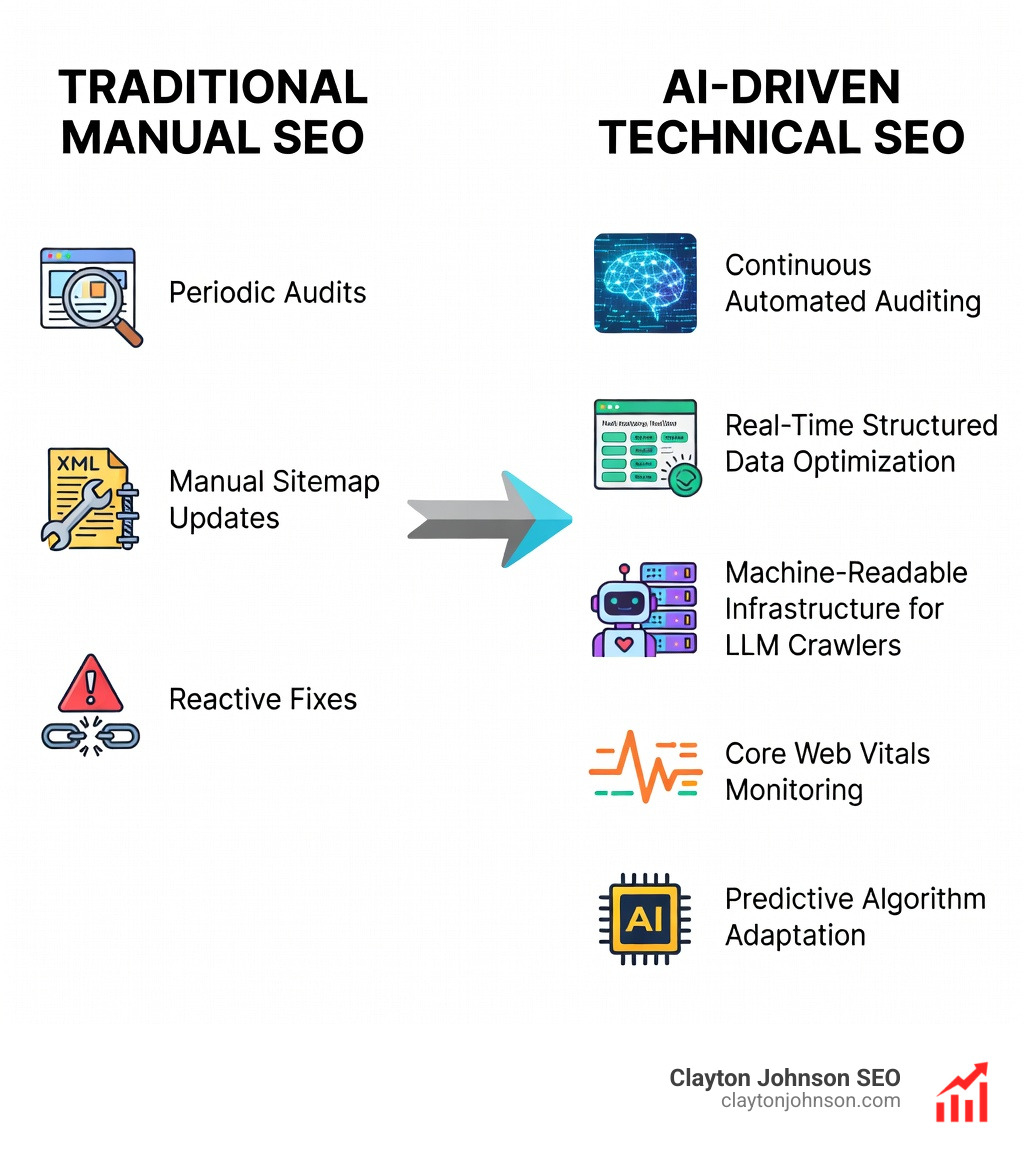
The old approach — manual audits, periodic fixes, reactive updates — can’t keep pace. AI changes the equation. It turns technical SEO from a slow, labor-intensive process into a continuous, automated system that scales with your site.
“Search is no longer won by guesswork. Rankings are shaped by data pipelines, language models, and fast feedback loops.”
The businesses winning in search today aren’t just publishing more content. They’re building infrastructure — technical systems that make their sites readable, trustworthy, and citable by both search engines and AI platforms.
That’s what this guide is built around.
I’m Clayton Johnson — an SEO strategist focused on engineering scalable traffic systems and AI-augmented marketing workflows, with deep experience applying AI for technical SEO to build search infrastructure that compounds over time. This guide translates that systems-level thinking into a practical framework you can execute.
Glossary for AI for technical SEO:
- SEO AI workflow automation
- AI driven SEO audits
- how to use AI for on-page SEO
The Evolution of AI for Technical SEO
The Search Engine Optimization history shows a clear trajectory: we have moved from simple keyword matching to complex intent analysis. In the early days, technical SEO was about making sure a crawler didn’t get stuck in a “spider trap.” Today, AI for technical SEO has turned site infrastructure into a data science problem.
Machine learning models now analyze massive datasets to identify patterns that human eyes simply can’t see. We use predictive analytics to forecast how a site might perform after a major update. Speaking of updates, Google algorithm updates and AI have become more frequent and volatile. Google frequently launches official updates throughout the year. AI helps us adapt by analyzing SERP fluctuations in real-time, allowing us to pivot technical strategies before traffic drops.
This evolution has led to search fragmentation. Your audience isn’t just “Googling” anymore; they are using LLMs (Large Language Models) like ChatGPT, which has hundreds of millions of weekly active users. This shift requires a robust data pipeline where your technical site data is constantly fed into AI models to ensure visibility across all discovery surfaces.
Automating the Technical Foundation with AI
The bedrock of any website is its crawlability. If a bot can’t find it, it doesn’t exist. AI tools like Indexly have revolutionized this by automating sitemap generation and submission. Instead of waiting weeks for Google to “catch up,” these tools use IndexNow protocols to notify search engines and AI chatbots of changes within hours.
We also see massive efficiency gains in:
- Robots.txt Optimization: AI can scan your entire site structure and suggest the most efficient crawl paths, preventing bots from wasting your crawl budget on low-value pages.
- Broken Link Detection: Rather than manual monthly checks, AI agents monitor server logs and 404 errors in real-time.
- Duplicate Content: AI excels at identifying “near-identical” content. While traditional tools look for exact matches, AI uses semantic analysis to find pages that are too similar in meaning, helping us implement canonicalization at scale.
One of our favorite tactics involves Screaming Frog AI prompts. By adding an API key to your crawler, you can automate tasks like generating image alt-text or identifying missing meta tags during a live crawl. This turns a standard audit into a self-healing system.
Conducting an AI for Technical SEO Audit
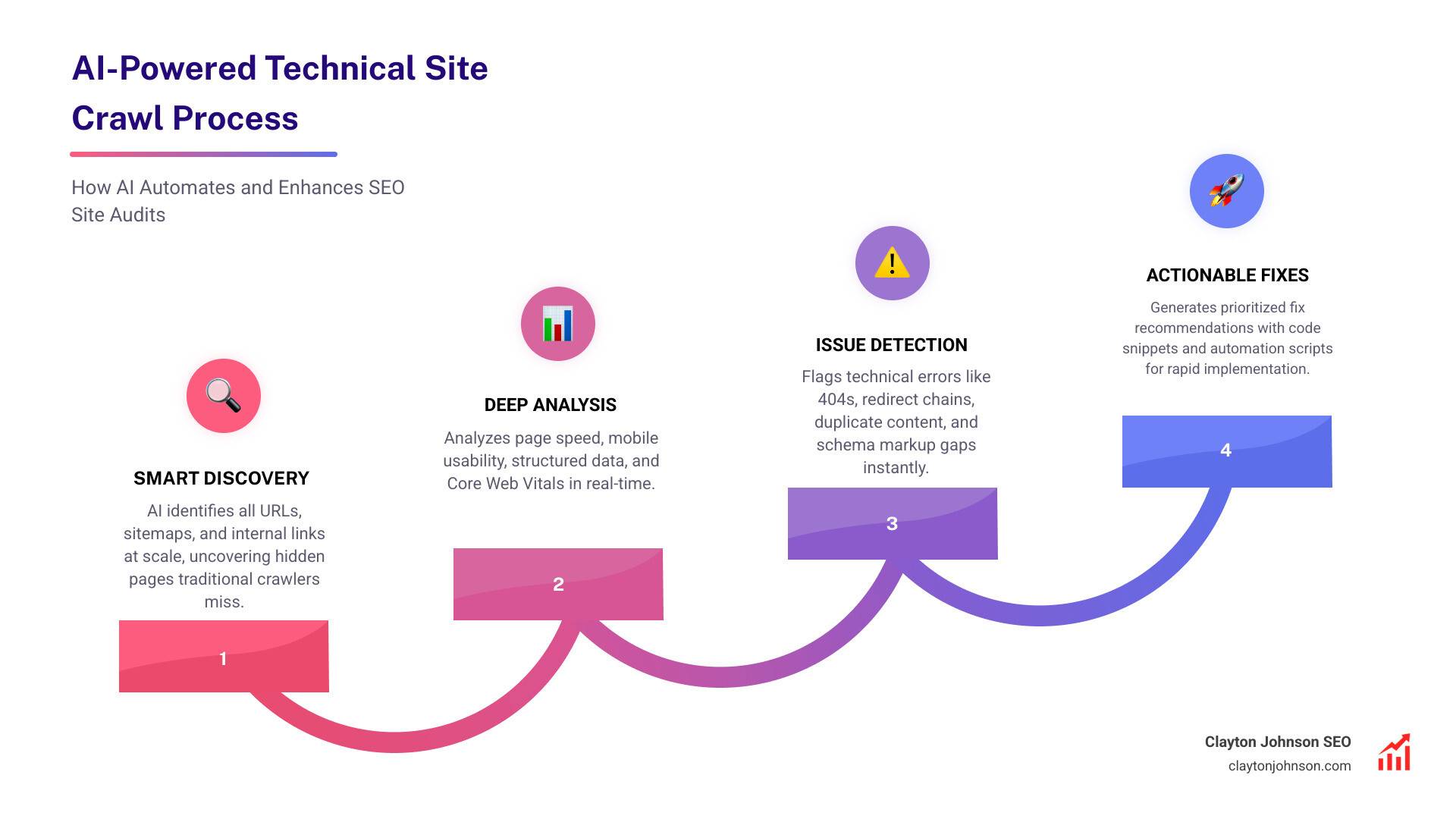
Manual SEO audits used to take days. With AI for technical SEO, we can conduct comprehensive SEO audits in minutes. These audits provide real-time reporting that alerts us the moment a markup error occurs or a page speed metric dips.
The real power here is scalability. For an e-commerce site with 50,000 products, manual oversight is impossible. AI agents can monitor every single URL, ensuring that technical health remains consistent. Furthermore, AI helps us communicate complex ideas to stakeholders by translating technical jargon into digestible visualizations and summaries. If you need help architecting this, you can find more info about SEO consultant services on our site.
Optimizing Structured Data and Meta Tags with AI
Structured data is the language of AI. By using a Schema markup generator, we provide search engines with a “source of truth.” AI enhances this by performing entity recognition—identifying the specific people, places, and things mentioned on your page and linking them to the global knowledge graph.
This directly boosts SERP visibility through rich results. We prioritize:
- FAQPage Schema: To capture real estate in both traditional SERPs and AI Overviews.
- Article and Author Markup: To strengthen E-E-A-T (Experience, Expertise, Authoritativeness, and Trustworthiness).
- Organization Schema: Which appears on 25-34% of pages cited by AI search engines.
For more on how to align your content with these technical signals, check out more info about SEO content marketing.
Enhancing Performance and Generative Engine Optimization (GEO)
Site speed is no longer just a “nice to have”—it’s a disqualifier. In Generative Engine Optimization (GEO), AI engines often skip slow-loading pages in favor of faster sources. We aim for a Time to First Byte (TTFB) under 200ms.
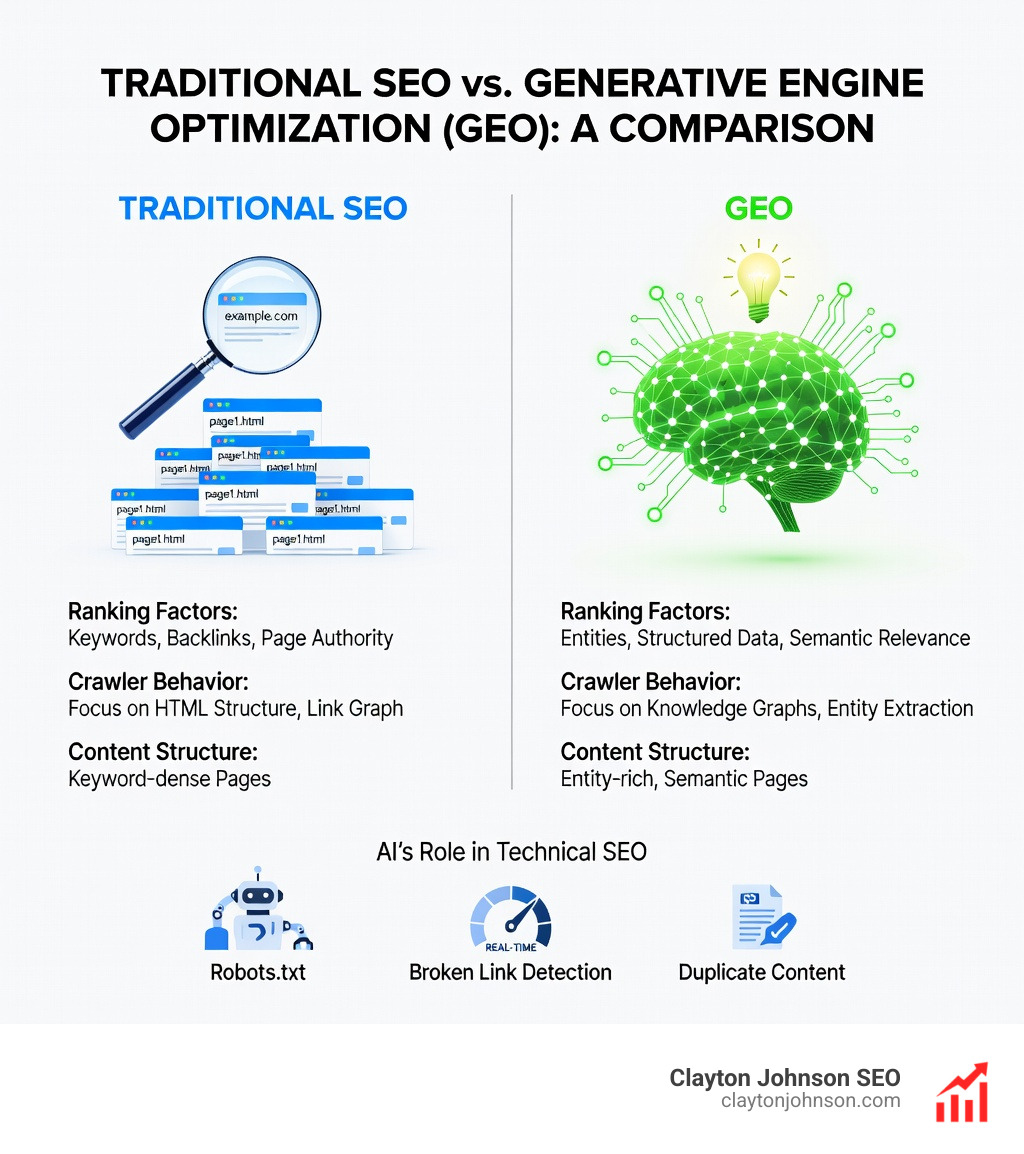
| Feature | Traditional SEO | Generative Engine Optimization (GEO) |
|---|---|---|
| Primary Goal | Rank in top 10 blue links | Be cited as the primary source in AI answers |
| Crawler Focus | HTML, Backlinks, Keywords | Semantics, Entities, Structured Data |
| Speed Requirement | Ranking factor | Disqualifying factor (engines skip slow sites) |
| User Intent | Keyword matching | Conversational problem solving |
To stay ahead, we focus on machine-readability. This means ensuring your technical infrastructure supports the “educated click”—where a user has already been briefed by an AI and arrives at your site ready to convert. You can find more info about conversion optimization to ensure you capture this high-intent traffic.
Building Machine-Readable Infrastructure for AI for Technical SEO
LLM crawlers (like GPTBot or PerplexityBot) behave differently than Googlebot. They often perform “shallow” crawls, focusing on raw HTML rather than rendering heavy JavaScript. To accommodate this, we recommend:
- llms.txt: A new proposed standard (similar to robots.txt) that provides llms.txt and AI readiness instructions for AI bots.
- Static HTML/Server-Side Rendering (SSR): Ensuring the most important content is visible without needing JS execution.
- Content Chunking: Structuring text into 300-500 token blocks that are easily “embedded” by AI models.
Monitoring bot logs becomes critical here. By analyzing which AI bots are hitting your site, we can adjust our AI search strategy to favor the platforms driving the most high-value traffic.
The Future of Autonomous Technical SEO Systems
The future of AI for technical SEO lies in autonomous AI agents. These aren’t just tools; they are teammates that connect perception (data), reasoning (strategy), and action (implementation).
These agents will handle:
- Hyper-personalization: Adjusting technical elements based on individual user behavior.
- Voice Search: With voice search statistics showing that a significant portion of global users now use voice, AI will optimize site structures for conversational queries.
- Predictive Trends: Identifying emerging search patterns before they become competitive.
This shift toward an “AI SEO Operating System” allows founders to focus on growth while the machine handles the maintenance. For those interested in the technical side of building these systems, we offer more info about AI coding and how it integrates with search architecture.
Frequently Asked Questions about AI for Technical SEO
Can AI handle technical SEO entirely on its own?
No. While AI is incredible at processing data and automating repetitive tasks, human oversight is essential. AI lacks critical thinking, brand intuition, and the ability to align technical fixes with broader business goals. You still need an architect to design the system; the AI just helps lay the bricks faster.
How does AI help with duplicate content issues?
AI uses semantic analysis to look beyond the words on the page. It can detect “near-identical” content by understanding the meaning and intent behind the text. This allows for better content clustering and more accurate canonicalization at a scale that manual audits could never achieve.
What are the best AI tools for technical audits?
We recommend a stack that includes:
- Screaming Frog: For deep crawls and AI-powered tag generation.
- Ahrefs Always-on Audit: For real-time monitoring and “self-healing” patches.
- SE Ranking: For tracking AI Overview visibility.
- DataForSEO: For building custom AI-driven research tools via API.
- Indexly: For automated indexing and sitemap management.
Conclusion
At Clayton Johnson SEO, we believe that clarity leads to structure, and structure leads to leverage. We are building Demandflow.ai to provide exactly that: a structured growth architecture for companies that are tired of random acts of marketing.
Our taxonomy-driven SEO systems and AI-augmented workflows ensure that your technical foundation isn’t just “fixed”—it’s optimized for compounding growth in an AI-first world. Whether you are in Minneapolis or competing on a global stage, your site needs to be more than just a collection of pages. It needs to be an authoritative, machine-readable ecosystem.
Ready to build your growth infrastructure? Explore our AI SEO services and let’s turn your technical SEO into a competitive advantage.