How to Find Your Next AI Regulatory Advisor


Why Finding the Right AI Regulatory Advisor Is Harder Than It Looks
Where find AI regulatory advisors is one of the most common questions facing founders and marketing leaders right now — and the answer is not as simple as a quick Google search.
Here is a fast answer to get you oriented:
Top places to find AI regulatory advisors:
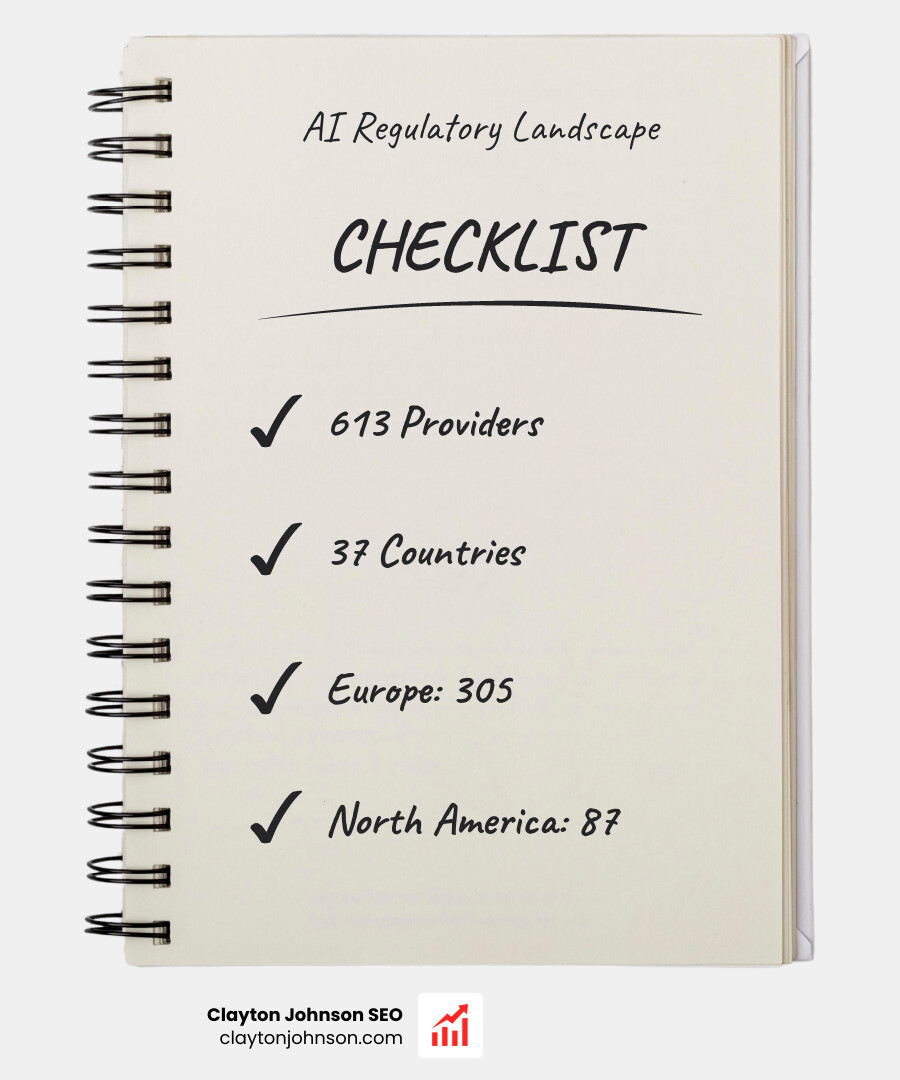
- Global directories — VerifyWise lists 613 AI governance providers across 37 countries, including 321 consultancies and 136 training providers
- Specialized law firms — Latham & Watkins, Baker McKenzie, and Morgan Lewis all offer dedicated AI regulatory practices
- Big Four consultancies — Deloitte (including its IBM watsonx.governance partnership) offers end-to-end AI governance services
- Boutique advisory firms — AI Governance Advisors and similar firms offer focused, standards-aligned guidance (NIST AI RMF, ISO 42001)
- Non-profit organizations — The Council on AI Governance provides enterprise-focused, pragmatic AI governance resources
- Professional associations — The IAPP AI Governance Center connects organizations with trained, credentialed experts
AI regulation is moving fast. The EU AI Act, GDPR, NIST AI RMF, and ISO 42001 are just a few of the frameworks organizations must now navigate. Yet 48% of executives cite insufficient trust as their top obstacle to expanding AI usage — and without the right advisor, that trust gap only widens.
The challenge is not a shortage of experts. It is knowing where to look, what to look for, and how to tell a generalist from a true specialist.
I’m Clayton Johnson — an SEO strategist and growth architect who helps founders build systems that scale, including navigating the fast-evolving landscape of where find AI regulatory advisors that align with both compliance requirements and business strategy. My work mapping structured frameworks across 50+ business models gives me a clear lens on how organizations can cut through the noise and connect with the right governance partners.
Where find AI regulatory advisors helpful reading:
Top Directories and Platforms to Locate AI Experts
When we start our search for specialized talent, the most efficient route is often through established directories. These platforms act as a filter, helping us distinguish between a standard IT consultant and a true regulatory specialist.
Currently, there are over 600 AI governance providers listed across 37 countries. These providers are not just individuals; they include large consultancies, professional associations, and dedicated training organizations. Having a bird’s-eye view of this landscape is essential because 94% of leaders believe AI is critical to their success, yet many struggle to find the right guide to manage the associated risks.

Where find AI regulatory advisors globally
The distribution of AI experts is heavily influenced by where the strictest regulations are being born. If you are looking for an advisor with deep experience in the EU AI Act, Europe is the primary hub.
- Europe: Leads the world with 305 providers. Germany is the frontrunner with 44 providers, followed closely by the UK (35) and France (27).
- North America: Features 87 providers, with the vast majority (64) located in the United States.
- Asia: A growing market with 144 providers, catering to a mix of local and international regulatory standards.
For those needing a jumpstart, use established global directories and professional networks to shortlist qualified advisors, then validate their experience against your target jurisdictions and frameworks (EU AI Act, GDPR, NIST AI RMF, ISO 42001). Using these regional stats helps us narrow down where find AI regulatory advisors based on the specific legal jurisdiction our company operates in.
Professional associations and training providers
Sometimes, the best way to find an advisor is to look at who is teaching the experts. Professional associations are goldmines for networking.
The IAPP AI Governance Center Advisory Board is a prime example. The IAPP (International Association of Privacy Professionals) provides a nexus for AI governance experts. They often have an annual call for volunteers and board members, which is a great place to identify thought leaders in the field.
Furthermore, with 136 providers offering AI governance training worldwide, looking at certification bodies can lead us to highly qualified independent consultants who have the most current “paperwork” to back up their claims.
Specialized Law Firms and Big Four Consultancies
If your organization is dealing with high-stakes deployment — such as Large Language Models (LLMs) or core AI hardware — you likely need the heavy hitters. Large law firms and the “Big Four” accounting firms have built massive practices around the “entire AI stack.”

Legal expertise in AI governance and IP
Law firms like Latham & Watkins, Baker McKenzie, and Morgan Lewis don’t just look at compliance; they look at the 360-degree legal picture. This includes:
- Intellectual Property (IP): Protecting trade secrets in proprietary algorithms and navigating patent landscapes.
- Dispute Resolution: Defending AI-related activities in court and before global regulators.
- Workforce Impact: Advising on how AI changes hiring, management, and employee privacy.
In our local region, firms like Fredrikson & Byron provide specialized AI services that bridge the gap between innovation and legal protection, ensuring that technical advancement is matched by robust legal frameworks.
Big Four and technology partnerships
The Big Four (Deloitte, PwC, EY, KPMG) are moving beyond pure consulting into technology partnerships. For example, Deloitte has partnered with IBM to offer Trustworthy AI services.
A key part of this is “operationalizing” governance. It’s one thing to have a policy on paper; it’s another to have a model inventory and automated compliance workflows. Tools like IBM’s watsonx.governance help automate the “paperwork” of compliance, making it easier for leaders to scale AI responsibly. According to Deloitte, 48% of executives indicate “insufficient trust” is the top obstacle to AI expansion — these partnerships aim to solve that by building a Trustworthy AI framework.
Specialized Advisory Firms and Non-Profits
Not every company needs a global law firm. For many founders, a boutique advisory firm or a non-profit resource is a more pragmatic starting point. These organizations often focus on “portfolio-grade” governance, which is particularly useful for Private Equity (PE) and Venture Capital (VC) investors who need to ensure their entire portfolio is compliant.

Where find AI regulatory advisors for niche governance
Specialized firms like AI GOVERNANCE ADVISORS focus on transforming AI risk into a competitive advantage. They align their tools with global standards like the NIST AI RMF and ISO 42001.
If you are looking for open-source and pragmatic resources, the Council on AI Governance is an independent non-profit that works across industry, academia, and government. They are a fantastic source for current, enterprise-ready frameworks. We highly recommend you Follow them on LinkedIn to stay updated on their latest pragmatic resources.
Boutique consultancies and regional experts
If you prefer to keep advisory support closer to home, consider hiring a local governance advisor or a Minneapolis-based consultancy with compliance and risk expertise. The goal is not just proximity; it’s faster collaboration with stakeholders across product, legal, security, and marketing.
When evaluating regional options, prioritize teams that can:
- Map your use cases to risk tiers (including high-risk and General Purpose AI where relevant)
- Build a practical model inventory and documentation workflow
- Implement controls aligned to the EU AI Act, GDPR, NIST AI RMF, and ISO 42001
If you want a starting point for discovery, search for “AI governance consultant Minneapolis” or ask local legal, privacy, and security communities for referrals, then validate each candidate using the criteria in the selection section below.
Key Services and Regulations Your Advisor Must Know
When you are interviewing potential advisors, you need to know if they speak the right “language.” AI regulation isn’t just one law; it’s a web of overlapping requirements.

Navigating high-risk AI systems and GPAI
Your advisor must be intimately familiar with the following:
- EU AI Act: The gold standard for risk-based AI regulation.
- GDPR: Crucial for any AI that processes personal data (which is most of them).
- NIST AI RMF: A voluntary but highly respected framework in the US for managing AI risk.
- ISO 42001: The international standard for AI management systems.
Advisors should provide services like bias reduction, transparency audits, and accountability frameworks. For those in the early stages, the AI innovation package from the European Commission provides funding and support for startups to help them prepare for compliance.
How to Evaluate and Select the Right Partner
Choosing an advisor is a high-stakes decision. If you pick wrong, you could end up with a “compliance theater” that doesn’t actually protect you from liability.
Implementation and institutional memory
One of the most innovative concepts in AI compliance right now is “institutional memory.” Tools like Norm Ai help capture every policy, precedent, and regulatory review to build a compounding knowledge base. This ensures that your compliance efforts become faster and more accurate over time, rather than starting from scratch every year.
When evaluating an advisor, ask about their specific governance and consulting processes. Do they use manual spreadsheets, or do they leverage AI to govern AI?
Key selection criteria should include:
- Sector Knowledge: Have they worked in your specific industry (e.g., healthcare, finance, HR tech)?
- Global Reach: Can they handle regulations in every country where you have customers?
- Technical Acuity: Do they actually understand how the models work, or are they just reading legal text?
Where find AI regulatory advisors and Free Resources
Before you sign a massive contract, explore the free resources and voluntary initiatives available. These can often provide a “regulatory sandbox” where you can test your AI systems without the immediate threat of heavy fines.
- The AI Pact: A voluntary industry consortium designed to help participants prepare for the EU AI Act.
- Government Portals: Sites like The White House AI policy page provide updates on executive actions and national priorities regarding AI.
- Regulatory Sandboxes: Many European countries offer sandboxes where startups can develop AI under the guidance of regulators.
Frequently Asked Questions about AI Regulatory Advisors
What are the typical costs for AI regulatory consulting?
Costs vary wildly based on the size of your organization and the complexity of your AI systems. A boutique advisor might charge $15,000 for a one-time risk assessment, while a Big Four firm could charge upwards of $250,000 for a full enterprise-wide governance implementation.
How long does it take to achieve EU AI Act compliance?
For most mid-sized companies, the journey takes 6 to 12 months. This includes auditing existing systems, classifying them by risk level, and implementing the necessary transparency and data governance controls.
What is the difference between a legal advisor and a technical AI consultant?
A legal advisor focuses on liability, contracts, and regulatory interpretation. A technical AI consultant focuses on the “how” — how to detect bias in the code, how to secure the data pipeline, and how to automate the monitoring of model drift. You often need both to be fully protected.
Conclusion
Finding the right advisor is about more than just checking a compliance box; it’s about building a foundation for sustainable growth. At Clayton Johnson and Demandflow.ai, we believe that clarity leads to structure, and structure leads to compounding growth.
Whether you are looking for where find AI regulatory advisors in Minneapolis or seeking a global partner to navigate the EU AI Act, the key is to find someone who understands that governance should enable innovation, not stifle it. By using the directories, law firms, and boutique advisors mentioned in this guide, you can turn regulatory risk into a competitive advantage.
Ready to build a structured growth architecture for your AI initiatives? Learn more about AI governance services and how we can help you scale with confidence.