OpenAI History: The Drama, The Dollars, and The Droids

Why OpenAI’s Story Matters to Everyone Building with AI
OpenAI history is one of the most dramatic and consequential stories in modern tech. What started as a non-profit research lab in 2015 became the company behind ChatGPT—the fastest-growing consumer app in history—and the center of a Silicon Valley power struggle that nearly tore it apart.
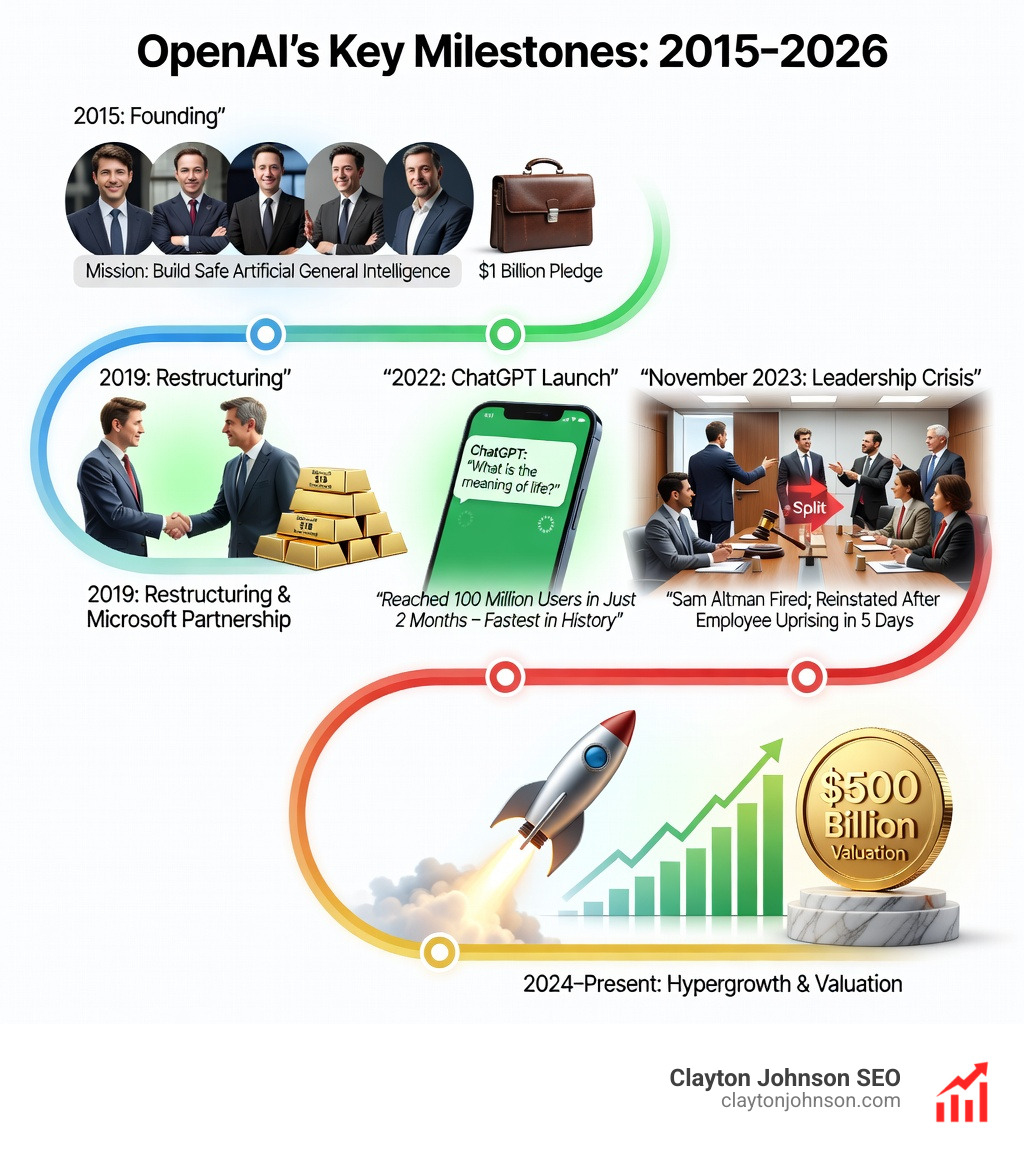
Here’s what you need to know about OpenAI’s evolution:
- 2015: Founded as a non-profit by Sam Altman, Elon Musk, and others with a $1 billion pledge to build safe AGI
- 2019: Restructured into a capped-profit model and secured $1 billion from Microsoft
- 2022: Launched ChatGPT, reaching 100 million users faster than any app in history
- November 2023: Sam Altman was fired and reinstated within five days after employee revolt
- 2024-Present: Raised $6.6 billion at a $500 billion valuation while burning $8 billion annually
The company went from altruistic research lab to the most valuable AI startup on earth. Along the way, it pioneered GPT models, sparked an AI arms race, survived a boardroom coup, and reshaped how millions of people work.
The stakes are massive. OpenAI’s decisions influence everything from how we search the web to national security policy. Understanding OpenAI history means understanding where AI is headed—and who controls it.
I’m Clayton Johnson, and I’ve spent years studying how search behavior evolves around transformative technologies like AI. Throughout this guide on OpenAI history, I’ll break down the drama, the dollars, and the strategic pivots that turned a research project into the most watched company in tech.
Open ai history terms you need:
The Definitive Open AI History: From Non-Profit to Global Powerhouse
The story of OpenAI begins in late 2015, born from a dinner at the Rosewood Sand Hill hotel in Silicon Valley. The mission was clear: to build Artificial General Intelligence (AGI) that benefits all of humanity. At the time, the founders were deeply concerned about the potential for AI to be monopolized by a few large corporations.
The founding team was a “who’s who” of tech talent. Sam Altman (then president of Y Combinator), Elon Musk, Greg Brockman (former CTO of Stripe), and Ilya Sutskever (a leading AI researcher from Google) led the charge. They launched with a $1 billion pledge from donors including Reid Hoffman, Peter Thiel, and Jessica Livingston.
Central to their identity was the OpenAI Charter, a document that outlined their commitment to safety and broad benefit. They operated as a non-profit under the umbrella of YC Research, focusing on altruistic AI development. Their early Scientific research on Generative Pre-Training laid the groundwork for what would eventually become the GPT series.
Early Milestones in Open AI History
In the early years, OpenAI focused on building tools for the broader research community. They released OpenAI Gym, a toolkit for developing reinforcement learning algorithms, and Universe, a platform for measuring an AI’s general intelligence across games and websites.
One of the most famous early demonstrations of their power was the OpenAI Five project. We watched as their AI agents learned to play Dota 2, eventually defeating world-champion human teams. This wasn’t just about gaming; it proved that reinforcement learning could master complex, long-term strategy. During this period, they also developed the GPT-1 architecture, proving that “pre-training” a model on vast amounts of text could lead to impressive language understanding.
The 2019 Pivot to Capped-Profit
By 2019, the leadership realized that the “non-profit only” model couldn’t sustain the astronomical costs of computing power needed to train larger models. To solve this, they created a unique “capped-profit” structure.
As detailed in the company’s blog post in 2019, they formed OpenAI LP. This allowed them to attract massive investment while technically remaining under the control of the non-profit board. Shortly after, they announced a massive partnership with Microsoft, securing a $1 billion investment. This move was controversial—Elon Musk famously left the board over disagreements regarding the direction and the lack of “openness” that the name originally promised. You can read more info about OpenAI’s structure to see how this complex hierarchy functions today.
The Product Revolution: GPT, DALL-E, and the ChatGPT Explosion
If the early years were about research, the 2020s have been about products. OpenAI moved from being a lab that published papers to a company that built tools used by hundreds of millions.

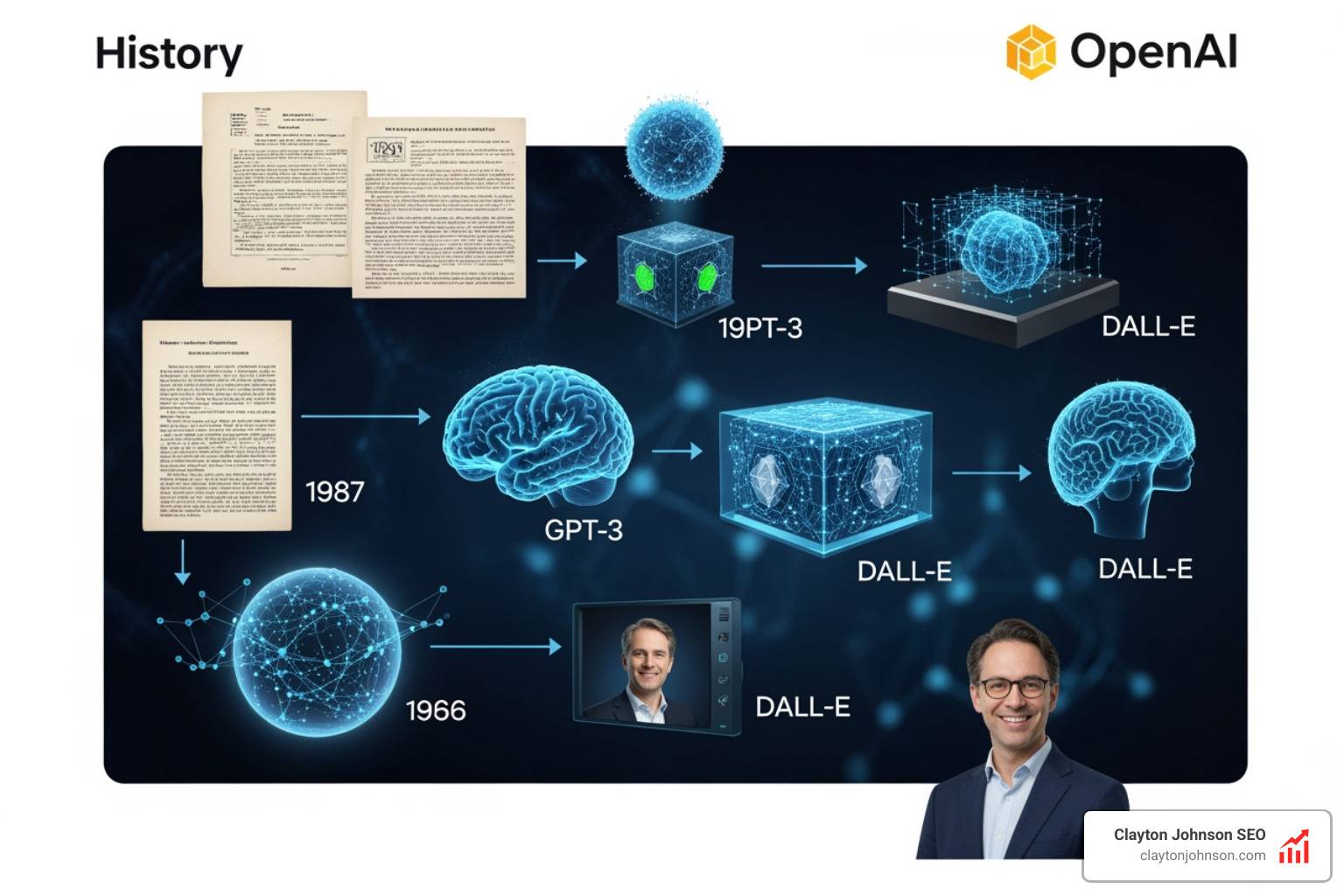
The release of GPT-3 in 2020 was a turning point. With 175 billion parameters, it was the first model that felt truly “human-like” in its writing. Then came DALL-E, a text-to-image generator that turned simple prompts into stunning visuals. But nothing compared to November 30, 2022—the day ChatGPT was released.
ChatGPT became the fastest-growing consumer app in history, reaching 100 million users in just two months. It wasn’t just a tool; it was a cultural phenomenon.
| Model | Key Feature | Primary Use Case |
|---|---|---|
| GPT-3 | 175B Parameters | General writing and coding |
| GPT-4 | Multimodal (Text/Image) | Complex reasoning and analysis |
| o1 (Preview) | Advanced Reasoning | Science, math, and logic |
We’ve seen this evolution continue with Sora, their text-to-video model, and more info about OpenAI services shows a company that is now a full-scale platform for developers and enterprises.
Scaling the GPT Series
With the launch of GPT-4, OpenAI moved into multimodal AI—meaning the model could “see” and “hear” as well as read. This led to a massive explosion in the developer ecosystem. Thousands of startups began building on the OpenAI API. The recent introduction of “reasoning models” like o1 represents the next frontier: AI that thinks before it speaks, solving complex problems that stumped previous versions.
Driving Growth Through Consumer AI
OpenAI didn’t just stop at a web interface. They launched ChatGPT Plus, which now boasts over 20 million subscribers. They also released mobile apps and entered a massive partnership with Apple to integrate ChatGPT directly into Siri. This move puts OpenAI’s technology into the pockets of billions of iPhone users worldwide.
The November 2023 Crisis: Five Days That Shook Silicon Valley
In the middle of its meteoric rise, OpenAI nearly collapsed in a single weekend. On November 17, 2023, the OpenAI announced that it was removing its co-founder Sam Altman as CEO.
The board of directors cited a “lack of candor” in Altman’s communications. What followed was a corporate thriller that played out in real-time on social media. Greg Brockman resigned in solidarity, and a tweet from Greg Brockman detailed the shock of the “board coup.”
The reaction was swift:
- Employee Mutiny: Over 700 of OpenAI’s 770 employees signed a letter demanding the board resign and Altman be reinstated, or they would follow him to Microsoft.
- Microsoft Intervention: Satya Nadella offered to hire the entire OpenAI team.
- Ilya Sutskever’s Regret: Ilya, a board member who initially voted to fire Altman, publicly stated he “deeply regretted” his participation in the board’s actions.
Within five days, Sam Altman was back. The board was reconstructed, removing critics like Helen Toner and Tasha McCauley, and adding heavyweights like Larry Summers and Bret Taylor.
Financial Restructuring and the $500 Billion Valuation
Following the 2023 crisis, OpenAI’s financial trajectory went into overdrive. The company is currently transitioning from its capped-profit roots into a Public Benefit Corporation (PBC). This transition is designed to make the company more attractive to traditional investors while maintaining a mission-driven focus.
The numbers involved in open ai history are now staggering:
- $6.6 Billion: The amount raised in a recent share sale.
- $500 Billion: The current valuation target, placing it in the same league as SpaceX.
- $12 Billion: Annualized revenue as of late 2024.
- $8 Billion: Projected operating loss due to massive compute costs.
- $115 Billion: Estimated burn rate over the next several years to reach AGI.
Investors now include NVIDIA, SoftBank, and Thrive Capital. This capital is being funneled into a massive global infrastructure play. You can find more info about OpenAI’s mission to understand how they balance these billions with their original charter.
The Future of Open AI History
We are seeing OpenAI move toward vertical integration. They are exploring custom AI chips through a partnership with Broadcom and building out massive data centers via an Oracle cloud deal. They aren’t just an AI company anymore; they are becoming a global infrastructure provider, even pursuing government contracts to support national security.
Safety, Controversies, and the Ethics of AGI
Despite the success, OpenAI faces significant headwinds. The “Superalignment” team, tasked with ensuring that a superintelligent AI wouldn’t go rogue, was dissolved after key leaders like Jan Leike resigned, citing that “safety culture and processes have taken a backseat to shiny products.”
The company is also embroiled in legal battles:
- Copyright Lawsuits: The New York Times and several prominent authors have sued OpenAI, alleging their work was used to train models without permission.
- Elon Musk Lawsuit: Musk sued his former colleagues, alleging a breach of contract and claiming the company has abandoned its original non-profit mission.
- Military Pivot: OpenAI recently updated its policies to allow for certain military and “dual-use” applications, leading to Pentagon contracts.
Furthermore, the company has expanded its operations globally, including significant data-labeling footprints in Africa, which has raised questions about labor practices and the “human cost” of AI. For those interested in who is currently steering the ship through these storms, check out more info about OpenAI’s leadership.
Frequently Asked Questions about OpenAI
Who founded OpenAI and why?
OpenAI was founded in 2015 by Sam Altman, Elon Musk, Greg Brockman, Ilya Sutskever, Wojciech Zaremba, and John Schulman. The goal was to develop AGI in a way that was safe and open, preventing a single corporation from monopolizing the most powerful technology in history.
How does the OpenAI capped-profit model work?
OpenAI is controlled by a non-profit board. Underneath that is a “capped-profit” entity (OpenAI Global, LLC). Investors and employees can earn a return on their investment, but that return is capped at a specific multiple. Any profit generated beyond that cap belongs to the non-profit for the benefit of humanity.
What is the relationship between Microsoft and OpenAI?
Microsoft is OpenAI’s largest investor and exclusive cloud provider. While Microsoft has invested over $13 billion and holds a non-voting observer seat on the board, OpenAI remains an independent company. Microsoft uses OpenAI’s models to power its “Copilot” features across Windows and Office.
Conclusion
The open ai history is a story of radical evolution. We’ve seen a small research lab transform into a global powerhouse that defines the current era of technology. From the altruistic goals of its 2015 founding to the high-stakes corporate maneuvering of 2023 and 2024, OpenAI remains at the center of the AGI pursuit.
As we look forward, the tension between corporate governance and the original mission will continue to be a focal point. At Clayton Johnson SEO, we believe that staying informed about these shifts is crucial for any leader looking to leverage AI for growth.
For those looking to dive deeper into the current state of the organization, you can find more info about OpenAI’s current structure here. The journey toward AGI is just beginning, and we’ll be here to help you navigate it.