All About Perplexity


What Perplexity AI Is and Why It Matters
Perplexity is an AI-powered answer engine that delivers direct, sourced responses to complex queries by combining large language models with real-time web search. Unlike traditional search engines that return a list of blue links, Perplexity synthesizes information from across the web and presents it conversationally—with numbered citations so you can verify every claim.
Quick Overview: What is Perplexity AI?
| Aspect | Details |
|---|---|
| Company Type | American privately held AI software company |
| Founded | August 2022 by Aravind Srinivas, Denis Yarats, Johnny Ho, and Andy Konwinski |
| Core Product | AI-powered answer engine combining LLMs with real-time search |
| Valuation | $20 billion (as of September 2025) |
| Monthly Queries | 780 million queries in May 2025 (~30 million daily) |
| Key Features | Focus Modes, Pro Search, Pages, Comet browser, Search API |
| Business Model | Freemium (free tier + Perplexity Pro subscription) |
| Headquarters | San Francisco, California |
Why Perplexity is disrupting search:
- Direct answers instead of endless scrolling through search results
- Real-time sourcing with verifiable citations for every response
- Conversational AI that remembers context and allows follow-up questions
- No ads in the core experience (unlike Google’s ad-heavy model)
- Specialized modes for academic research, YouTube content, social platforms, and more
The platform launched its main search engine in December 2022 and has grown explosively since. By February 2023, it had 2 million unique visitors. By mid-2025, it was processing over 30 million queries daily with 20%+ month-over-month growth. Major investors include Jeff Bezos, Nvidia, and Databricks, signaling strong confidence in its potential to reshape how people find information online.
Perplexity hasn’t been without controversy. The company has faced multiple copyright infringement lawsuits from publishers including Forbes, The New York Times, BBC, and Japanese newspapers for alleged unauthorized content scraping. Investigations by Wired and Cloudflare revealed that Perplexity used “stealth web crawlers” with spoofed user-agent strings to bypass robots.txt protocols—a practice that drew sharp criticism from the tech community.
Despite these challenges, Perplexity continues to innovate aggressively. It’s launched products like the Comet AI browser, enterprise search solutions, and even made bold acquisition bids including a $34.5 billion offer for Google Chrome in August 2025.
I’m Clayton Johnson, and I’ve been building AI-assisted marketing systems and SEO frameworks for years—Perplexity represents a fundamental shift in how search intent gets satisfied, which has major implications for content strategy. This guide breaks down everything you need to know about the platform, from its core technology to its competitive positioning and legal battles.
What is Perplexity AI?
At its core, Perplexity is what we call an “Answer Engine.” While a traditional search engine acts like a librarian pointing you to a shelf of books, Perplexity acts like the researcher who reads those books for you and summarizes the answer. It bridges the gap between the static knowledge of a standard chatbot and the real-time chaos of the open web.
The company focuses on “powering curiosity” by providing answers backed by up-to-date sources. This is a massive departure from early AI models that suffered from “knowledge cutoffs.” When Perplexity launches AI-powered answer engine capabilities, it changed the expectation of what an AI could know about today’s news or current stock prices.
Understanding the Perplexity Answer Engine
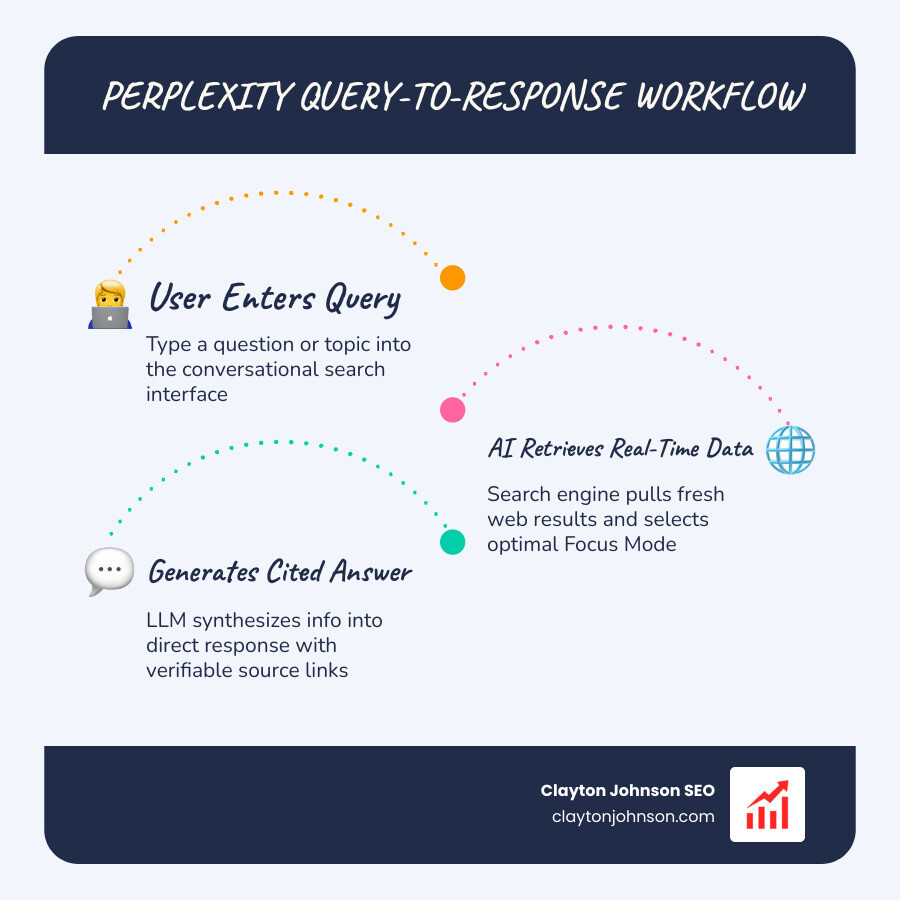
How does it actually work? Perplexity orchestrates two distinct “engines”:
- The Knowledge Engine: A massive search index that crawls the live web.
- The Reasoning Engine: A Large Language Model (LLM) that processes the data retrieved by the search index.
Instead of giving you a list of “blue links” to click, it provides a synthesized paragraph. Every sentence is typically followed by a small, clickable number. These citations are the backbone of the platform, allowing users to verify that the AI isn’t just “hallucinating” (making things up). It transforms the search experience from “finding” to “knowing.”
Comparison with Traditional Search Engines
We’ve all experienced “search clutter.” You search for a recipe or a product review, and you’re met with three screens of ads, followed by SEO-optimized articles that take 1,000 words to get to the point.
Perplexity removes this friction. Because it is largely ad-free in its core interface, the focus remains entirely on user intent. It also maintains conversational context. If you ask, “Who is the CEO of Nvidia?” and follow up with “Where did he go to school?”, Perplexity knows “he” refers to Jensen Huang. Traditional search engines often require you to start a brand-new search for every step of your journey.
Founding and Growth Trajectory
The story of Perplexity is one of rapid execution. Founded in August 2022, the company is headquartered in the tech hub of San Francisco. The founding team consists of heavy hitters from AI research: Aravind Srinivas (formerly of OpenAI and Google), Denis Yarats, Johnny Ho, and Andy Konwinski.
For those of us in the marketing world, watching their growth is a lesson in Using AI Competitive Insights to Outsmart Your Rivals. They identified a weakness in Google’s armor—the “Innovator’s Dilemma”—where Google’s reliance on ad clicks prevents them from giving direct answers that might keep users off advertiser websites.

Funding and Valuation Milestones
The financial world has taken notice. What started as a promising startup quickly became a unicorn. By April 2024, the company had raised $165 million, hitting a $1 billion valuation. However, the real acceleration happened in 2025.
In June 2025, a $500 million funding round boosted the company’s valuation to $14 billion. By September 2025, that number skyrocketed to an incredible $20 billion. High-profile investors include:
- Jeff Bezos (Founder of Amazon)
- Nvidia (The chipmaking giant)
- Databricks
- Cristiano Ronaldo (Who invested in December 2025 to expand AI visibility)
This trajectory shows that Perplexity AI Solves Search With Conversational AI in a way that the biggest names in tech are willing to bet on.
User Metrics and Query Volume
The user growth is just as staggering as the valuation. In February 2023, the site saw two million unique visitors. Fast forward to May 2025, and the platform processed 780 million queries in a single month. That averages out to about 30 million queries every single day, with a consistent 20% month-over-month growth rate.
Key Features and Products of Perplexity
What makes Perplexity a “power user” tool is its suite of specialized features. It isn’t just a search box; it’s a modular research environment. We often emphasize that Why Your Brand Needs an AI Growth Strategy Right Now is because tools like this are changing how customers discover your brand.
Focus Modes and Specialized Search
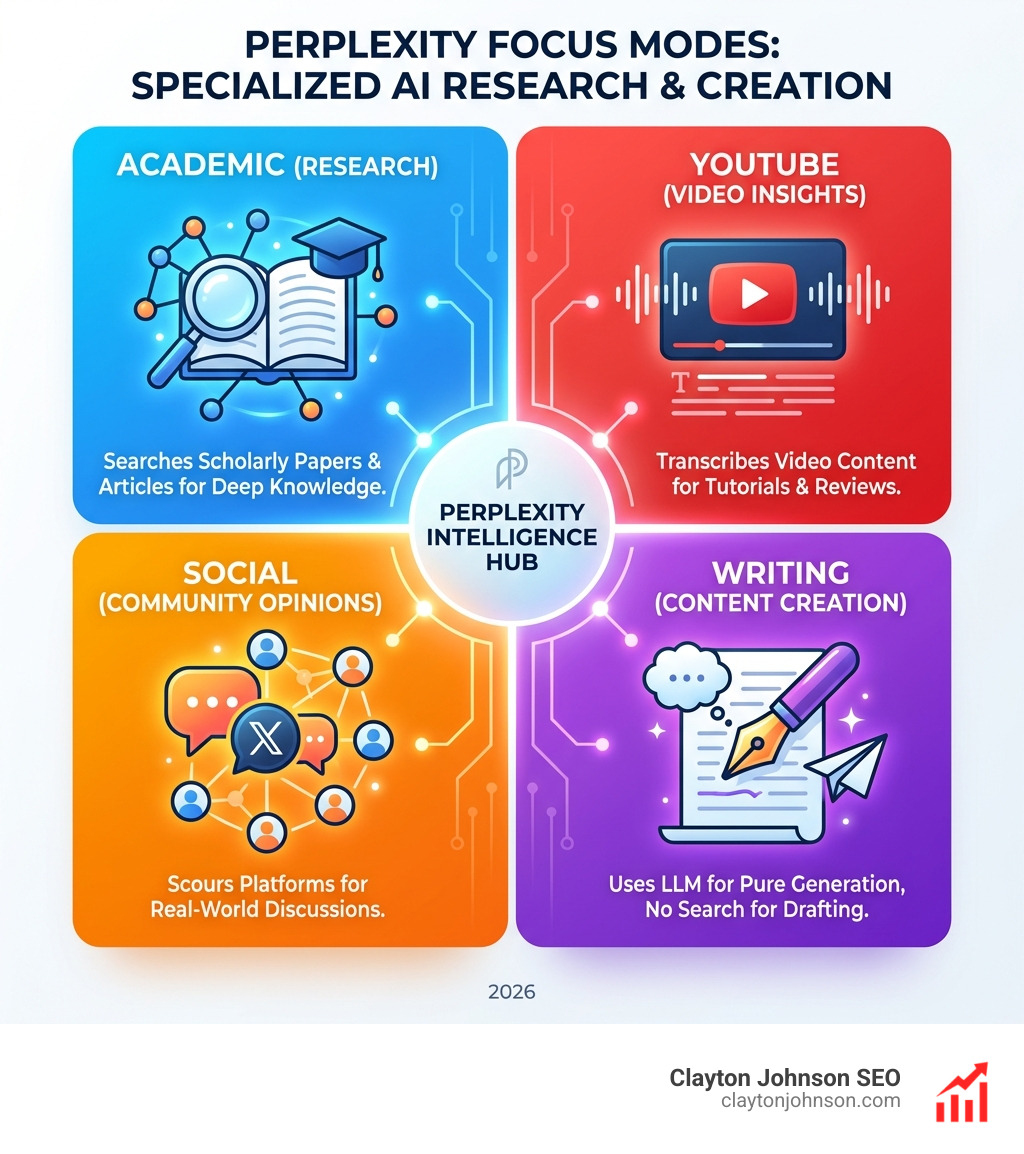
One of the most useful features is the Focus button. This allows you to tell the AI exactly where to look for information:
- Academic: Searches through published research papers and scholarly articles.
- YouTube: Transcribes and searches video content to find specific tutorials or reviews.
- Social: Scours platforms like Reddit and X (formerly Twitter) for real-world opinions and discussions.
- Writing: Uses the LLM for pure generation without searching the web—ideal for brainstorming or drafting emails.
The Comet Browser and Mobile Apps
In late 2024 and early 2025, Perplexity expanded beyond the web portal. They launched Comet, a Chromium-based AI browser. Comet integrates the answer engine directly into the browsing experience, allowing you to summarize articles, describe images, and research topics without leaving your current tab.
The mobile experience is equally robust. With dedicated iOS and Android apps, users can use voice input and get “on-the-go” answers that are significantly more helpful than standard mobile search results.
Enterprise Solutions and Search API
For businesses, Perplexity offers “Enterprise Pro.” This tier allows teams to upload and index up to 500 internal files (PDFs, Word docs, Excel). This means you can search your company’s internal data alongside the live web.
Additionally, they offer a Search API for developers. This allows other apps to build on top of Perplexity‘s search infrastructure using models like Sonar (based on Llama 3.3) or R1 1776 (an open-source model designed to remove censorship from DeepSeek-R1).
Controversies and Legal Challenges
Success often invites scrutiny, and Perplexity has found itself at the center of a heated debate regarding web ethics. The primary issue is how the company handles web scraping.
In mid-2024, Wired and developer Robb Knight accused Perplexity of ignoring the robots.txt file—the industry standard for telling bots which parts of a website they aren’t allowed to crawl. Furthermore, Cloudflare’s CEO Matthew Prince compared their tactics to “North Korean hackers,” alleging they used “stealth crawlers” to bypass security blocks, as detailed in scientific research on stealth web crawlers.
Copyright and Trademark Infringement Allegations
The legal pressure has come from some of the biggest names in publishing:
- Forbes: Accused the company of “cynical theft” after a story was allegedly copied without proper prominent citation.
- The New York Times: Issued a cease-and-desist letter regarding the unauthorized use of its content.
- News Corp (WSJ & NY Post): Filed a lawsuit alleging “massive free-riding” on their journalism.
- BBC: Demanded financial compensation and the deletion of all retained BBC material.
- Japanese Media: Yomiuri Shimbun filed a lawsuit in August 2025 over the “free-riding” use of 120,000 articles.
Perplexity‘s CEO, Aravind Srinivas, has maintained that the platform “aggregates” rather than plagiarizes, but the company has since launched a “Publishers’ Program” to share ad revenue with content creators in an attempt to mend these relationships.
The Future of Perplexity and Market Ambitions
Despite the lawsuits, Perplexity is playing offense. In August 2025, the company made a headline-grabbing $34.5 billion bid to buy the Chrome browser from Google. While a longshot, it signaled their intent to own the entire search pipeline. They also reportedly submitted an 11th-hour bid to merge with TikTok US amid looming ban threats.
With the backing of legends like Jeff Bezos and the star power of investors like Cristiano Ronaldo, Perplexity is positioning itself not just as a Google alternative, but as the new standard for the AI-native internet.
Frequently Asked Questions about Perplexity
Who founded Perplexity AI and when?
Perplexity AI was founded in August 2022. The founding team includes Aravind Srinivas (CEO), Denis Yarats (CTO), Johnny Ho, and Andy Konwinski. The founders bring together deep expertise from OpenAI, Meta, Google, and Databricks.
Is Perplexity AI free to use?
Yes, Perplexity uses a “freemium” model.
- Free Tier: Offers unlimited basic searches and a limited number of “Pro Searches” per day.
- Perplexity Pro: A subscription tier ($20/month) that provides unlimited Pro Searches, the ability to choose between different AI models (like GPT-4o, Claude 3.5, or Sonar), and increased file upload limits for document analysis.
How does Perplexity handle data privacy and scraping?
This is a point of significant debate. While Perplexity claims to respect user privacy, it has been accused by Cloudflare and Wired of using “stealth crawlers” that spoof their identity to bypass robots.txt blocks. The company denies these specific “hacker-like” tactics, calling some of the research a “publicity stunt,” but they have faced numerous lawsuits from publishers over how they scrape and summarize copyrighted content.
Conclusion
Perplexity is more than just a new tool; it represents a shift in the digital landscape. For users, it offers a faster, cleaner, and more intelligent way to find answers. For businesses and creators, it presents a new challenge: how do you stay visible in a world where an AI summarizes your content instead of sending a user to your website?
At Clayton Johnson SEO, we specialize in navigating these shifts. From building AI-assisted workflows to developing content systems that survive the “answer engine” era, we help marketing leaders execute strategies with measurable results. If you’re looking to adapt your growth strategy for the age of AI, explore our More info about SEO content marketing services to see how we can help you stay ahead of the curve.
The world of search is changing. Whether Perplexity becomes the “Google killer” or simply a powerful niche tool, its influence on how we interact with information is undeniable. It’s time to stop scrolling and start knowing.