Real Examples of Social Media Strategies That Drive ROI


Why Most Social Media Strategies Fail (And What the Best Ones Do Differently)
social media marketing strategy examples are the fastest way to cut through theory and see what actually drives measurable business results.
Here are the core strategy types that consistently deliver ROI:
| Strategy Type | Primary Goal | Best Platform |
|---|---|---|
| User-Generated Content (UGC) | Brand trust & awareness | Instagram, TikTok |
| Branded Hashtag Campaigns | Reach & community | Instagram, X, TikTok |
| Shoppable Features | Direct sales | Instagram, Pinterest |
| Influencer Partnerships | Audience growth | TikTok, YouTube |
| Interactive Content (quizzes, polls) | Lead generation | TikTok, Instagram |
| Cause-Driven Storytelling | Brand loyalty | All platforms |
| Live Video & Real-Time Engagement | Community building | Facebook, Instagram |
| Gamified Challenges | Viral reach | TikTok, Instagram |
With 93% of marketers using social media for business — and 73% calling it effective — the question is no longer whether to invest. It’s how to invest strategically.
The gap between brands that grow and brands that stall is almost always the same thing: strategy vs. random activity.
A feed full of posts is not a strategy. A content calendar is not a strategy. A strategy is a structured system — one that connects goals, platforms, content, and measurement into a growth engine that compounds over time.
The best campaigns prove this. Apple’s #ShotOniPhone generated over 100,000 posts and 70 million interactions. Invisalign’s TikTok Smile Quiz dropped cost per lead by 11% while increasing form submissions by 28%. The Barbie movie’s social campaign contributed to $1.45 billion in global box office revenue. These weren’t accidents — they were engineered outcomes.
I’m Clayton Johnson, an SEO and growth strategist who builds scalable content architectures and structured marketing frameworks for founders and marketing leaders — including real-world social media marketing strategy examples that connect brand visibility to measurable pipeline outcomes. The patterns I’ve seen across 50+ business models consistently show that strategy structure, not creative alone, is what separates campaigns that compound from campaigns that flatline.
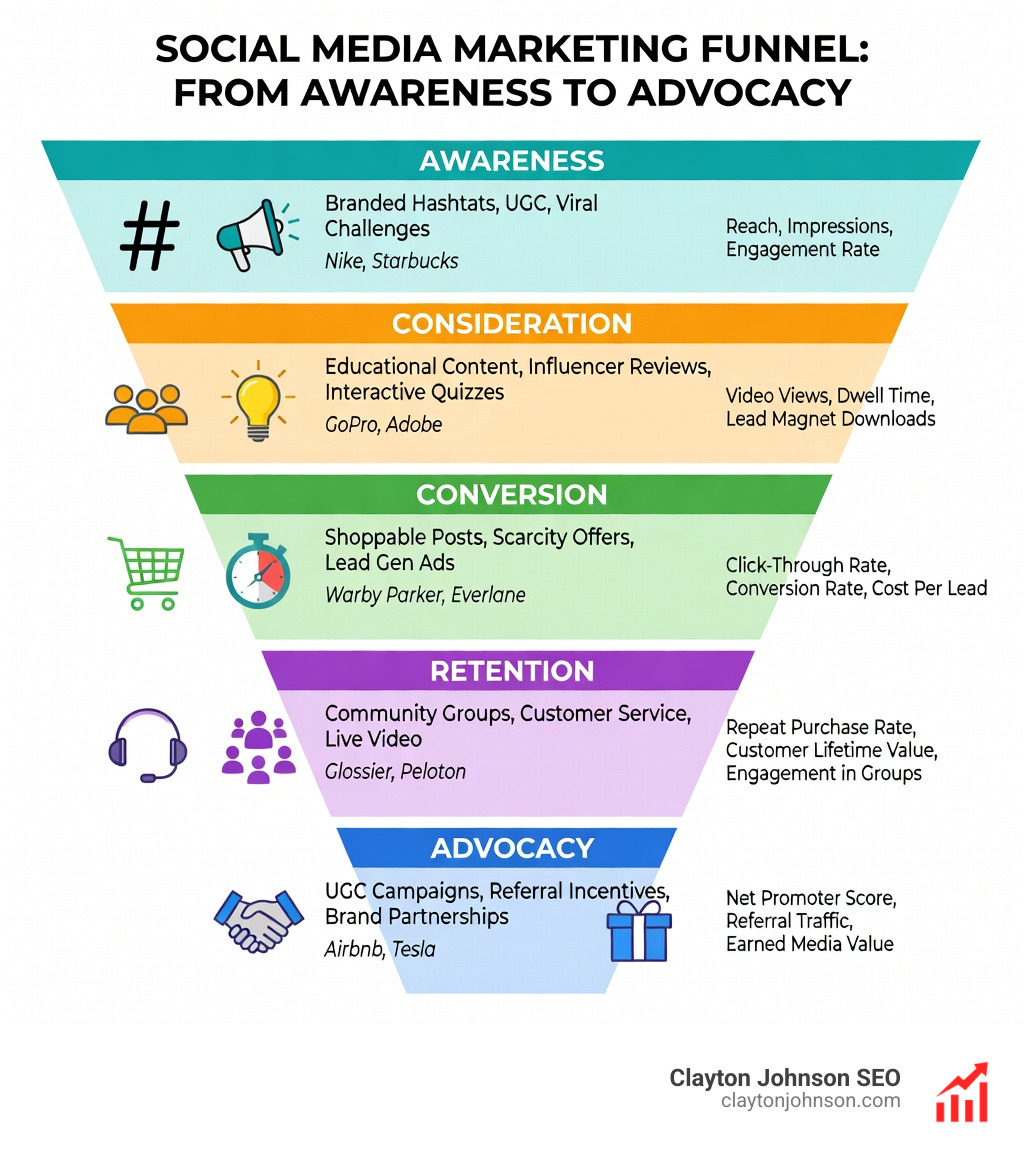
Important social media marketing strategy examples terms:
Fundamental Components of a High-Impact Strategy
Before we dive into the flashy social media marketing strategy examples, we need to talk about the “boring” stuff that makes them work. Diving into social media without a strategy is like trying to cook a five-course meal without a recipe. You might end up with something edible, but it’s probably going to be a mess.
To build a high-impact strategy, we focus on four pillars:
- SMART Goals: We don’t just say “we want more followers.” We say “we want to increase Instagram followers by 20% over the next six months.” Goals must be Specific, Measurable, Attainable, Relevant, and Time-bound.
- Audience Research: You need to know exactly who you’re talking to. What are their pain points? Do they hang out on LinkedIn (for industry trends) or TikTok (for lunch inspiration)? Almost 40% of young people in the U.S. now use TikTok or Instagram for search instead of Google Maps.
- Platform Selection: You don’t need to be everywhere. You just need to be where your customers are. If you’re a B2B company in Minneapolis, LinkedIn is your best friend. If you’re selling handmade jewelry, Pinterest and Instagram are your go-to channels.
- Content Pillars: These are your brand’s “mojo.” For a haircare brand, pillars might include “hair growth tips,” “product tutorials,” and “customer transformations.”
Effective social media is a blend of messaging, timing, and analytics. It’s about building a structured growth architecture rather than just throwing spaghetti at the wall.
Platform Comparison Table
| Platform | Best For | Core Demographics | Content Strength |
|---|---|---|---|
| Visual storytelling & Shop | Millennials & Gen Z | Reels, Stories, High-quality imagery | |
| TikTok | Virality & Entertainment | Gen Z & Alpha | Short-form video, Trends, Challenges |
| B2B & Thought Leadership | Professionals | Expert articles, Industry news, Networking | |
| Community & Local Ads | Diverse (Strong 35+) | Groups, Live Video, Long-form updates | |
| Discovery & Shopping | High-intent shoppers | Pins, Infographics, “Window shopping” | |
| X (Twitter) | Real-time & Customer Service | News junkies & Tech | Short updates, Threads, Sarcastic humor |
To get your strategy started, you can use this How to Create a Social Media Marketing Strategy guide. At Clayton Johnson SEO, we also emphasize SEO content marketing services to ensure your social content is discoverable across both social search and AI ecosystems.
Proven Social Media Marketing Strategy Examples for Brand Awareness
Brand awareness is about being “top of mind.” When someone thinks of a smartphone camera, Apple wants you to think of them. When you think of a summer blockbuster, the Barbie movie team wanted you to see pink everywhere.
Visual Storytelling and Branded Hashtags
Apple’s #ShotOniPhone campaign is a masterclass in awareness. It started as a simple challenge: share your best photos taken on an iPhone. Apple then featured these photos on social feeds and billboards worldwide. This didn’t just tell people the camera was good; it showed them. The iPhone 13 Pro iteration alone sparked over 26 million posts.
The Barbie movie used a “scorched earth” approach to awareness. They used BTS footage, AR filters, and a viral selfie generator. By the time the movie launched, it had garnered over a million TikTok videos using the soundtrack and led to $1.45 billion in global box office revenue.
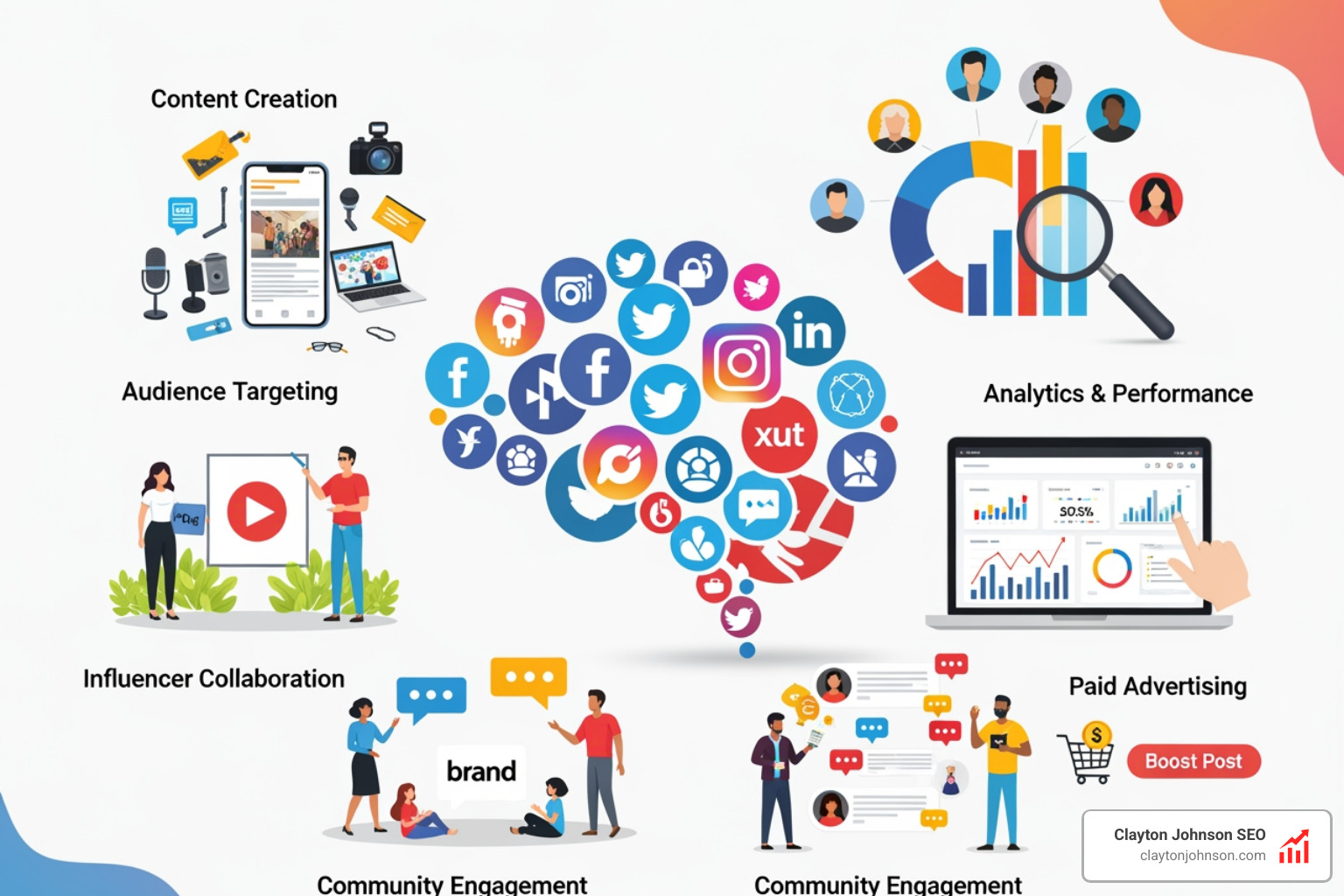
When running these high-level awareness campaigns, we often pair them with paid advertising services to amplify the reach. You can learn more about Apple’s specific approach in their research on macro photography campaigns.
Leveraging User-Generated Content (UGC) for Social Media Marketing Strategy Examples
UGC is the holy grail of social media marketing. Why? Because people trust other people more than they trust brands. In fact, UGC ranks first among content types for generating customer trust (33%), beating professionally shot content (24%).
- GoPro: More than 50% of GoPro’s video content is sourced from users. By encouraging fans to submit their footage for prizes, GoPro creates a self-sustaining content machine that posts 4X more frequently than its competitors.
- Glossier: This brand built a $1 billion empire by treating every customer like an influencer. Their feed is full of “real people” using their products in non-stylized settings. This authenticity has earned them over 2.7 million followers.
- Getty Museum: During lockdowns, they launched the #GettyMuseumChallenge, asking people to recreate famous artworks using three household items. It turned art into a fun, interactive game that exploded globally.
Check out this research on customer trust in UGC to see why this strategy is so effective.
Cause-Driven Marketing and Brand Storytelling
Modern consumers expect brands to take a stand. About 91% of consumers are more likely to buy from a brand that supports social or environmental issues.
- Patagonia: They are the gold standard here. By consistently sharing content about environmental activism — and even telling customers “Don’t Buy This Jacket” to discourage overconsumption — they’ve built a fanatical level of loyalty. Their sales actually surged to $543 million after that campaign.
- Starbucks: Their #WhatsYourName campaign in the UK was inspired by transgender customers who used the coffee shop as a safe space to try out their new names. This emotional storytelling resonated deeply and won major industry awards.
- Dove: The Project #ShowUs campaign created a library of 10,000+ images to offer a more inclusive vision of beauty. Since 70% of women don’t feel represented in advertising, Dove stepped in to fill that gap.
You can read more about why this works in this research on consumer support for social issues.
Growth and Engagement Strategies That Build Active Communities
Once you have awareness, you need engagement. High engagement tells social media algorithms that your content is valuable, which in turn increases your reach.
Account Takeovers and Brand Partnerships
Account takeovers involve letting an influencer or a partner brand “run” your feed for a day. It’s like a fresh coat of paint for your content.
- Duolingo: Their social strategy is famously “unhinged.” By leaning into the personality of their mascot (Duo the Owl), they’ve created a community that treats the brand like a person. When they “killed off” the mascot in a stunt, it garnered over 2 million likes and 40,000 comments.
- KFC: When customers in the UK complained about their fries, KFC didn’t hide. They launched a campaign with the hashtag #NewKFCfries and even made it “rain fries” on X whenever the tag was clicked. It turned a negative into a viral positive.
- e.l.f. x Chipotle: These two brands collaborated on a makeup collection inspired by Chipotle ingredients (think: avocado sponges). It generated massive buzz because it was unexpected and fun.
For brands looking to turn that engagement into sales, we recommend exploring conversion optimization services.
Interactive and Gamified Social Media Marketing Strategy Examples
Interactive content stops the scroll. If you give someone a quiz or a challenge, they are much more likely to remember your brand.
- Invisalign: Their “Smile Quiz” on TikTok resulted in a 28% increase in lead form submissions and an 11% drop in cost per lead (CPL). It combined education with a fun, gamified experience.
- Spotify Wrapped: This is the ultimate gamified campaign. By giving users personalized data about their listening habits, Spotify creates a “FOMO” event every December. In one week, app downloads increased by 21%.
- P&G #DistanceDance: Partnering with influencer Charli D’Amelio, P&G encouraged people to stay home during the pandemic. The campaign garnered over 8 billion views in its first week.
Over 1 billion people use AR features on social media, and conversion rates can increase by 90% for brands that use them. See more research on AR feature usage.
Community Management and Real-Time Engagement
The “social” in social media is often forgotten. The best brands talk with their audience, not at them.
- Facebook Live: 80% of Facebook users prefer live video to reading a blog post. It’s a great way to host Q&As or show behind-the-scenes content.
- Polls and Threads: Asking simple questions like “Grey walls or bright walls?” can skyrocket your engagement metrics.
- Ryanair: They are famous for their sarcastic, funny replies to customer comments. It’s inexpensive, scalable, and makes the brand feel incredibly human (and hilarious).
Check out this research on Facebook Live video preference to see why going live should be part of your growth strategy.
Driving Direct Sales and Lead Generation via Social Platforms
At the end of the day, we’re here to drive ROI. Social commerce is exploding, with 130 million users tapping an Instagram Shop post every month.
Shoppable Features and Scarcity Tactics
- Instagram Shop: This interface allows users to buy products without ever leaving the app. It removes friction from the buying process.
- Pinterest Buyable Pins: Pinterest is essentially a search engine for shoppers. Buyable Pins link directly to the checkout page, making it a powerful tool for eCommerce brands.
- Hinge: Their TikTok ad campaign “The dating app meant to be deleted” was genius. It targeted Gen Z with a unique value proposition that stood out from every other app trying to keep you hooked.
Lead Generation Hacks
- Myprotein: They use a network of fitness influencers to promote exclusive bundles. By using custom coupon codes, they can track exactly which influencer is driving the most sales.
- SMS Marketing: While not strictly “social,” it’s a powerful companion. More than half of consumers reply to texts within two minutes, and 70% have opted in to receive texts from businesses.
Integrating your social leads with email marketing services is essential for long-term nurturing. For more on direct messaging tactics, see this research on SMS marketing receptiveness.
Measuring Success: KPIs and Competitive Analysis
If you don’t measure it, you can’t improve it. We focus on KPIs that actually move the needle, not just “vanity metrics” like likes.
- Reach: How many unique eyes saw your content?
- Engagement Rate: Are people actually interacting, or just scrolling by?
- Cost Per Lead (CPL): How much are you paying to get a potential customer into your funnel?
- Share of Voice: How much of the conversation in your industry are you owning compared to your competitors?
We also recommend conducting a regular competitive analysis. Don’t just look at what your competitors are posting; look at how their audience is responding. Where can you “zig” where they “zag”? For example, if your competitor has a boring customer service feed, you can win by being the most responsive and helpful brand in Minneapolis.
Our analytics and data services can help you set up these tracking systems. You can also learn how to conduct a competitive analysis to refine your strategy.
Frequently Asked Questions about Social Media Strategy
What are the most effective social media strategies for small businesses?
For small businesses, we recommend focusing on UGC and community engagement. You don’t need a $3 billion budget like Priceline to be successful. Encourage your customers to post photos of your product, and make sure you respond to every single comment. It builds trust and loyalty that big corporations can’t easily replicate.
How do you measure the ROI of a social media campaign?
ROI is measured by tracking the customer journey from the first social touchpoint to the final sale. Use UTM parameters on your links and set up conversion tracking in Google Analytics 4. If a $1,000 ad spend on Instagram leads to $5,000 in sales, your ROI is 400%.
Which social media platforms should my brand prioritize?
Prioritize the platforms where your audience is most active and where you have the bandwidth to post consistently. It’s better to be amazing on one platform than mediocre on five. If you’re B2B, start with LinkedIn. If you’re a visual brand, start with Instagram or TikTok.
Conclusion: Building a Structured Growth Architecture
The social media marketing strategy examples we’ve explored show that success isn’t about luck — it’s about structure. Whether it’s Apple’s UGC machine or Invisalign’s gamified lead gen, these brands succeed because they have a clear roadmap.
At Clayton Johnson SEO, we believe that most companies don’t lack tactics — they lack structured growth architecture. Through our platform, Demandflow.ai, we help founders and marketing leaders move beyond random posting and into a system where every piece of content compounds their brand’s authority.
Modern SEO and social media are no longer separate silos. They are part of a unified ecosystem where your brand must be visible across traditional search, AI Overviews, and social feeds.
If you’re ready to stop guessing and start growing, explore our social media marketing services. We provide the frameworks, the technical SEO, and the authority-building systems you need to dominate your market.
Clayton Johnson SEO Scalable Authority Retainer Framework
If you’re looking to build long-term authority that feeds your social and search presence, here is how we can help:
- Foundation Authority ($1,997/mo): Baseline ranking growth and initial AI eligibility.
- Growth Authority ($2,997/mo): Increased link velocity and expanded cluster depth.
- Competitive Authority ($3,997/mo): Multi-cluster ranking expansion and AI Overview positioning.
- Expansion Authority ($4,997/mo): Broader keyword penetration and higher AI inclusion probability.
- Scale Authority ($6,997/mo): Accelerated authority density for faster SERP capture.
- Market Leader Authority ($9,997/mo): Durable market dominance and AI citation authority.
Clarity leads to structure. Structure leads to leverage. Leverage leads to compounding growth. Let’s build your growth architecture together.