Real World Growth Strategy Examples for Success


Why Every Growth Strategy Case Example Matters for Your Business Success
A growth strategy case example gives you a concrete, tested model to follow when a business needs to expand revenue, enter new markets, or scale efficiently. Here is a quick answer to what these cases cover:
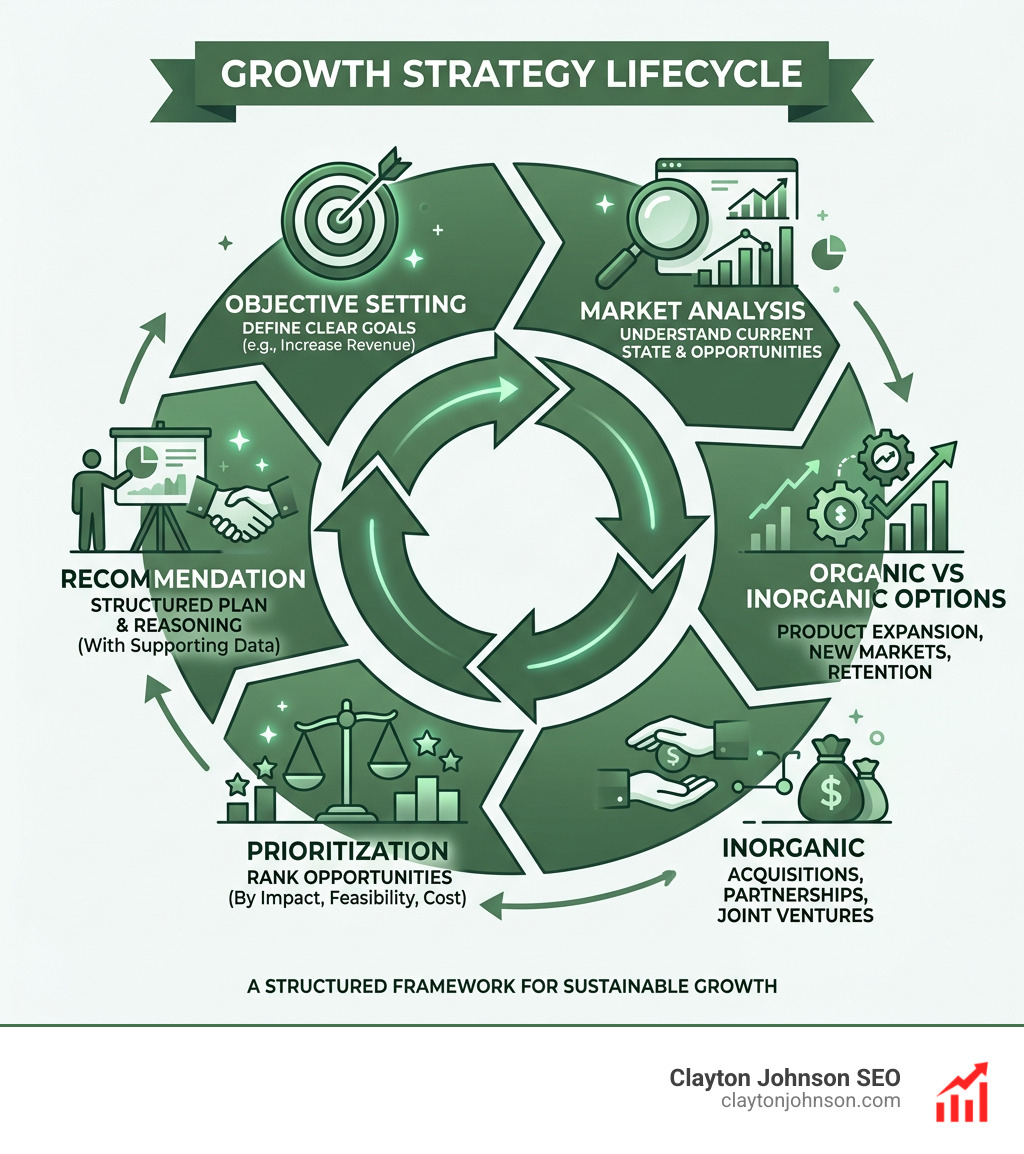
What a growth strategy case example typically includes:
- A clear growth objective – such as increasing revenue by 15% or entering a new market segment
- Current state analysis – understanding where the business stands today
- Growth options – both organic (product expansion, new markets, retention) and inorganic (acquisitions, partnerships, joint ventures)
- Prioritization – ranking opportunities by impact, feasibility, cost, and timing
- A structured recommendation – with clear reasoning and supporting data
These case examples are used in two main ways. Consulting firms use them to test candidates in interviews. And real businesses use the same frameworks to make actual strategic decisions.
The stakes are high in both contexts. In consulting interviews, firms like McKinsey, BCG, and Bain use growth strategy cases to assess whether candidates can think in a structured, logical way under pressure. In the real world, companies that skip disciplined growth analysis often end up like the global media business that expanded into 100+ countries through opportunistic partnerships – and ended up losing tens of millions of dollars per year.
Getting this right matters enormously.
I’m Clayton Johnson, an SEO strategist and demand generation expert who has spent nearly two decades helping businesses build scalable growth frameworks – including analyzing growth strategy case examples across industries to identify what separates sustainable growth from costly missteps. In the sections below, I’ll walk you through the frameworks, real-world cases, and prioritization methods that produce measurable results.
Mastering the Growth Strategy Case Example for Strategic Application
When we look at a growth strategy case example, we aren’t just looking for a “correct” answer. Instead, we are evaluating the strategic aptitude of the person solving it. In a consulting interview, the interviewer is looking for structured logic and the ability to perform a systematic analysis of a complex problem.
The goal is to move from a vague desire for “more money” to a concrete plan for “sustainable value.” This requires a deep dive into evaluation criteria. Are we looking for quick wins or long-term compounding growth? Are we prioritizing profit margins or market share? By studying growth marketing firms, we can see how professional strategists move through these layers of complexity to find the highest-leverage opportunities.
How to Solve a Growth Strategy Case Example Step-by-Step
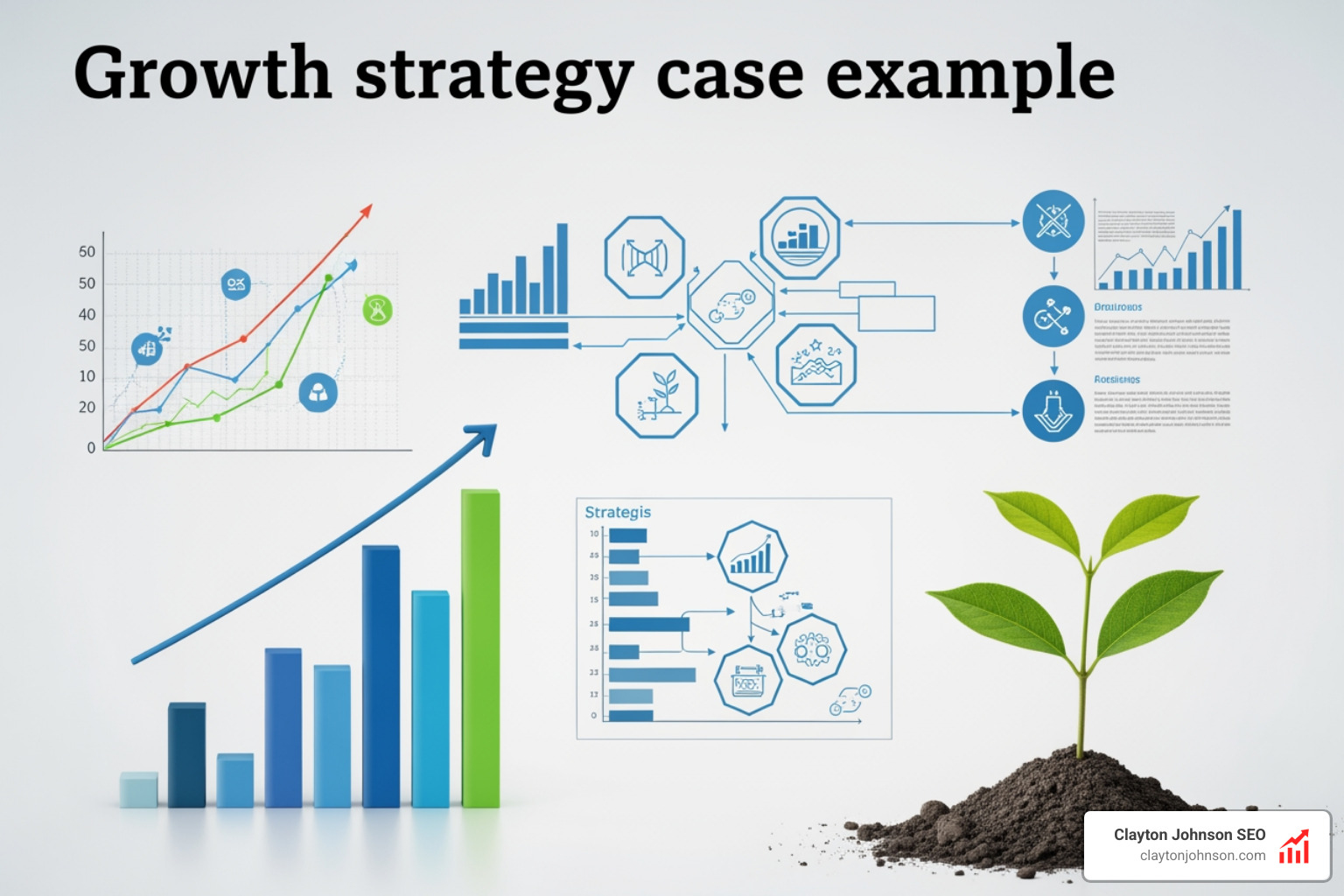
Solving a growth case is like peeling an onion—except the onion is a business, and instead of crying, you’re finding revenue. We follow a five-step process to ensure no stone is left unturned:
- Objective Clarification: We never start running until we know where the finish line is. We ask: “Is the goal to grow revenue by $100 million in three years, or to increase market share by 5%?”
- Quantifying Targets: If the client wants 20% growth, we calculate exactly what that looks like in dollars and units.
- Data Analysis: We look at the current state. What are the product life cycles? How is the pricing compared to competitors? Are customers happy, or are they churning out the back door?
- Option Generation: We brainstorm both organic and inorganic paths.
- Prioritization and Communication: We rank the ideas and present a clear, data-backed path forward.
| Strategy Type | Definition | Pros | Cons |
|---|---|---|---|
| Organic Growth | Internal expansion (new products, more sales, new markets). | More control, sustainable, builds internal DNA. | Can be slower, requires high internal capability. |
| Inorganic Growth | External expansion (M&A, joint ventures, partnerships). | Rapid scale, instant market entry, access to new tech. | High risk, integration challenges, expensive. |
A Comprehensive Framework for Growth Strategy Case Example Success
To truly master a growth strategy case example, we need a framework that covers every angle. We break this down into four key pillars:
- Current State: We analyze the product mix, current financials, and existing resources.
- Market Dynamics: We look at industry growth rates and competitor moves. For example, in the contact lens market, we know that while only 25% of sales happen online, grocery retailers hold a massive 32.25% share of the offline market. This “market dynamic” is a huge clue for growth.
- Risk Assessment: What could go wrong? Will a new product cannibalize an old one?
- Financial Analysis: We calculate the ROI. If Curiosity Stream creates a history-specific landing page, does the 64% increase in acquisition justify the marketing spend? (Spoiler: usually, yes).
You can see this type of disciplined thinking in action through A Comprehensive Approach to Growth Marketing: A Detailed Case Study from Curiosity Stream. They used the ICE framework (Impact, Confidence, Ease) to stop guessing and start growing.
Real-World Growth Strategy Case Studies and Implementation
The theory is great, but seeing how real companies apply these strategies is where the magic happens. Let’s look at Figma. Figma didn’t just build a better design tool; they built a “browser-first” collaboration engine.
By focusing on Product-Led Growth (PLG), Figma grew from 0 to over 4 million active designers and reached $400M in Annual Recurring Revenue (ARR) in just six years. Their foundational insight was that design is inherently collaborative. They created a viral loop where “view-only” file sharing naturally converted stakeholders into new users. This led to a peak viral coefficient of 2.3—meaning every new user brought in more than two others!

This systematic disruption is a perfect Figma Growth Strategy: 0 to $20B Case Study Analysis for anyone wanting to understand how to take on an incumbent like Adobe.
Organic Growth via Product Extension and Personalization
Organic growth is often the most sustainable path. Take Hubble, the direct-to-consumer contact lens company. Their growth strategy case example shows that by expanding from spherical lenses into toric lenses, they could increase their addressable market by 50%. Why? Because spherical lenses only account for 58% of the market.
Furthermore, by targeting the 35+ demographic—who constitute 75% of the total lens market—Hubble could double its obtainable market without changing its core business model. This is the power of product extension.
Similarly, Curiosity Stream found that the “one-size-fits-all” homepage was a conversion killer. By creating a history-specific landing page for history buffs, they saw a 64% acquisition lift. This proves that matching your “selling” page to the user’s specific intent is a winning move. For those looking to implement these systems, working with SEO consultants can help map out these intent-based journeys.
Scaling Revenue through Customer Retention and Multi-Channel Optimization
Growth isn’t just about getting new customers; it’s about keeping them and making them more valuable. We see this in the case of Kodak Batteries UK. They achieved a 27% total revenue growth and a staggering 806x growth in “Subscribe & Save” revenue. By focusing on recurring revenue, they turned one-time buyers into loyal, long-term assets.
In the jewelry space, Pip Pop Post showed us how to scale paid media efficiently. They increased their conversion volume 14x while improving their blended Return on Ad Spend (ROAS) by 6x. Their secret? They didn’t just throw money at the wall. They used a full-funnel structure where retargeting emerged naturally as their prospecting scale increased. This disciplined approach is a cornerstone of strategic frameworks used by top-tier operators.
Navigating Inorganic Growth and Strategic Rebranding
Sometimes, growth requires a radical shift or an external move. Inorganic growth includes:
- Mergers and Acquisitions (M&A): Buying a competitor or a complementary technology.
- Joint Ventures: Partnering with another firm to enter a new geography.
- Strategic Partnerships: Using another company’s distribution network.
A unique growth strategy case example is Copini. After a forced rebrand, they didn’t just retreat; they relaunched with a system-led marketing engine. By treating their rebrand as a full-scale launch and leveraging founder-led content, they achieved 890% revenue growth with a 10x Marketing Efficiency Ratio (MER). They turned a potential “death sentence” into a massive growth chapter.
For founders navigating these high-stakes pivots, business coaches can provide the outside perspective needed to stay objective.
Prioritizing Opportunities and Delivering Recommendations
The final step in any growth strategy case example is deciding what not to do. We use an Impact vs. Feasibility matrix to score opportunities.
- High Impact / High Feasibility: These are your “Home Runs.” Do these first (e.g., Hubble expanding into toric lenses).
- High Impact / Low Feasibility: These are “Big Bets.” They require significant resources and time (e.g., Figma building a browser-based engine from scratch).
- Low Impact / High Feasibility: These are “Quick Wins.” Good for momentum but won’t move the needle alone.
- Low Impact / Low Feasibility: These are “Time Wasters.” Ignore them.
At Clayton Johnson SEO, we believe in building durable systems that operationalize these strategies. We don’t just chase tactics; we build content architectures and AI-augmented workflows that turn fragmented efforts into coherent growth engines. Whether you are preparing for a consulting interview or scaling a Fortune 500 brand, the goal remains the same: Clarity → Structure → Leverage → Compounding Growth.
If you are ready to turn your strategic goals into a measurable SEO strategy, we are here to help you build the system that makes it happen.