Stop Working Harder and Start Using AI Powered Tools


🚀 The AI Powered Tools That Actually Move the Needle
AI powered tools are software applications that use machine learning, large language models (LLMs), and automation to help you work faster, smarter, and at scale.
Here are the top categories worth knowing:
| Category | What It Does | Top Example |
|---|---|---|
| Content Creation | Drafts copy, blogs, ads | Jasper, Brandwell |
| AI Chatbots | Answers, research, brainstorm | ChatGPT, Claude |
| Productivity & Scheduling | Saves time on tasks | Clockwise, Motion |
| Marketing Automation | Runs campaigns, scores leads | Albert.ai, Zapier |
| Meeting Assistants | Transcribes, summarizes | Fireflies, Granola |
| Image & Video Generation | Creates visual content | Midjourney, Runway |
| SEO & Search | Finds and optimizes content | Perplexity, Surfer SEO |
Most people already know AI is changing how work gets done. But knowing which tools to use — and how to connect them into a system — is where most founders and marketing teams get stuck.
Here is the reality: the average professional spends roughly one month per year just managing email. That is before you factor in manual reporting, content production, and campaign optimization.
AI does not just speed those tasks up. It removes them from your plate entirely — when set up correctly.
But there is a catch. 78% of enterprises report struggling to integrate AI with their existing tech stacks. The tools are not the problem. The system is.
That is exactly what this guide is built to solve.
I’m Clayton Johnson — an SEO strategist and growth operator who has spent years building AI-augmented marketing workflows and structured growth systems for founders and marketing leaders. My work with AI powered tools focuses on turning fragmented tool stacks into cohesive, compounding growth engines. Let’s get into the tools that are actually worth your time.
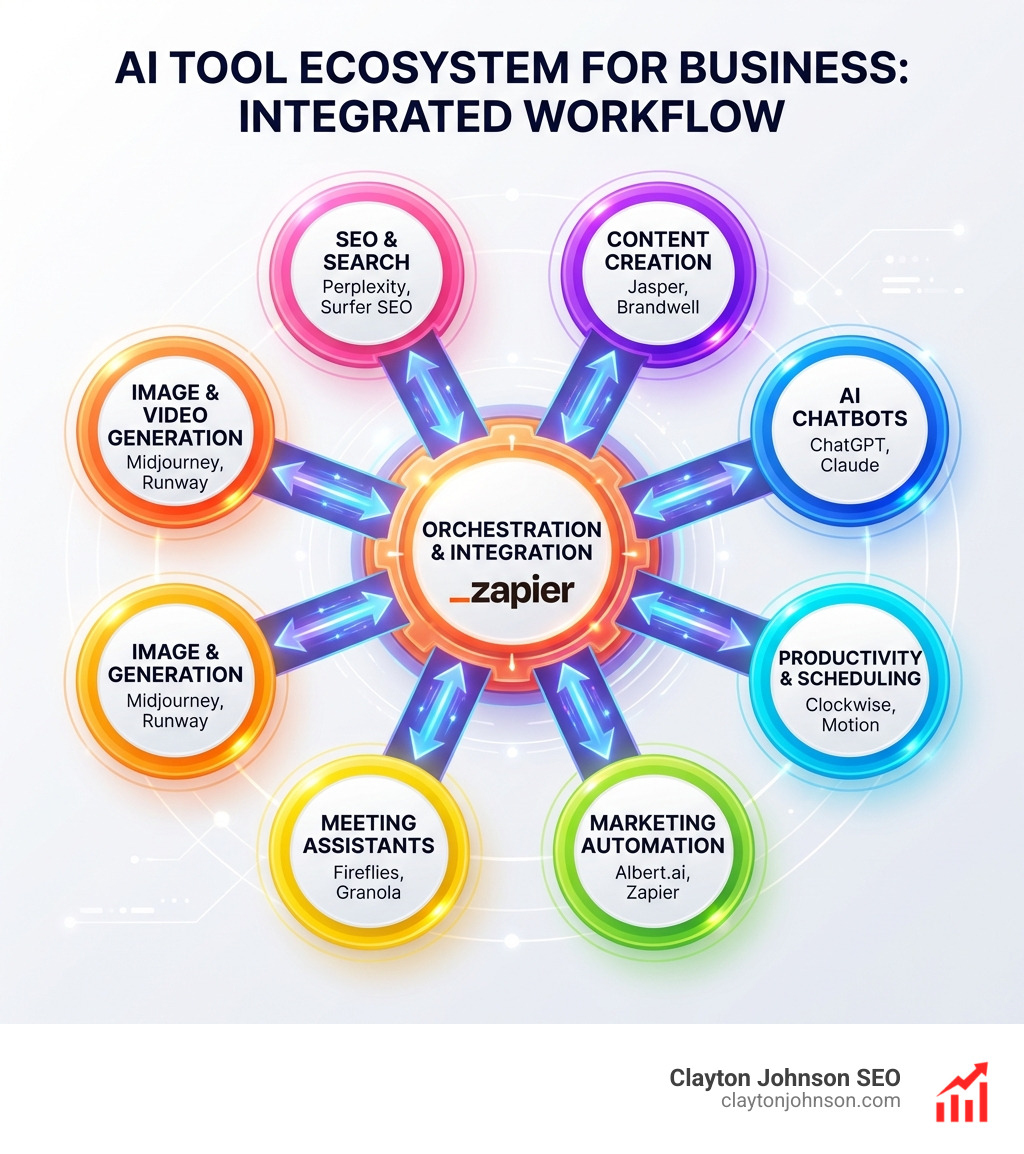
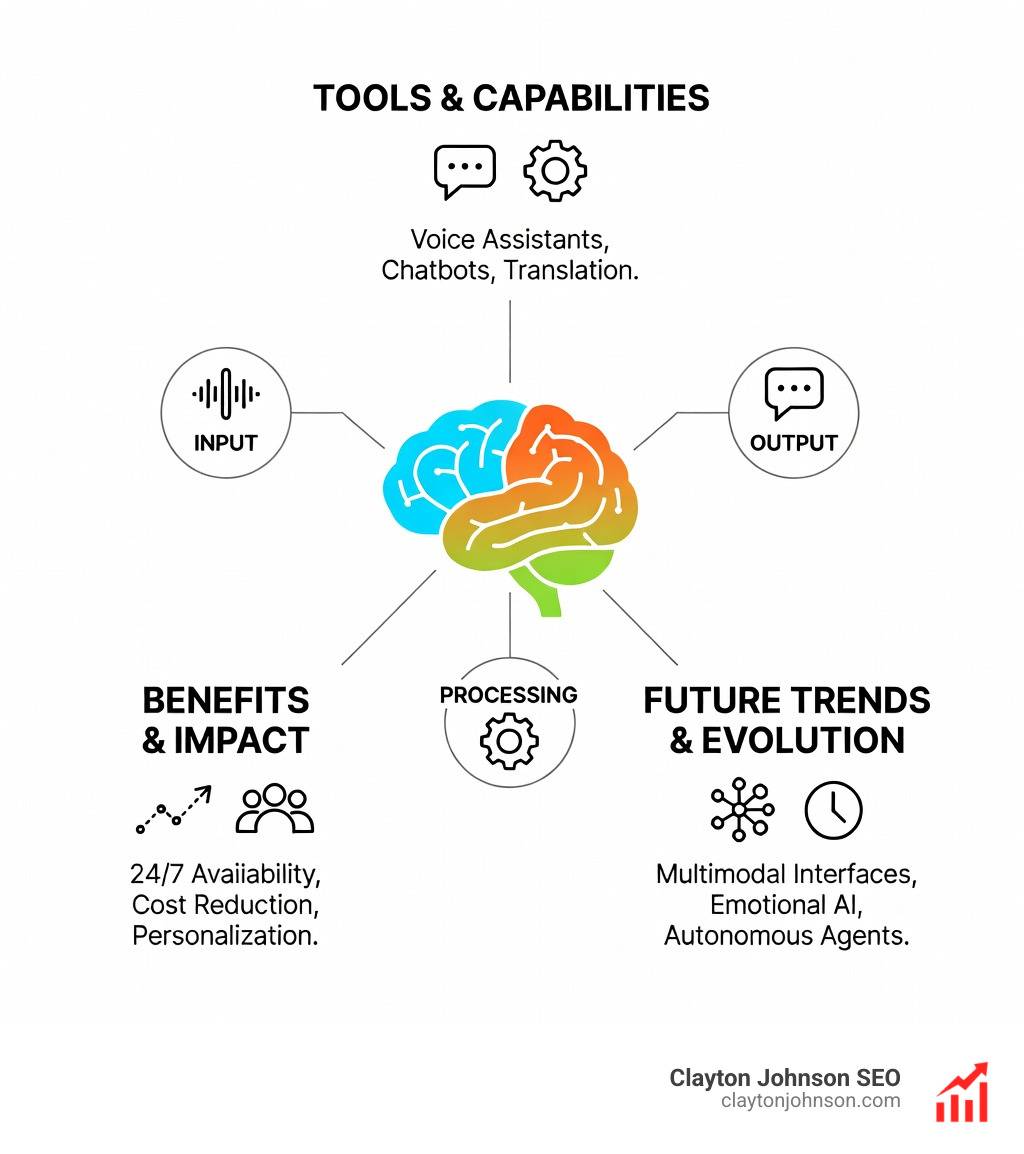
Ai powered tools terms simplified:
The Evolution of AI Powered Tools for Business Growth
The shift from manual labor to machine intelligence isn’t just a trend; it’s a fundamental change in how we achieve leverage. In the past, scaling a business meant hiring more people to handle more tasks. Today, scaling means deploying ai powered tools that act as force multipliers.

We have moved past the “hype” phase. We are now in the era of data-powered creativity, where algorithms analyze millions of data points to tell us exactly what our customers want before they even know it themselves. For those of us in Minneapolis and across the country, this means we can compete with global giants by using smarter AI tools to handle the heavy lifting.
Defining Modern AI Software
When we talk about ai powered tools, we are usually referring to software built on Large Language Models (LLMs) and neural networks. These aren’t just “if-then” programs. They are generative systems that can understand context, predict outcomes, and create entirely new content.
ChatGPT is the most famous example, but the ecosystem has expanded into specialized models like Claude, which excels at long-form reasoning, and Perplexity, which functions as an answer engine with real-time web access. These tools don’t just store information; they process it like a digital brain.
The Essential Nature of Automation
Why is this essential? Because human bandwidth is finite. Companies that refuse to automate are essentially choosing to work with one hand tied behind their backs.
Take a look at the results:
- Harley Davidson saw a staggering 2,930% increase in leads per month by using Albert.ai to optimize their digital advertising.
- Tools like Clockwise promise to save you one hour per week just by optimizing your calendar.
- Email marketing campaigns, which often have a low conversion rate of around 1.22%, can be scaled and personalized using AI to turn “lowly” numbers into significant revenue.
Efficiency is no longer about working more hours; it’s about building a structured growth architecture where AI handles the repetition so you can focus on strategy.
Top Categories of AI Software to Transform Your Workflow
To stop working harder, you need to know which tool fits which problem. We categorize ai powered tools into three main buckets: Orchestration, Creation, and Productivity.

Ensuring you have the right AI infrastructure in place is the first step toward true automation.
AI Powered Tools for Content Creation and Marketing
Content is the fuel for modern growth, but producing it manually is slow and expensive.
- Jasper: With over 5,000 5-star reviews, Jasper is the industry standard for marketing copy. It learns your brand voice and helps you draft everything from social posts to ad copy.
- Brandwell: Formerly known as Content at Scale, Brandwell is designed for deep SEO. It generates long-form blog posts that often pass AI detectors as at least 70% human-written.
- Writer: This is a collaborative tool for teams. Writer ensures that every piece of content produced across your organization follows the same style guide and factual standards.
- Anyword: If you want to know which headline will perform best before you publish, Anyword uses predictive analytics to score your copy.
Building AI marketing workflows allows you to move from a single blog post a week to a full-scale content engine without increasing your headcount.
Essential AI Powered Tools for Team Productivity and Search
Productivity isn’t just about doing things faster; it’s about finding information instantly.
- Search Engines: Perplexity and Komo provide cited answers, replacing the need to click through ten blue links on Google.
- Knowledge Management: Notion AI and Mem act as a “second brain,” connecting your notes and documents so you can ask your workspace questions like, “What did we decide in the meeting last Tuesday?”
- Meeting Assistants: Tools like Fireflies and Avoma record, transcribe, and summarize your calls so you never have to take manual notes again.
| Tool | Primary Strength | Best For |
|---|---|---|
| Fireflies | Integration | Connecting meeting notes to your CRM |
| Granola | Live Notepad | Adding your own thoughts to AI summaries |
| Avoma | Revenue Intelligence | Analyzing sales calls for closing signals |
Overcoming Integration Challenges and Ethical Hurdles
Despite the benefits, ai powered tools aren’t magic. As mentioned, 78% of enterprises struggle to integrate AI with their current tech stacks. This usually happens because tools are treated as isolated “islands” rather than part of a connected system.
There is also the risk of “hallucinations” — when AI confidently states something that is factually wrong. This is why building a responsible AI framework is non-negotiable for any serious business.
Solving the Integration Gap
The secret to making these tools work together is orchestration. Zapier is the “Lego” of the tech world, featuring over 3,000 integrations. It allows you to build workflows like: “When a new lead comes in via a Facebook Ad, use Claude to analyze the contract or inquiry, and then send a personalized summary to our Slack channel.”
By using AI agents, you can move from simple automations to complex, multi-step processes that run in the background while you sleep.
Ethical Considerations and Data Privacy
When you adopt ai powered tools, you must consider where your data goes.
- Privacy: Many tools, like JSTOR’s AI research tool, have strict privacy policies that ensure your data isn’t used to train public models.
- Grounding: To prevent hallucinations, we use “grounding.” This means we connect the AI to your specific data (like your internal docs or customer history) so it answers based on facts, not guesses.
- Bias: AI models can inherit biases from their training data. Regular audits and human-in-the-loop reviews are essential to maintain brand integrity.
How to Choose the Right Tech Stack for Your Needs
With thousands of ai powered tools available, “shiny object syndrome” is a real threat. You don’t need every tool; you need the right tools.

Evaluating Selection Criteria
We recommend choosing tools based on these four pillars:
- Problem-First Approach: Don’t buy a tool because it’s cool. Buy it because you spend too much time on a specific task (like the one month per year people spend on email).
- API & Integration: Can it talk to your CRM? If it doesn’t integrate with Zapier or have a robust API, it will likely become a data silo.
- Scalability: Can it handle 10x the volume next year?
- ROI: Does the time saved or leads generated justify the monthly cost?
Evaluating Integration Capabilities
Some tools are designed to work “in the flow.” For example, Slack AI puts the power of search and summarization directly where your team is already talking. Others, like Browse AI, are used by over 2,500 companies (including Adobe and Amazon) to scrape web data for competitive intelligence.
If you are a developer or a technical founder, you might look into AI code assistants to speed up your builds. For everyone else, no-code builders like Softr or Lovable allow you to create custom apps just by describing them.
Grounding Models with Data
The most powerful ai powered tools are the ones that know your business. Notion AI is a great example of this. Because it is grounded on your data, it generates answers and points you to the exact sources within your workspace. This reduces the “where did I put that file?” friction that kills team productivity.
Why SEO Still Matters — Especially in the Age of AI
Search has changed. Google now delivers AI-generated answers, AI Overviews, and conversational search results directly in the SERPs. If your business isn’t visible in traditional organic rankings, Google AI Overviews, or generative AI search experiences (ChatGPT, Gemini, Perplexity), you are invisible where decisions are being made.
Modern SEO helps businesses:
- ✅ Rank in traditional Google search results
- ✅ Appear in Google AI Overviews
- ✅ Be cited in generative AI search engines (GEO)
- ✅ Build trust, authority, and brand legitimacy
Clayton Johnson SEO Scalable Authority Retainer Framework
We offer structured authority-building through our retainer tiers, designed to help you dominate both traditional and AI-driven search:
- Foundation Authority — $1,997 / month: Focuses on foundational authority and initial AI eligibility signals.
- Growth Authority — $2,997 / month: Increases link velocity and expanded cluster depth for better ranking momentum.
- Competitive Authority — $3,997 / month: Deeper topic authority to capture multi-cluster rankings.
- Market Leader Authority — $9,997 / month: High-consistency authority acquisition for durable market dominance and AI citation authority.
SEO is a compounding asset. Most businesses in the Minneapolis area and beyond see measurable traction within 3–4 months as their topical depth and backlink density increase.
Frequently Asked Questions about AI Software
What are the best AI tools for small businesses?
For most small businesses, we recommend starting with a core stack: ChatGPT for general assistance, Canva for design, Grammarly for writing, and Zapier to connect them. These provide the highest ROI for the lowest technical barrier.
How do I integrate AI into my existing workflow?
Start with one problem. Use a tool like Fireflies to handle meeting notes. Once that is working, use Zapier to push those notes into your CRM or project management tool like Asana or ClickUp.
Are AI tools secure for sensitive company data?
It depends on the tool. Enterprise-grade solutions like Microsoft 365 Copilot and Slack AI do not use your data to train their public models. Always check for SOC2 compliance and read the data usage policies before uploading sensitive documents.
Conclusion
The future of work isn’t about humans vs. machines; it’s about humans plus machines. We are moving toward a world of “agentic workflows,” where ai powered tools don’t just wait for your prompts — they proactively manage your calendar, update your CRM, and optimize your marketing campaigns.
At Clayton Johnson SEO, we are building Demandflow.ai to help you navigate this transition. We provide the structured growth architecture you need to turn these tools into a compounding growth engine.
Stop working harder. Start building the systems that allow you to scale without the burnout. If you’re ready to move from fragmented tactics to a measurable growth model, let’s talk.