SEO Strategies for Wealth Managers Demystified


Why Most Wealth Managers Are Invisible Online (And How to Fix It)
SEO strategies for wealth managers are the proven set of tactics — keyword targeting, content creation, technical optimization, and local search — that help your firm appear when high-net-worth prospects search for financial guidance online.
Here’s a quick overview of the core strategies:
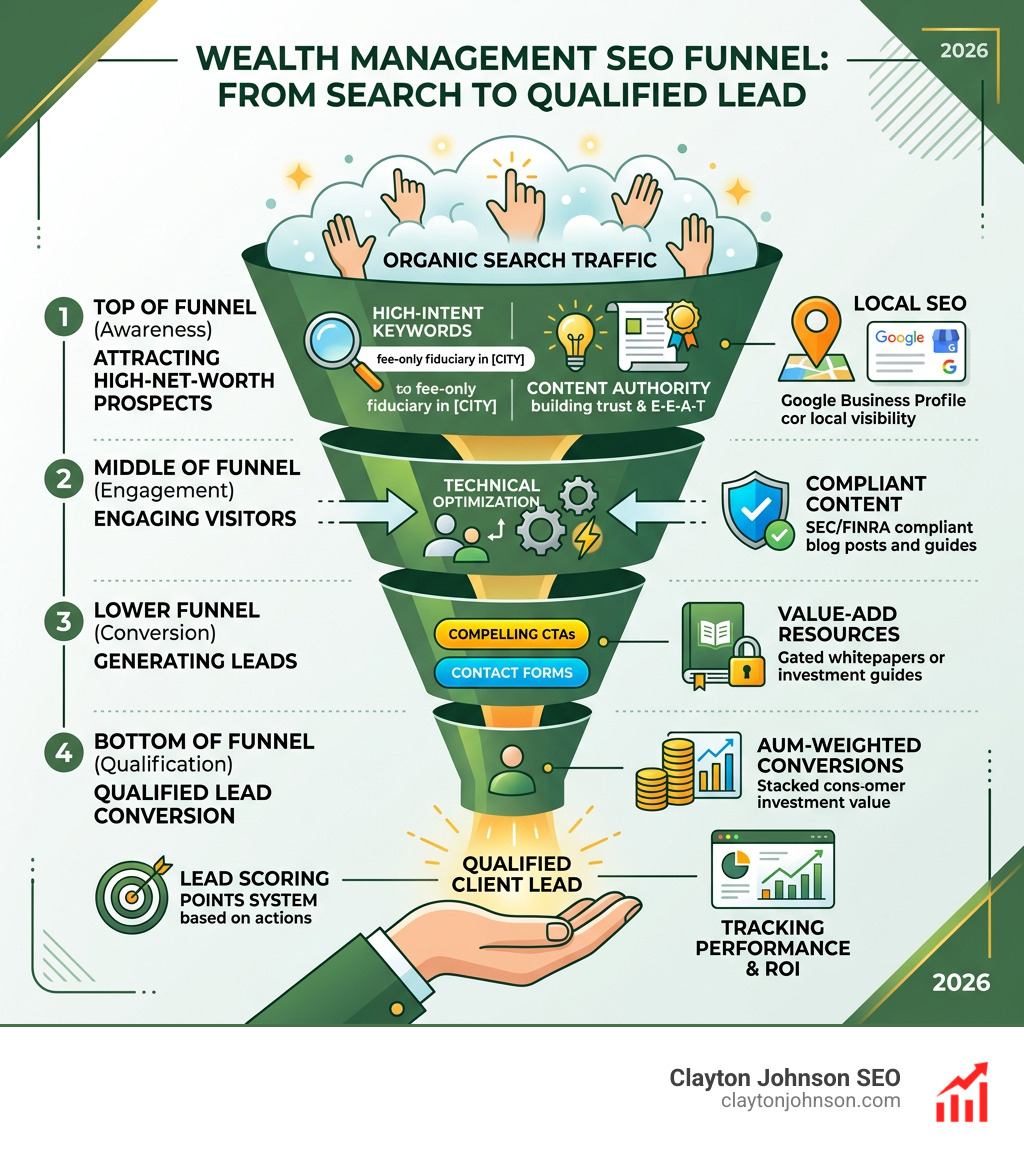
- Keyword research — Target long-tail, high-intent terms like “fee-only fiduciary advisor in Chicago” instead of broad terms dominated by national players
- Content authority — Publish thought leadership on estate planning, tax mitigation, and retirement to build trust and E-E-A-T signals
- Local SEO — Optimize your Google Business Profile and location pages to capture nearby prospects
- Technical SEO — Ensure fast load times, mobile-friendly design, HTTPS, and clean site architecture
- Compliant link building — Earn backlinks from financial directories, associations, and press mentions within SEC/FINRA guidelines
- Performance tracking — Measure organic traffic, lead quality, and AUM-weighted conversions — not just rankings
Here’s the uncomfortable truth: most wealth management firms offer exceptional service but are nearly invisible in search results.
Potential clients — busy executives, business owners, physicians — start their search for a financial advisor online. If your firm doesn’t appear, you don’t exist to them. A competitor does.
What makes this harder for wealth managers specifically? A few things stack up at once:
- Financial content falls under Google’s YMYL (Your Money or Your Life) standards, meaning Google holds it to a higher credibility bar
- Broad keywords like “wealth management” are locked up by massive national brands with enormous budgets
- Compliance rules from the SEC and FINRA limit how you can promote your services
But here’s the good news. None of this makes SEO impossible. It just means the strategy has to be smarter — more targeted, more trust-focused, and built around how high-net-worth individuals actually search.
That’s exactly what this guide covers.
Why SEO Strategies for Wealth Managers are Essential in 2025
In the current digital landscape, a website that doesn’t rank is essentially a digital brochure that no one reads. For wealth managers, the stakes are higher than in almost any other industry. We aren’t just selling a product; we are selling a lifelong relationship built on the highest levels of trust.
Search Engine Optimization (SEO) is the engine that drives organic growth by placing your expertise in front of people at the exact moment they are looking for answers. Unlike a cold call or a generic mailer, a search query represents active intent. When someone searches for “how to manage a liquidity event,” they are inviting an expert to provide a solution.
However, Google treats financial websites differently. Because your advice can fundamentally alter a person’s financial future, your site is categorized under Google’s YMYL standards. This means search engines demand higher levels of accuracy, transparency, and credentialed information. If you’re new to this concept, our SEO 101 guide can help you understand the foundational mechanics of how search engines evaluate your site.
SEO vs. Paid Advertising for Financial Services
Many firms lean heavily on Pay-Per-Click (PPC) advertising because it offers immediate visibility. While PPC has its place, it is essentially “rented” space. The moment you stop paying, your traffic disappears. Furthermore, the cost-per-click for high-value financial terms can be staggering, often exceeding $50 or $100 per click in competitive markets.
In contrast, SEO strategies for wealth managers focus on “owning” the digital real estate. SEO provides compounding value; a well-written article on tax-efficient estate planning can continue to attract high-net-worth leads for years without an additional dime spent on media. More importantly, organic rankings serve as a trust signal. Many sophisticated investors skip the “Sponsored” ads entirely, viewing organic results as more credible and earned. For those just starting out, check out an absolute beginners guide to mastering core SEO to see how these two worlds differ.
Navigating Compliance and High Competition
We understand that for wealth managers, every word published must pass through a rigorous filter. FINRA guidelines and SEC rules regarding testimonials, promissory language, and disclosures are non-negotiable. This regulatory scrutiny often scares firms away from aggressive digital marketing, but it actually provides a competitive advantage for those who do it right.
High competition from national “megafirms” means you shouldn’t try to outspend them on the term “financial advisor.” Instead, focus on niche differentiation. By targeting specific client personas—such as “wealth management for tech founders with ISOs”—you can bypass the giants and speak directly to your ideal client. Compliance shouldn’t be a barrier to SEO; it should be integrated into your content workflow, ensuring every piece of thought leadership is as safe as it is effective.
High-Net-Worth Keyword Research and Content Authority
Keyword research for wealth management isn’t about finding the most popular terms; it’s about finding the right terms. High-net-worth individuals (HNWIs) search differently than the general public. They aren’t looking for “how to save money”; they are looking for “multi-generational wealth transfer strategies” or “charitable remainder trust benefits.”
| Keyword Type | Example | Search Intent | Competition |
|---|---|---|---|
| Short-Tail | Wealth Management | Broad/Research | Extremely High |
| Long-Tail | Asset protection for physicians in California | Specific/High Intent | Low to Medium |
| Service-Specific | Tax-loss harvesting for HNWIs | Technical/Problem Solving | Medium |
To find these “gold nugget” keywords, we utilize leading SEO tools like Ahrefs, Semrush, and Google Keyword Planner. These platforms allow us to see exactly what your prospects are typing into that search bar at 2:00 AM.
Targeting SEO strategies for wealth managers toward HNWIs
The ultra-wealthy often have complex financial lives that involve estate planning, private equity co-investments, and offshore trusts. Your content needs to reflect this sophistication. According to the Edelman-LinkedIn Report on thought leadership, 64% of buyers say thought leadership is a more trustworthy basis for assessing a firm’s competency than marketing materials.
Instead of generic blog posts, create “decision frameworks” and deep-dive guides. If you want to attract a client with a £10 million portfolio, your content must answer the high-level questions they are actually asking. This is the core of our financial services SEO philosophy: speak to the problem, provide a sophisticated solution, and the right clients will follow.
Building E-E-A-T through Thought Leadership
Google’s algorithm uses a framework called E-E-A-T: Experience, Expertise, Authoritativeness, and Trustworthiness. For wealth managers, this means showcasing your credentials (CFP®, CFA, etc.) prominently. Every piece of content should have an author bio that links to your professional profile and highlights your years in the industry.
By following Google’s E-E-A-T guidelines, you signal to search engines that your site is a safe and authoritative source of financial information. This isn’t just about “gaming the system”—it’s about proving to both Google and your future clients that you are a legitimate fiduciary. Our wealth managers SEO services are designed specifically to amplify these trust signals across your entire digital footprint.
Technical and Local SEO Foundations
You could have the most brilliant financial insights in the world, but if your website takes ten seconds to load on a smartphone, no one will ever see them. Technical SEO is the “plumbing” of your website, and it’s a critical component of SEO strategies for wealth managers.

Mobile-First Design and Site Speed
In 2025, mobile-friendliness is not optional. According to OuterBox mobile statistics, mobile devices now account for over 70% of all online sales and a massive portion of professional service searches. Google uses “mobile-first indexing,” meaning it looks at the mobile version of your site to determine your rankings.
We recommend using Google’s Lighthouse or PageSpeed Insights to audit your performance. You should aim for a load time of under 2.5 seconds. Slow sites lead to high bounce rates—when a prospect leaves before the page even loads—which tells Google your site isn’t a good result. For a deeper dive into these technical requirements, see our beginners guide to wealth manager SEO.
Optimizing Local SEO strategies for wealth managers
Wealth management remains a deeply personal, often local business. Even if you serve clients nationally, many HNWIs prefer to work with someone who has an office nearby. This is where Google Business Profile optimization comes in.
To dominate local search, you must:
- Claim and Verify your Google Business Profile.
- Maintain NAP Consistency: Your Name, Address, and Phone number must be identical across every directory on the web (Yelp, BBB, etc.).
- Create Location Pages: If you have offices in multiple cities, create dedicated landing pages for each, such as a Minneapolis SEO optimized page for a local branch.
- Use Schema Markup: This is a snippet of code that helps search engines understand your specific services, hours, and credentials.
Advanced Tactics: Backlinks, AI, and Performance Tracking
Once your foundation is set, it’s time to build authority through off-page SEO. In the eyes of Google, a backlink—a link from another website to yours—is a “vote of confidence.” However, for wealth managers, quality is infinitely more important than quantity.
Compliant Link Building and Social Signals
You shouldn’t go out and buy links from “link farms.” Instead, focus on earning links from reputable industry sources. Getting listed in professional directories like NAPFA or specialized sites like Experts du Patrimoine provides high-quality link equity. Even a profile on the BBB helps establish your firm as a legitimate, trustworthy entity.
Social media also plays a role. While social “likes” aren’t a direct ranking factor, they drive traffic and brand awareness. Interesting fact: internet users spend an average of 141 minutes per day on social platforms. Furthermore, Instagram indexing means your captions can now appear in Google searches, making your social strategy more important for SEO than ever before.
Preparing for AI-Powered Search and Measuring ROI
The search landscape is changing with the introduction of Google’s Search Generative Experience (SGE) and other AI-powered tools. These systems favor conversational, long-tail content that answers complex questions directly. Instead of just targeting “retirement planning,” you should create content that answers “How does a Roth conversion impact my Medicare premiums in 2025?”
To ensure your SEO strategies for wealth managers are actually working, you must track the right metrics. We use Search Console to monitor which queries are bringing people to your site and Google Analytics to track what they do once they arrive. Don’t just look at “traffic”—look at “conversions.” Are people downloading your white papers? Are they booking consultations? That is the true measure of SEO success.
Frequently Asked Questions about Wealth Management SEO
How long does it take to see results from SEO?
SEO is a marathon, not a sprint. Typically, you will start to see foundational improvements within 3 months, but significant gains in competitive rankings and lead generation usually take 6 to 12 months of consistent effort.
Is SEO better than PPC for wealth managers?
It’s not necessarily “better,” but it is more sustainable. PPC is great for immediate traffic, but SEO builds long-term authority and has a much higher ROI over time because you aren’t paying for every single click. Most successful firms use a hybrid approach.
How do I stay compliant with SEC and FINRA rules?
By working with an agency that understands the industry. You must avoid promissory language (e.g., “guaranteed returns”), include all necessary disclosures, and ensure that any mention of past performance is framed correctly. Always have your compliance officer review new “evergreen” content.
Conclusion
At Clayton Johnson SEO, we believe that SEO is more than just a marketing tactic—it’s a digital referral system. Just as a client wouldn’t recommend an advisor they don’t trust, Google won’t “refer” a user to a website it doesn’t see as credible and authoritative.
By implementing these SEO strategies for wealth managers, you can move your firm from being invisible to being the go-to authority in your niche. Whether you are targeting local retirees or ultra-high-net-worth business owners, a strategic approach to search will ensure you are found by the people who need your expertise most.
Ready to take your digital presence to the next level? Connect with SEO expert Clayton Johnson today to discuss our specialized SEO services for wealth managers and start building a sustainable pipeline of organic leads.