Smart Money: 4 AI Tools for Investment Advisor Marketing


Why AI Marketing for Investment Advisors Companies Is Changing the Game
AI marketing for investment advisors companies is the use of artificial intelligence tools to automate, personalize, and scale marketing efforts — helping advisory firms attract more clients, reduce costs, and grow assets under management.
Here’s a quick breakdown of what it covers:
| What AI Does | How It Helps Advisors |
|---|---|
| Automates content and newsletters | Saves hours of manual marketing work |
| Personalizes client outreach | Deepens engagement and builds trust |
| Scores and qualifies leads | Reduces wasted spend on cold prospects |
| Monitors compliance risks | Keeps marketing within regulatory bounds |
| Analyzes behavior data | Reveals client needs before they ask |
The stakes are real. U.S. advisors spend $8 billion every year chasing organic growth through referrals and lead vendors. AI can cut up to 90% of that cost — while opening access to a $7 trillion mass-affluent market that most firms have never systematically targeted.
And advisors are paying attention. Nine out of ten believe AI can help grow their book of business. Yet most firms are still figuring out where to start and how to do it without breaking compliance rules.
That’s exactly what this guide covers.
I’m Clayton Johnson — SEO strategist, demand generation expert, and founder of Clayton Johnson SEO — and I’ve spent nearly two decades helping businesses use data-driven marketing and AI automation to capture qualified leads at scale, including in the competitive world of AI marketing for investment advisors companies. The strategies in this guide reflect what actually moves the needle.
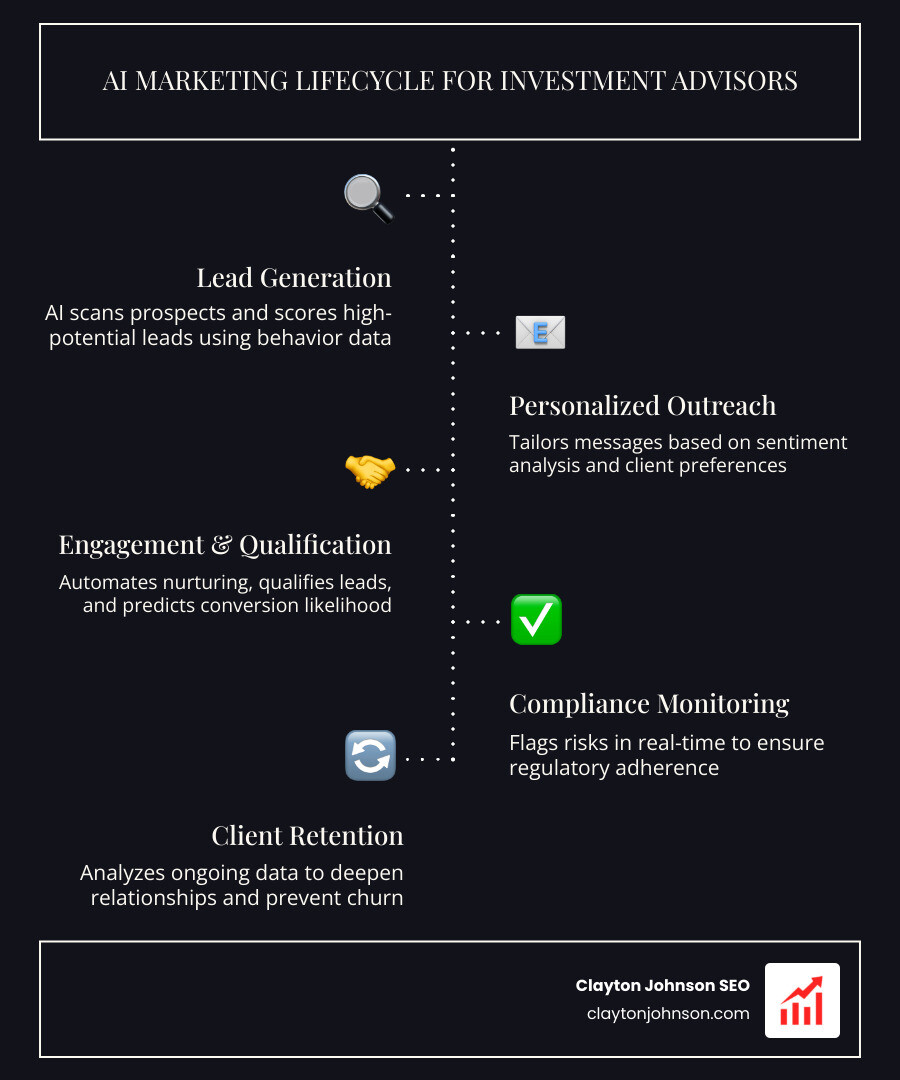
The Strategic Shift to AI Marketing for Investment Advisors Companies
The financial services industry has always been a game of numbers, but for too long, the marketing side of the business has relied on “gut feelings” and expensive steak dinners. We are now entering an era of augmentation where ai marketing for investment advisors companies is no longer a luxury—it is a survival requirement.
Traditional marketing is often reactive. You wait for a referral to call or for a client to mention a life change during a quarterly review. AI shifts this posture to proactive engagement. By using predictive insights, we can identify which prospects are most likely to convert and which current clients might be at risk of leaving before they even realize it themselves.
At its core, AI helps us solve the “cognitive burden” problem. Advisors are expected to be experts in tax law, estate planning, market analysis, and relationship management. When you add “full-time marketer” to that list, something eventually breaks. AI acts as a co-pilot, handling the heavy lifting of data analysis and content distribution so we can focus on high-value strategic consultation.
One of the most powerful applications is in the realm of complex financial modeling. While advisors have used Monte Carlo simulations for years to project retirement outcomes, AI takes this a step further. It can analyze thousands of “what-if” scenarios across an entire marketing funnel to determine which specific touchpoints lead to the highest-quality AUM growth.

Hyper-Personalization in AI Marketing for Investment Advisors Companies
In the past, “personalization” in a newsletter meant the software automatically inserted the client’s first name. Today, that is the bare minimum. True hyper-personalization involves understanding the “hearts and minds” of investors by analyzing their behavior.
We can now use sentiment analysis to monitor client communications—emails, chat logs, and even meeting transcripts—to flag signs of anxiety or stress. If a client starts checking their portfolio three times a day during a market dip, an AI-driven system can alert the advisor to reach out proactively.
Tools like AdvisorStream have revolutionized this by offering vast libraries of unbiased, advisor-centric content that AI can automatically match to a client’s specific interests. If the data shows a client is frequently engaging with estate planning articles, the system doesn’t just send more of the same; it suggests a specific discussion topic for the next meeting. This level of Wealth Manager SEO and content strategy ensures that every digital interaction reinforces the advisor’s value.
Scaling Lead Generation and Organic Growth
The “mass-affluent” market—those with significant but not ultra-high net worth—represents a $7 trillion opportunity. Historically, these individuals have been difficult to target programmatically because they require a level of attention that most small-to-medium RIAs couldn’t afford to give.
AI changes the math. By decoupling firm growth from human headcount, we can now use intelligent automation to identify and qualify these leads without hiring a massive sales team. Platforms like VastAssembly use AI-powered lead intelligence to identify prospects who are “tech-savvy and data-aware”—the next generation of investors who value digital transparency over traditional referrals.

By leveraging proprietary automation, firms can identify high-intent prospects and engage them with precision. This isn’t just about sending more emails; it’s about “digital activation.” We can use AI to score leads based on their online behavior, ensuring that when an advisor finally picks up the phone, they are speaking to someone who is already 80% of the way to a “yes.” For those just starting out, our Beginner’s Guide to Financial Advisor Lead Generation offers a solid foundation for building these systems.
Automating Compliance and Risk Mitigation
If there is one thing that keeps investment advisors up at night, it’s compliance. The SEC and FINRA have made it clear that existing fiduciary duties apply to AI just as they do to any other tool. This means we must be incredibly careful about “AI washing”—overstating what our AI can actually do—and ensuring data privacy under Regulation S-P.
The good news? AI is actually one of the best tools for maintaining compliance. We can use specialized platforms to perform automated reviews of marketing materials, flagging potentially misleading statements or “hallucinations” before they ever reach a client’s inbox.
Key compliance risks that AI can help mitigate include:
- Algorithmic Bias: Ensuring that advice models don’t inadvertently discriminate against specific client segments.
- Data Integrity: Verifying that the data being fed into the AI is clean, accurate, and permitted for use.
- Audit Trails: Automatically documenting every AI-generated interaction to satisfy regulatory recordkeeping requirements.
Advisors should regularly consult resources like the FINRA AI Report to stay ahead of the curve. By implementing early warning signals, we can detect if a marketing campaign is veering into “promising returns” territory, allowing for immediate correction.

Building a Future-Proof Advisory Firm
At Clayton Johnson SEO, our philosophy is simple: Clarity → Structure → Leverage → Compounding Growth. We don’t believe in chasing the latest shiny object. Instead, we focus on building durable systems where AI serves as the leverage.
To build a future-proof firm, we must embrace the “human-in-the-loop” mentality. AI is a fantastic assistant, but it is a terrible principal. It can draft a blog post or analyze a spreadsheet, but it cannot sit across the table from a grieving widow and provide the empathy and judgment required for complex estate decisions.
The secret sauce of modern success is high-quality data hygiene. If your CRM is a mess, your AI will be a mess. We help firms clean up their data architecture so that when they flip the switch on an AI marketing engine, it actually works. Our The Ultimate Guide to AI-Driven SEO Strategy and Systems goes deep into how to align your content architecture with these new technologies.
Essential Tools for AI Marketing for Investment Advisors Companies
When we talk about ai marketing for investment advisors companies, we aren’t just talking about ChatGPT. We are talking about a sophisticated stack of specialized tools designed for the unique rigors of finance.
| Category | Tool Example | Automation Focus |
|---|---|---|
| Meeting Intelligence | Zocks | Auto-transcription, CRM sync, and action item assignment. |
| Compliance Review | Fidelity’s Saifr | Real-time scanning of marketing materials for regulatory risks. |
| Portfolio Analysis | BlackRock’s Aladdin | Advanced risk analytics and automated trade execution. |
| Document Processing | Blue Prism / UiPath | Extracting data from unstructured client PDFs and invoices. |
| Client Onboarding | ComplyAdvantage | AI-driven AML and KYC screening to speed up risk checks. |
By integrating these tools, an advisory firm can transform from a fragmented collection of manual tasks into a coherent growth engine. For example, using a tool like Rogo allows an investment bank or private equity firm to analyze over 50 million financial documents in seconds, providing insights that would take a human analyst weeks to compile.
Best Practices for Workflow Integration
Integrating AI into your daily workflow requires more than just a login; it requires a culture of continuous learning. We recommend starting small—focus on low-risk, non-client-facing administrative tasks first.
- Master Prompt Engineering: The quality of AI output is entirely dependent on the detail of the input. Define the AI’s role (e.g., “Act as a senior financial advisor”), state your target audience clearly, and explain the exact action required.
- Establish Written Supervisory Procedures (WSPs): Every AI tool you use should have a formal procedure for how it is monitored and who is responsible for its output.
- Audit Your Models: Regularly test your AI tools to ensure they aren’t developing “automation bias” or producing inaccurate “hallucinations.”
- Protect Your Brand Voice: Use AI for brainstorming and first drafts, but always have a human editor refine the final product to ensure it aligns with your firm’s unique values.
For a deeper dive into operationalizing these steps, check out our guide on How to Win at Implementing AI Marketing Systems.
We have seen how these systems can transform a practice. One firm we worked with doubled their revenue in just six months by automating their lead nurturing process, while another saw a 540% increase in qualified leads by aligning their organic search strategy with AI-driven topic selection.
The future of wealth management isn’t about robots replacing advisors; it’s about “augmented advisors” who use ai marketing for investment advisors companies to provide a level of service and efficiency that was previously impossible. If you’re ready to stop chasing tactics and start building a system, we are here to help you navigate the Financial Services landscape.
The “steak dinner” era of growth is over. The era of the intelligent, data-driven firm has arrived. Is your practice ready?