Stop Letting Your Rivals Win with a Competitive Content Gap Finder


Why Most Businesses Are Fighting Blind in Search Rankings
A Competitive SEO analysis tool helps you understand who’s actually competing for your target audience’s attention in search results—and what strategies are working for them.
Top competitive SEO analysis tools to discover:
- Semrush – Comprehensive keyword gap, backlink gap, and position tracking across up to 5 competitors
- SEOptimer – Free SEO audit analyzing 100+ data points with competitor comparison for 5 sites
- Advanced Web Ranking (AWR) – Track up to 50 competitor websites per project with granular difficulty metrics
- Ubersuggest – Free competitor research for organic keywords, traffic estimates, and backlink profiles
Here’s the uncomfortable truth: Your real SEO competitors aren’t always your traditional business rivals.
A local bakery might compete with recipe blogs for “sourdough bread.” A law firm gets outranked by government sites and legal directories. The digital marketplace doesn’t care about your offline market position—it cares about content relevance and search intent.
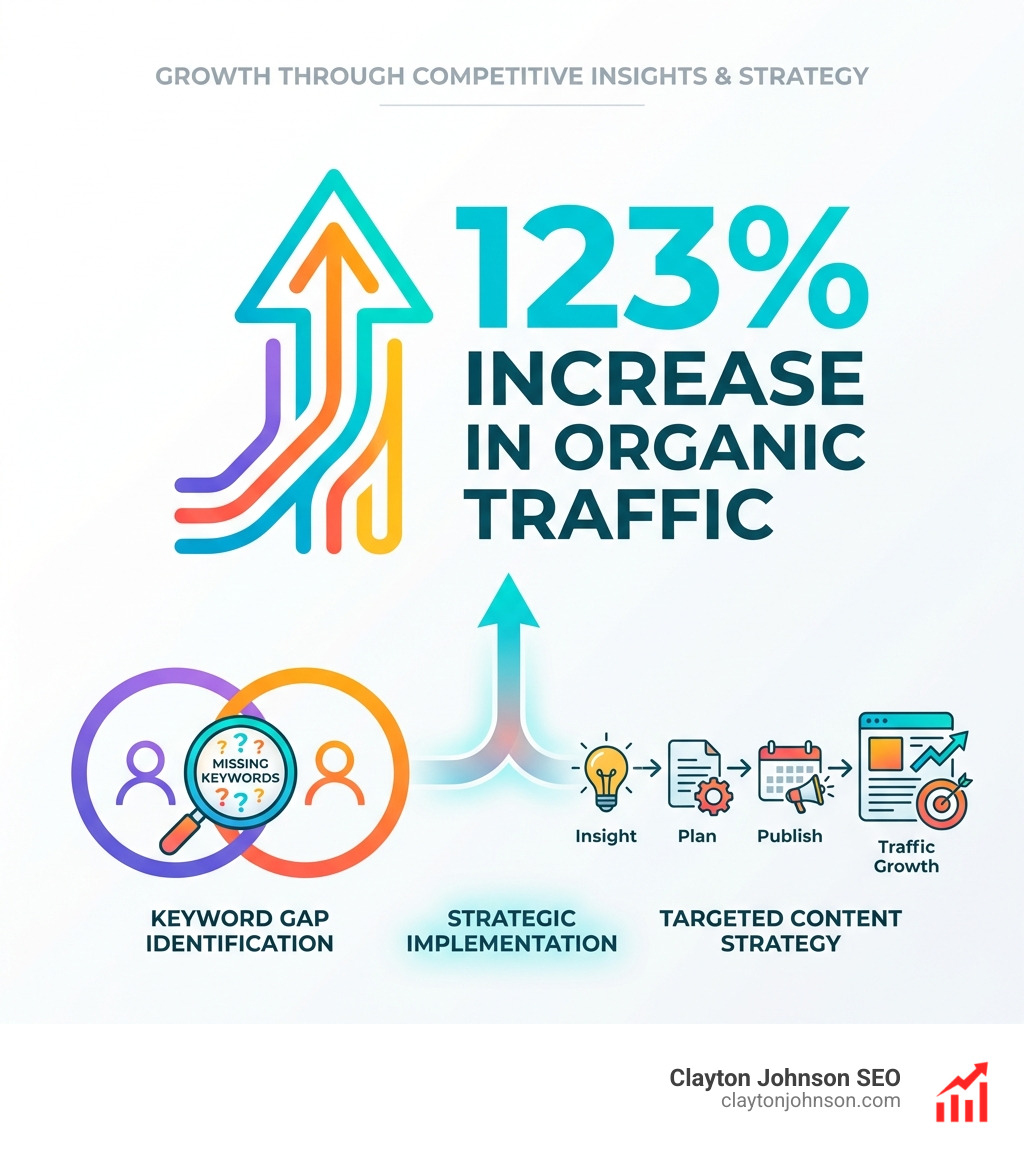
According to industry data, businesses using competitive analysis tools have seen organic traffic increases ranging from 230% to 700%. One comprehensive content strategy informed by competitive insights increased potential organic traffic by 123%. These aren’t vanity metrics—they represent real market share captured from competitors who weren’t paying attention.
The challenge? Most marketing teams are making decisions in a vacuum. They guess at keyword targets, build content without understanding what’s already ranking, and wonder why their SEO efforts plateau. Meanwhile, competitors are systematically analyzing SERP dynamics, identifying keyword gaps, and building backlink strategies based on actual data.
I’m Clayton Johnson, and I’ve spent years building structured SEO systems that turn competitive intelligence into measurable growth. A Competitive SEO analysis tool is the foundation of every strategic framework I build—because you can’t outmaneuver rivals you haven’t properly identified.
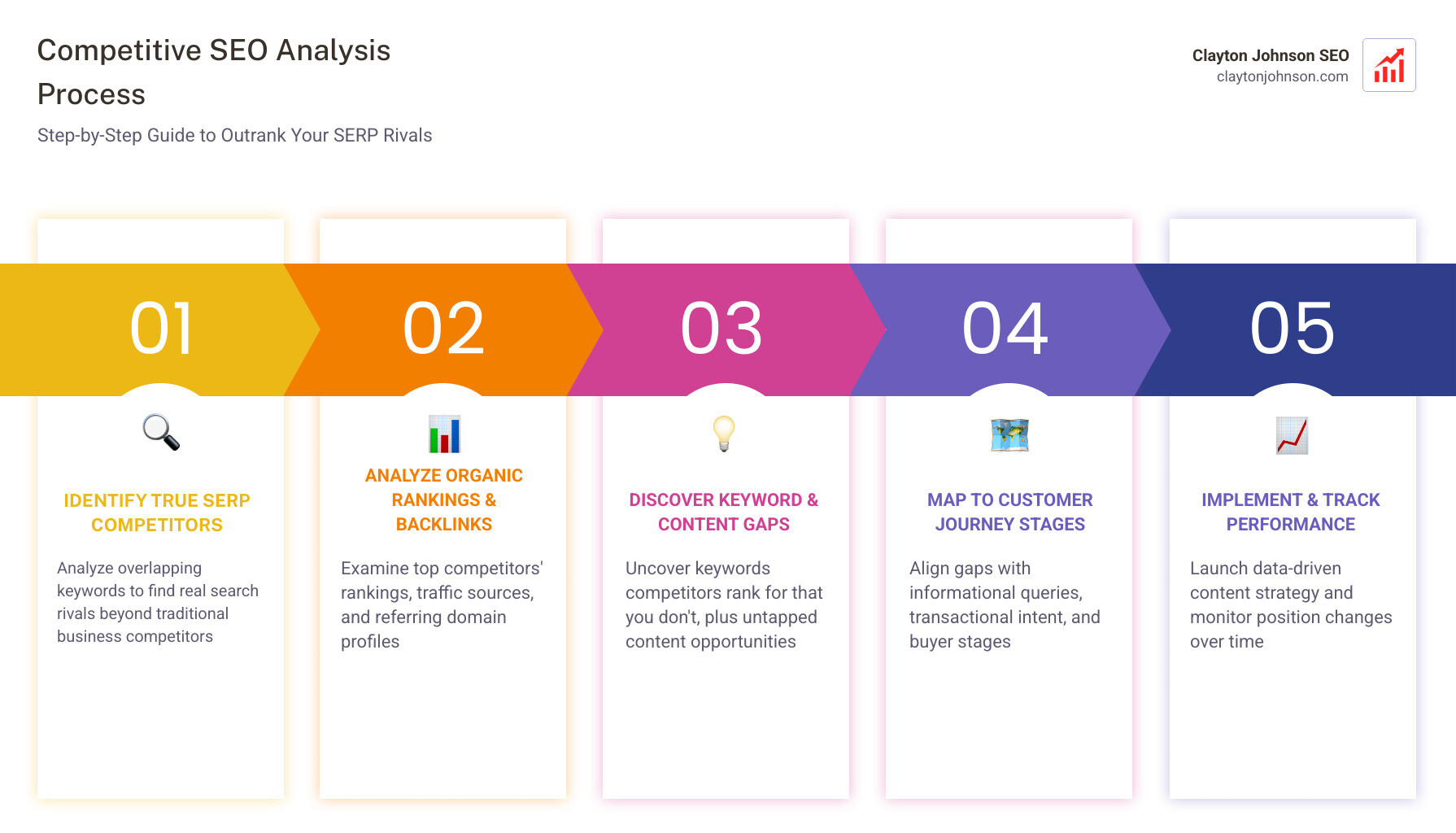
Why You Need a Competitive SEO Analysis Tool to Dominate Search
In digital marketing, “hope” is not a strategy. We see it all the time: founders in Minneapolis and beyond pouring resources into blog posts that never see the light of page one. Without a competitive SEO analysis tool, you are essentially throwing darts in a dark room. You might hit the board, but you won’t hit the bullseye.
A robust Market Analysis is the first step toward understanding where you stand. When you use these tools, you aren’t just looking at numbers; you’re looking at a roadmap of what Google already likes. If your competitor’s organic traffic increased by 230% using specific tools, there is a data-backed reason for it.
By performing a SWOT Analysis, we can identify your site’s strengths and weaknesses relative to the field. Are you lagging in referring domains? Is your content too thin? A competitive SEO analysis tool answers these questions with cold, hard data. Furthermore, Using AI Competitive Insights allows us to predict where the market is moving before your rivals even wake up.
Understanding the Importance of Online Presence
Your online presence is your digital storefront. However, unlike a physical shop in Minneapolis, your digital visibility is subject to the whims of search engine algorithms. Google is rapidly rolling out updates, and if you aren’t monitoring how these changes affect your rivals, you’re at a disadvantage.
This is where E-E-A-T (Experience, Expertise, Authoritativeness, and Trustworthiness) comes into play. Tools like Semrush provide an “Authority Score” that helps you understand how Google perceives your site’s credibility compared to others. If your rivals have higher authority, you need to know why. Is it their backlink profile? Their deep, expert-led content? You must learn How to Think About Competitive Pressure to stay ahead of the curve.
Benchmarking Against Industry Leaders
Benchmarking isn’t about copying; it’s about setting a baseline for success. By looking at the domain performance of industry leaders, we can set realistic KPIs for your own growth. A comprehensive Market, Industry, and Competitive Analysis allows us to see the “ceiling” for your niche.
If the top player in your space is getting 75% of their traffic from a specific cluster of blog posts, that is a clear signal. Using a competitive SEO analysis tool to benchmark these metrics ensures that your investment in SEO is prioritized for the highest possible ROI.
Identifying Your True SERP Rivals vs. Traditional Business Competitors
One of the biggest mistakes we see is businesses focusing on the wrong “enemies.” In the physical world, your competitor is the guy across the street. In the SERPs (Search Engine Results Pages), your competitor is anyone—and we mean anyone—taking up a spot on page one for your target keywords.
Why SEO Competitors Differ from Offline Rivals
Search engines prioritize content relevance over business categories. This means you aren’t just competing with other service providers; you’re competing with:
- Publishers and Blogs: Sites like Forbes or niche industry blogs that write about your topics.
- Affiliates: Sites that review products and services to earn commissions.
- Directories: Platforms like Yelp or industry-specific listings.
Understanding this distinction is vital. You might use Porter’s Five Forces to analyze your business landscape, but in SEO, the “threat of new entrants” can come from a teenager with a laptop and a great content strategy.
How to Uncover Hidden Competitors in Your Niche
To find your true rivals, you need to look at common keywords. A competitive SEO analysis tool can analyze which domains overlap most frequently with yours. For instance, SEOptimer analyzes 100 website data points to show you exactly who is outperforming you on a technical level.
If you find that an informational blog is consistently outranking your service pages, that’s a signal that your audience wants more “how-to” content before they are ready to buy. Working with an SEO Expert can help you interpret these overlaps and pivot your strategy accordingly. You can even use a PESTLE Analysis to see how external factors are driving new search trends that these “hidden” competitors are exploiting.
Essential Features of a Robust Competitive SEO Analysis Tool
Not all tools are created equal. Some give you a surface-level glance, while others let you perform a digital autopsy on your competitor’s strategy. When we evaluate a competitive SEO analysis tool, we look for a suite of features that provide a 360-degree view of the search landscape.
Top Features of a Competitive SEO Analysis Tool
A robust tool should offer more than just rank tracking. It needs to dive into:
- Technical Audits: Understanding how fast a competitor’s site loads and how they use JavaScript rendering.
- On-Page Content Analysis: Checking keyword density, header structures, and meta tags.
- Social Factors: How much engagement their content receives across social platforms.
| Feature | Semrush | SEOptimer | AWR |
|---|---|---|---|
| Max Competitors | 5 (Gap Tools) | 5 | 50 |
| Data Points | Thousands | 100 | Granular SERP Data |
| Best For | All-in-one Strategy | Quick Free Audits | Precise Rank Tracking |
| Keyword Gap | Yes | Limited | Yes |
| Backlink Gap | Yes | No | No |
Using these features, an SEO Consultant can identify exactly where a rival is vulnerable. For example, if a competitor has great content but a slow, poorly optimized site, that is your opening to outrank them with a superior user experience. You can explore the full range of tools available to see which fits your specific workflow.
Backlink and Keyword Gap Analysis
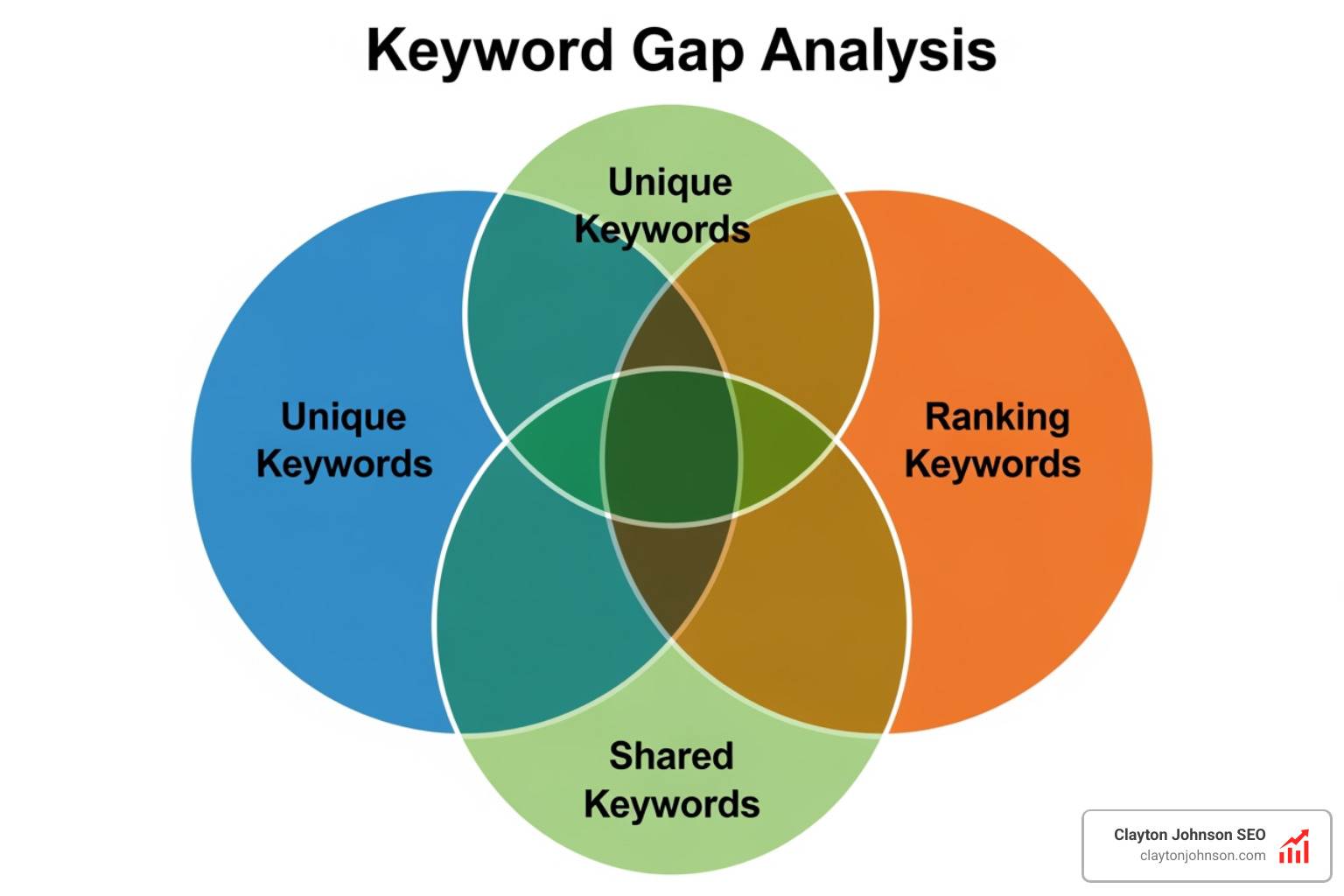
This is where the “magic” happens. The Keyword Gap Analysis tool allows you to compare your site against up to five competitors side-by-side. It highlights “Missing” keywords—terms your rivals rank for, but you don’t. This is the fastest way to build a content calendar that actually drives traffic.
Similarly, the Backlink Gap tool reveals which referring domains are linking to your competitors but not to you. Since backlinks are a primary ranking factor, closing this gap is essential for building domain authority. If you see that multiple rivals are getting links from a specific industry news site, that site should be your top outreach target. For more options, check out these SEO Competitive Analysis Tools to see which one fits your budget and needs.
Turning Competitive Insights into a Winning Content Strategy
Data is useless if it doesn’t lead to action. Once you have identified the gaps, you need to bake those insights into your SEO Content Marketing plan. This involves moving beyond single keywords and building “content systems.”
Mapping the Customer Journey with a Competitive SEO Analysis Tool
Your competitors are likely targeting users at different stages of the funnel. By analyzing their top-performing pages, you can see how they map their content to the customer journey:
- Informational Queries: “What is…” or “How to…” posts that build awareness.
- Mid-Funnel Searches: Comparison articles or reviews that help users decide.
- Transactional Pages: High-converting product or service pages.
If your analysis reveals thin or poorly optimized content on your own site while competitors have robust pillar pages, you know where to focus. Use the Keyword Strategy Builder to turn these insights into an actionable plan, ensuring every piece of content serves a specific purpose in the funnel.
Tracking and Monitoring Performance Over Time
SEO is not a “set it and forget it” game. Competitors will react to your moves. That’s why the Position Tracking tool is vital. It provides daily updates on your Google Rankings and your share of voice in the market.
AWR allows for tracking up to 50 competitors, which is perfect for broader industries where the landscape is constantly shifting. By monitoring these fluctuations, you can stay up-to-date on the latest algorithm impacts and adjust your strategy before your traffic takes a hit.
Frequently Asked Questions about Competitive SEO Analysis
How do I identify my real SEO competitors?
The easiest way is to use a competitive SEO analysis tool like Ubersuggest or Semrush. Enter your domain, and the tool will show you which other websites share the highest percentage of keywords with you. You should also manually search your top “money keywords” and see who consistently holds the top three spots—those are your primary SERP rivals.
What is the difference between keyword gaps and backlink gaps?
A keyword gap refers to search terms that your competitors rank for, but you do not. It represents a content opportunity. A backlink gap refers to websites (referring domains) that link to your competitors’ sites but haven’t linked to yours yet. It represents an authority-building opportunity. Both are essential for a complete SEO strategy.
How often should I track competitor performance?
For highly competitive industries in Minneapolis or nationwide, we recommend daily position tracking. For most businesses, a deep-dive competitive audit should be performed at least once a quarter. This allows you to spot new emerging rivals and see if your content updates are successfully closing the gaps you identified previously.
Conclusion
Stop fighting for scraps in the search results. By leveraging a competitive SEO analysis tool, you can stop guessing and start executing with precision. Whether you are looking to increase organic traffic sevenfold or just want to ensure your local Minneapolis SEO is outperforming the shop down the street, the data is there for the taking.
At Clayton Johnson SEO, we specialize in turning these complex data points into simple, actionable growth strategies. We help founders and marketing leaders diagnose their growth problems and build content systems that actually move the needle.
Ready to see what your rivals are hiding? Explore our SEO Services and let’s build a strategy that puts you at the top of the SERPs. Don’t let your competitors win by default—take control of your data today.