How to Audit Your Hotel SEO and Win the Keyword War

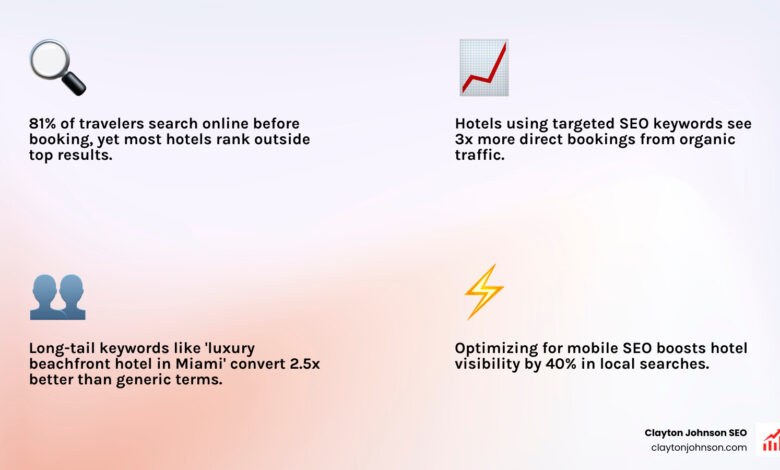
Why Most Hotels Are Invisible Online (And How Keywords Fix That)
SEO keywords for hotels are the specific search terms potential guests type into Google when looking for a place to stay. Getting them right is the difference between a fully booked property and an empty one.
Here are the most important hotel keyword categories to target:
| Keyword Type | Example | Why It Works |
|---|---|---|
| Location-based | “hotels near Times Square” | High local intent, ready-to-book traffic |
| Amenity-based | “hotel with rooftop pool in Miami” | Filters out unqualified visitors |
| Long-tail booking | “pet-friendly boutique hotel in Austin” | Lower competition, higher conversion |
| Branded | “your hotel name + reviews” | Captures bottom-funnel searchers |
| Seasonal | “romantic hotels for Valentine’s Day NYC” | Targets peak booking windows |
| Voice search | “What’s the best hotel near Central Park?” | Captures mobile and smart speaker queries |
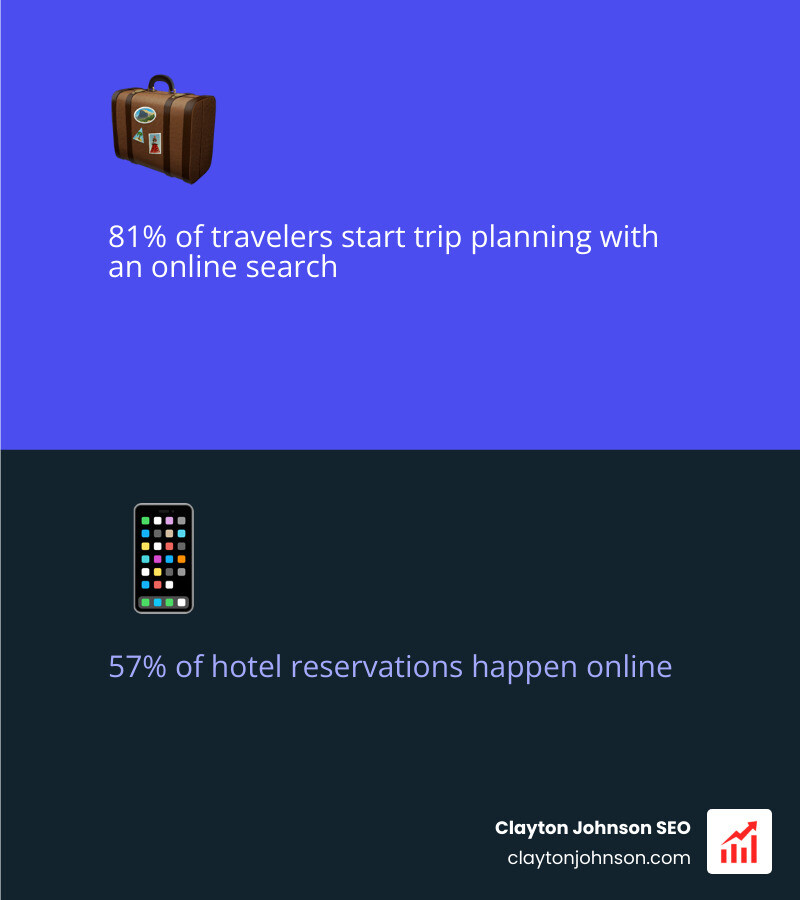
The numbers make the opportunity obvious. 81% of travelers start their trip planning with an online search. More than 57% of all hotel reservations now happen online. And the top Google result captures 28% of all clicks.
Yet most independent hotels are invisible in search results — buried under Booking.com, Expedia, and big chains.
The problem is almost never the hotel itself. It’s the keywords.
Most hotels either target terms that are impossibly competitive (“hotels in New York”) or skip keyword strategy altogether. Both approaches leave direct bookings on the table.
The good news: with the right keyword strategy, even a small independent hotel can attract highly qualified guests without paying OTA commissions on every booking.
Mastering SEO keywords for hotels to Drive Direct Bookings
In hospitality, visibility is the new currency. If you aren’t appearing on the first page of Google, you might as well be invisible. Research shows that 92% of online traffic begins with a search, and for hotels, that search is often the first step in a very long customer journey.
To master SEO keywords for hotels, we have to look past simple search volume. A keyword like “hotels” has a staggering 151,000,000 monthly searches, but it is virtually impossible to rank for. Even if you did, the traffic would be so broad that your conversion rate would likely plummet. Instead, we focus on the “Sweet Spot”—the intersection of decent search volume, manageable keyword difficulty, and high transactional intent.
Transactional intent means the user is ready to pull out their credit card. When someone searches for “best family-friendly hotel in Miami,” they aren’t just browsing; they are planning a trip. At Clayton Johnson SEO, we believe in building systems that capture this intent. We use tools like Ahrefs for deep competitor analysis to see exactly which terms are driving traffic to the Online Travel Agencies (OTAs) so we can reclaim that traffic for our own sites.
Understanding how to align your content with these terms is part of a broader ultimate guide to keyword strategy that focuses on intent modeling rather than just chasing numbers. By learning how to find untapped keywords like a search engine ninja, we can identify high-intent phrases that your competitors have completely overlooked.

Categorizing High-Value SEO keywords for hotels
Not all keywords are created equal. To build a robust strategy, we need to categorize our targets to cover every stage of the guest’s journey.
- Location-Based Keywords: These are your bread and butter. Since 46% of all Google searches have local intent, terms like “hotels in downtown Chicago” or “boutique hotels near the Eiffel Tower” are essential. They capture guests who have already decided on a destination but haven’t picked a bed yet.
- Amenity-Based Keywords: These are perfect for filtering. If your hotel has a world-class spa or is pet-friendly, you should be targeting “pet-friendly hotels in [City]” or “spa resorts in [Region].” These users have specific needs, and meeting them leads to much higher conversion rates.
- Branded vs. Non-Branded: You must own your brand. It’s a common mistake to assume you’ll always rank #1 for your own name. OTAs often bid on your brand name in PPC or optimize for it in SEO. You need to target “Hotel Name + reviews,” “Hotel Name + photos,” and “Hotel Name + offers” to ensure you capture direct traffic.
- Experience-Driven Keywords: Travelers often search for a vibe. “Romantic getaway in Vermont” or “business traveler hotels in NYC” target the reason for the trip.
- Seasonal Terms: Don’t forget the calendar. Terms like “summer vacation deals” or “Christmas market hotels” allow you to capture peak demand.
As we often say, long-tail keywords are your secret weapon. They might have lower individual search volume, but collectively, they represent the majority of search traffic and carry much higher conversion potential because they are so specific.
Conducting Effective Research for SEO keywords for hotels
Keyword research isn’t a one-and-done task; it’s an ongoing process of discovery. We start with “seed keywords”—basic terms like “hotel” combined with your city. From there, we use tools like Google Keyword Planner to expand that list into hundreds of variations.
The goal is to think like your guest. If you were traveling to your city, what would you ask Google? Would you look for “cheap motels” or “luxury suites”? The language matters. We also look at what we call “Search Reality Checks.” This involves typing your target keywords into Google and seeing who actually ranks. If the entire first page is dominated by massive OTAs and national news sites, that keyword might be too difficult for a single property to rank for initially.
Instead, we look for “Content Gaps.” By analyzing what your competitors are ranking for using tools like SEMrush or Ahrefs, we can find terms they’ve ignored. Maybe no one is writing about “hotels near the [Local Convention Center]” or “best places to stay for the [Local Annual Festival].” These are your opportunities.
We also focus on how to target low-volume keywords for high-volume profits. In the hotel industry, 10 visitors searching for “hotel with electric vehicle charging in Denver” are worth more than 1,000 visitors searching for “Denver attractions” because the intent to book is significantly higher.

Optimizing for Local SEO and Voice Search
Local SEO is where the battle for the “near me” search is won. With 46% of searches having local intent, your Google Business Profile (GBP) is often the first thing a guest sees—even before your website.
To optimize for local search, you must maintain NAP consistency (Name, Address, Phone number) across the entire web. If your address is listed as “123 Main St” on your site and “123 Main Street” on TripAdvisor, search engines might get confused. We also recommend leveraging Google Hotel Ads to appear in the high-visibility map pack results.
Then there’s voice search. As more travelers use Siri, Alexa, and Google Assistant, search queries are becoming more conversational. People don’t type “best hotel NYC”; they ask, “What’s the best luxury hotel near Times Square?” To capture this, we create FAQ sections on our websites that answer these specific, long-tail questions. This strategy is similar to how to make your psychiatry practice the top result near me, where local relevance and clear answers to user queries drive the highest rankings.
Strategic Implementation Across Your Website
Once you have your list of SEO keywords for hotels, you need to put them to work. This isn’t about “keyword stuffing”—the outdated practice of cramming words into every sentence until the text is unreadable. Instead, it’s about strategic placement in the areas Google prioritizes:
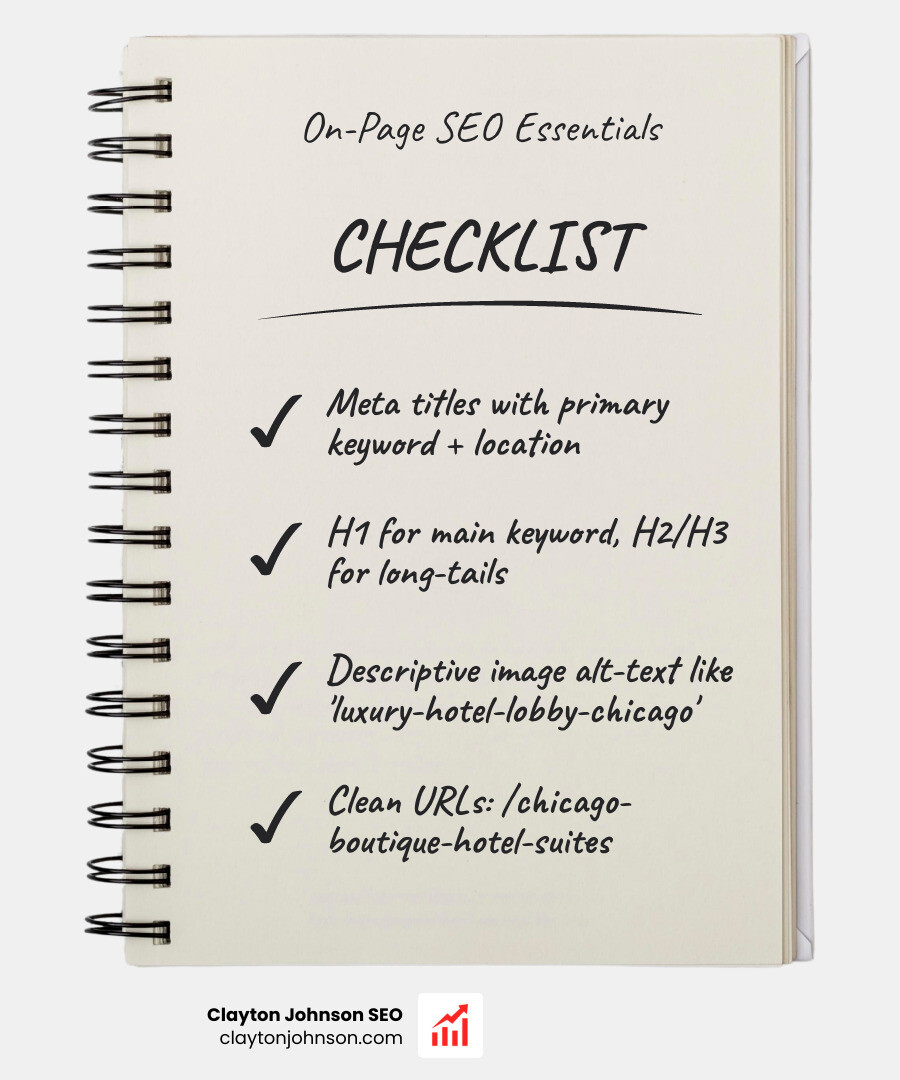
- Meta Titles and Descriptions: These are your “billboards” in the search results. Include your primary keyword and your location here.
- Header Tags (H1, H2, H3): Use these to structure your content. Your H1 should contain your main target keyword, while H2s can target related long-tail terms.
- Image Alt-Text: Google can’t “see” your beautiful lobby, but it can read the alt-text. Instead of “lobby.jpg,” use “luxury-hotel-lobby-in-chicago.jpg.”
- URL Structure: Keep it clean.
/chicago-boutique-hotel-suitesis much better than/pageid=123.
To help visualize the difference in value, consider this comparison:
| Metric | High-Volume Keyword (e.g., “Hotels”) | Long-Tail Keyword (e.g., “Pet-friendly hotel Chicago”) |
|---|---|---|
| Monthly Searches | Millions | Hundreds |
| Competition | Extreme (OTAs) | Moderate (Local) |
| Conversion Rate | Very Low | Very High |
| Effort to Rank | Years | Months |
For those just starting, our SEO 101 guide provides the foundational steps for on-page optimization. For more advanced users, our AI-search/keyword strategy explores how machine learning is changing how we identify and target these terms.
Scaling Your Strategy and Measuring Success
SEO is not a “set it and forget it” project. It’s a compounding system. As you rank for more long-tail terms, your site’s overall authority grows, making it easier to rank for more competitive terms later.
At Clayton Johnson SEO, we focus on measurable outcomes. We use Google Search Console to track which keywords are actually driving clicks and Google Analytics to see which of those clicks turn into bookings. If you find you’re ranking for “free parking in [City]” but no one is booking rooms, it’s time to shift your focus to more transactional terms.
Competing with OTAs is a marathon, not a sprint. While they have massive budgets, you have something they don’t: local expertise. By creating deep, authoritative content about your neighborhood, you can outrank the giants for hyper-local searches. We help hotels turn fragmented marketing efforts into coherent growth engines. If you’re ready to build a durable system for your property, you can contact us for hospitality growth systems or explore our insights on AI for restaurants and hospitality.
Avoiding Common Pitfalls in Hotel Keyword Strategy
Even the most well-intentioned SEO strategies can go off the rails. One of the biggest mistakes we see is ignoring search intent. If you target “things to do in Miami” on your room booking page, you’ll likely see a high bounce rate. People looking for activities aren’t necessarily looking for a room at that exact moment. Match your keywords to the right page: informational keywords for blog posts, and transactional keywords for booking pages.
Another pitfall is an over-reliance on OTAs. While Booking.com and Expedia are great for “billboard effect” visibility, every direct booking you lose to them is money out of your pocket. Your keyword strategy should be designed to intercept the guest before they head to an OTA.
Finally, don’t let the technical side overwhelm you. You don’t need to spend 40 hours a week on this if you build the right systems. We’ve even developed guides on how to automate your keyword strategy without losing your soul, allowing you to focus on what you do best: running your hotel.
Competing with OTAs and Big Chains
How does a 50-room boutique hotel compete with a global chain or a multi-billion dollar OTA? By being the “Big Fish in a Small Pond.”
OTAs are generalists. They have to cover every hotel in every city. You are a specialist. You can create a 2,000-word guide on the “Best Coffee Shops Within Walking Distance of [Your Hotel]” or “The History of [Your Specific Neighborhood].” These niche, hyper-local content pieces attract long-tail traffic that OTAs simply can’t target effectively.
Focus on branded informational queries. When someone searches for “Marriott rewards,” they are a Marriott loyalist. But when they search for “best rooftop view in [Your City],” they are up for grabs. By targeting the experience and the location rather than just the “room,” you level the playing field. This is a similar philosophy to our beginners guide to wealth manager seo, where personal authority and local trust often beat out massive, faceless corporations.
By focusing on clarity, structure, and leverage, you can turn your hotel’s website into a booking engine that works for you 24/7. It’s time to stop being invisible and start finding your “Suite Spot” in the search results.