Strategy Structure and Systems The Hard Truth About the 7S Model

Why Organizations Struggle to Close the Strategy-Execution Gap
McKinsey 7S model application is the process of diagnosing and aligning seven interconnected organizational elements to close the gap between strategic intent and actual performance. It’s used to identify misalignments, guide change initiatives, and ensure that structure, systems, and culture work together to support business goals.
Quick Framework Overview:
- Hard elements (Strategy, Structure, Systems) — tangible, manageable components
- Soft elements (Shared Values, Skills, Style, Staff) — culture-driven, harder to change
- Central principle — all seven elements must align; changes in one affect all others
- Primary use cases — mergers, restructuring, digital transformation, strategic pivots
- Key limitation — focuses internally; doesn’t account for external market forces
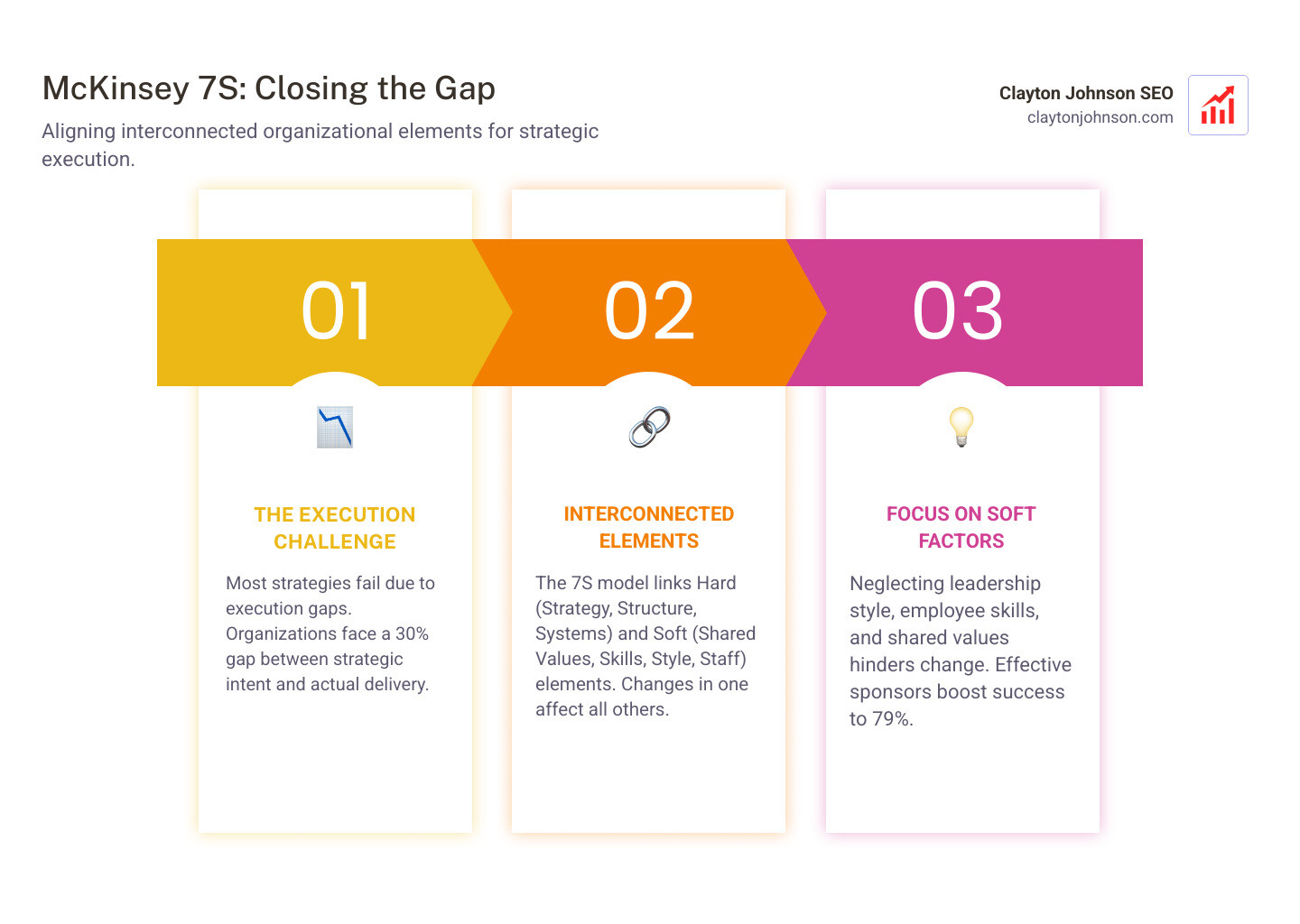
Most strategies fail not because they’re poorly conceived, but because organizations can’t execute them. Even high-performing companies face a 30 percent gap between what their strategy promises and what they actually deliver. The culprit? Misalignment across structure, systems, people, and culture.
The McKinsey 7S framework was introduced in the late 1970s by consultants Tom Peters and Robert Waterman at McKinsey & Company. It marked a watershed shift in organizational thinking — away from the obsession with structure alone and toward understanding how coordination across multiple interdependent factors drives performance.
The model divides organizational elements into two categories:
- Hard elements (Strategy, Structure, Systems) are visible, manageable, and often documented
- Soft elements (Shared Values, Skills, Style, Staff) are cultural, behavioral, and harder to measure
When these seven elements align, organizations execute with clarity and speed. When they don’t, even the best strategies stall.
Despite being developed decades ago, the 7S model remains relevant because organizational complexity hasn’t decreased — it’s intensified. Companies now face rapid technological shifts, distributed teams, and AI-driven disruption. The need for intentional alignment across strategy, systems, and culture is more critical than ever.
However, many leaders make a common mistake: they focus on structure and strategy while neglecting the softer elements like leadership style, employee skills, and shared values. Research shows that 79% of change initiatives with extremely effective sponsors met or exceeded objectives, compared to just 27% with ineffective sponsors. Leadership and culture aren’t optional — they’re central to whether change succeeds or fails.
I’m Clayton Johnson, and I’ve spent years helping organizations close the strategy-execution gap through structured SEO systems, competitive positioning, and operational alignment — all of which depend on applying frameworks like the McKinsey 7S model application to diagnose misalignment and build cohesive growth systems. Whether you’re scaling a SaaS company, managing a digital transformation, or restructuring after an acquisition, understanding how these seven elements interact is foundational to execution success.
McKinsey 7S model application terms simplified:
- MOST framework business review
- Operational Systems & Marketing Mix
The Seven Elements: Hard vs. Soft Factors
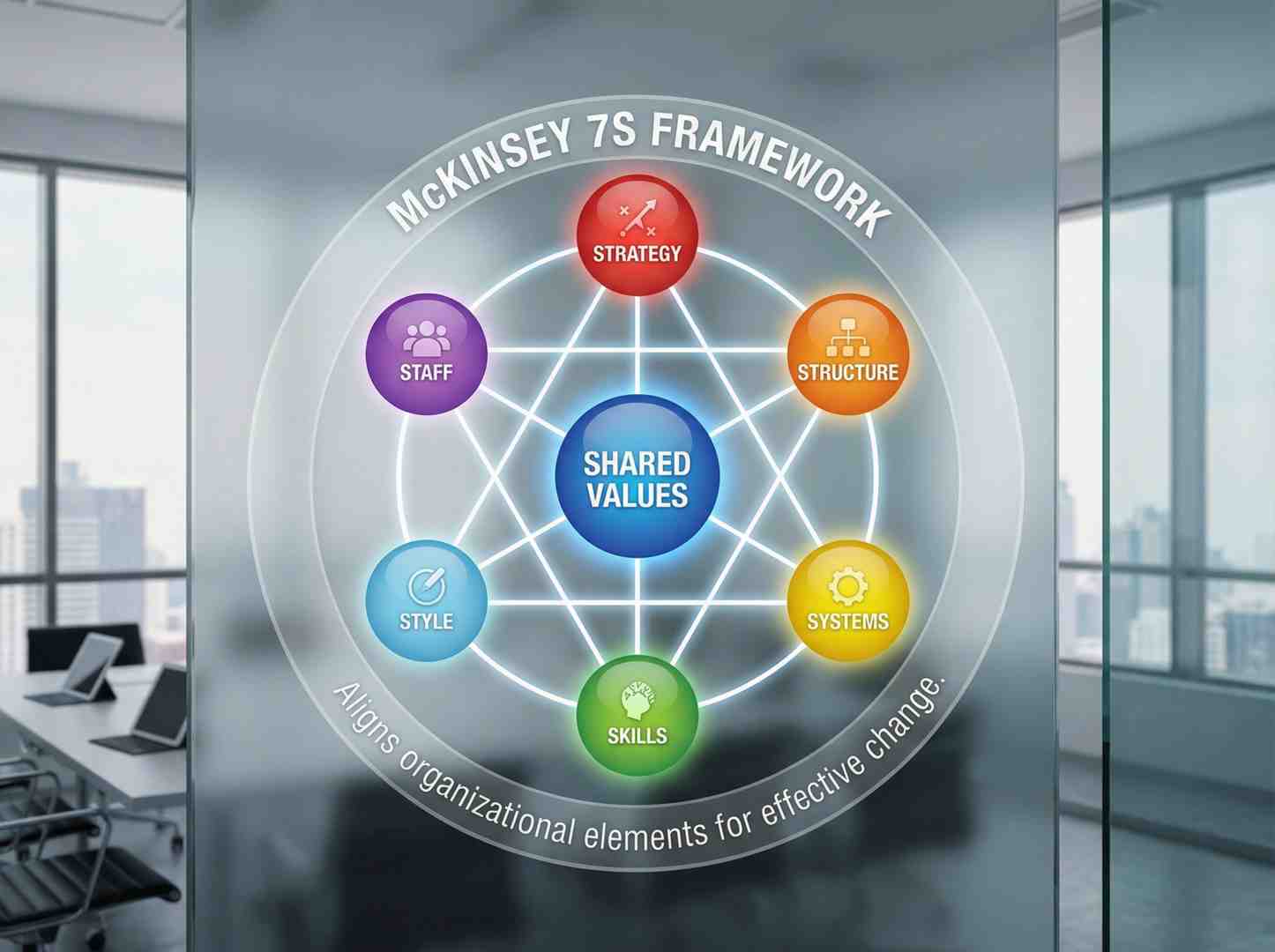
To truly master the McKinsey 7S model application, we have to look past the surface-level org chart. The framework is built on the idea that an organization is not just a collection of departments, but a “constellation of interrelated factors.” If you pull on one string, the whole web moves.
McKinsey categorizes these seven elements into “Hard” and “Soft” factors. This distinction is vital for leaders to understand because while hard elements are easier to define and control, the soft elements are often what determine whether a strategy actually lives or dies in the real world.
| Element | Category | Description |
|---|---|---|
| Strategy | Hard | The plan devised to maintain and build competitive advantage. |
| Structure | Hard | The way the organization is structured and who reports to whom. |
| Systems | Hard | The daily activities and procedures staff members use to get the job done. |
| Shared Values | Soft | The core values of the company as evidenced in the corporate culture. |
| Style | Soft | The style of leadership adopted. |
| Staff | Soft | The employees and their general capabilities. |
| Skills | Soft | The actual skills and competencies of the employees working for the company. |
For a deeper dive into the origin of these categories, you can explore the Enduring Ideas: The 7-S Framework from McKinsey’s own insights.
The Central Role of Shared Values
Notice that in every diagram of the 7S model, Shared Values (originally called Superordinate Goals) sits right in the middle. This isn’t an accident. Shared Values represent the fundamental ideas around which a business is built. They are the “True North” that should remain relatively stable even when the other six elements are in flux.
When we apply the 7S model, we start here. If your Strategy is to become the most innovative tech firm in Minneapolis, but your Shared Values prioritize risk-aversion and “the way we’ve always done it,” your strategy will fail. Alignment starts with ensuring that the mission and vision are not just posters on a wall, but the actual drivers of decision-making at every level.
Distinguishing Hard Elements from Soft Elements
Think of Hard Elements as the skeleton of the organization. They are tangible, easy to identify, and can be influenced directly by management through decrees or documentation.
- Strategy: Your competitive positioning and long-term goals.
- Structure: The hierarchy, reporting lines, and functional divisions.
- Systems: The formal processes, IT infrastructure, and performance tracking.
Soft Elements, on the other hand, are the blood and nervous system. They are intangible and far more difficult to describe because they are constantly evolving through human interaction.
- Staff: This isn’t just a headcount; it’s about demographics, diversity, and how you nurture talent.
- Skills: The core competencies that set you apart. Do you have the actual “chops” to deliver on your brand promise?
- Style: This refers to the cultural “vibe” and leadership behavior. Is it top-down and authoritative, or collaborative and empowering?
The “Hard Truth” is that most leaders spend 90% of their time on the Hard elements because they feel “manageable.” But in reality, it is the Soft elements that often provide the greatest leverage for compounding growth.
Step-by-Step McKinsey 7S Model Application
Applying this model isn’t a one-time event; it’s a diagnostic process. We use it to find the “friction” in our growth architecture. Here is how we recommend implementing the model step-by-step:
- Analyze the Current State: Start with Shared Values. Ask: “What do we actually stand for today?” Then move through the Hard elements (Strategy, Structure, Systems) and finally the Soft elements (Skills, Staff, Style). Use surveys, workshops, and data to get an honest picture.
- Identify Misalignments: Look for the gaps. If your Strategy requires rapid speed-to-market, but your Systems require fifteen levels of approval for a single blog post, you have a misalignment.
- Define the Desired State: Don’t just “fix” things. Design the “Ideal 7S” based on your long-term vision. What should our structure look like to support our new AI-augmented workflows?
- Determine the ‘How’ and ‘What’ of Change: This is where we create the action plan. Who owns which “S”? What are the KPIs for success?
- Execute and Adjust: Execution is where 90% of strategies fail. Use a platform like Demandflow to maintain structure during the transition.
- Continuous Review: The market doesn’t stand still. Periodically revisit the 7S to ensure your operating model is keeping up with your evolving strategy.
For those looking to integrate these frameworks into their digital presence, check out our SEO content marketing services to see how we align content strategy with organizational systems.
Leveraging Soft Elements for McKinsey 7S Model Application
We cannot stress this enough: you cannot “command” culture into existence. You have to influence it. When we look at the Skills, Staff, and Style elements, we are looking at the human side of change.
According to a recent Employee Experience Study, employees at people-centric organizations are 12 times more likely to say change was well-managed. If your Style (leadership) is transparent and your Staff feel empowered, your McKinsey 7S model application will be significantly smoother. People need to know why the structure is changing, not just that it is changing.
Measuring Success in McKinsey 7S Model Application
How do you know if your alignment is working? You need measurable outcomes.
- Clarity: Do employees understand the strategy? (Survey scores)
- Speed: Has decision-making time decreased? (Process cycle time)
- Skills: Are we hitting our innovation targets? (New product/service ROI)
- Commitment: Has turnover decreased and engagement increased? (Employee Net Promoter Score)
Success isn’t just a “balanced” diagram; it’s an organization that moves as one cohesive unit toward a shared goal.

Real-World Examples: From Chick-fil-A to Nokia
Theory is great, but seeing the McKinsey 7S model application in the wild helps us understand the stakes.
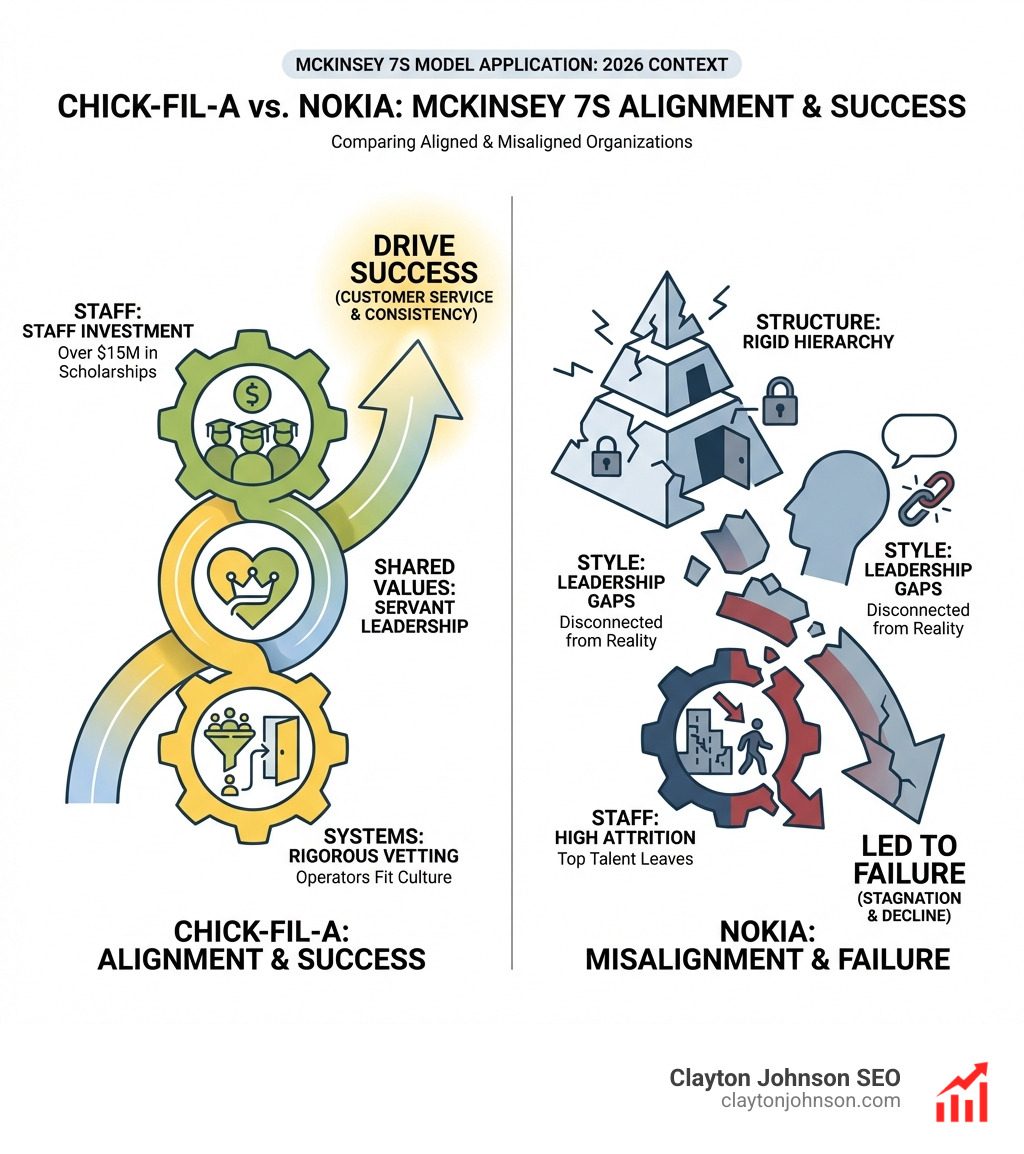
Chick-fil-A: A Masterclass in Alignment
Chick-fil-A is often cited as a success story because of its incredible internal alignment.
- Shared Values: Their “servant leadership” philosophy is the heartbeat of the company.
- Staff: They invest heavily in their people, providing over $15 million in scholarships in a single year.
- Systems: Their rigorous vetting process for “Operators” ensures that only those who fit the culture are allowed to lead locations.
- Style: A family-owned, long-term approach that prioritizes customer service over short-term quarterly gains.
This alignment has made them one of the most beloved fast-food chains in America, consistently ranking top in customer service. You can read more about their approach in the Chick-fil-A Culture documentation.
Nokia: The Cost of Misalignment
On the flip side, Nokia’s decline in the smartphone era is a textbook case of 7S failure. While they had a strong Strategy on paper, their Structure became overly hierarchical and siloed. Their Style of leadership became disconnected from the technical realities on the ground (even removing the CTO role at a critical juncture), leading to high attrition of top talent (Staff) and a stagnation in innovation (Skills). The “Hard” elements were there, but the “Soft” elements crumbled.
McDonald’s and Starbucks
- McDonald’s: Uses the 7S to maintain global operational efficiency. Their Systems (standardized cooking processes) and Structure (franchise model) are perfectly aligned with their Strategy of cost-leadership and consistency.
- Starbucks: Focuses heavily on Shared Values and Staff. By calling employees “partners” and providing health benefits even for part-timers, they align their Staff and Style with their Strategy of being the “third place” between work and home.
Why Strategies Fail Without Alignment
Execution gaps aren’t usually caused by lazy employees. They are caused by Siloed Teams and Rigid Hierarchies that prevent information from flowing. When your Systems don’t talk to each other, or your Shared Values are diluted by rapid growth, the “domino effect” of the 7S model works against you. One misaligned element can bring down the entire structure.
Success Stories in Digital Transformation
In Knowledge-Based Organizations, digital transformation is the ultimate test of the 7S model. Successful companies don’t just “buy new software” (Systems). They:
- Upskill their workforce (Skills).
- Restructure into agile, cross-functional teams (Structure).
- Foster an innovation culture where failure is a learning opportunity (Style/Shared Values).
Strategic Advantages and Limitations
The McKinsey 7S model application is a powerful tool, but it isn’t a silver bullet. We need to be honest about what it can and can’t do.
Advantages:
- Holistic View: It forces you to look at the “whole” organization, not just the problem of the day.
- Alignment Tool: It acts as a bridge between a high-level strategy and daily operations.
- Adaptability: It works for small startups in Minneapolis and global conglomerates alike.
Limitations:
- Internal Focus: This is the big one. The 7S model ignores the external environment. It doesn’t tell you what your competitors are doing or how the market is shifting.
- Complexity: Analyzing seven interconnected variables can lead to “analysis paralysis.”
- Lack of Prioritization: The model treats all seven ‘S’s as equal, but in some scenarios, one might be significantly more important than the others.
For businesses looking to solve the “External” piece of the puzzle, our SEO consulting services focus on competitive intelligence and market positioning to complement your internal 7S alignment.
Comparing 7S with SWOT and Prosci
How does the 7S stack up against other popular frameworks?
- 7S vs. SWOT: A SWOT analysis looks at both internal (Strengths/Weaknesses) and external (Opportunities/Threats) factors. The 7S is a much deeper dive only into the internal side. Think of SWOT as the “Map” and 7S as the “Engine Inspection.”
- 7S vs. Prosci (ADKAR): Prosci is specifically focused on the “Human side of change.” While the 7S includes “Staff” and “Skills,” the Prosci ADKAR model (Awareness, Desire, Knowledge, Ability, Reinforcement) provides a more granular roadmap for moving individuals through a transition.
In our view, the most effective leaders use a combination. They use the 7S to align the organization’s “hard and soft” architecture, and then use models like ADKAR to manage the human resistance that inevitably arises during implementation.
Frequently Asked Questions about the 7S Model
Is the McKinsey 7S Model still relevant?
Absolutely. While the business world has become more digital and , the fundamental need to align people, processes, and purpose hasn’t changed. In fact, with the rise of remote work and AI, ensuring that Systems and Shared Values are synchronized is more difficult—and more important—than ever.
How does the 7S Model differ from SWOT analysis?
The 7S Model is an internal diagnostic tool that examines seven specific organizational elements. SWOT is a broader strategic tool that looks at both internal and external factors. You use SWOT to decide where to go, and 7S to ensure your organization is capable of getting there.
Who developed the 7S Framework?
It was developed in the late 1970s by Tom Peters and Robert Waterman, consultants at McKinsey & Company. They later popularized the concepts in their bestselling book, In Search of Excellence.
Conclusion
At the end of the day, McKinsey 7S model application is about building a Growth Architecture that doesn’t crumble under pressure. Strategy is just a wish until it is supported by a structure that enables it, systems that automate it, and a culture that breathes life into it.
Most companies don’t lack tactics—they lack the structured infrastructure to turn those tactics into compounding growth. Whether you are navigating a merger, a digital transformation, or simply trying to scale your marketing efforts, the 7S model provides the diagnostic clarity needed to identify what’s holding you back.
At Clayton Johnson and Demandflow.ai, we specialize in building these structured growth systems. We believe that clarity leads to structure, structure leads to leverage, and leverage leads to the kind of growth that most companies only dream of.
If you’re ready to stop guessing and start building a high-performance organization, let’s talk. Work with me to audit your current alignment and build a roadmap for your future success.