Why Refining AI Personas Is the Difference Between Generic and Genuinely Useful
How to refine AI personas is one of the most practical skills you can build if you use AI for UX research, content creation, or customer strategy.
Here is a quick answer to get you started:
How to Refine AI Personas: Quick Steps
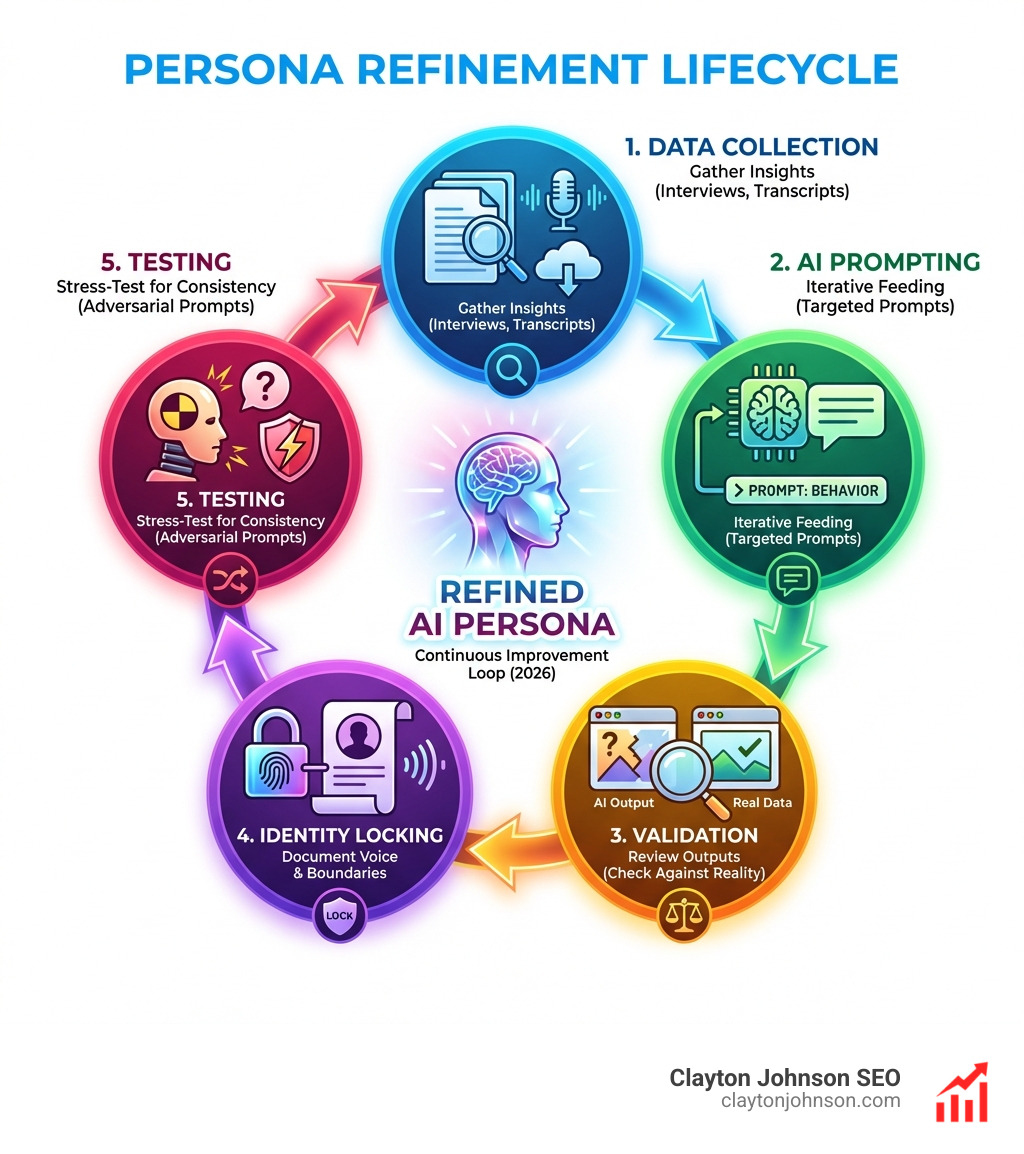
- Gather your data – Collect user interviews, transcripts, and research reports
- Define your persona sections – Goals, challenges, motivations, behaviors, affinities
- Upload your dataset – Use a secure AI tool like ChatGPT Team or HeyMarvin
- Prompt iteratively – Feed data in stages using targeted behavior prompts
- Review and validate – Check AI outputs against your original research to catch bias
- Lock in the identity – Document the persona’s voice, tone, and boundaries in a control document
- Test for consistency – Use adversarial prompts and follow-up questions to stress-test the persona
Most AI-generated personas feel hollow. Not because AI lacks capability, but because the identity behind the persona was never properly defined. Without a structured process, AI defaults to generic outputs that are technically correct but emotionally flat — useless for driving real product or content decisions.
The good news is that refining AI personas is a learnable, repeatable process. It combines structured prompting, iterative data feeding, and human validation to produce personas your team will actually use.
I’m Clayton Johnson, an SEO strategist and growth architect who has built AI-assisted marketing workflows and content systems for founders and marketing leaders across multiple industries. My work on how to refine AI personas sits at the intersection of structured strategy, technical SEO, and AI workflow integration — turning fragmented AI outputs into scalable, compounding growth assets.
Understanding the AI Persona Landscape
Before we dive into the “how,” we need to understand the “what.” In UX and strategy, not all personas are created equal. When we talk about how to refine AI personas, we are usually dealing with three distinct types of profiles.
Many teams start with “proto-personas” (or alignment personas). These are based on internal assumptions rather than deep field research. While some might call them “ad-hoc personas,” we often prefer the term “assumptions-based personas.” This prevents stakeholders from mistakenly thinking the research phase is already finished.
As Steve Mulder highlights in his book, The User is Always Right, every element of a persona must have a purpose. If a detail doesn’t help your team empathize or make a design decision, it’s just noise.
| Persona Type | Data Source | Primary Use | AI’s Role |
|---|---|---|---|
| Data-Informed | Real user interviews, surveys, and analytics. | Finalizing product roadmaps and high-stakes marketing. | Analyzing massive datasets to find hidden patterns. |
| Proto-Persona | Internal stakeholder workshops and assumptions. | Initial alignment and hypothesis testing. | Speeding up the creative writing of taglines and stories. |
| AI-Generated | Synthetic data or general LLM knowledge. | Ideation, role-playing, and quick drafting. | Simulating a “average” user for rapid testing. |
Refining these personas ensures they move from being “flat characters” to “dynamic users.” If you are interested in how these fit into a broader business strategy, you can check out Tamara Adlin’s great work on alignment personas. For those specifically looking to improve their marketing reach, we recommend exploring more info about buyer personas to see how they drive SEO and conversion.
How to refine AI personas: A Step-by-Step Framework
Refining a persona isn’t a “one-and-done” prompt. It is a conversation. We have found that “spoon-feeding” data to an AI produces much better results than dumping a 50-page PDF and asking for a summary.

Step 1: Gather and Clean Your Data
Start by collecting everything: interview transcripts, support tickets, and survey results. If you’re using tools like ChatGPT or HeyMarvin, ensure you are following data privacy best practices. We recommend using enterprise versions (like ChatGPT Team) that offer better data retention policies.
Step 2: Define the Sections
Don’t let the AI decide what’s important. Tell it exactly which sections you need. Common sections include:
- Values and Motivations: What keeps them up at night?
- Affinities: What brands or tools do they already love?
- Challenges: What is the “friction” in their current workflow?
- Behaviors: How do they actually interact with your product?
Step 3: Iterative Prompting
Instead of one giant prompt, use a series of smaller ones.
- The Skeleton: “Based on these three transcripts, create a basic profile for a mid-level manager.”
- The Depth: “Now, add a section on their professional aspirations using the ‘voice of the customer’ (first-person).”
- The Narrative: Use a prompt to get a “day in the life story.”
For a head start, you can downloadable persona creation prompts provided by the Interaction Design Foundation. If you want to dive deeper into the mechanics of the prompts themselves, see the ultimate guide to GPT AI persona prompts.
How to refine AI personas for UX and Product Design
In UX, a persona is a tool for empathy. AI can help us move beyond simple demographics into behavioral patterns. We use AI to assist with:
- Affinity Diagramming: Uploading hundreds of user quotes and asking the AI to group them into themes.
- Research Ideation: Asking the AI to identify gaps in our current user knowledge.
- Participant Recruitment: Generating screening criteria for our next round of interviews.
By integrating the Jobs To Be Done (JTBD) strategy, we can refine our AI personas to focus on the “job” the user is trying to hire our product for, rather than just who they are on paper.
How to refine AI personas for Consistent Brand Voice
For content creators, a persona is a “Writing Mechanic.” It’s a system, not an aesthetic choice. To refine this, we build an Identity Framework:
- Intellectual Stance: Is the persona a teacher, a strategist, or a contrarian?
- Emotional Baseline: Is the tone calm and analytical or urgent and intense?
- Professional Positioning: What is their level of depth? Do they use jargon or plain language?
We then document these in an AI Persona Control Document. This “locks in” the identity so that every piece of content feels like it came from the same mind.
Advanced Prompting and Behavior Refinement

To truly master how to refine AI personas, you have to go beyond the basics of “Name: Marketing Mike.” You need to prompt for behavioral nuances.
As Bill Bulman suggests in Crafting Personas with AI-Augmented Research, the goal is to make the AI “live” the persona. We do this by providing “behavior prompts” that cover personal goals and professional incentives.
For example, don’t just ask for “challenges.” Ask: “What are the internal political pressures this person faces when trying to implement a new SEO strategy?”
By providing specific examples — like this example of a Marketing Manager persona — we give the AI a high-quality “anchor” to follow. This is called “few-shot prompting,” where we provide a few examples of exactly how we want the persona to look and feel.
The “Spoon-Feeding” Technique
We’ve noticed that putting too many demands in one prompt confuses the model. It’s better to:
- Provide the data.
- Ask for the goals.
- Review.
- Ask for the challenges.
- Review.
This iterative refinement ensures the AI stays grounded in the data you provided rather than hallucinating generic “best practices.”
Technical Fine-Tuning: RAG, Custom GPTs, and Constitutional AI
For those building AI assistants or personalized agents, refinement happens at a deeper technical level.
Retrieval Augmented Generation (RAG)
RAG allows an AI to “look up” specific documents before it answers. If you want a persona to reflect a specific CEO’s writing style, you don’t just prompt it; you connect it to a database of their past emails and blog posts. This creates a “memory layer” that keeps the persona’s voice consistent over time.
The Persona Selection Model
Research from labs like Anthropic suggests that AI models don’t just “have” a personality; they simulate one based on their training. This is called the Persona Selection Model. Pre-training creates a vast space of possible characters, and post-training “selects” the one that acts like a helpful assistant.
When we refine a persona, we are essentially narrowing that selection. We can use “Constitutional AI” to give the model a set of rules (a constitution) to follow. For instance: “I am a thoughtful, skeptical researcher who prioritizes data over hype.”
Custom GPTs and Instructions
Custom GPTs allow us to set “System Prompts” or “Developer Instructions.” These are invisible to the end user but guide every interaction.
- Shot-based prompting: Including 3-5 examples of “Good” vs. “Bad” responses within the system instructions.
- Token Efficiency: Using “colon scoping” (e.g.,
:SourceDocument) to tell the AI exactly which part of its memory to use for a specific query.
For those interested in the cutting edge of this field, you can read more about scientific research on Open Character Training, which explores how to shape personas through self-reflection and synthetic interaction.
Validating and Measuring Persona Success

How do you know if your refined persona is actually accurate? You can’t just “feel” it; you have to test it.
Revealed Preferences and Elo Scores
One advanced method is “revealed preferences.” Instead of asking the AI “Are you a helpful persona?”, we give it two options and see which one it chooses. We can even use “Elo scores” (the same system used to rank chess players) to see which version of a persona is more coherent or “human-like” to a panel of judges.
Adversarial Testing (The “Stress Test”)
We like to “badger” our personas. We ask them questions that try to break their character.
- The Sarcastic Test: If the persona is meant to be professional, does it stay professional when we ask it something ridiculous?
- The Bias Test: Does the persona default to stereotypes? (e.g., assuming all “Founders” are young men in tech).
Human Validation
At the end of the day, AI is an assistant, not a replacement. Human researchers must review the outputs. We compare the AI-generated persona against our original research notes. If the AI says a “Small Business Owner” cares about “enterprise-grade scalability,” but our interviews showed they actually care about “paying rent next month,” we know the persona needs more refinement.
As mentioned in the classic text, The User is Always Right, the goal is empathy. If the AI-generated story doesn’t make your team feel for the user, it has failed.
Frequently Asked Questions about AI Personas
What is the difference between a persona and a proto-persona?
A persona is grounded in actual user research, interviews, and data. A proto-persona is based on the assumptions and collective knowledge of your internal team. We use proto-personas to get started quickly, but we always refine them with real data as the project progresses.
How do I avoid bias in AI-generated personas?
AI models are trained on the internet, which is full of bias. To mitigate this, we provide very specific, data-driven prompts. Avoid generic descriptors. Instead of saying “Create a persona for a nurse,” say “Create a persona based on these 10 interview transcripts of ER nurses in Minneapolis.” Always use human oversight to catch and correct stereotyping.
Can AI personas replace real user interviews?
No. AI personas are excellent for simulating interactions and summarizing data, but they cannot generate new, primary insights. You still need to talk to real humans to uncover the “unknown unknowns.” Think of AI as a way to scale and interact with the insights you’ve already gathered.
Conclusion
Mastering how to refine AI personas is a journey from generic automation to structured growth. In our work at Clayton Johnson SEO, we see personas not as static documents, but as dynamic parts of a structured growth architecture.
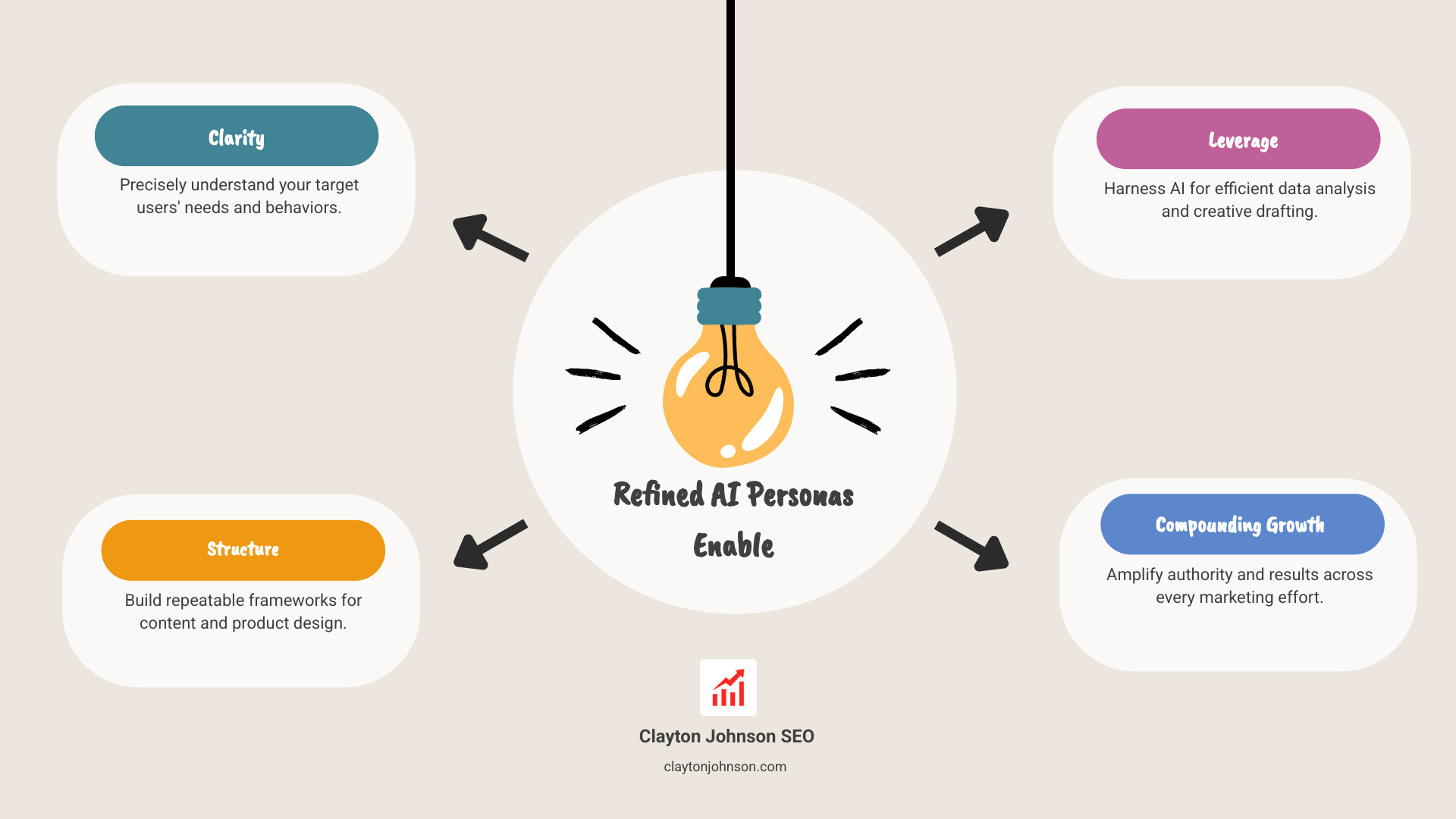
When you refine your personas, you aren’t just making a prettier PDF. You are building a system that allows for:
- Clarity: Understanding exactly who you are talking to.
- Structure: Creating a repeatable framework for content and product design.
- Leverage: Using AI to do the heavy lifting of data analysis and creative drafting.
- Compounding Growth: Ensuring every piece of content builds authority with your target audience.
If you are ready to take your marketing to the next level, we invite you to explore Demandflow.ai. We help founders and marketing leaders move past random tactics and into a structured strategy that wins. To start improving your own workflows, you can master AI prompt engineering for business growth and see how these refined personas can transform your SEO and customer acquisition.