Iterate or Die: Using the Hypothesis Canvas to Pivot


Why Business Model Innovation Separates Winners from Failures
Business model innovation canvas is a systematic framework that provides 145 specific innovation paths across seven strategic modules to help organizations identify opportunities, analyze problems, and design new business models—unlike the traditional Business Model Canvas which focuses on describing existing models.
Quick Answer:
| What It Is | A grounded-theory-based visual tool with three levels and seven modules for business model innovation |
| Key Difference from BMC | BMC describes what exists; BMIC guides how to innovate with 145 specific options |
| Core Purpose | Capture innovation hotspots, generate new directions, design adapted models |
| Best For | Startups pivoting, enterprises adapting to disruption, teams exploring emerging tech |
Most businesses die not from competition, but from strategic stagnation.
They cling to working models until the market shifts beneath them. The Business Model Canvas became the standard for visualizing your business—but it doesn’t tell you how to evolve it.
That’s where the Business Model Innovation Canvas comes in.
Built from analysis of 13,670 scientific papers using grounded theory methodology, the BMIC transforms abstract innovation concepts into 145 concrete options organized across value-driven modules. It’s not just another framework poster. It’s a decision system.
Think of it as the difference between a map and a compass. BMC shows where you are. BMIC shows where you could go—and gives you structured paths to get there.
The framework emerged from academic research but solves a practical problem: how do you systematically explore new business models without guessing? Whether you’re a founder testing product-market fit or a corporate team responding to disruption, BMIC provides the scaffolding for hypothesis-driven pivots.
I’m Clayton Johnson, and I’ve spent years building SEO and growth systems around structured strategy frameworks—including business model innovation tools that turn abstract planning into executable roadmaps. The Business Model Innovation Canvas represents a rare intersection of academic rigor and practical utility that actually works in real-world scenarios.
Business model innovation canvas helpful reading:
What is the Business Model Innovation Canvas?
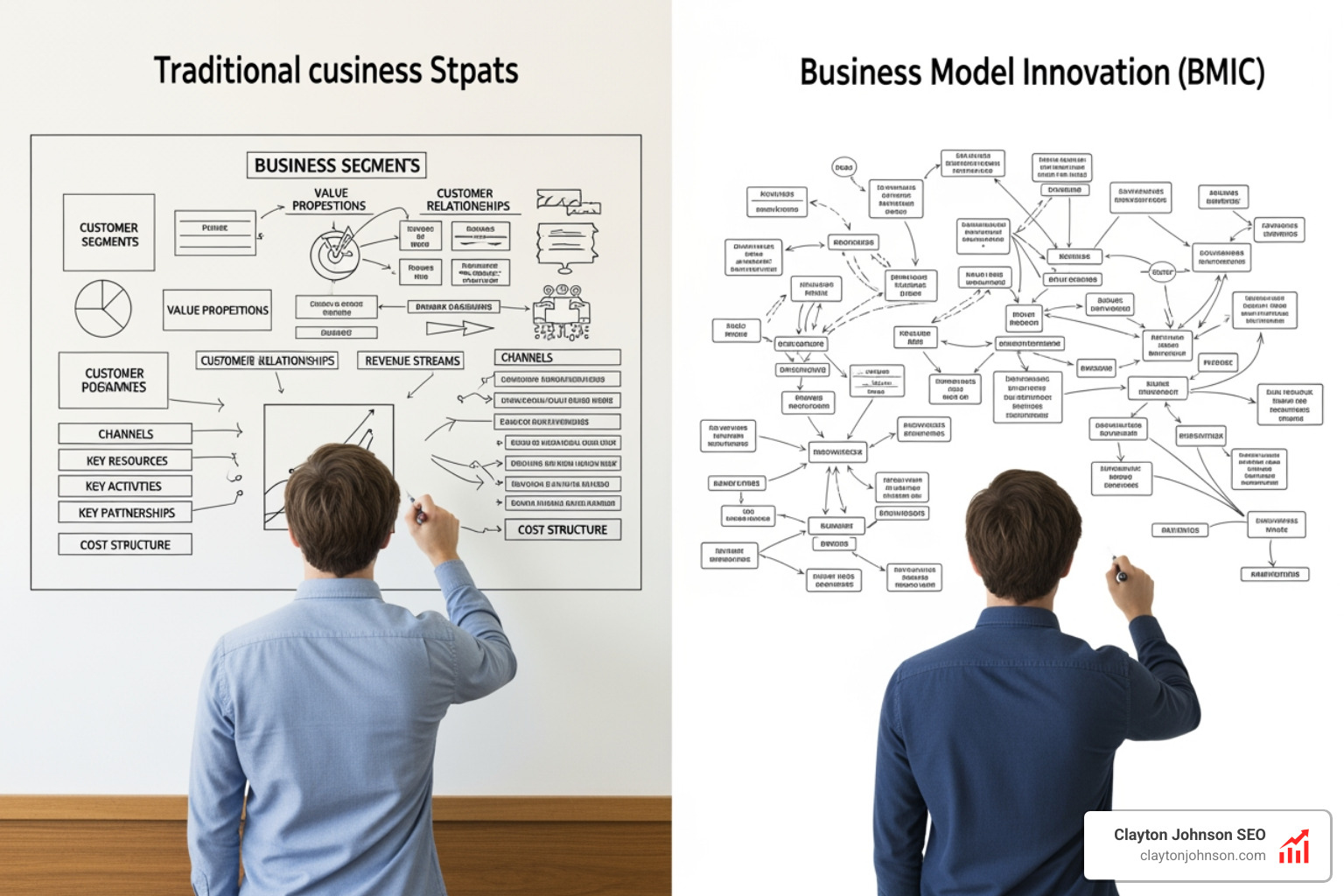
The Business model innovation canvas (BMIC) is a visual, strategic tool designed specifically to guide the process of changing how a company creates and captures value. While many are familiar with Alexander Osterwalder’s The Business Model Ontology, which laid the groundwork for the traditional Business Model Canvas (BMC), the BMIC is a more recent evolution that addresses the “how-to” of innovation.
At its core, the BMIC is a visual framework that maps out specific innovation paths. If the traditional BMC is a snapshot of your current state—helping you with how to visualize your business with BMC mapping—the BMIC is the blueprint for your future state. It was developed to provide systematic guidance in an era where emerging technologies like AI, 3D printing, and VR are making traditional competitive advantages obsolete.
The BMIC doesn’t just ask you to brainstorm; it provides a library of 145 pre-defined innovation options. This structure ensures that teams aren’t just staring at a blank page but are instead evaluating proven strategic maneuvers that have been distilled from thousands of successful business model transitions.
The Methodology Behind the BMIC
What sets the BMIC apart from many “consultant-made” frameworks is its intense academic rigor. It was developed using the SLCP paradigm of grounded theory. This isn’t just a fancy acronym; it represents a massive data-mining effort.
Researchers analyzed 13,670 scientific literatures related to business model innovation. Using a process called spindle coding (or selective coding), they extracted 870 unique tags or labels. These tags were then clustered to ensure “theoretical saturation”—meaning the researchers kept digging until no new information or categories could be found.
This scientific research on business model innovation ensures that the BMIC isn’t based on a few popular anecdotes (like “be the Uber of X”), but on a comprehensive map of how value has been successfully reconfigured across industries for over two decades.
Core Components and the 145 Innovation Options
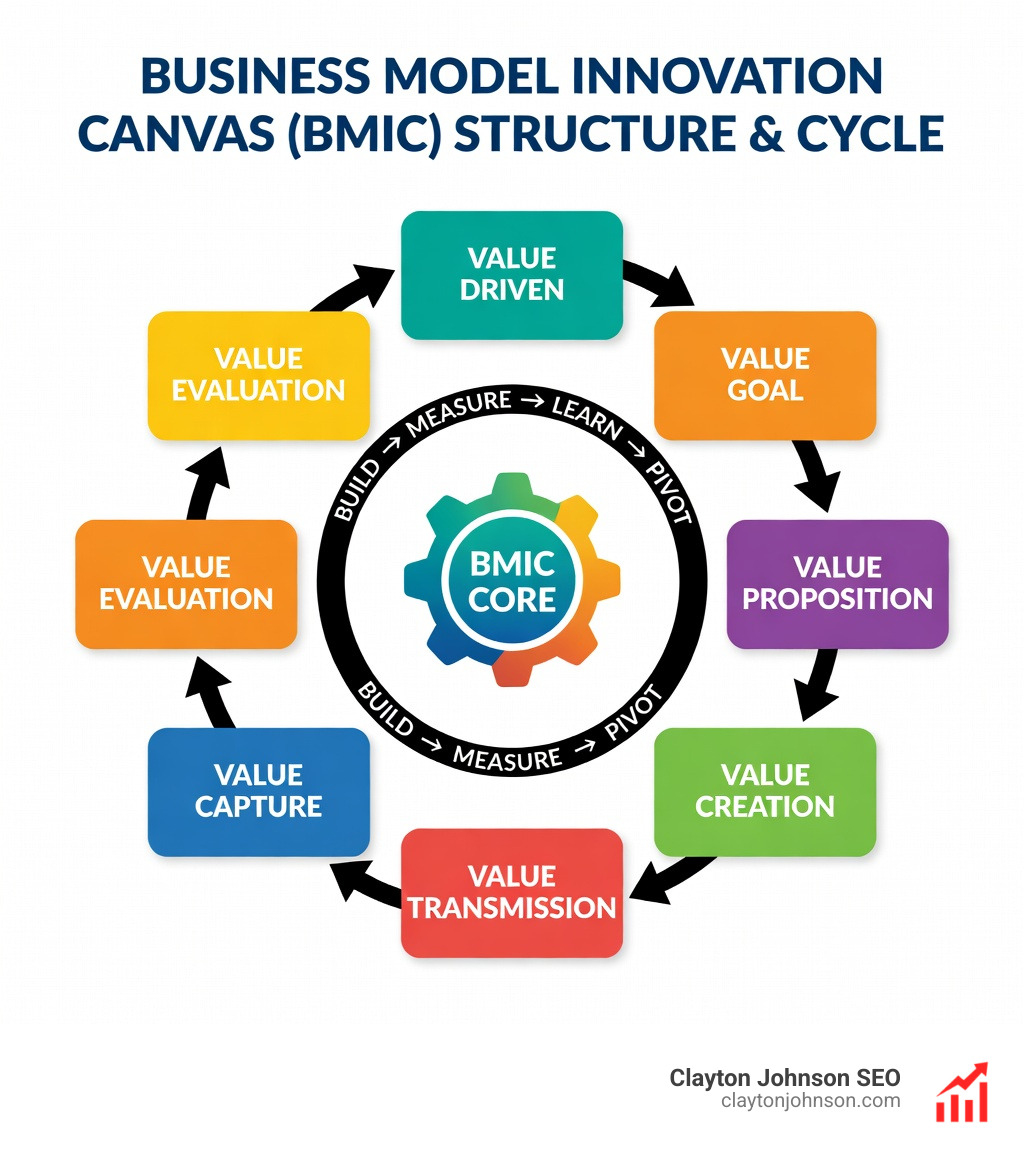
The Business model innovation canvas is organized into three levels and seven distinct modules. This hierarchy allows you to zoom in on specific operational changes while keeping the overall “Value Goal” in sight.
The seven modules are:
- Value Driven: What is the primary force behind the change? (e.g., technology, sustainability, or customer demand).
- Value Goal: What are we trying to achieve? (Efficiency, novelty, or social impact).
- Value Proposition: What new product-service combinations are we offering?
- Value Creation: How do we change our activities, resources, and partnerships?
- Value Transmission: How do we reach the customer and deliver the value?
- Value Capture: How do we change our revenue streams and deep dive into BMC cost structure?
- Value Evaluation: How do we measure success and sustainability?
Identifying Innovation Hotspots in the Business model innovation canvas
Innovation doesn’t happen everywhere at once. It starts at a “hotspot”—a specific area where your current model is failing or where a new opportunity exists. By using the BMIC, we can perform a Hotspot Analysis.
For instance, if a competitor introduces AI-driven personalization, your “Value Proposition” module becomes a hotspot. The BMIC then provides specific options to respond. This is similar to the ultimate guide to BMC SWOT integration, where you use external threats to trigger internal model changes.
| BMIC Module | Example Innovation Options | Potential Direction |
|---|---|---|
| Value Driven | Technology push, Demand pull, Regulatory change | Shift to AI-first operations |
| Value Creation | Modular production, Open innovation, Crowdsourcing | Outsourcing non-core R&D |
| Value Capture | Subscription, Freemium, Pay-per-use | Move from hardware sales to SaaS |
| Value Transmission | Direct-to-consumer, Omni-channel, Platform-based | Eliminating retail middle-men |
Step-by-Step Guide to Applying the Business model innovation canvas
Applying the BMIC isn’t a one-time workshop; it’s an iterative process of hypothesis testing. We recommend using a digital whiteboard or a large physical wall to allow for non-linear thinking.
Step 1: Capture Hotspots
Look at your current business model. Where is the friction? Are your costs too high? Are customers leaving? Use the seven modules of the BMIC to pinpoint exactly where the “heat” is.
Step 2: Analyze Problems
Once you’ve found a hotspot (e.g., Value Capture), look at the specific reasons why. Is it a lack of recurring revenue? High customer acquisition costs? This is the stage where you look at the definitive BMC tech startup template to see how others in your space are structuring their finances.
Step 3: Generate Directions
This is where the 145 innovation options come in. Instead of guessing, you browse the options within your hotspot module. If your problem is “Value Transmission,” you might choose the “Platform-based” or “Community-driven” options.
Step 4: Design New Models
Combine your chosen options into a new, cohesive model. At this stage, you might download the official Business Model Canvas template to visualize how these new innovation directions fit into a standard 9-block format for team communication.

Integrating the BMIC with Value Proposition Canvas (VPC)
The BMIC works best when you “zoom in” on the customer using the Value Proposition Canvas. While the BMIC handles the macro-strategy, the VPC focuses on Customer Jobs, Pains, and Gains.
When you identify a hotspot in the “Value Proposition” module of the BMIC, you should immediately run the essential guide to BMC customer discovery. This ensures that your innovation isn’t just “cool tech” but actually provides “Pain Relievers” and “Gain Creators” that the market wants. This alignment is critical for achieving product-market fit. If you need help articulating this to your audience, our SEO content marketing services can help translate these value propositions into high-converting messaging.
Real-World Case Study: 3D Printing in the Clothing Industry
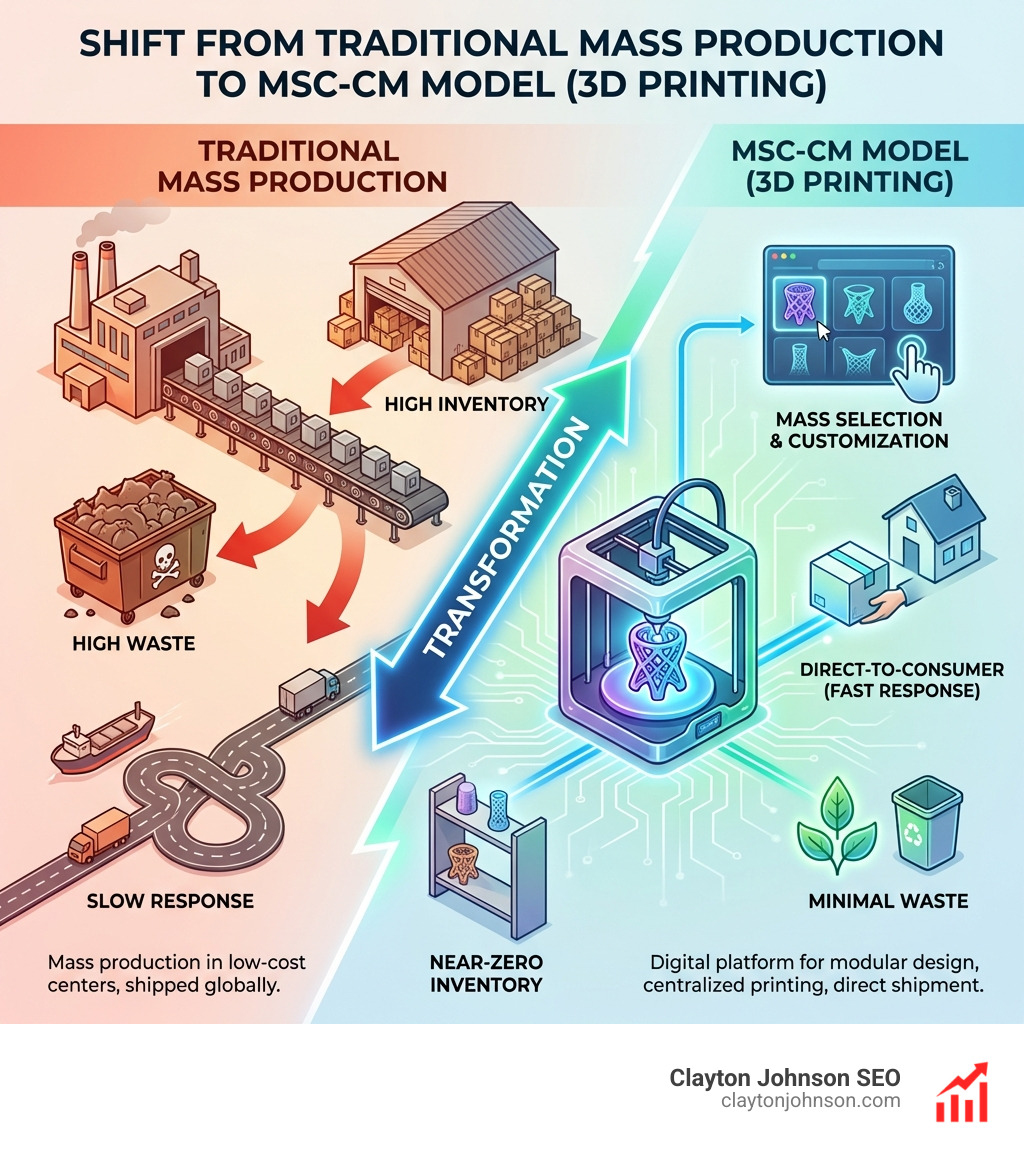
To see the Business model innovation canvas in action, let’s look at how clothing enterprises are adapting to 3D printing technology. Traditionally, clothing is mass-produced in low-cost centers and shipped globally—a model with high waste and slow response times.
Using the BMIC, researchers developed the Mass Selection Customization-Centralized Manufacturing (MSC-CM) model.
- Hotspot: Value Creation and Value Transmission.
- Innovation Options Chosen: Modular production, 3D printing technology, and Direct-to-consumer sales.
- Result: Instead of making 10,000 identical shirts, the company offers a digital platform where users “mass select” modular designs. These are then printed at a centralized high-tech hub and shipped directly.
This shift reduced inventory costs to nearly zero and eliminated the need for traditional retail partners. By understanding how to choose the right key partners in BMC, these companies shifted their focus from “Wholesale Distributors” to “Software Developers” and “Material Scientists.” This is the “Iterate or Die” philosophy in practice, as outlined in the Business Model Generation handbook.
Frequently Asked Questions about Business Model Innovation
How does BMIC differ from the traditional Business Model Canvas?
The traditional BMC is a static tool for description. It’s great for getting everyone on the same page about how the business works now. The Business model innovation canvas is a dynamic tool for transformation. It provides 145 specific “cheat codes” or paths to change the model. Think of BMC as the “what” and BMIC as the “how.” For more on this, check out our guide on digital innovation via the Business Model Canvas.
What are the main benefits of using the BMIC for startups?
For startups, the BMIC is a risk mitigation tool. It helps you identify gaps in your logic before you spend capital. It supports rapid pivoting by giving you a menu of alternative models if your “Plan A” fails. It’s a key part of mastering the Lean Startup model canvas, allowing founders to test hypotheses scientifically rather than relying on “gut feel.”
How can teams collaboratively use the BMIC?
We suggest a “Post-it note” approach, whether physical or digital.
- Cross-functional involvement: Bring in people from sales, tech, and finance.
- Non-linear thinking: Don’t feel forced to start at Module 1. Start where the problems are.
- Repetitive refinement: Your first canvas is a draft. Test the options with customers and come back to refine.
Tools like Confluence whiteboards are excellent for keeping these canvases as “living documents” that the whole team can access.
Conclusion
In a world of constant disruption, the ability to innovate your business model is more important than the ability to innovate your product. The Business model innovation canvas provides the structured, scientific approach needed to navigate this complexity without getting lost.
By moving through the levels of value—from your overarching goals to the granular 145 innovation options—you can turn “strategic agility” from a buzzword into a repeatable process. We’ve seen how iterative testing and hypothesis-driven pivots separate the market leaders from the companies that disappear.
At Clayton Johnson SEO, we specialize in helping businesses execute these strategic shifts through growth systems that actually scale. If you’re looking to diagnose your growth problems or need a partner to help execute your new business model directions, explore our SEO consultant services to see how we can help you win.