The Robot Revolution in CFO Marketing


Why AI Marketing Is a Game-Changer for CFO Services Companies
AI marketing for cfo services companies is transforming how financial advisory firms attract clients, nurture leads, and scale revenue — without adding headcount.
Here’s what AI marketing can do for CFO services firms right now:
| AI Marketing Capability | What It Means for CFO Firms |
|---|---|
| Automated lead generation | Identifies and targets CEOs of scaling businesses 24/7 |
| Hyper-personalized outreach | Matches prospects to services based on their financial profile |
| AI content creation | Publishes thought leadership at scale without a full marketing team |
| Secure client intake automation | Runs conflict-of-interest checks and qualifies leads automatically |
| ROI tracking and reporting | Shows exactly which campaigns drive client acquisitions |
| Agentic AI workflows | Handles multi-step marketing tasks autonomously |
The numbers back this up. Finance professionals already spend 20-30% less time on data-heavy tasks when using AI decision support tools. And according to McKinsey research, 44% of CFOs are now using generative AI across more than five use cases — up from just 7% the year prior. The firms that move first on AI marketing will compound that advantage into a durable lead pipeline that competitors simply can’t match manually.
The challenge? Most CFO services firms still rely on referrals, sporadic LinkedIn posts, and outdated agency relationships. That leaves enormous pipeline potential sitting on the table.
I’m Clayton Johnson, an award-winning SEO strategist and AI marketing innovator who has spent nearly two decades helping professional services firms build scalable, data-driven growth engines — including applying ai marketing for cfo services companies to drive measurable client acquisition results. This guide walks you through exactly how to implement it.

Implementing AI Marketing for CFO Services Companies
When we talk about ai marketing for cfo services companies, we aren’t just talking about a better way to send emails. We are talking about a fundamental shift in how “digital labor” handles the heavy lifting of business development. For a fractional CFO or a mid-sized accounting firm, time is the only inventory. If you are spending ten hours a week hunting for leads, those are ten hours you aren’t billing at $300+/hour.
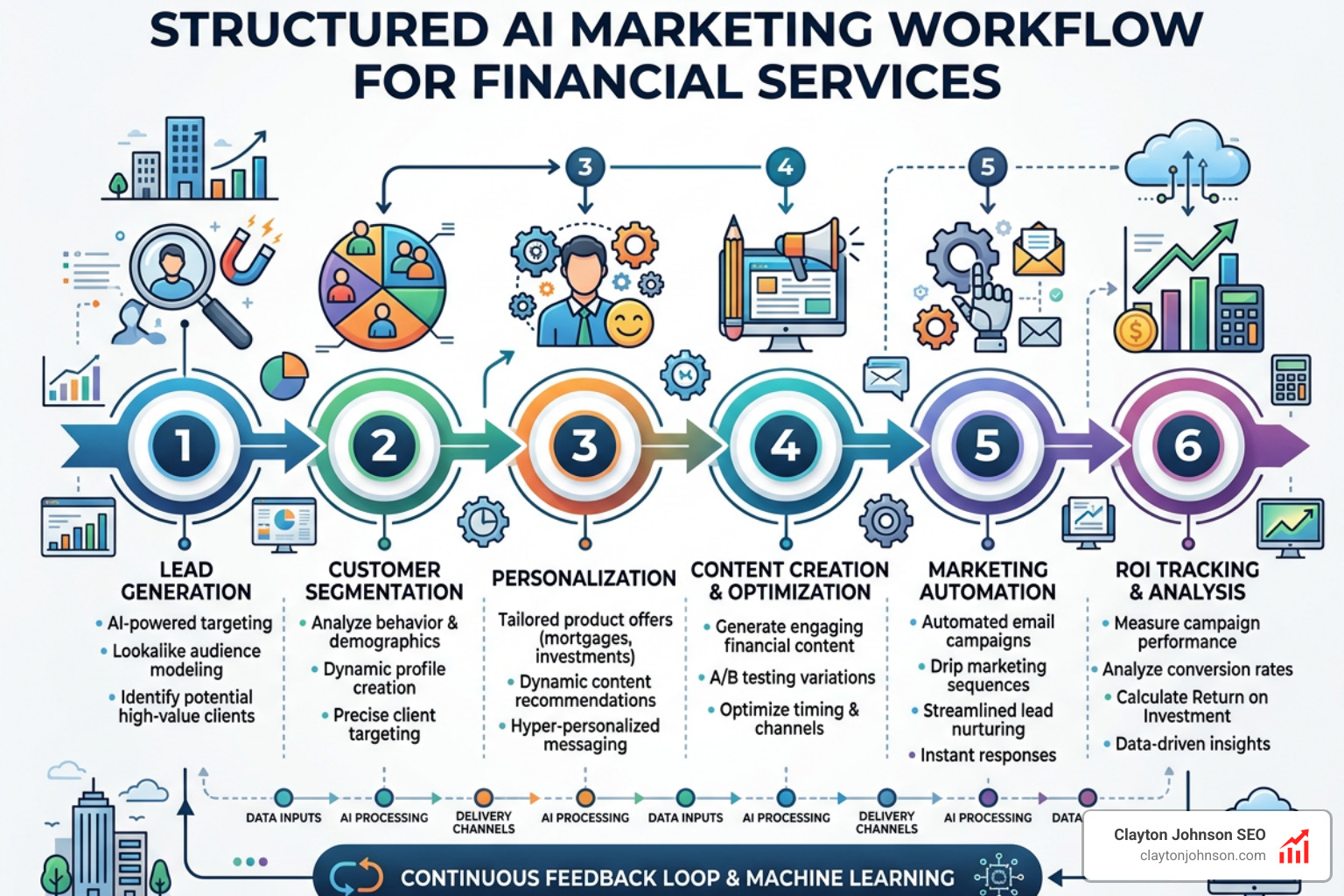
The first step in any successful implementation is moving away from “generic AI” (like asking a basic chatbot to write a blog post) and toward bespoke orchestration. This involves building a growth system to survive that connects your CRM, your financial data, and your outreach tools into a single, automated engine.
The Essential AI Marketing Stack for CFO Firms
To get started, we recommend focusing on these core areas:
- Agentic AI Agents: These aren’t just chatbots; they are autonomous workers that can research a prospect, check for conflicts of interest, and draft a personalized proposal.
- Data Lakehouses: Secure environments like Snowflake or Databricks where your firm’s private data lives, allowing AI to “reason” over your specific client success stories without leaking data to the public.
- Zero-Persistence Tools: Specialized platforms that process sensitive lead data without storing it, ensuring you stay compliant with financial regulations.
For a deeper dive into how to bridge the gap between technical tools and actual business results, check out our guide on AI strategy and implementation for people who hate jargon.
The Shift from Traditional to Agentic AI Marketing
Traditional marketing for CFOs is reactive. You wait for a referral, send a brochure, and hope for a discovery call. Agentic AI marketing is proactive and autonomous. An “agent” is an AI system capable of goal-setting and adaptation.
Recent research on AI reshaping finance functions suggests that CFOs are uniquely positioned to lead this charge because they already understand data-driven decision-making. While traditional marketing relies on “gut feel” and broad demographics, agentic systems use reasoning engines to identify “lookalike” prospects who share the exact financial pain points of your most profitable current clients.
| Feature | Traditional Marketing | Agentic AI Marketing |
|---|---|---|
| Lead Sourcing | Manual LinkedIn searching | Autonomous “scouts” finding high-intent CEOs |
| Personalization | Name and Company tags | Deep financial context (e.g., “I noticed your margin slipped…”) |
| Decision Velocity | Weeks of back-and-forth | Real-time automated qualification |
| Scaling | Requires hiring more “Business Dev” staff | Scales via digital labor and API calls |
Leveraging Generative AI for CFO Services Companies
Generative AI is the “voice” of your marketing engine. However, for a CFO firm, the voice must be authoritative, not “fluffy.” We use Gen AI to build AI-driven SEO strategies that focus on high-intent keywords like “fractional CFO for SaaS scaling” or “EBITDA optimization services.”
How we use Gen AI for content architecture:
- Narrative Reporting: Automatically turning complex financial case studies into anonymized, “client-proof” success stories for your website.
- Hyper-Personalized Outreach: AI can analyze a prospect’s public financial filings or news mentions to draft an email that speaks to their specific cash flow challenges.
- Automated Thought Leadership: By feeding the AI your unique frameworks (like the “Clarity → Structure → Leverage” model), it can produce 2,000-word deep dives that actually sound like you.
This level of precision is essential for financial services marketing, where trust is built through demonstrated expertise, not catchy slogans.
Secure Lead Generation and Client Intake Automation
One of the biggest hurdles in ai marketing for cfo services companies is confidentiality. You cannot upload sensitive prospect data into a public model. This is where zero-persistence architecture becomes a competitive advantage.
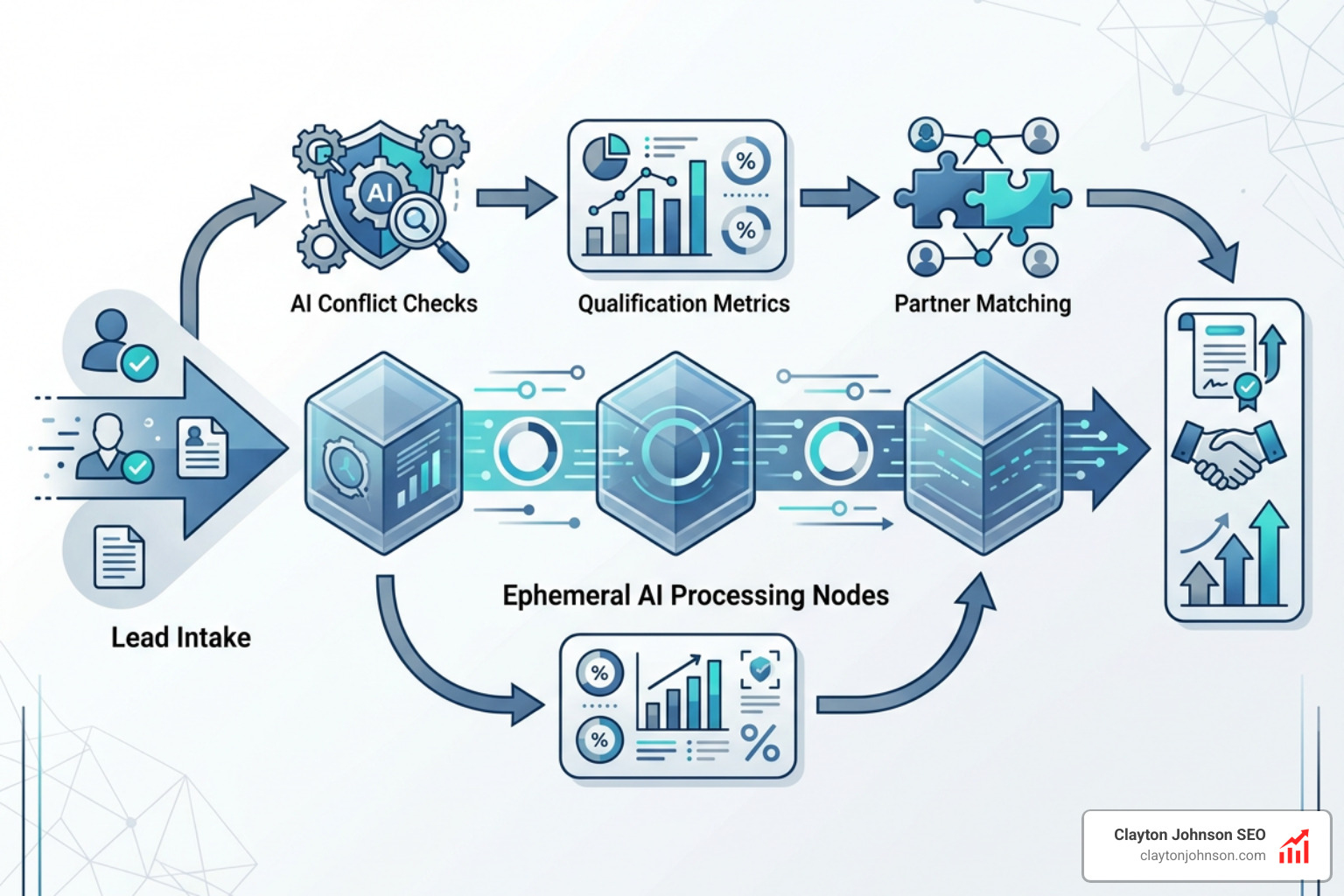
When a lead enters your funnel, a bespoke AI agent can:
- Run Conflict Checks: Instantly cross-reference the prospect against your current client database to ensure no ethical breaches occur.
- Qualify Based on Metrics: Ask the prospect questions about their revenue, burn rate, and accounting software (e.g., QuickBooks vs. NetSuite) to ensure they are a fit.
- Match to Partner: Use historical “win rates” to assign the lead to the partner in your firm who has the best track record with that specific industry.
By automating these steps, you ensure that only high-value, qualified leads ever reach your calendar. For more on the metrics that matter during this phase, see our article on 13 financial performance measures every manager should monitor.
Scaling Advisory with AI Marketing for CFO Services Companies
The “referral trap” prevents CFO firms from scaling because the partners become the bottleneck. AI marketing allows you to scale your expertise without scaling your headcount.
Imagine a multi-client financial intelligence dashboard that doesn’t just show data, but actively “markets” your advisory services to existing clients. If the AI detects a margin slip in a client’s books, it can automatically draft an “Advisory Alert” email for you to send, effectively upselling your strategic consulting services without you having to lift a finger.

This is the “secret sauce” for enterprise AI success. It turns your marketing into a value-add service. Instead of “selling,” you are “notifying” and “advising.”
Mitigating Risks: Compliance, Privacy, and Data Security
In regulated industries, the risk of data leakage is real. CFOs must be aware of the Data Governance Act and evolving AI regulations. Compliance isn’t just a checkbox; it’s a marketing pillar.
Our best practices for secure AI marketing:
- Privilege Protection: Ensure your AI tools are hosted on your own cloud (Azure, AWS, or GCP) so that data never leaves your firewall.
- Audit Trails: Maintain an immutable log of every decision the AI makes. If an AI agent qualifies a lead or drafts a proposal, you need to know exactly what data it used to do so.
- Human-in-the-Loop: Never let the AI hit “send” on a high-stakes proposal without a partner’s review. AI provides the leverage; you provide the judgment.
To better understand the terminology around these risks, explore our guide on financial value metrics terms demystified.
Measuring ROI and Building the CFO-Proof Business Case
To invest in ai marketing for cfo services companies, you need to speak the language of the boardroom: ROI.
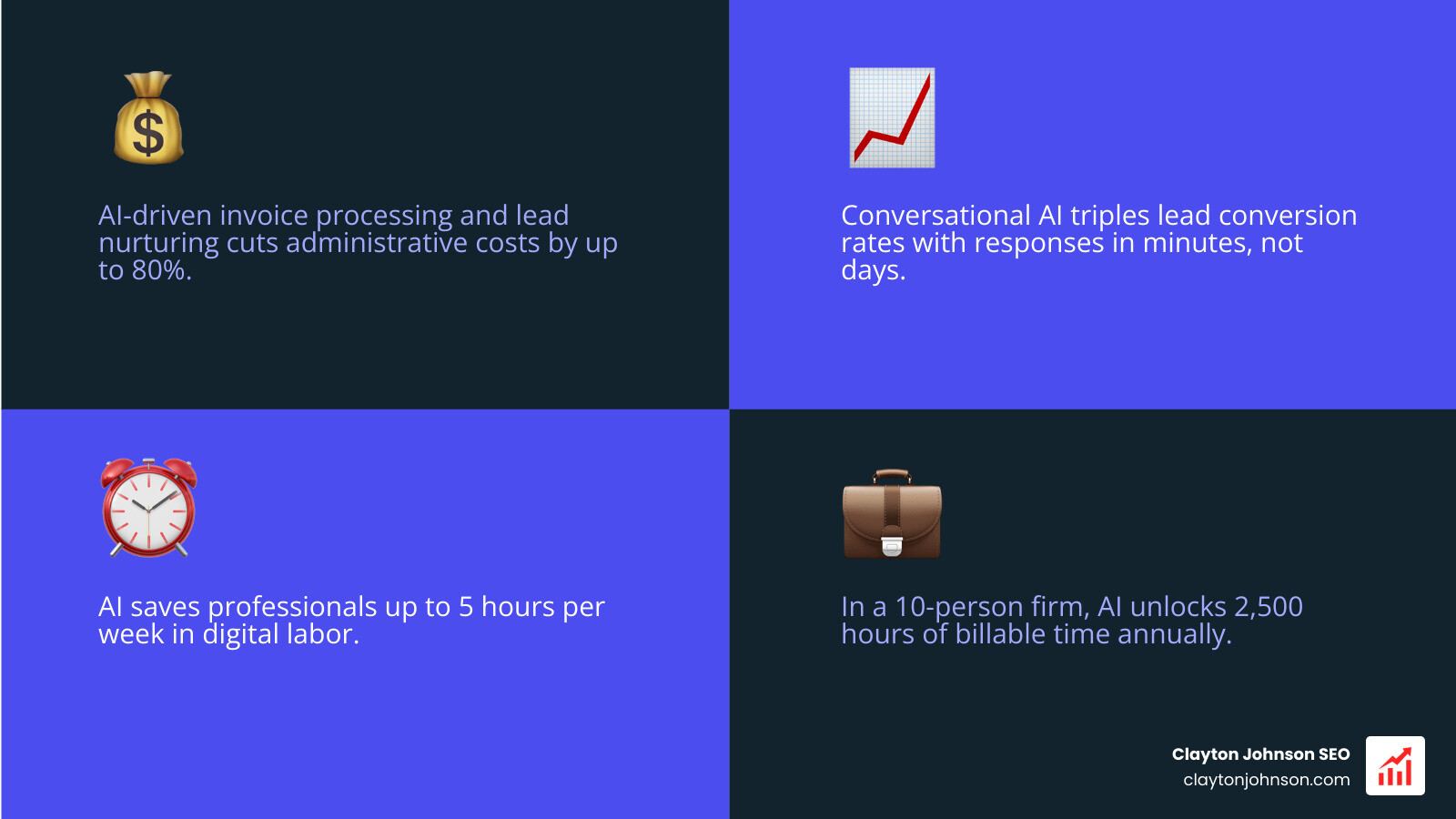
The Business Case for AI Marketing:
- Cost Optimization: AI-driven invoice processing and lead nurturing can cut administrative costs by up to 80%.
- Lead Conversion: Firms using conversational AI often see conversion rates triple because prospects get responses in minutes, not days.
- Digital Labor Savings: AI can save a professional up to five hours a week. In a firm of ten people, that is 2,500 hours of “found” billable time per year.
74% of CFOs expect AI agents to either cut costs or increase revenue by approximately 20%. When you build your proposal, focus on these “hard savings” and the ability to scale without increasing your multibillion-euro spend base on salaries. For more data-backed arguments, read about AI for business growth.
Conclusion: Building a Growth System for the Future
The robot revolution isn’t coming; it’s already in your general ledger. For CFO services firms, the choice is simple: automate the “tedious” parts of marketing so you can focus on the “strategic” parts of advisory.
At Clayton Johnson SEO, we don’t just “do SEO.” We build compounding growth engines. We combine technical SEO depth with AI workflow implementation to ensure your firm isn’t just found, but chosen. Our philosophy is built on Clarity → Structure → Leverage → Compounding Growth.
If you are ready to turn your fragmented marketing efforts into a coherent growth engine driven by ai marketing for cfo services companies, let’s build the system that operationalizes your expertise. The future of finance is agentic — make sure your firm is the one leading the charge.