Why Automated SEO Audit Tools Matter for Modern Websites
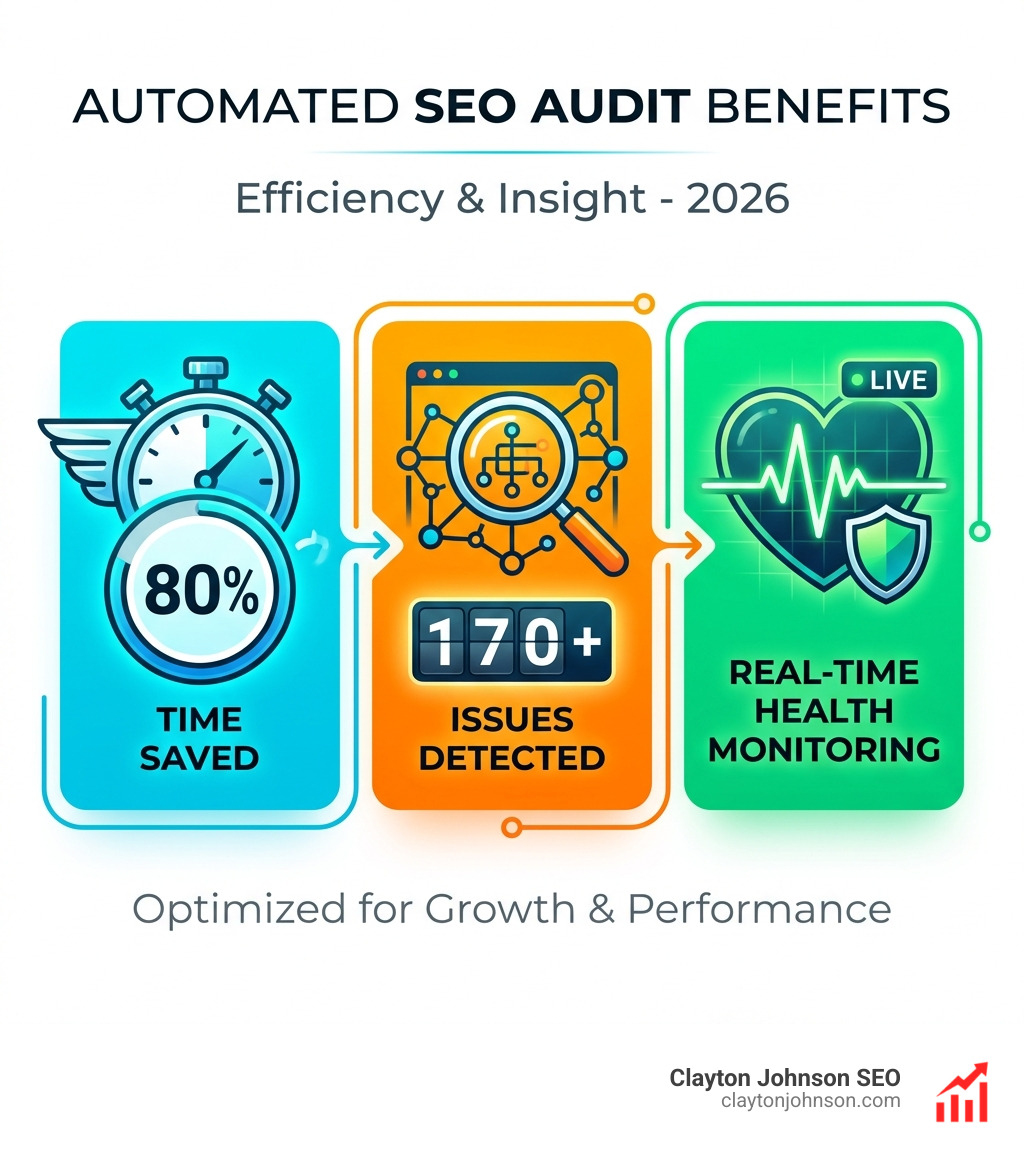
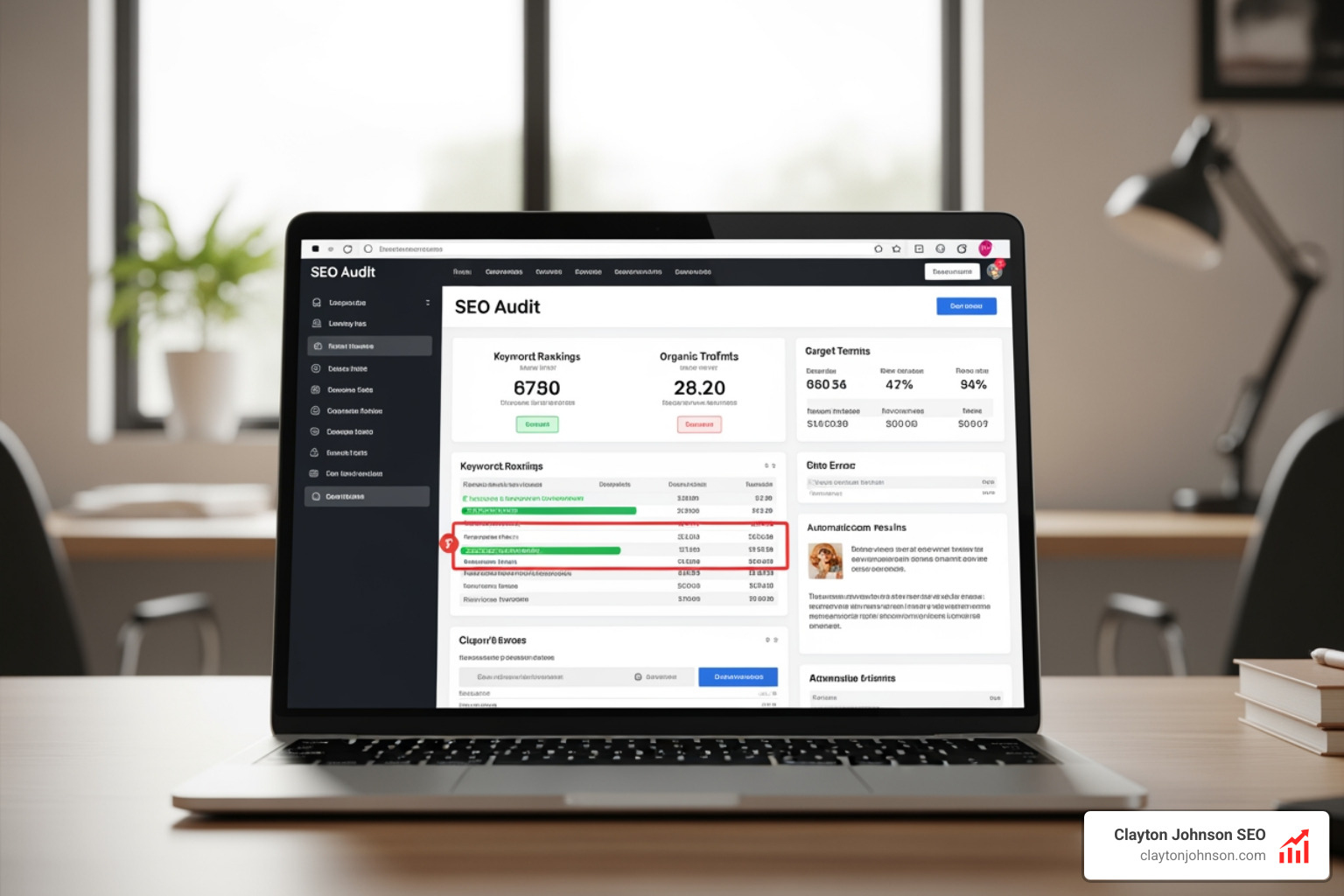
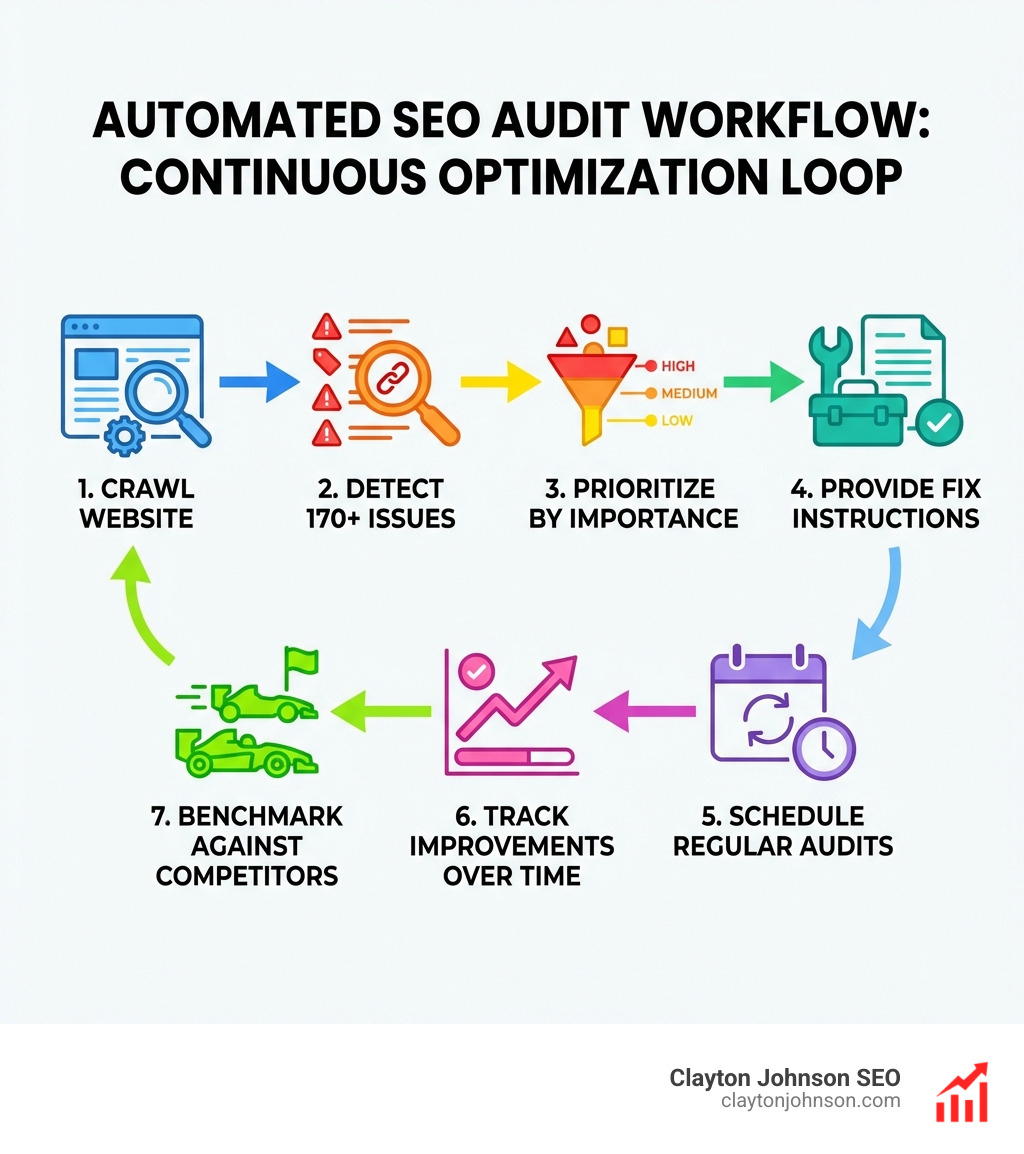
Automated SEO audit tools scan your website to identify technical errors, on-page issues, and performance problems that hurt your rankings—without requiring manual checks across hundreds or thousands of pages. Here’s what they do:
- Crawl your entire site to flag 170+ common SEO issues like broken links, missing meta descriptions, slow pages, and indexability problems
- Provide actionable recommendations with clear instructions on how to fix each issue, prioritized by importance
- Schedule regular audits so you catch problems early and track improvements over time
- Generate reports that show your site’s overall health score and compare performance between crawls
If you’re like most humans, the word “audit” gives you an instant twinge of anxiety. But if you’re building a growth system for your business, automated SEO audits are how you spot the small, fixable issues that keep great content from ranking—without spending hours manually checking every page.
You could be publishing excellent content yet still fail to rank if your foundations are flawed. Getting your website to rank in Google is harder and more competitive than ever, and search engines now consider factors like on-page content, performance, social signals, and backlink profiles when determining rankings. Manual audits simply don’t scale when you’re managing multiple sites, growing your content library, or trying to stay ahead of algorithm updates.
That’s where automation changes everything. Tools like Ahrefs Site Audit can crawl up to 170,000 URLs per minute and scan for 170+ technical and on-page SEO issues across categories like Core Web Vitals, duplicate content, structured data, and mobile-friendliness. Semrush allows you to schedule regular automated audits and track resolutions with an audit stat dashboard. Even free options like Screaming Frog (500 URLs) and Ahrefs Webmaster Tools (5,000 pages per month) provide generous limits for smaller sites.
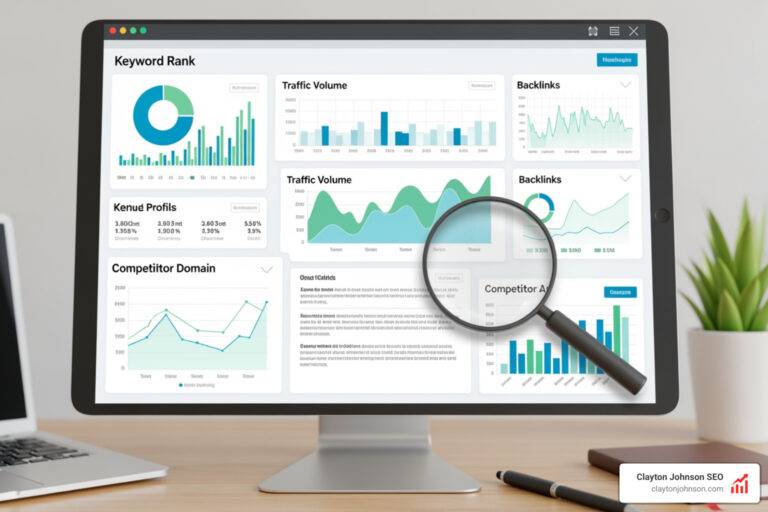
The best automated SEO audit tools don’t just find problems—they help you understand what to fix first and track your progress. They segment issues into errors, warnings, and notices so you can prioritize high-impact fixes. They visualize data with charts showing indexability distribution, page load speed, and duplicate content patterns. And increasingly, they use AI to detect patterns, suggest internal linking opportunities, and even generate optimized content elements like alt text.
I’m Clayton Johnson, and I’ve spent years building scalable SEO systems that turn fragmented marketing efforts into coherent growth engines. Throughout my work with automated SEO audit tools, I’ve learned that the right tool selection depends on your team size, budget, and specific workflow needs—not just feature lists.
Why Your Business Needs Automated SEO Audit Tools
In the early days of the web, you could manually click through a dozen pages and feel confident your site was “SEO-friendly.” Today, even a modest small business site can easily balloon into hundreds of URLs when you account for blog posts, category pages, and tags. This is where Automated SEO audit tools become non-negotiable for maintaining high Google Rankings.
Scalability and Efficiency
Manual auditing is a linear process; the more pages you have, the longer it takes. Automation is exponential. Tools like Ahrefs can scan 170,000 URLs per minute. For a business owner or an agency team, this means shifting 80% of your time from manual data collection to high-level strategy. Instead of spending Tuesday afternoon checking 200 pages for broken links, you can spend it brainstorming a killer campaign.
Detecting “Invisible” Technical Errors
Many issues that sink rankings aren’t visible to the naked eye. Automated tools perform deep dives into:
- Indexability: Are you accidentally blocking Googlebot via robots.txt?
- Structured Data: Is your Schema markup valid? Ahrefs, for instance, validates against 190+ Google and Schema.org requirements.
- JavaScript Rendering: Modern sites use heavy JS. If your audit tool can’t render it, it’s missing the content Google actually sees.
Performance and On-Page Health
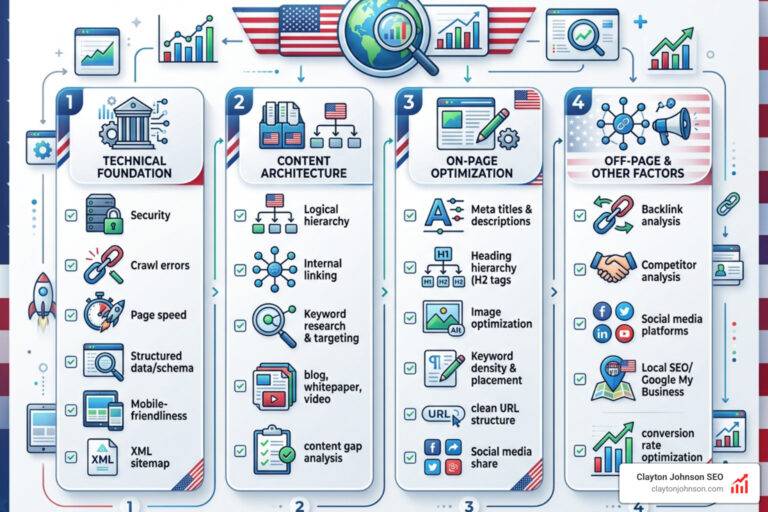
Beyond technical “breaks,” these tools measure the “health” of your content. They flag missing alt text, thin content, and poor heading structures. When we provide SEO Services, we use these audits to prioritize “quick wins”—like moving a keyword from position 15 to position 8 by simply fixing an on-page meta tag or improving internal linking.
Competitive Benchmarking
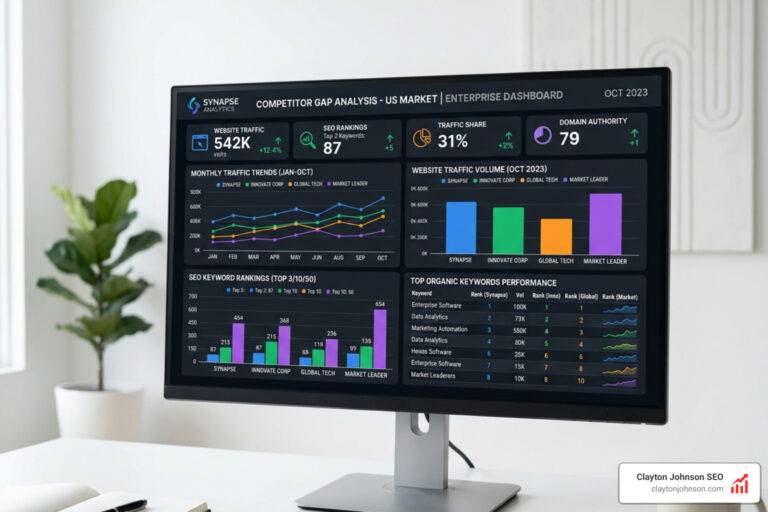
You don’t exist in a vacuum. Automated tools allow you to run audits on competitor sites to see where they are outperforming you in terms of site speed or backlink profile. By comparing your Authority Score (AS) and referring domains against the competition, you can build a more aggressive and informed growth plan.
Key Features to Look for in Automated SEO Audit Tools
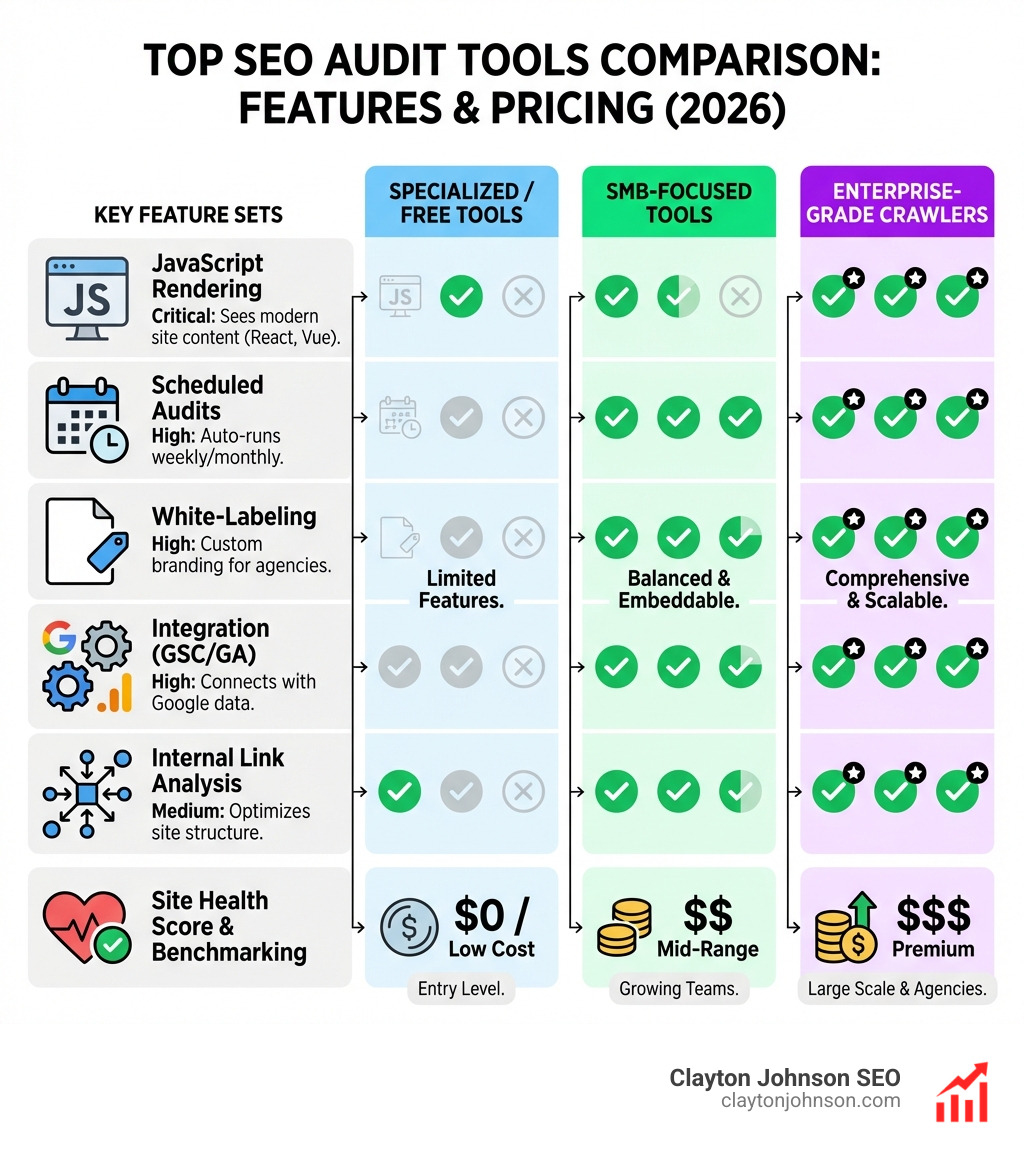
Not all Automated SEO audit tools are created equal. Some are “light” checkers that only look at homepages, while others are enterprise-grade crawlers. When choosing, we recommend looking for these specific capabilities:
| Feature | Importance | What it Does |
|---|---|---|
| JavaScript Rendering | Critical | Ensures the crawler sees content generated by JS, just like Google. |
| Scheduled Audits | High | Automatically runs audits weekly or monthly to catch new errors. |
| White-Labeling | High (for Agencies) | Allows you to put your own branding on reports for clients. |
| Internal Link Analysis | Medium | Suggests where to add links to boost underperforming pages. |
| Integration | High | Connects with Google Search Console (GSC) and Google Analytics (GA). |
Comprehensive Site Audits: What Matters Most
A top-tier tool must provide a “Health Score.” This is a high-level metric that allows you to see at a glance if your site is improving or degrading. For example, Ahrefs Site Audit provides a health score based on the number of errors found relative to the total number of pages.
We also look for JavaScript execution. Since many modern websites are built on frameworks like React or Vue, a tool that can’t render JS is essentially blind. Tools like SEOptimer and Ahrefs excel here, ensuring that your on-page content and performance metrics are accurately captured.
Value for Agencies and Teams
If you are running a Minneapolis SEO agency, your needs differ from a solo founder. You need white-labeling and embeddable audit tools. SEOptimer is a favorite for SMB agencies because it allows you to embed a “Free Audit” widget on your site. This serves as a lead magnet and builds instant trust by providing potential clients with a comprehensive overview of their site’s current status and actionable next steps.
Working with an SEO Consultant can help you interpret these complex data points, but having a tool that generates clean, branded PDFs makes the sales and reporting process significantly smoother.
Specialized and Free Automated SEO Audit Tools
You don’t always need a $100/month subscription to get started. There are several powerful free and specialized options available in 2025.
Free Google Ecosystem Tools
- Google Search Console (GSC): The gold standard for seeing exactly how Google views your site. It reports on technical elements like indexing, mobile usability, and Core Web Vitals.
- PageSpeed Insights (PSI): Uses real-world data (CRuX) and lab data (Lighthouse) to analyze loading speeds and provide specific optimization suggestions.
- Google Analytics (GA): While not a technical audit tool per se, it provides real-time reports on performance metrics that indicate if an SEO issue is causing users to bounce.
Professional Free Tiers
- Ahrefs Webmaster Tools (AWT): This is arguably the best free deal in SEO. It allows you to crawl up to 5,000 pages per month for your own verified websites. It scans for 170+ issues and provides the same depth as their paid plans for your own domains.
- Screaming Frog SEO Spider: A desktop-based tool that is a favorite among technical SEOs. The free version allows you to crawl up to 500 URLs. It is incredibly powerful for finding broken links, analyzing page titles, and even connecting to AI chatbots for bulk task automation.
Real-Time Monitoring and Change Tracking
Most Automated SEO audit tools run on a schedule (daily, weekly, monthly). However, some tools offer real-time monitoring.
- Conductor Website Monitoring (formerly ContentKing): This is unique because it offers 24/7 continual monitoring. If a developer accidentally deletes a H1 tag or changes a canonical URL, you get an alert immediately. This “always-on” approach is vital for enterprise sites where a single error can cost thousands in lost revenue.
- Semrush Site Audit: While not 24/7, it allows for frequent scheduling and features a “Progress” tab that visualizes how your health score changes over time.
AI-Powered Features in Modern Automated SEO Audit Tools
AI has transformed auditing from simple “error detection” to “strategic optimization.”
- Content Gap Analysis: Tools like MarketMuse and Surfer SEO automate the process of finding what your competitors are talking about that you aren’t. This typically takes 4-6 hours manually but can be done in minutes with AI.
- Automated Alt-Text: Screaming Frog now allows you to connect to AI chatbots (like ChatGPT) to automatically generate descriptive, keyword-optimized alt text for thousands of images.
- Internal Linking Suggestions: Ahrefs uses AI to look at the keywords your pages already rank for and suggests relevant pages to link from/to, providing the exact anchor text context needed. This is a massive win for SEO Content Marketing strategies.
Selecting the Best Automated SEO Audit Tools for Your Team
Choosing a tool is about finding the intersection of your budget, team skill level, and technical requirements.
Budget vs. ROI
If you’re a small business, a tool like SE Ranking (starting at $52/month) or SEOptimer ($29/month) offers incredible value. They provide the core technical checks without the enterprise price tag. For larger agencies, the $130+ price point for Semrush or Ahrefs is justified by the depth of their backlink databases and competitive intelligence features.
Team Size and Skill Level
- For Beginners: Morningscore is an excellent choice. It gamifies SEO, treating the user as a “Captain” on a mission. This makes the daunting task of auditing feel more like a game than a chore.
- For Technical Pros: Screaming Frog or the advanced settings in Ahrefs Site Audit are preferred. These allow for granular control over crawl speed, URL parameters, and custom regex searches.
Reporting and Integration
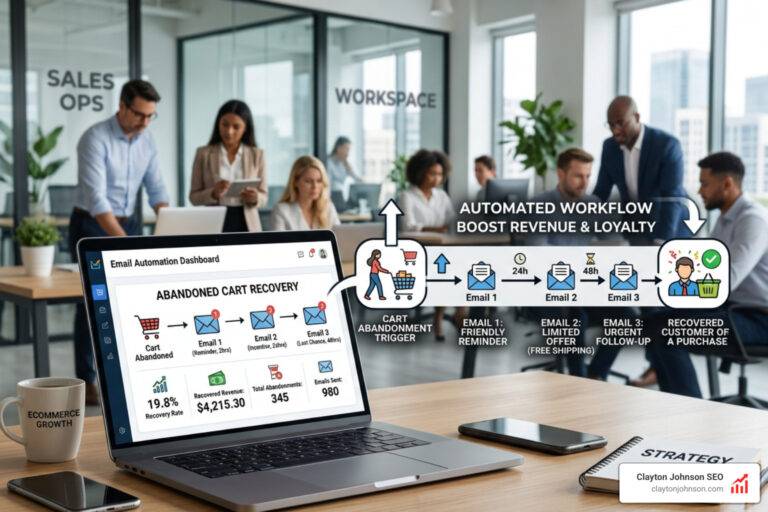
If your team lives in Looker Studio or uses Zapier to automate workflows, ensure your tool has native integrations. Semrush and Ahrefs offer robust Looker Studio connectors, allowing you to pull your SEO health score directly into your company’s main performance dashboards.
For those looking for a comprehensive guide on how to implement these fixes, our Technical SEO Services Guide provides a step-by-step roadmap.
Frequently Asked Questions about SEO Audits
How do automated tools differ from manual audits?
Automated tools are about speed and breadth. They can check 10,000 pages for broken links in seconds. Manual audits are about strategy and nuance. An automated tool might tell you a page is slow, but a human SEO Expert / Clayton Johnson can tell you why it matters for your specific business goals and which fixes will actually move the needle for your bottom line. Automation finds the “what,” humans find the “so what.”
What are the limitations of free SEO audit tools?
The primary limitations are crawl credits and data retention. For example, Ahrefs’ free tool limits you to 5,000 pages per month. If you have a site with 50,000 pages, you’ll only see a fraction of the issues. Free tools also often lack advanced features like JavaScript rendering, historical data comparison, and white-label reporting.
How often should I run an automated audit?
We recommend a two-tiered approach:
- Weekly/Monthly: Schedule a full site crawl to catch new technical errors, broken links, or redirect loops.
- Post-Update: Run an audit immediately after making significant site changes or when Google announces a major algorithm update. Google released four major updates in 2024 alone; staying on top of these with automated checks ensures you aren’t left wondering why your traffic suddenly dipped.
Conclusion
Automated SEO audit tools are the “secret weapon” for any business serious about growth. They transform the overwhelming task of site maintenance into a series of manageable, prioritized actions. Whether you’re using the gamified dashboards of Morningscore, the real-time monitoring of Conductor, or the technical depth of Ahrefs, the goal remains the same: building a healthy, high-performing foundation for your content.
At Clayton Johnson SEO, we focus on building actionable frameworks and content systems that deliver measurable results. We don’t just look at the data; we help you execute the strategy. If you’re ready to stop guessing and start growing, explore our SEO Services Minneapolis to see how we can help you diagnose your growth problems and choose the right strategy.