The Ultimate Guide to BMC SWOT Integration Canvas

Why Strategic Alignment Requires More Than Standalone Tools
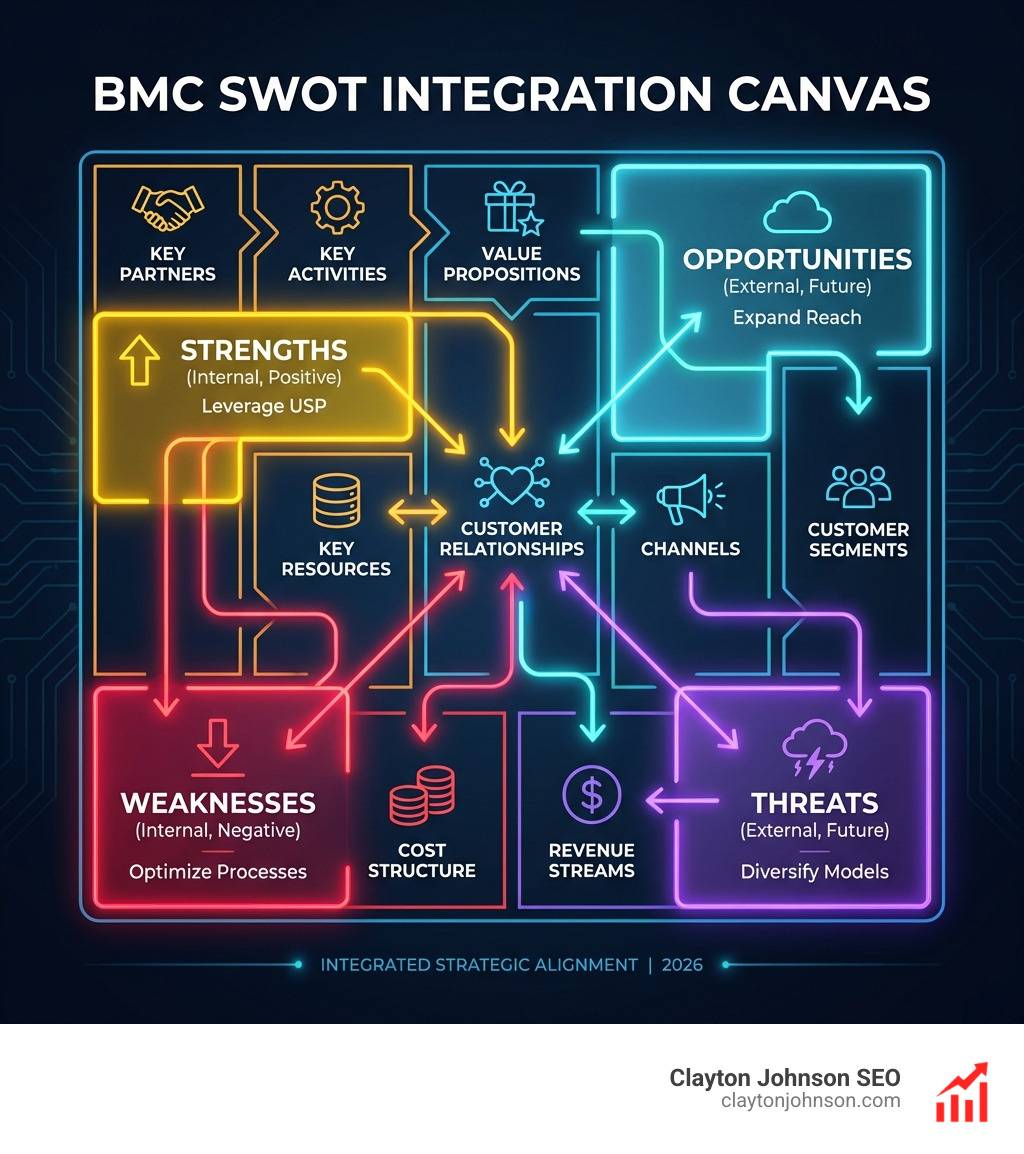
A BMC SWOT integration canvas combines two foundational strategic frameworks—the Business Model Canvas and SWOT Analysis—into a single, actionable tool that maps internal strengths and weaknesses alongside external opportunities and threats directly onto your business model’s nine building blocks.
Here’s what BMC SWOT integration delivers:
- Visual alignment between what you can do (strengths/weaknesses) and what the market demands (opportunities/threats)
- Targeted improvements by mapping SWOT findings to specific BMC elements like Value Propositions, Key Resources, or Revenue Streams
- Strategic clarity that moves beyond static lists to show how internal capabilities connect to market realities
- Actionable insights for resource allocation, competitive positioning, and business model adaptation
Less than 10% of companies successfully develop and communicate value propositions to customers. Most strategic planning efforts fail because they treat analysis tools in isolation—running a SWOT exercise without connecting findings to the actual business model, or filling out a Business Model Canvas without rigorously challenging assumptions about competitive position.
The Business Model Canvas, created by Alexander Osterwalder, provides a one-page visual framework covering nine building blocks: Customer Segments, Value Propositions, Channels, Customer Relationships, Revenue Streams, Key Resources, Key Activities, Key Partnerships, and Cost Structure. SWOT Analysis evaluates internal factors (Strengths and Weaknesses) and external factors (Opportunities and Threats). When integrated, they create a diagnostic layer that reveals where your business model is vulnerable and how to strengthen it.
Research shows this integrated approach helps businesses identify growth levers more effectively than either tool alone. A frozen food small business in Indonesia used BMC SWOT integration to expand from online-only sales to offline channels by mapping resource weaknesses (limited staff, no production facility) and external opportunities (specialty food trends, certification requirements) directly onto their canvas—leading to targeted investments in halal certification, production capacity, and bazaar participation.
I’m Clayton Johnson, and I’ve spent years building SEO and growth strategy systems that connect market analysis to execution. The BMC SWOT integration canvas is one of the most practical frameworks I use to help founders move from fragmented insights to coherent strategic action.
Understanding the Foundations: BMC and SWOT
Before we dive into the “mashup” that is the BMC SWOT integration canvas, we need to make sure we’re all speaking the same language. Think of the Business Model Canvas (BMC) as the anatomy of your business—the bones, muscles, and organs that make it run. Think of the SWOT analysis as a health check-up that tells you where you’re fit and where you might need a triple bypass.
Alexander Osterwalder revolutionized strategic planning in 2008 when he introduced the BMC. Before him, business plans were often 50-page paperweights that nobody read. The BMC changed that by putting everything on a single, visual page. But even a great anatomy chart doesn’t tell you if the patient is about to get hit by a bus (an external threat) or if they have a hidden talent for sprinting (an internal strength). That’s where SWOT Analysis comes in.
By combining these two, we move from a static description of “how we make money” to a dynamic strategy of “how we win.”
The Nine Building Blocks of BMC
If you’re going to use a Business Model Canvas (BMC) – SCORE, you need to know the nine blocks like the back of your hand. Here’s the quick rundown:
- Customer Segments: Who are we solving problems for? (Hint: “Everyone” is not a segment).
- Value Propositions: Why do they care? What’s the “magic” we offer?
- Channels: How do we reach them? (Social media, brick-and-mortar, carrier pigeons?)
- Customer Relationships: Is it a long-term marriage or a one-night stand (transactional)?
- Revenue Streams: How does the cash actually enter the bank account?
- Key Resources: What do we need to own? (Patents, talented staff, a really big espresso machine?)
- Key Activities: What do we need to do every day to stay alive?
- Key Partnerships: Who are our allies? (Suppliers, distributors, or that one guy who knows how to fix the server).
- Cost Structure: Where is the money going?
The Mechanics of SWOT Analysis
SWOT isn’t just a corporate buzzword; it’s a rigorous way to perform Market Analysis. It breaks down into:
- Strengths (Internal): What are you better at than your neighbor? Maybe it’s your proprietary tech or your brand’s “cool factor.”
- Weaknesses (Internal): Where are you dropping the ball? High employee turnover? A website that looks like it was built in 1998?
- Opportunities (External): What’s happening in the world that you can exploit? New regulations? A competitor going bankrupt?
- Threats (External): What’s keeping you up at night? Economic downturns? A new AI that does your job for half the price?
Why Use a BMC SWOT Integration Canvas?
You might be wondering, “Clayton, why can’t I just do these separately?” Well, you could, but you’d be missing the connective tissue. When you perform a SWOT in a vacuum, you end up with a list of “Strengths” that don’t actually help your “Value Proposition.” Or you identify a “Threat” but don’t realize it’s going to completely cannibalize your “Revenue Streams.”
The BMC SWOT integration canvas acts as a diagnostic layer. It forces you to Analyze your business model with a critical eye. It’s the difference between saying “We have great customer service” and saying “Our customer service is a core Strength that supports our Customer Relationships block, allowing us to charge a premium in our Revenue Streams.”
The Power of Integration
Less than 10% of companies successfully develop value propositions that actually resonate. Integration helps fix this. By mapping your SWOT directly onto the canvas, you ensure that your strategy isn’t just a list of wishes—it’s a plan for your specific infrastructure.
| Feature | Standalone BMC | Standalone SWOT | Integrated Canvas |
|---|---|---|---|
| Focus | How the business works | Internal/External factors | How factors impact the model |
| Output | A visual map | A list of four categories | A strategic roadmap |
| Flexibility | High (easy to change) | Low (often a static list) | High (iterative and dynamic) |
| Depth | Conceptual | Analytical | Diagnostic & Actionable |
Identifying Internal Strengths and Weaknesses in the BMC SWOT integration canvas
When we look at the internal side of the BMC SWOT integration canvas, we focus on the “Backstage” of the business: Key Resources, Key Activities, and Cost Structure.
For example, if you have a highly efficient automated supply chain, that’s a Strength in your Key Activities. If your Operational Alignment is off because your sales team doesn’t talk to your product team, that’s a Weakness in Key Activities. Using this framework to Diagnose internal issues prevents you from building a “Frankenstein” business model where the parts don’t fit together.
Mapping External Opportunities and Threats to the BMC SWOT integration canvas
The “Frontstage” (Customer Segments, Channels, Value Prop) is where external factors hit the hardest. You need to know How to Think About Competitive Pressure so you don’t get blindsided.
- Opportunities: Maybe a PESTLE Analysis shows a shift toward eco-friendly products. You map this Opportunity to your Value Proposition block to see if you can pivot.
- Threats: If a new competitor enters your city with a massive marketing budget, you map that Threat to your Channels and Customer Segments. Do you have the resources to fight back, or do you need to find a new niche?
Step-by-Step Methodology for Integration
Ready to get your hands dirty? Integrating these tools isn’t rocket science, but it does require a bit of Strategic Design. We like to break it down into a four-step process that ensures you don’t miss any blind spots.
Phase 1: Mapping the Current State
You can’t fix what you haven’t measured. Start by filling out a standard Business Model Canvas. This is your “baseline.” Get your team in a room (or a Zoom call) and perform a Scan of your current operations. Don’t write down what you want to be; write down what you are right now. If your current “Channel” is just you cold-calling people from your basement, put that down. Honesty is the only way this works.
Phase 2: Applying the SWOT Overlay
Now, for each of the nine blocks, ask: “What are the Strengths, Weaknesses, Opportunities, and Threats specifically for this block?”
- Value Proposition: Is our product actually unique (Strength), or is it a commodity (Weakness)?
- Revenue Streams: Are we over-reliant on one big client (Threat)?
- Key Partners: Do our suppliers give us a competitive edge (Strength)?
This SWOT Analysis in Business Model Canvas Crafting approach prevents the “vague list” problem. Instead of a generic “Weakness: Marketing,” you might find “Weakness: Our Channels aren’t reaching Gen Z.”
Phase 3: Designing the Future Model
Once you’ve identified the vulnerabilities, it’s time to redesign. This is where you use Porter’s Five Forces to see how you can build barriers to entry or improve your bargaining power.
If you found an Opportunity in a new market segment, how do you change your Key Activities to serve them? If you found a Threat in your Cost Structure (e.g., rising shipping costs), do you need to find new Key Partners? This is where strategy happens. You aren’t just filling boxes; you’re reallocating resources to where they’ll have the most impact.
Practical Applications and Strategic Outcomes
The BMC SWOT integration canvas isn’t just an academic exercise. It has real-world legs. When we look at companies that have successfully steerd major shifts, they almost always used some form of this integrated thinking—even if they didn’t call it a “canvas.”
The Nespresso Example: A Masterclass in Integration
Nespresso is a classic case of business model innovation. Originally, coffee was a commodity sold through grocery stores (Channels). Nespresso integrated their “machine and pod technology” (Key Resource) with a “club” model (Customer Relationship) and direct-to-consumer sales (Channels).
By using an integrated approach, they identified that their Strength (patented technology) could be leveraged to create a high-margin Revenue Stream (recurring pod sales) that bypassed traditional retail threats. They didn’t just sell coffee; they redesigned the entire Sales Strategy based on their internal capabilities and market opportunities.
Case Study: Culinary Small Business Adaptation
Let’s look at a smaller-scale example. Imagine a local frozen food business. During the pandemic, their “Frontstage” (physical bazaar events) disappeared. By using a BMC SWOT integration canvas, they were able to:
- Identify a Weakness: They had no digital presence (Channels).
- Spot an Opportunity: Demand for ready-to-eat home food was surging.
- Identify a Strength: A unique family recipe that packaged well.
- Pivot: They shifted their Key Activities to digital marketing and partnered with local delivery apps (Key Partners).
This wasn’t just “trying harder.” It was a calculated shift in their business model based on a rigorous Market, Industry, and Competitive Analysis. They even pursued specific certifications to build trust in their new digital channels—a move that directly addressed the “Threat” of consumer skepticism toward home-based food businesses.
Overcoming Implementation Challenges
Of course, it’s not all sunshine and rainbows. There are problems to clear:
- Data Complexity: Sometimes you have too much Analytics Data and you can’t see the forest for the trees.
- Subjective Bias: Everyone thinks their department is a “Strength.” You need a neutral facilitator (or a very honest team) to call out the Weaknesses.
- The “Static Snapshot” Trap: Markets change. A canvas you filled out in January might be useless by June. We recommend quarterly reviews to stay agile.

Frequently Asked Questions about BMC SWOT Integration
What are the common challenges of BMC SWOT integration?
The biggest pitfall is oversimplification. It’s easy to put “Good Team” in the Strengths box and call it a day. But why is the team good? Do they have a specific skill that supports a Key Activity? Another challenge is analysis paralysis—getting so bogged down in the SWOT that you never actually update the BMC. Finally, avoid mixing present and future states. Keep your “current” canvas separate from your “future” canvas so you don’t get confused about what’s real and what’s a dream.
How often should a business update its integrated canvas?
We typically recommend a quarterly review. However, if there’s a major market shift (like a new competitor or a global pandemic), you should pull it out immediately. The BMC SWOT integration canvas is a living document, not a trophy to be hung on the wall and forgotten.
Can startups use this framework for ideation?
Absolutely! In fact, it’s a perfect companion to the Lean Startup methodology. Startups can use the canvas to prototype different business models and then use SWOT to “stress test” them before spending a dime on development. It helps in Strategic Design by identifying which growth engines are most likely to survive contact with the real world.
Conclusion
Strategic planning doesn’t have to be a headache. By using the BMC SWOT integration canvas, you’re giving your business a clear, visual roadmap that accounts for both your internal reality and the external world. It’s about moving from “guessing” to “knowing.”
At Clayton Johnson, we’re all about building practical strategy-and-growth systems. Whether you’re looking to Assess your current market position or you need a full-scale Social Media Marketing Services overhaul, the key is always the same: align your strengths with the right opportunities.
Don’t let your strategy be one of the 90% that fails to deliver. Take your Business Model Canvas, overlay a rigorous SWOT, and start building a business that’s not just functional, but resilient.