Product Market Fit: The Only Thing That Actually Matters


Why Product Market Fit Determines Startup Success
Product Market Fit is the degree to which your product satisfies a strong, identifiable demand in a specific market — and it’s widely considered the single most important milestone for any startup or growth-stage company.
Quick answer:
| Element | What It Means |
|---|---|
| Definition | Your product solves a real problem for a clearly defined market |
| Key signal | Customers buy, use, and tell others without being prompted |
| Core test | 40%+ of users say they’d be “very disappointed” without your product |
| Why it matters | 42% of startups fail simply because no market need exists |
| When you have it | Growth feels pulled by the market, not pushed by your team |
Marc Andreessen, who popularized the term, put it plainly:
“Product/market fit means being in a good market with a product that can satisfy that market.”
And his corollary — originally from investor Andy Rachleff — is even blunter:
“The only thing that matters is getting to product/market fit.”
That’s not hyperbole. It’s a pattern observed across hundreds of startups. Great teams fail in bad markets. Weak teams win in great ones. The market is the force that matters most.
Before you obsess over growth tactics, hiring plans, or feature roadmaps — this guide will show you exactly what Product Market Fit is, how to measure it, and how to find it systematically.
I’m Clayton Johnson, an SEO and growth strategist who has worked across 50+ business models diagnosing why growth stalls — and Product Market Fit is almost always the root variable. This guide draws on those frameworks to give you a clear, actionable path forward.
The Fundamentals of Product Market Fit
To understand where we are going, we have to look at where the concept began. While Marc Andreessen popularized the term in his famous blog post “Part 4: The only thing that matters”, the intellectual heavy lifting was done by Andy Rachleff. Rachleff, a co-founder of Benchmark Capital, developed the concept based on his observations of Don Valentine, the legendary founder of Sequoia Capital.
Valentine’s investing style was simple: Market primacy. He believed that a great market—a giant, hungry, or desperate market—was more important than the team or the product itself. As the saying goes, “Give me a giant market—even with a mediocre team—and the market will pull the product out of the startup.”
In our work at Demandflow, we see this play out constantly. You can have the best SEO strategy in the world, but if you are selling sand in the desert, no amount of “leverage” will create growth.
The Value Hypothesis and Customer Discovery
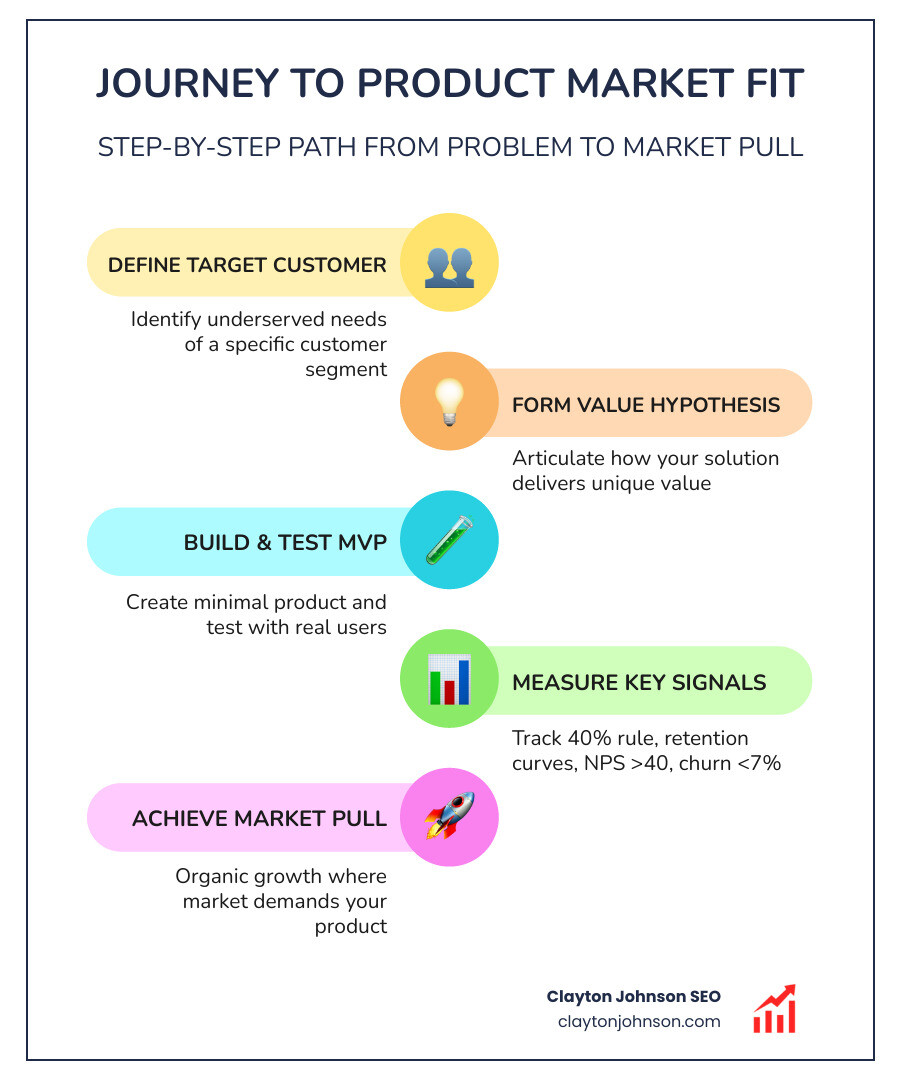
Before you can reach Product Market Fit, you must first achieve what Steve Blank calls “Customer Discovery.” This is the process of validating your value hypothesis: the assumption of why a customer will use your product.
We often advise founders to focus on Achieving Problem Solution Fit Before You Build. This means identifying a “hair on fire” problem. If someone’s hair is on fire, they don’t care if the hose you hand them is the “wrong color” or has a clunky UI; they just want the fire out. That is the essence of market demand.
How to Measure and Validate Success
How do you know if you’ve actually “struck gold” or if you’re just experiencing a temporary spike in interest? Measuring Product Market Fit requires a blend of qualitative “gut feel” and hard quantitative data.
The Sean Ellis 40% Rule
One of the most popular heuristics is The Sean Ellis test. Ellis, who led early growth at Dropbox and LogMeIn, discovered a “magic number” after surveying hundreds of startups. He asks users one simple question:
“How would you feel if you could no longer use the product?”
If 40% or more of your users respond with “Very Disappointed,” you have likely achieved Product Market Fit. If you’re below that threshold, you’re likely a “nice-to-have” rather than a “must-have.”
Retention Curves: The Ultimate Truth
While surveys are great, behavior is better. We look for “flat” retention curves.
If your retention curve continues to drop toward zero, you are a “leaky bucket.” No amount of marketing spend will save you. However, if the curve flattens out—meaning a cohort of users continues to find value month after month—you have found your “fit.”
Other critical indicators include:
- Net Promoter Score (NPS): A score above 40 is generally considered a strong signal.
- Churn Rates: For SaaS, a monthly churn rate of 5% or less (or 5-7% annually for enterprise) is a healthy benchmark.
- LTV to CAC Ratio: Your Customer Lifetime Value (LTV) should ideally be 3x your Customer Acquisition Cost (CAC).
For a deeper dive into these numbers, check out our guide on The Metrics That Make or Break Your Lean Canvas.
Measuring Product Market Fit with Data
It is easy to get distracted by “vanity metrics” (like total downloads or social media followers) that make us feel good but don’t indicate a viable business. To find the truth, we must look at “clarity metrics.”
| Vanity Metric | Clarity Metric (The Truth) |
|---|---|
| Total Registered Users | Daily Active Users (DAU) / Monthly Active Users (MAU) |
| Total Downloads | Retention Rate (at Day 30, 60, 90) |
| Page Views | Time on Site / “Core Action” Completion Rate |
| Marketing Spend | Organic Growth / Word-of-Mouth Referrals |
Andrew Chen on consumer startup metrics notes that for consumer startups, you should look for “unscalable” signs of love: users coming back every day, high engagement in specific niches, and a product that spreads through pure organic desire.
Strategic Frameworks for Growth
Finding fit isn’t a matter of luck; it’s a matter of process. We recommend using structured frameworks to move from an idea to a validated business.
The Product-Market Fit Pyramid
Created by Dan Olsen, author of The Lean Product Playbook, this framework breaks the concept into five layers:
- Target Customer: Who are you serving?
- Underserved Needs: What is their “hair on fire” problem?
- Value Proposition: How is your solution better?
- Feature Set: What is the Minimum Viable Product (MVP)?
- UX Design: How do they interact with it?
By iterating from the bottom up, you ensure that your UX and features are built on a foundation of real market need. This aligns perfectly with the Business Model Canvas, which helps you visualize how all parts of your business (from channels to cost structures) support your value proposition.
Frameworks to Achieve Product Market Fit
Sequoia Capital’s The Arc Product-Market Fit Framework offers a unique perspective by identifying three archetypes of fit:
- Hair on Fire: You are solving an urgent, obvious problem in a crowded market. Success here requires a “best-in-class” product and high velocity.
- Hard Fact: You are solving a problem people have accepted as “just the way it is.” Success here requires educating the market on a better way.
- Future Vision: You are creating a new paradigm (think OpenAI or early Apple). Success requires endurance and “commercial pit stops” to survive until the world catches up.
To validate these, we often use conjoint analysis to understand the trade-offs customers are willing to make, ensuring we aren’t just building features nobody wants.
Common Pitfalls and Premature Scaling
The road to Product Market Fit is littered with the carcasses of startups that thought they had it when they didn’t. In fact, 70% of startups scale prematurely, spending money on growth before they’ve solidified their value.
The Product Death Cycle
Product Death Cycle originally coined by David Bland is a trap many teams fall into. It looks like this:
- No one is using the product.
- Ask users “What features are missing?”
- Build those features.
- Still, no one uses the product.

The mistake here is iterating on the what (the product) instead of the who (the customer). If you don’t have fit, don’t add more features—find a more desperate customer.
Other Common Mistakes
- Pursuing well-known customers over desperate ones: Big companies might have the budget, but early adopters have the pain.
- Confusing “Problem/Solution Fit” with “Product/Market Fit”: Just because someone likes your idea doesn’t mean they will pay for and use your product at scale.
- Slowing Innovation: Thinking Product Market Fit is a one-time achievement. Markets move, and your fit can evaporate overnight if you stop listening to your users.
Scaling Sustainably After Validation
Once you have confirmed Product Market Fit, the game changes. You move from the “Before Product Market Fit” (BPMF) phase to the “After Product Market Fit” (APMF) phase.
In this stage, your focus shifts to building “structured growth architecture.” This is where Demandflow excels—helping you turn that initial spark of fit into a compounding growth engine.
The Benefits of True Fit
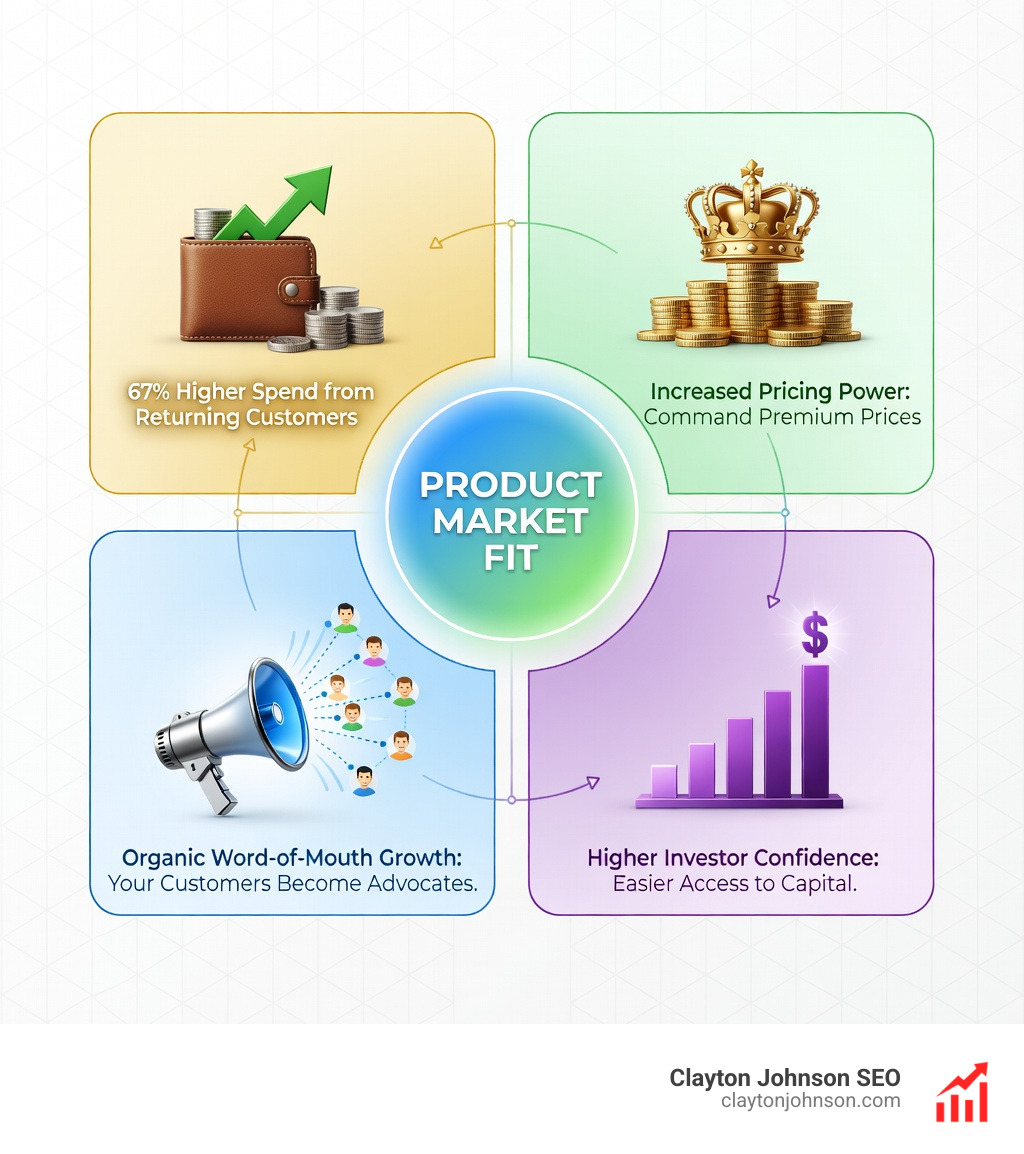
When you have fit, you gain Pricing Power. You are no longer competing on price because your product is indispensable. You also benefit from Organic Growth. Statistics show that returning customers spend 67% more than new customers, and your cost of acquisition drops as your users become your best marketing team.
At this stage, we help founders implement:
- Taxonomy-driven SEO systems: To capture the massive search demand your validated category now commands.
- AI Integration: To scale content and customer success workflows without bloating your headcount.
- Competitive Positioning Models: To protect your market leadership as incumbents try to copy your success.
You can read more about these systems in our deep dive on Product Market Fit.
Frequently Asked Questions
Who is responsible for achieving fit in an organization?
Achieving Product Market Fit is a shared responsibility. While the Product and Engineering teams build the solution, Marketing and Sales are responsible for identifying the right “who” and “where.” It requires a cross-functional effort to ensure the value proposition matches the customer’s reality.
Is product-market fit a one-time achievement?
Absolutely not. Markets evolve, competitors enter, and customer needs shift. Think of Product Market Fit like a marriage—it requires constant maintenance, communication, and iteration to stay healthy over the long term.
How does it differ from problem-solution fit?
Problem-solution fit happens when you’ve identified a problem and a way to solve it. Product Market Fit is when you’ve built a product that solves that problem and people are buying and using it in a repeatable, scalable way. One is an idea; the other is a business.
Conclusion
Finding Product Market Fit is the central quest of every founder. It is the bridge between a “project” and a “company.” Without it, every marketing dollar is wasted and every new hire is a risk. With it, you have the foundation to build something legendary.
At Clayton Johnson SEO and Demandflow.ai, we don’t just provide content—we provide the structured growth architecture needed to navigate the journey from BPMF to APMF. We believe in clarity, structure, and leverage.
If you are ready to stop guessing and start growing, explore our The Ultimate Guide to Product Market Fit or reach out to us in Minneapolis, Minnesota, to see how we can help you build a system that generates compounding growth. Let’s find your fit.