6 Competitive Analysis Frameworks to Leave Your Rivals in the Dust

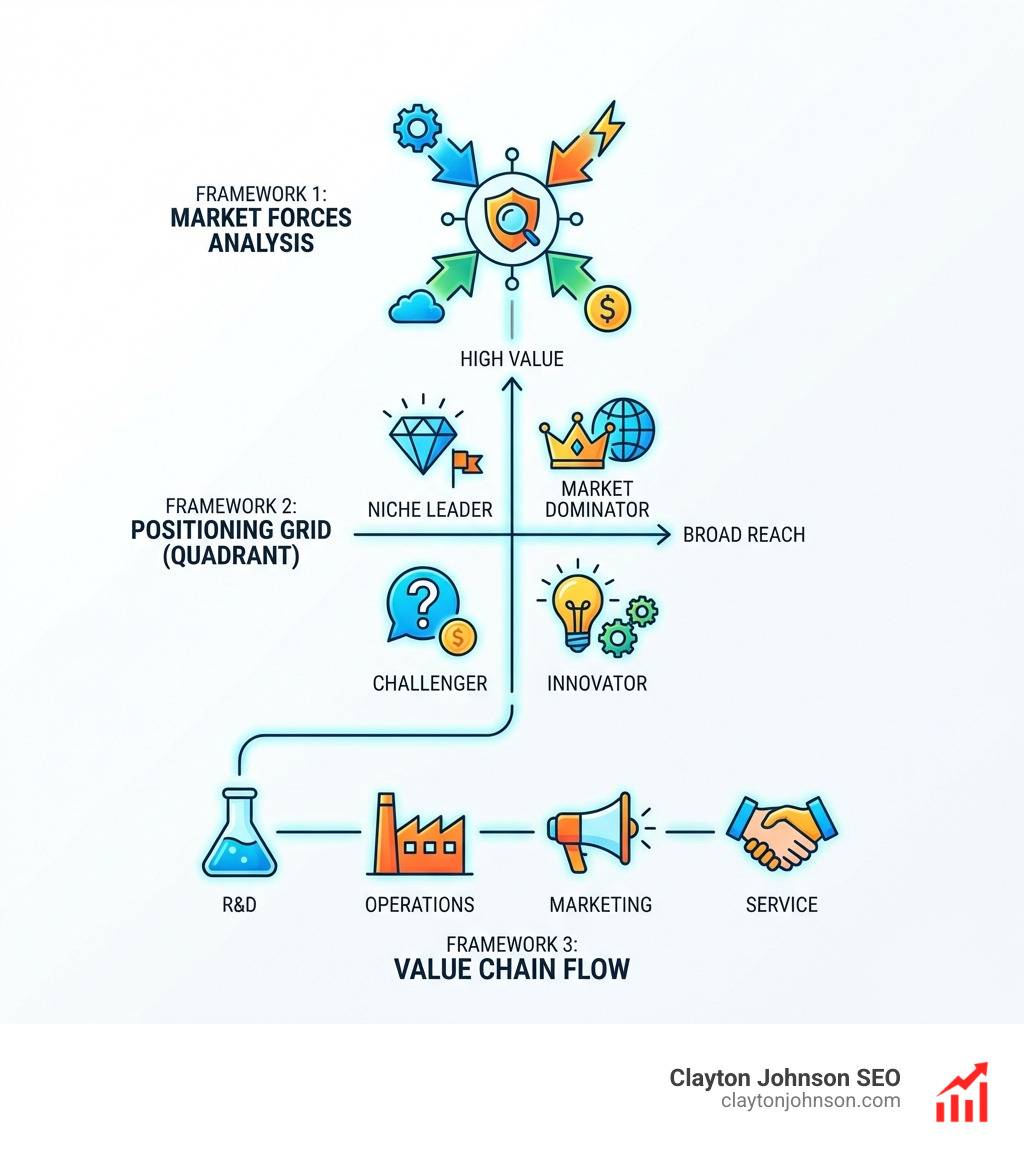
Analysis competitive positioning frameworks are structured methods for mapping your market, evaluating rivals, and identifying where your business can win.
Here is a quick overview of the most widely used frameworks and when to use each:
| Framework | Best Used For | Adoption Rate |
|---|---|---|
| SWOT Analysis | Quick internal/external health check | 70%+ of companies |
| Porter’s Five Forces | Industry attractiveness and profit potential | ~40% of firms |
| BCG Matrix | Portfolio prioritization and capital allocation | Improves capital efficiency by ~15% |
| Perceptual Mapping | Customer perception and brand positioning | 35-40% adoption |
| Strategic Group Analysis | Identifying true rivals by strategic cluster | 35-40% adoption |
| PESTLE Analysis | Macro-environmental scanning | ~50% of organizations |
| 7Ps Marketing Mix | Competitive marketing audit | Broad use across consumer industries |
Most businesses compete harder without competing smarter. They track competitor activity reactively, run surface-level SWOT exercises, and end up with insight decks that never influence decisions.
The real value of competitive positioning analysis is not the data itself. It is the strategic clarity that follows — knowing where to play, where to invest, and where to stop wasting resources.
Over 70% of companies use SWOT analysis, yet most treat it as a box-checking exercise rather than a decision-making engine. The frameworks exist. The discipline to use them well is where most teams fall short.
I’m Clayton Johnson, an SEO strategist and growth operator who has applied analysis competitive positioning frameworks across 50+ business models to build structured growth systems that compound over time. In this guide, I’ll walk you through every major framework, how to choose the right one, and how to turn competitive insights into decisions that actually move the needle.
Why Analysis Competitive Positioning Frameworks Drive Business Success
In a market where barriers to entry are lower than ever—especially in SaaS and digital services—mapping out your competitive landscape is no longer optional. We believe that trying to grow a business without a structured framework is like trying to navigate a maze blindfolded. You might move fast, but you aren’t necessarily getting closer to the exit.
The primary reason analysis competitive positioning frameworks are crucial is that they transform “noise” into “intelligence.” Market intelligence allows us to monitor threats before they become existential crises. By using models championed by experts like Michael Porter of Harvard Business School, we can look beyond direct rivals to understand the structural forces—like buyer power and the threat of substitutes—that dictate long-term profitability.
Strategic differentiation is the ultimate goal. As the saying goes, differentiation is the essence of strategy. You don’t just win by doing what others do; you win by doing it differently or better. These frameworks help us identify “Blue Oceans” of uncontested market space rather than fighting in “Red Oceans” where competition is fierce and margins are thin.
Beyond winning deals, these frameworks drive capital efficiency. Research indicates that properly integrating tools like the BCG Matrix can improve capital allocation efficiency by an average of 15%. This means your resources go toward “Stars” rather than “Dogs.”
Expert practitioners, such as Hunter Sones, emphasize that the real value of these analyses goes well beyond basic bullet points. It’s about creating a “game tape” for your sales and product teams so they know exactly how to counter a rival’s move.
Core Business Benefits:
- Risk Mitigation: Anticipate market shifts and competitor pivots before they impact your revenue.
- Resource Allocation: Stop over-investing in stagnant products and double down on high-growth opportunities.
- Sales Enablement: Provide your team with the “battlecards” they need to win competitive RFPs.
- Strategic Clarity: Move from reactive “firefighting” to proactive market leadership.
Primary Types of Analysis Competitive Positioning Frameworks
Choosing the right framework depends entirely on the problem you are trying to solve. Are you looking at a specific product feature, your entire company health, or the industry as a whole?
| Framework | Primary Focus | Key Outcome |
|---|---|---|
| SWOT | Internal/External Health | Actionable list of opportunities and threats. |
| Porter’s Five Forces | Industry Structure | Assessment of long-term profit potential. |
| BCG Matrix | Product Portfolio | Decisions on where to invest, harvest, or divest. |
| Perceptual Mapping | Customer Psychology | Visual map of brand gaps in the market. |
| Strategic Group Analysis | Rivalry Clusters | Identification of true direct competitors. |
For those looking deeper into brand perception, Perceptual Mapping is an invaluable tool. It allows us to plot competitors on a graph based on two attributes important to customers (e.g., Price vs. Quality). This often reveals “white space” where no one is currently playing.
Another powerful model is the Forrester Competitive Analysis Model. This assesses competitors through two specific lenses: disruptive ability and go-to-market capability. By plotting rivals into quadrants—Vulnerable, Emerging, Entrenched, or Lethal—we can plan specific competitive responses. A “Lethal” competitor requires a very different strategy than an “Emerging” one.
Finally, for a comprehensive marketing audit, we often turn to the 7Ps Marketing Mix (Product, Price, Place, Promotion, People, Process, and Physical Evidence). This serves as a structured checklist to ensure our strategy is tighter than the competition’s across every touchpoint. For a deeper dive into how these positions shift, HBR: Mapping Your Competitive Position provides a foundational look at how price and benefit interact.
Foundational Analysis Competitive Positioning Frameworks: SWOT and PESTLE
The SWOT analysis remains the most popular tool, used by over 70% of companies. Its beauty lies in its simplicity: assessing internal Strengths and Weaknesses alongside external Opportunities and Threats. However, we find it most effective when it’s data-backed. Instead of saying “we have good customer service,” a high-level SWOT should say “our NPS is 15 points higher than the industry average.”
To complement the internal focus of SWOT, we use PESTLE Analysis to scan the macro-environment. This looks at Political, Economic, Social, Technological, Legal, and Environmental factors. About 50% of organizations use this to ensure they aren’t blindsided by external trends—like a new privacy regulation or a shift in consumer spending habits—that could render a competitive advantage obsolete.
Portfolio and Industry Analysis Competitive Positioning Frameworks
When we look at businesses with multiple product lines, we turn to the Boston Consulting Group and their famous BCG Matrix. This framework categorizes products into four quadrants:
- Stars: High growth, high market share. These need heavy investment.
- Cash Cows: Low growth, high market share. These fund the rest of the business.
- Question Marks: High growth, low market share. These are the “bets” that could become Stars.
- Dogs: Low growth, low market share. These often need to be phased out.
For a broader view of the “battlefield,” Porter’s Five Forces is the gold standard. It helps us understand the intensity of rivalry, the bargaining power of buyers and suppliers, and the threat of new entrants or substitutes. If buyer power is high and switching costs are low, the industry is structurally difficult for high margins. Understanding this allows us to build “moats” to protect our position.
Step-by-Step Process for Conducting a Comprehensive Analysis
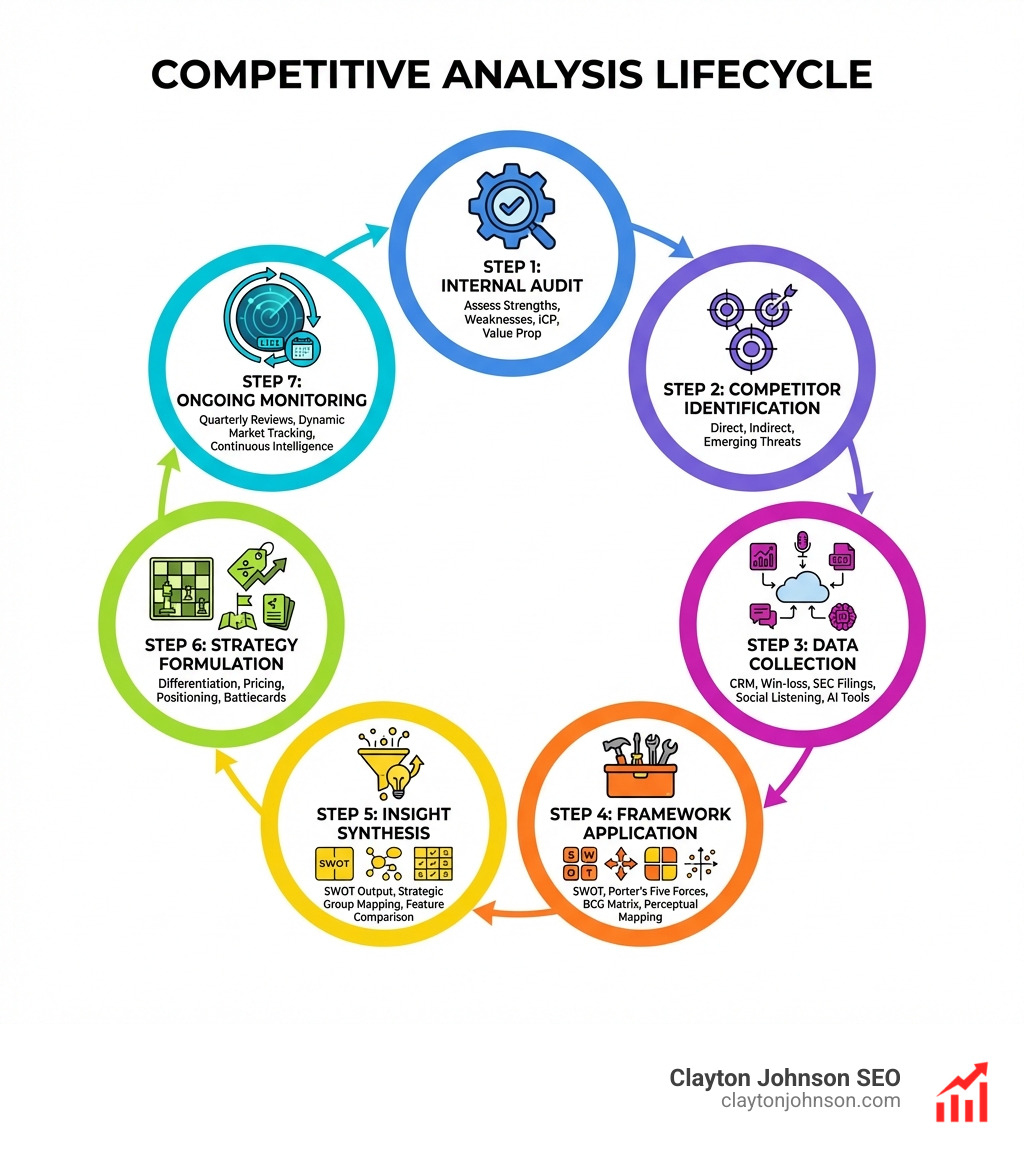
Conducting an analysis competitive positioning frameworks project shouldn’t be a one-off task that gathers dust. We follow a repeatable seven-step process to ensure the insights are actionable.
- Internal Company Assessment: Before looking outward, we must look inward. What are our core capabilities? Who is our Ideal Customer Profile (ICP)? What is our current “win rate” in sales?
- Identify and Categorize Competitors: We divide rivals into three buckets:
- Direct Rivals: They solve the same problem with a similar product (e.g., Coke vs. Pepsi).
- Indirect Competitors: They solve the same problem with a different product (e.g., Zoom vs. Business Class Flights).
- Emerging Threats: Startups or new technologies that could disrupt the category.
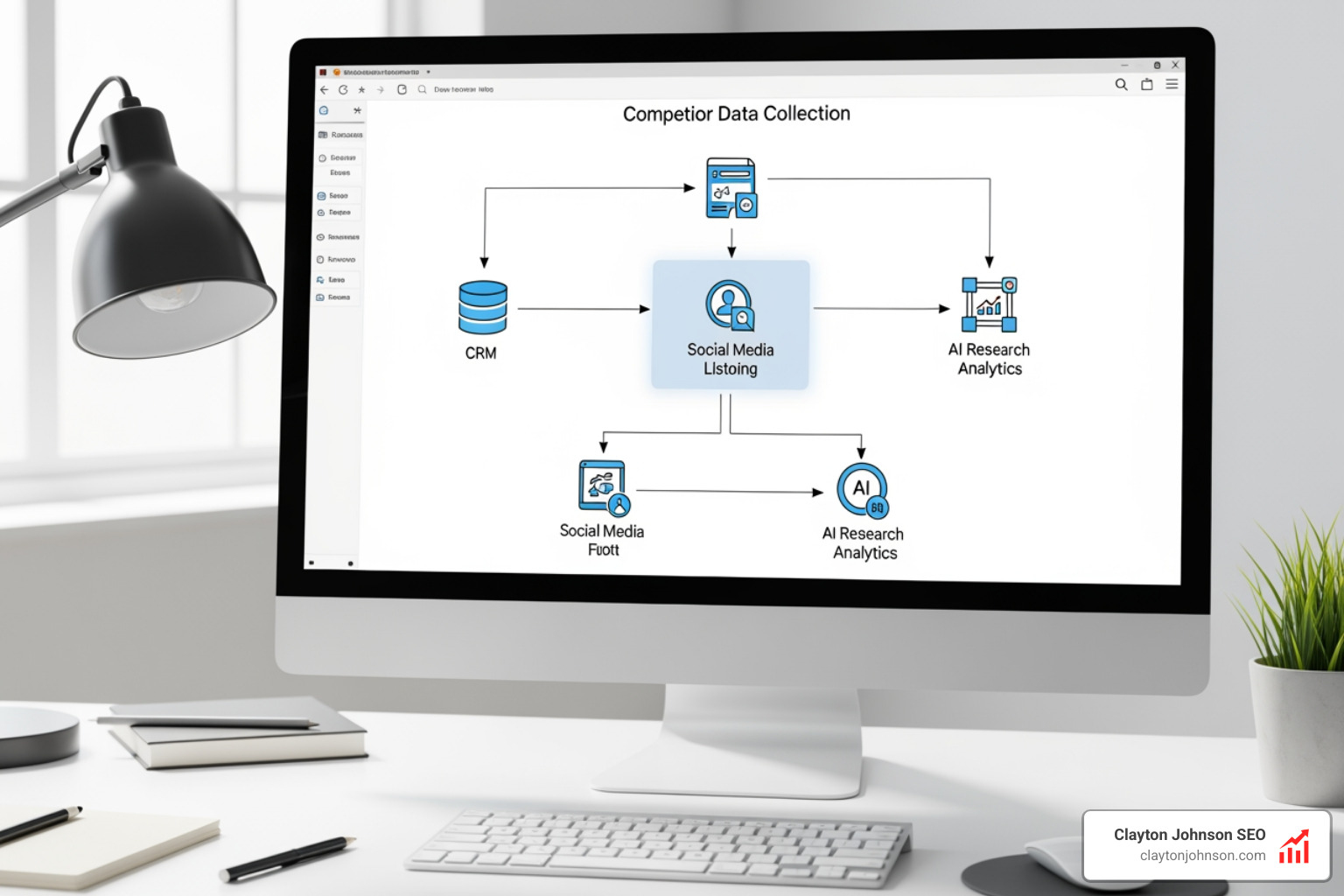
- Gather High-Quality Data: We go beyond Google searches. We analyze SEC filings for financial health, listen to sales call recordings, and conduct win-loss interviews. Churn analysis is particularly helpful—why are customers leaving us for a specific rival?
- Leverage Modern Tools: While traditional research is vital, about 33% of marketers now use AI for research. Tools like Perplexity can help synthesize large amounts of competitor news or review data from sites like G2 and Capterra quickly.
- Apply the Framework: This is where we plug the data into a SWOT, BCG Matrix, or Perceptual Map to see the patterns.
- Distill the “So What?”: Data is useless without a conclusion. If a competitor is winning 40% of mid-market deals because we lack a specific integration, the “so what” is that our product roadmap needs to prioritize that integration.
- Visualize and Distribute: We create “Battlecards” and visual matrices so the entire organization—from the CEO to the sales reps—knows the strategy.
Translating Competitive Insights into Actionable Growth Strategies
The ultimate goal of any analysis competitive positioning frameworks project is to define your strategic posture. Are you going to be Aggressive, Defensive, Conservative, or Competitive?
- Aggressive Posture: Used when you have a strong competitive advantage in a stable, attractive industry. You invest heavily to gain share.
- Defensive Posture: Used when you are in a high-risk industry with low competitive advantage. You focus on protecting your current base and increasing switching costs.
We use feature comparison tables to identify “market gaps.” If every competitor is focusing on “enterprise-grade security” but ignoring “ease of use for small teams,” that gap is your opportunity for differentiation. This is the heart of a Blue Ocean Strategy—finding a way to make the competition irrelevant by offering something they cannot or will not provide.
In the SaaS world, this often translates into sales enablement. We take the weaknesses identified in a rival’s SWOT and turn them into “landmines” our sales team can drop during calls. If we know a competitor has poor post-sale support, we emphasize our 24/7 dedicated success managers in our value proposition.
Common Pitfalls and Best Practices in Competitive Mapping
Even with the best frameworks, many companies stumble. The most common mistake is analysis paralysis—spending months gathering data and never actually making a decision. We recommend setting a hard deadline for the research phase.
Another trap is competitor tunnel vision. If you only watch your direct rivals, you might miss a “substitute” that makes your entire category obsolete. Think of how Netflix didn’t just compete with Blockbuster; it changed the way people consumed media entirely.
Best Practices for Success:
- The “So What?” Test: Every insight must lead to an action. If you find out a competitor raised $50M, ask “So what does this mean for our pricing or R&D?”
- Ethical Intelligence: Stay within legal and ethical boundaries. Use public data, customer interviews, and expert networks. Avoid anything that compromises integrity.
- Involve Multidisciplinary Teams: Don’t let competitive analysis stay in the marketing department. Involve sales, product, and customer success to get a 360-degree view.
- Update Cadence: A competitive analysis is a snapshot in time. In dynamic markets like SaaS or e-commerce, these should be reviewed quarterly.
Frequently Asked Questions about Competitive Positioning
How often should a competitive analysis be updated?
We recommend a quarterly rhythm for most businesses. However, if you are in a fast-moving industry like SaaS, monthly check-ins on key rivals are better. You should also trigger a refresh whenever a major competitor launches a new product, gets acquired, or changes their pricing significantly.
What is the difference between direct and indirect competitors?
Direct competitors offer a nearly identical solution to the same target audience (e.g., two local coffee shops). Indirect competitors solve the same underlying problem with a different product or service (e.g., a coffee shop vs. an energy drink brand). Both compete for the same “problem-solving” budget.
Can small startups effectively use these frameworks?
Absolutely. Startups actually need these frameworks more because they have fewer resources to waste. By using a niche focus and low-cost tools, a startup can find a specific weakness in a large incumbent and “chip away” at their market share with a superior, specialized offering.
Conclusion
At Clayton Johnson, we believe that most companies don’t lack tactics—they lack structured growth architecture. Analysis competitive positioning frameworks are a critical piece of that architecture. They provide the clarity needed to stop guessing and start growing with intent.
Our platform, Demandflow.ai, is built on this exact thesis. We combine actionable strategic frameworks with taxonomy-driven SEO and AI-augmented workflows to help founders and marketing leaders build systems that compound. Strategy is not a one-time event; it is a continuous process of assessing the field, benchmarking the rivals, and executing with precision.
Ready to move beyond reactive marketing and start building your growth system? Build your growth system today and turn your competitive landscape into your greatest strategic advantage.