SEO optimization for financial advisors is the process of improving your website so that high-intent prospects find you on Google — without paying for every click. Here’s what it covers at a glance:
| SEO Pillar | What It Does for Your Practice |
|---|---|
| Local SEO | Gets you found in “financial advisor near me” searches |
| Content SEO | Builds trust and authority with educational articles |
| Technical SEO | Makes your site fast, secure, and mobile-friendly |
| Off-Page SEO | Earns backlinks that signal credibility to Google |
Timeline: Most financial advisors see measurable gains in 3-6 months. Significant results typically take 12+ months — but they compound over time like a well-managed portfolio.
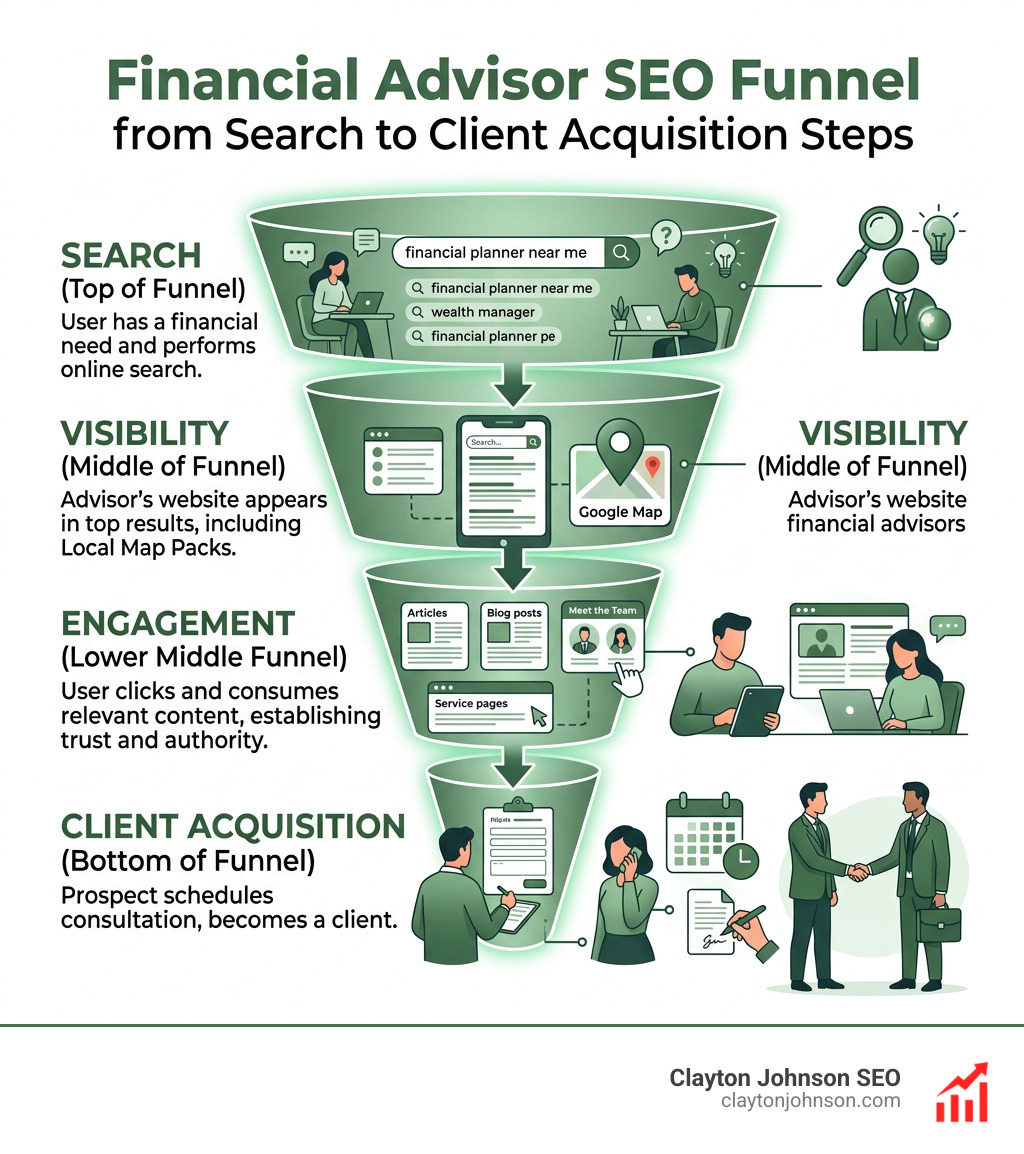
Picture this: a high-net-worth executive opens Google and types “retirement planner near me.” They’re ready to hire. The question is whether your firm shows up — or your competitor’s does.
The numbers make this hard to ignore. 96% of prospects research financial advisors online before making contact. The keyword “financial advisor” alone pulls roughly 131,000 searches every month. Each major city generates between 3,000 and 5,000 monthly searches for financial service professionals.
Yet most advisors still rely primarily on referrals. That’s not a bad strategy — but it’s an incomplete one. The advisors winning new clients in 2026 are showing up where prospects are already looking.
That’s exactly what SEO does. It turns your website into a 24/7 lead generation engine — one that attracts qualified prospects, builds trust before the first conversation, and keeps working long after you’ve logged off for the day.
This guide breaks down every piece of the puzzle: from keyword research and local visibility to content strategy, technical fundamentals, and compliance. Whether you’re starting from scratch or looking to sharpen an existing strategy, you’ll leave with a clear, actionable playbook.
In the early days of digital marketing, having a website was enough. Today, your website is your digital storefront, and if it’s on page ten of Google, it might as well not exist. SEO optimization financial advisors utilize today is the key to moving from invisible to in-demand.
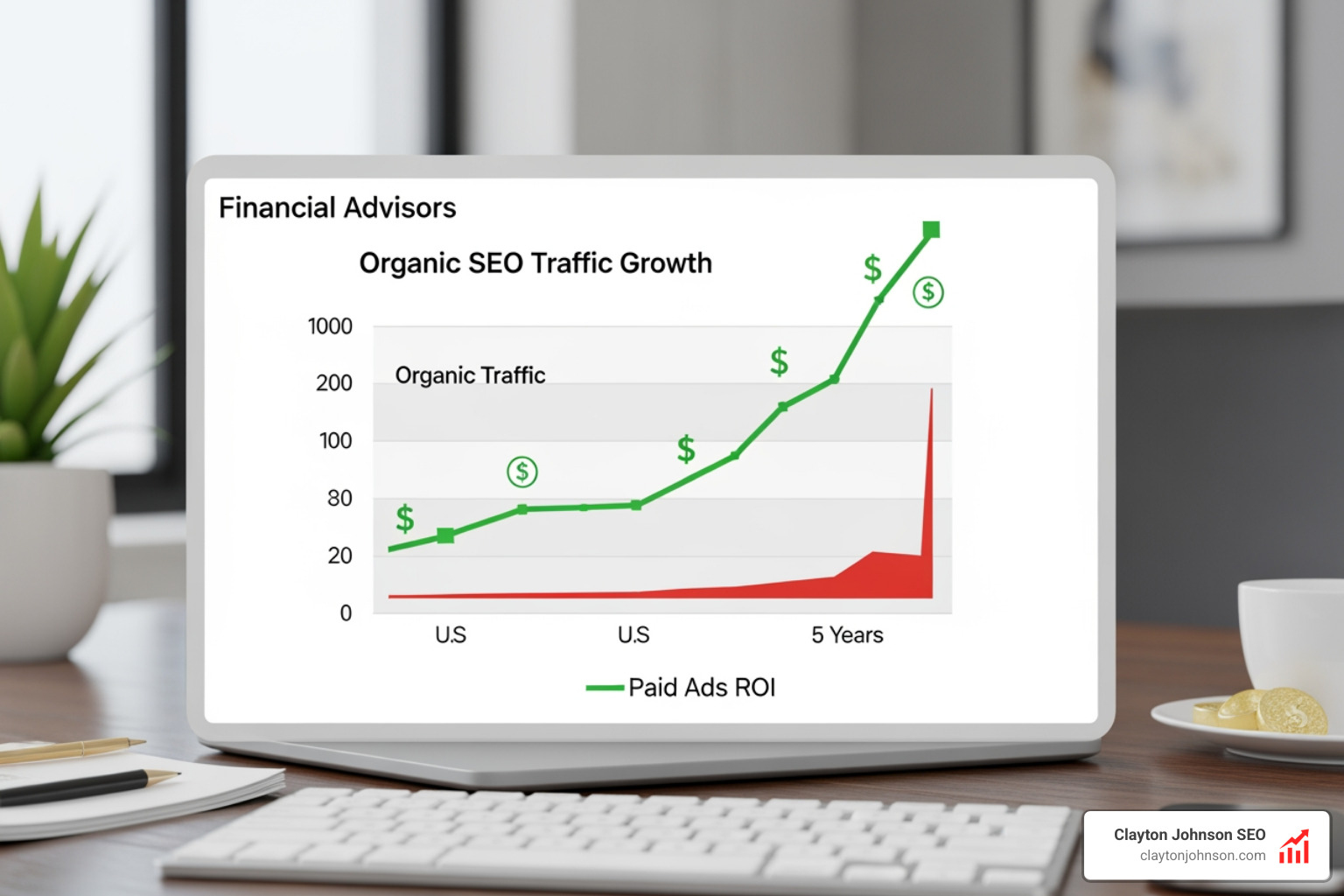
Unlike the stock market, where past performance doesn’t guarantee future results, SEO is a compounding asset. Research shows that while it can take 3 to 6 months to see measurable gains, the long-term ROI is staggering. One firm reported adding $40-$50M in AUM annually through organic traffic, achieving a 9000% marketing ROI over five years.
Furthermore, Google’s ever-elusive algorithm has evolved. It no longer rewards keyword stuffing; it rewards helpfulness. In 2026, staying ahead means understanding AI SEO and how search engines summarize your expertise for users. For those just starting, our beginners-guide-to-wealth-manager-seo offers a foundational look at this shift.
How SEO Differs from Paid Advertising (SEM)
We often get asked: “Why not just buy ads?” Search Engine Marketing (SEM) is like renting a house—you have a place to stay as long as you pay the landlord. SEO is like owning the home.
Paid ads offer immediate visibility, but the moment you stop paying, the traffic disappears. More importantly, high-net-worth individuals often skip the “Sponsored” results. They trust organic results more because those rankings are earned through authority, not bought with a credit card. SEO builds long-term equity and sustainable lead flow that doesn’t vanish when your monthly budget runs out.
The Impact of AI Search and Voice Search
The rise of AI search is the biggest shift we’ve seen in a decade. With ChatGPT reaching 800 million weekly users in 2025, people are no longer just typing keywords; they are asking complex questions.
AI Overviews now summarize the best content on the web. To show up here, your site must use structured data and answer conversational queries like, “How do I minimize taxes on a $5M inheritance?” Instead of fighting AI, we optimize for it by ensuring your content is the most authoritative answer available.
The Four Pillars of Financial Practice SEO
To dominate the search results, we focus on a holistic strategy. It’s not just about one blog post or a fast site; it’s about how these four pillars work together to drive AUM growth. You can explore our specific wealth manager services to see how we apply this framework.
Local SEO: Dominating Your City
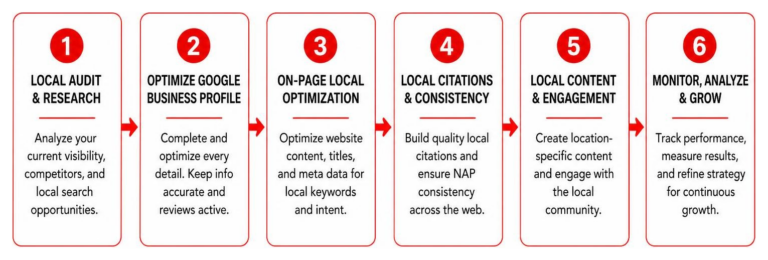
Most financial advice is still local. When a prospect searches for an advisor in Minneapolis or Austin, Google presents the “Local 3-Pack”—the map results at the top.
To win here, your Google Business Profile must be flawless. This means having consistent NAP (Name, Address, Phone) data across the web. We also recommend getting listed in top-tier directories like NAPFA. Local citations are the fifth most important ranking factor for local queries, acting as “digital referrals” that prove to Google you are a legitimate, local business.
Content SEO: Building E-E-A-T and YMYL Authority
In Google’s eyes, financial advice falls under “Your Money or Your Life” (YMYL). Because your advice impacts a person’s financial well-being, Google holds your site to a higher standard.
This is where Google’s E-E-A-T guidelines (Experience, Expertise, Authoritativeness, Trustworthiness) come in. We help you create content that doesn’t just “rank” but converts. This involves showcasing your CFP® or CFA credentials, citing sources like the IRS or SEC, and writing in-depth guides that solve real client problems.
Technical SEO: Speed, Security, and Mobile-First
If your website takes longer than three seconds to load, over half of your visitors will leave. After five seconds, bounce rates can soar to 90%.
Google uses Core Web Vitals to measure user experience. We use tools like PageSpeed Insights to ensure your site is lightning-fast. With over 62% of traffic coming from mobile devices, a mobile-responsive, secure (HTTPS) site is no longer optional—it’s the baseline for ranking.
Off-Page SEO: High-Quality Backlinks and Referrals
Off-page SEO is everything that happens away from your website to build your reputation. The most important factor? Backlinks. A backlink is a vote of confidence from another site.
We focus on earning links from reputable financial publications, local chambers of commerce, and industry associations. Tactics like HARO (Help A Reporter Out) outreach or appearing on podcasts can earn you high-authority links. Even social signals matter; Instagram now indexes post content, meaning your captions can actually help your Google visibility.
Mastering Keyword Research for High-Intent Prospects
Keyword research is the diagnostic tool of SEO. It tells us exactly what your ideal clients are worried about. For a deeper dive, check out our ultimate-guide-to-keyword-strategy.
| Keyword Type | Example | Search Volume | Intent |
|---|---|---|---|
| Short-Tail | Financial Advisor | Very High | Researching/Broad |
| Long-Tail | Tax-efficient investing for retirees in Chicago | Low | High-Intent/Ready to Hire |
| Question-Based | How much do I need to retire at 55? | Medium | Educational/Problem-Solving |
Finding Profitable SEO Optimization Financial Advisors Keywords
The “gold” is often in the long-tail keywords. While everyone fights for “financial advisor,” you can win by targeting “fiduciary wealth management for tech executives.” These phrases have lower competition and much higher conversion rates because they match a specific need.
Tools for Financial Keyword Discovery
We use professional-grade tools like Semrush and Ahrefs to find “content gaps”—topics your competitors are ignoring. Google Keyword Planner is also a great free starting point to see what people are actually typing into the search bar.
Navigating Compliance and Technical Excellence
We know that for financial advisors, marketing isn’t just about creativity—it’s about staying within the lines. SEO optimization financial advisors require must be compliant with the SEC’s Marketing Rule for Investment Advisers-1).
To keep your site safe:
- Avoid Promissory Language: Never guarantee specific returns.
- Include Disclosures: Ensure every blog post has the necessary legal footers.
- Verify Testimonials: If you use reviews, ensure they meet the latest SEC guidelines.
- Audit Regularly: Keep a record of all site changes for compliance reviews.
For those new to the technical side, our seo-101 guide can help you understand the basics of safe optimization.
Common SEO Mistakes to Avoid
Many advisors fail because they try to “game” the system. Keyword stuffing—cramming your city name into every paragraph—will get you penalized. Similarly, duplicate content (using the same “market update” text as 500 other advisors) tells Google your site provides no unique value.
User Experience (UX) and Site Structure
Your site structure should be intuitive. If a prospect can’t find your “Contact” page within two seconds, you’ve lost them. We recommend using internal linking to guide users from a blog post about “Estate Planning” directly to your “Service” page. Adding interactive tools like a loan consolidation calculator can also keep users on your site longer, which signals to Google that your content is valuable.
Measuring Success and Scaling Your Practice
You can’t manage what you don’t measure. We use Google Search Console to track which keywords are bringing people to your site and Google Analytics to see what they do once they arrive.
Advanced SEO Optimization Financial Advisors Metrics
We look beyond simple “traffic.” We track:
- Organic Sessions: Are you attracting the right people?
- Conversion Rate: How many visitors are booking a discovery call?
- Keyword Rankings: Are you moving up for your “money” terms?
- Domain Authority: Is your site becoming more “trustworthy” in Google’s eyes?
Partnering with Specialized SEO Experts
Let’s be honest: 85% of advisors struggle to find time for marketing. You didn’t spend years mastering wealth management to spend your weekends fixing broken meta tags.
Partnering with a specialist allows you to focus on your clients while we focus on the algorithm. Specialized SEO provides a strategic advantage because we understand the nuances of the financial industry—from compliance to the specific search behavior of high-net-worth individuals.
Frequently Asked Questions about Financial SEO
How long does it take to see results from SEO?
SEO is a marathon, not a sprint. You’ll typically see movement in 3-6 months. By the 12-month mark, you should see significant, compounding gains in organic leads. Think of it as the “Rule of 72” for your marketing; the growth starts slow but accelerates rapidly.
Is local SEO important if I work with clients nationally?
Yes! Even if you serve clients across the country, Google prioritizes local authority. Ranking well in your home city builds the overall “trust” of your domain, making it easier to rank for national terms later. Most national firms started by dominating their local backyard first.
How do I handle compliance with SEO content?
We work closely with your compliance department. Every piece of content should be reviewed, and we use “archiving” tools to ensure you have an audit trail of everything published. SEO and compliance can coexist perfectly when you prioritize education over “salesy” claims.
Conclusion
The digital landscape for wealth managers is more competitive than ever, but it’s also filled with more opportunity. By implementing a dedicated strategy for seo optimization financial advisors, you can stop chasing leads and start attracting them.
At Clayton Johnson SEO, we specialize in helping wealth management firms grow their AUM through data-driven, compliant search strategies. Don’t let your expertise remain the best-kept secret in your city.
CLICK HERE: To Schedule Your SEO Consultation and let’s discuss how we can take your firm from invisible to in-demand.