Why Your Brand Needs an AI Growth Strategy Right Now

Why Brand Growth AI Is No Longer Optional
Brand growth AI is the strategic application of artificial intelligence to accelerate brand recognition, consistency, and revenue through automation, personalization, and predictive analytics. Here’s what you need to know:
What Brand Growth AI Delivers:
- 60% greater revenue growth for leaders who deeply integrate AI into marketing workflows
- 4x to 5x conversion rates from AI citations compared to traditional search
- Real-time personalization at scale—71% of consumers expect it, 96% are more likely to buy when they receive it
- Predictive brand measurement through metrics like First-Fast Response (FFR), which is 2.6x more responsive and 4x more predictive of sales than traditional awareness metrics
- Automated content systems producing 3x more content while maintaining brand consistency
The Four Maturity Stages:
- Essentials – Basic AI tools for copywriting and automation
- Scaling – Integrated data and cross-channel AI activation
- Leading – Real-time segmentation and dynamic budget allocation
- Changing – Full AI flywheel across media, creative, and measurement
If you’re building a company today, you’re entering a world where AI is reshaping brands faster than most companies can update their websites. The gap between AI leaders and laggards is becoming unbridgeable—and the stakes have never been higher.
AI commoditizes products and features. Your brand is the only thing AI cannot copy.
But here’s the problem: 80% of brands are still just exploring or experimenting with AI, while the top 20% who’ve integrated it deeply are adapting to consumer trends twice as fast and capturing disproportionate growth. Three out of four marketers now believe that cutting brand spending causes more damage than it did five years ago—and cutting $1 of brand investment today costs $1.92 in future spending to regain lost market share.
The attention economy is collapsing. Consumers check email 70+ times per day, switch tasks every 47 seconds, and see 5x as many vendor options as they did in 2020. In this environment, brands must become machine-readable and algorithmically recognizable to show up when someone asks their AI assistant for a solution like yours.
Strong brands don’t just perform better—they create unfair advantages. Recruiting costs drop 50%, sales cycles shrink 23%, and customer acquisition costs fall by 50-60%. Valuations jump 20-30% when acquirers recognize brand equity. And consistent brands get an algorithmic boost with 3x better organic reach.
I’m Clayton Johnson, an SEO and growth strategist who helps founders build scalable traffic systems and AI-augmented marketing workflows. Through my work with Brand growth AI frameworks and structured content ecosystems, I’ve seen how companies that treat brand as a strategic investment—not a cost center—compound their growth while others plateau. This guide will show you how.
Defining Brand Growth AI and the Maturity Path to Excellence
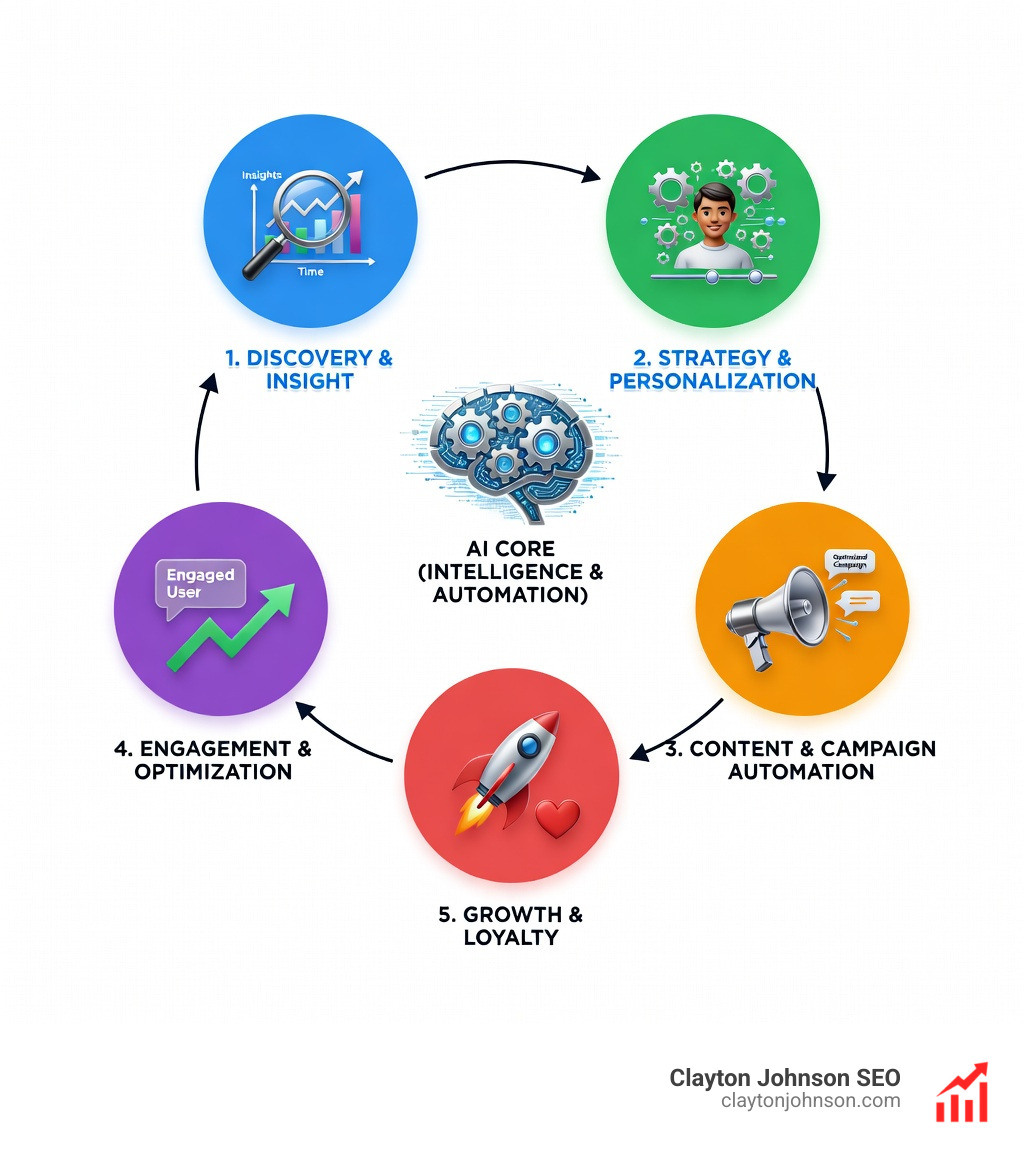
To understand Brand growth AI, we have to stop looking at AI as just a better way to write emails. It is a fundamental shift in how brands interact with the world. According to research from BCG and Google, the top 20% of AI marketing leaders are achieving 60% greater revenue growth because they’ve moved past the “experimentation” phase into deep integration.
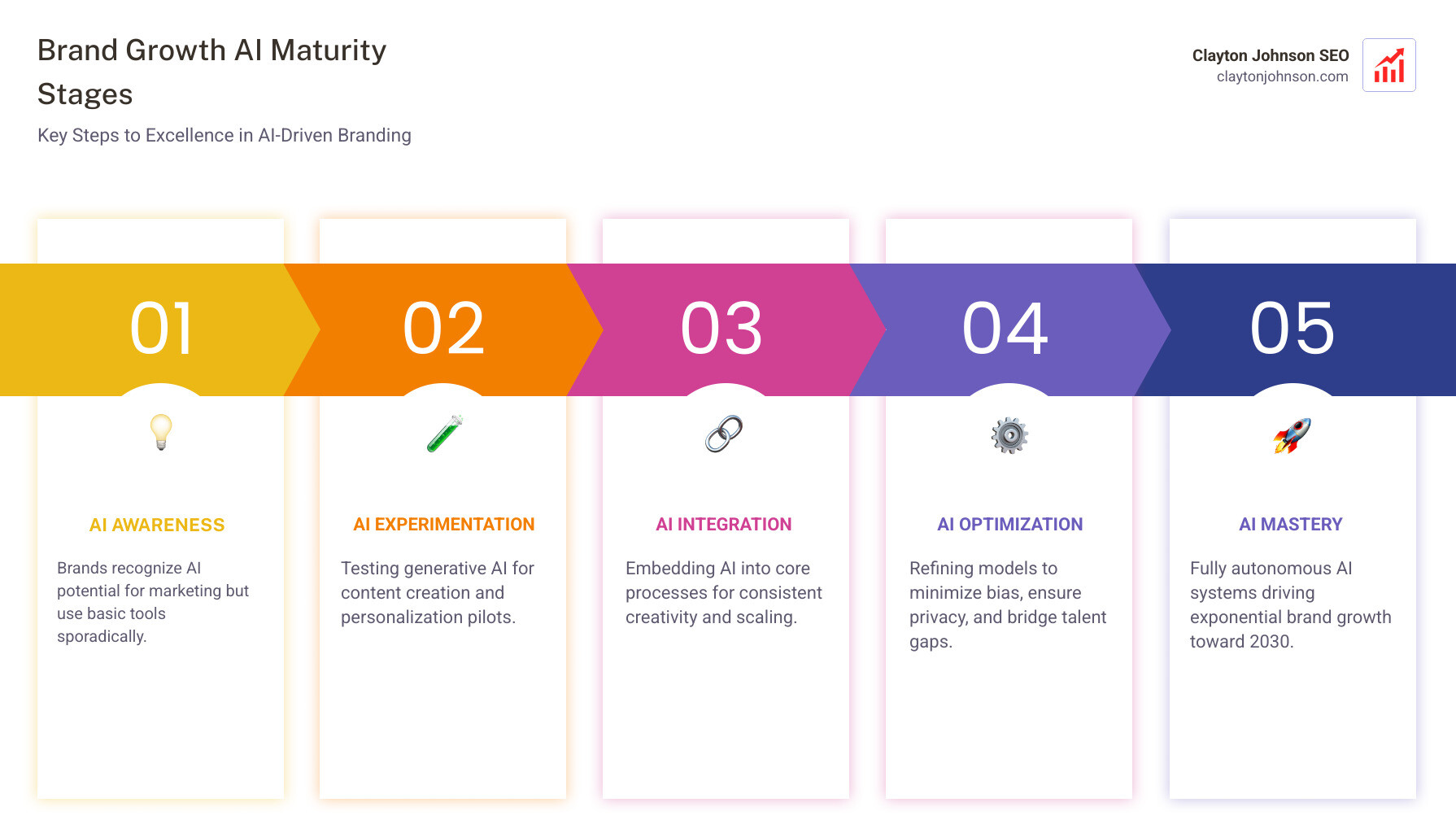
The journey to AI excellence isn’t a single jump; it’s a four-stage maturity path:
- Essentials: You’re using GenAI for basic copywriting or image generation. You’re saving time, but your data is still siloed.
- Scaling: You’re starting to layer AI into core workflows. You might be using it for predictive lead scoring or basic audience segmentation.
- Leading: You have a unified customer view. You can shift budgets dynamically across channels and use AI for real-time creative optimization.
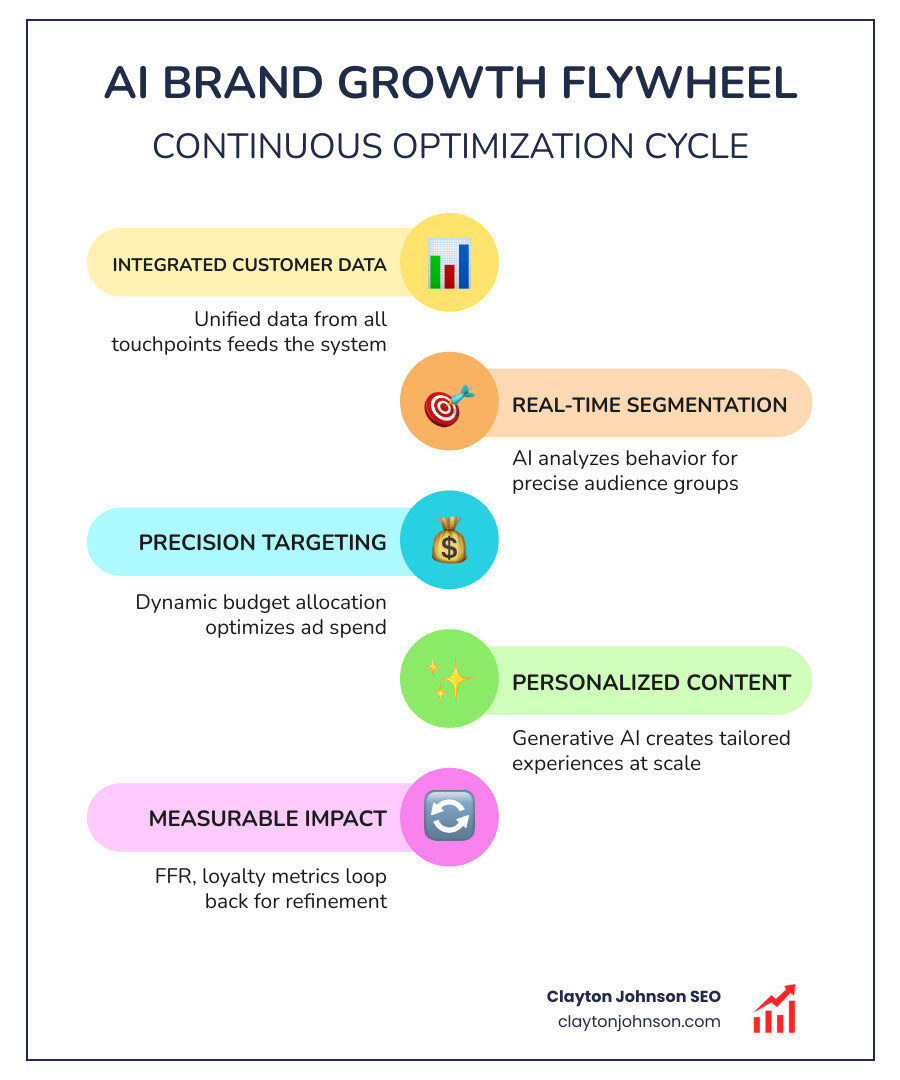
- Changing: This is the “flywheel” state. Your media planning, creative production, activation, and measurement are all connected by a single AI intelligence layer.
according to McKinsey, 71% of consumers now expect companies to deliver personalized interactions, and 75% get frustrated when it doesn’t happen. If you want to see where your brand currently sits on this spectrum, you should Analyze your current market position to identify the gaps in your digital presence.
The Six Actions of Top-Performing AI Marketing Leaders
What separates the leaders from the laggards? It comes down to six specific strategic actions:
- Integrated Customer View: Building a “golden record” of the customer using first-party data so the AI actually knows who it’s talking to.
- Test Acceleration: Using AI to design, execute, and analyze hundreds of market tests in the time it used to take to run one.
- Dynamic Budgeting: Shifting spend in real-time based on AI predictions of where the next dollar will work hardest.
- Real-Time Segmentation: Moving away from static “personas” to fluid, behavioral segments that update as the consumer moves.
- Full Creative Lifecycle: Using GenAI not just for the first draft, but for versioning, localization, and performance analysis.
- Cross-Functional Culture: Breaking down the walls between marketing, data, and IT to build a “squad model” for AI adoption.
To master these, you need a deep understanding of market industry and competitive analysis to know exactly where your competitors are vulnerable.
Measuring Impact with First-Fast Response (FFR)
Traditional metrics like “unaided awareness” are becoming obsolete. They are lagging indicators that don’t tell you if your brand is actually winning the moment of choice. Enter First-Fast Response (FFR).
FFR measures the immediate cognitive association between a brand and a specific consumer need. Research shows FFR is 2.6 times more responsive to marketing changes and 4 times more predictive of sales than traditional awareness metrics. By focusing on FFR, we can treat brand equity as a compounding asset rather than a vague feeling. If you aren’t sure how your brand is being perceived by these new algorithmic filters, it’s time to Diagnose your brand health using modern data tools.
Scaling Creativity and Consistency with Generative AI
One of the biggest fears in the era of Brand growth AI is that automation will dilute the brand’s soul. However, leading brands like Nike are proving the opposite. Nike collaborated with AI artists to redesign the iconic Air Max, using generative models trained on their own classic designs. The result? A limited-edition release that sold out in under 10 days because it was both innovative and unmistakably “Nike.”
Leah Lanza, Chief Production Officer at ThePub, argues that AI should be a “growth partner” in advertising production. By using “sandboxed” environments, brands can experiment with AI without risking their intellectual property or brand safety. Platforms like Jasper AI and Blaze.ai are making this possible at scale.
For those looking to master these tools, you can Learn more about Jasper Foundations to understand how to build these automated guardrails.
Leveraging Generative AI for Brand Growth AI and Content Velocity
The numbers behind AI-driven content are staggering. We’ve seen teams:
- Achieve 3x content production speeds.
- Generate 7,500 on-brand product descriptions in just 24 hours.
- Automate up to 60% of their SEO processes.
This isn’t just about volume; it’s about velocity. When you can produce localized, compliant content in minutes instead of weeks, you can react to market trends while your competitors are still in a status meeting. This is especially critical for local businesses in competitive markets. Our SEO Services Minneapolis team uses these AI-assisted workflows to ensure our clients aren’t just creating content, but dominating search results with precision.
Protecting Brand Voice in an Automated World
The real risk isn’t using AI—it’s using it without judgment. As strategist Jason Dojc wrote recently, the ability to critically evaluate AI’s output is the “red thread” of modern marketing.
To protect your brand voice, you must:
- Codify your style guides: Feed your brand’s specific vocabulary, tone, and “banned phrases” into the AI’s context hub (like Jasper IQ).
- Maintain human oversight: AI generates the options; humans provide the “taste” and final vetting.
- Ensure Governance: Use enterprise-grade tools with robust Security and Governance at Jasper to ensure your data isn’t being used to train public models.
Overcoming Challenges: Privacy, Bias, and the Talent Gap
The road to Brand growth AI isn’t without potholes. Data privacy remains a top concern, especially with global regulations tightening. Furthermore, algorithmic bias can lead to “tone-deaf” marketing if the training data isn’t diverse and representative.
The biggest hurdle, however, is the talent gap. Your job won’t be taken by AI, but it might be taken by a person who knows how to use AI. Upskilling your team to move from “tactical execution” to “strategic orchestration” is the most important investment a CMO can make today.
| Feature | Human-Led Workflow | AI-Augmented Workflow |
|---|---|---|
| Content Creation | 4-8 hours per article | 30-60 minutes (with editing) |
| Data Analysis | Manual spreadsheets (Days) | Real-time dashboards (Seconds) |
| Personalization | Broad segments | Hyper-individualized |
| Testing | 1-2 variants | Hundreds of variants |
| Optimization | Reactive / Monthly | Proactive / Real-time |
Building a Cross-Functional AI Culture
To scale, you have to break the silos. Marketing can’t do this alone. You need “squad models” where creative, data, and engineering work together. A strong brand becomes a “talent magnet” in the AI era, attracting elite professionals who want to work with cutting-edge systems. This starts with a clear customer strategy that aligns every department around the user’s needs.
Future-Proofing Your Brand: Trends Toward 2030
By 2030, the way we think about brands will be unrecognizable. We are moving toward:
- AI-Native Personas: Brands will have “digital consciousness”—AI agents that can converse with millions of customers simultaneously while staying perfectly on-brand.
- Ambient Brands: Branding that lives in the background of our lives, reacting to our needs before we even voice them (neuro-responsive experiences).
- AI Citations as the New SEO: As people move from Google Search to AI assistants (ChatGPT, Claude, Perplexity), being the “cited source” is the new goal. These citations already convert at 4x to 5x the rate of regular search.
Implementing a 90-Day Playbook for Brand Growth AI
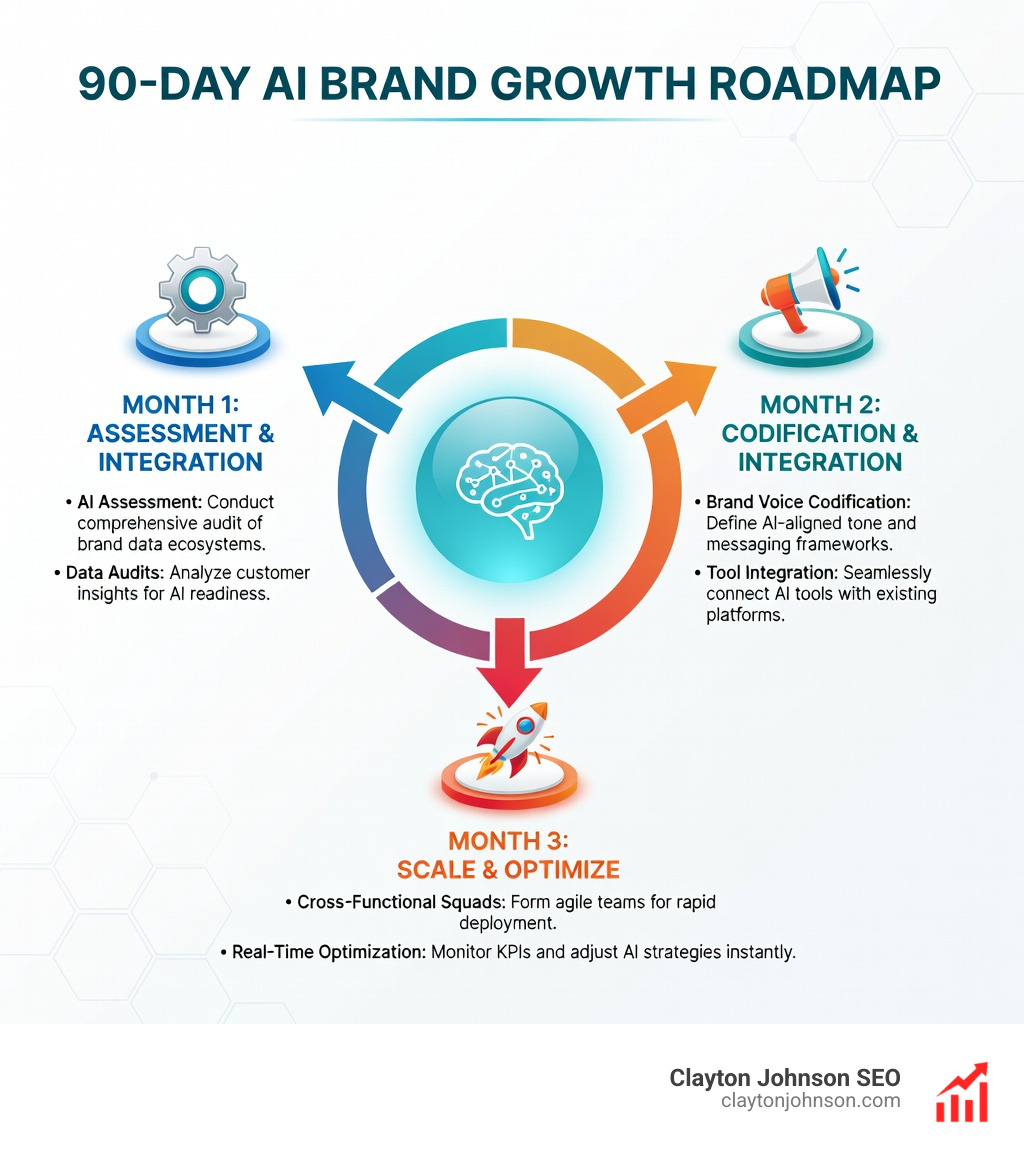
Don’t wait for 2030 to start. You can open up growth in the next three months with a simple 90-day playbook:
- Month 1: Foundation Repair. Conduct an AI excellence assessment. Audit your brand for tone consistency. Update your buyer personas with behavioral AI data.
- Month 2: Consistency. Codify your brand voice into an AI platform. Implement the “3-3-3” framework (3 core messages, 3 audiences, 3 channels).
- Month 3: Acceleration. Launch your first cross-functional AI task force. Set 2-3 quarterly goals for AI-driven testing.
Frequently Asked Questions about AI Branding
How does AI reduce Customer Acquisition Cost (CAC)?
AI reduces CAC by eliminating waste. Through predictive analytics and precision targeting, you stop spending money on audiences that won’t convert. Strong brands using AI see CAC drops of 50-60% because the AI identifies “look-alike” audiences that are 25% cheaper to acquire.
Can AI maintain a consistent brand voice?
Yes, but only if you use tools like Jasper IQ or Blaze.ai that allow you to upload your specific Brand Voice and Style Guides. Without these guardrails, AI will default to a generic “average” tone. When properly trained, AI can actually increase consistency by ensuring every social post and product description follows your exact rules.
What are the first steps for a CMO to adopt AI?
Start with an AI excellence assessment to see where you are on the maturity path. Then, launch a cross-functional task force and set 2-3 small, measurable quarterly goals—like “automate 50% of social media versioning” or “reduce test market analysis time by 70%.”
Conclusion
The “growth open up” is no longer a secret—it’s a system. Brand growth AI allows us to combine human taste and judgment with machine speed and power. When attention is the scarcest resource, the brands that win will be those that are both humanly authentic and algorithmically optimized.
At Clayton Johnson, we specialize in building these content systems and SEO strategies that turn brand equity into measurable revenue. Whether you are a founder in Minneapolis or a marketing leader looking to scale globally, the time to build your AI flywheel is now.
Ready to dominate your market? Unlock your brand growth with SEO Services Minneapolis and let’s build your 90-day playbook together.