Why Your Product Expansion Needs an Ansoff Intervention

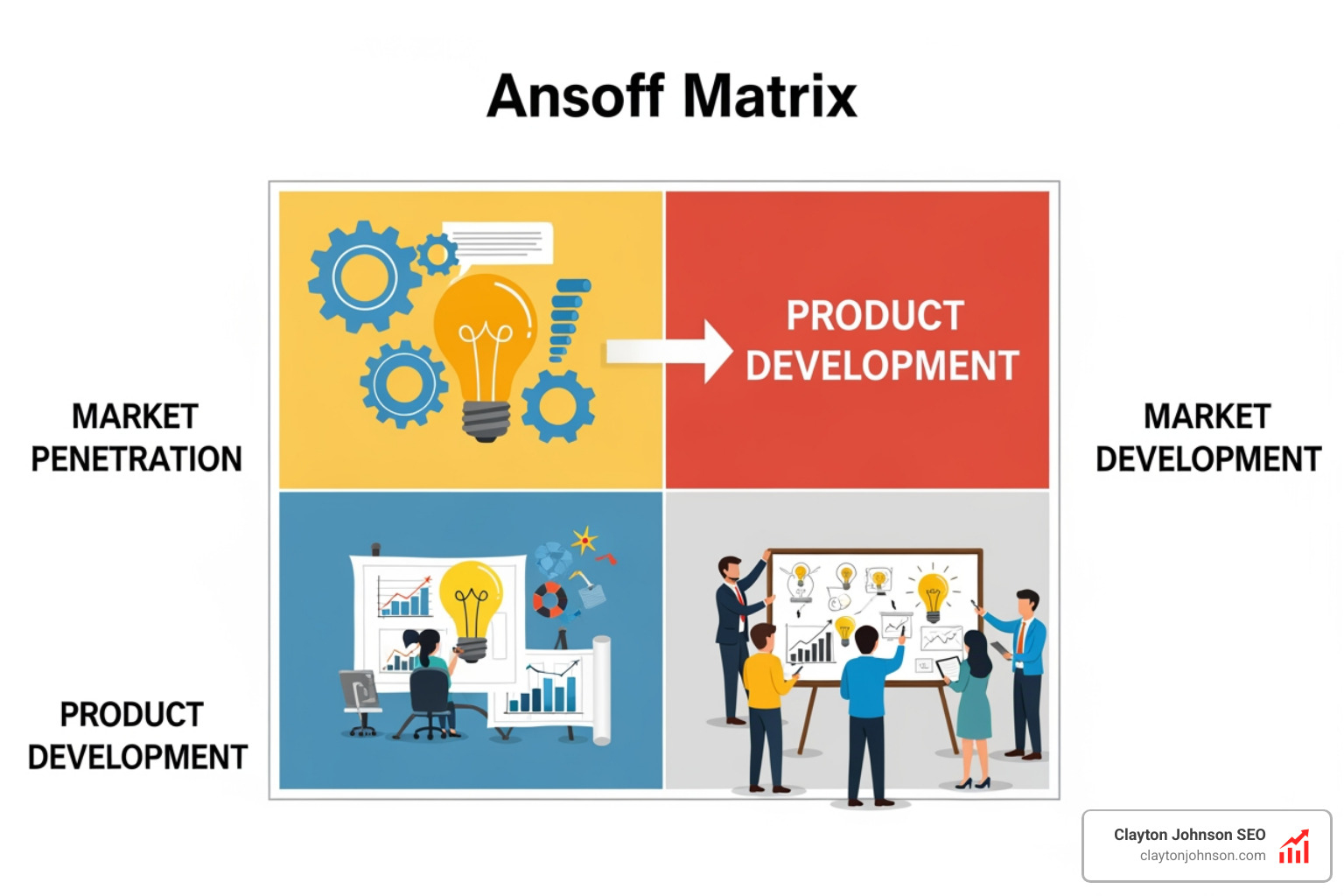
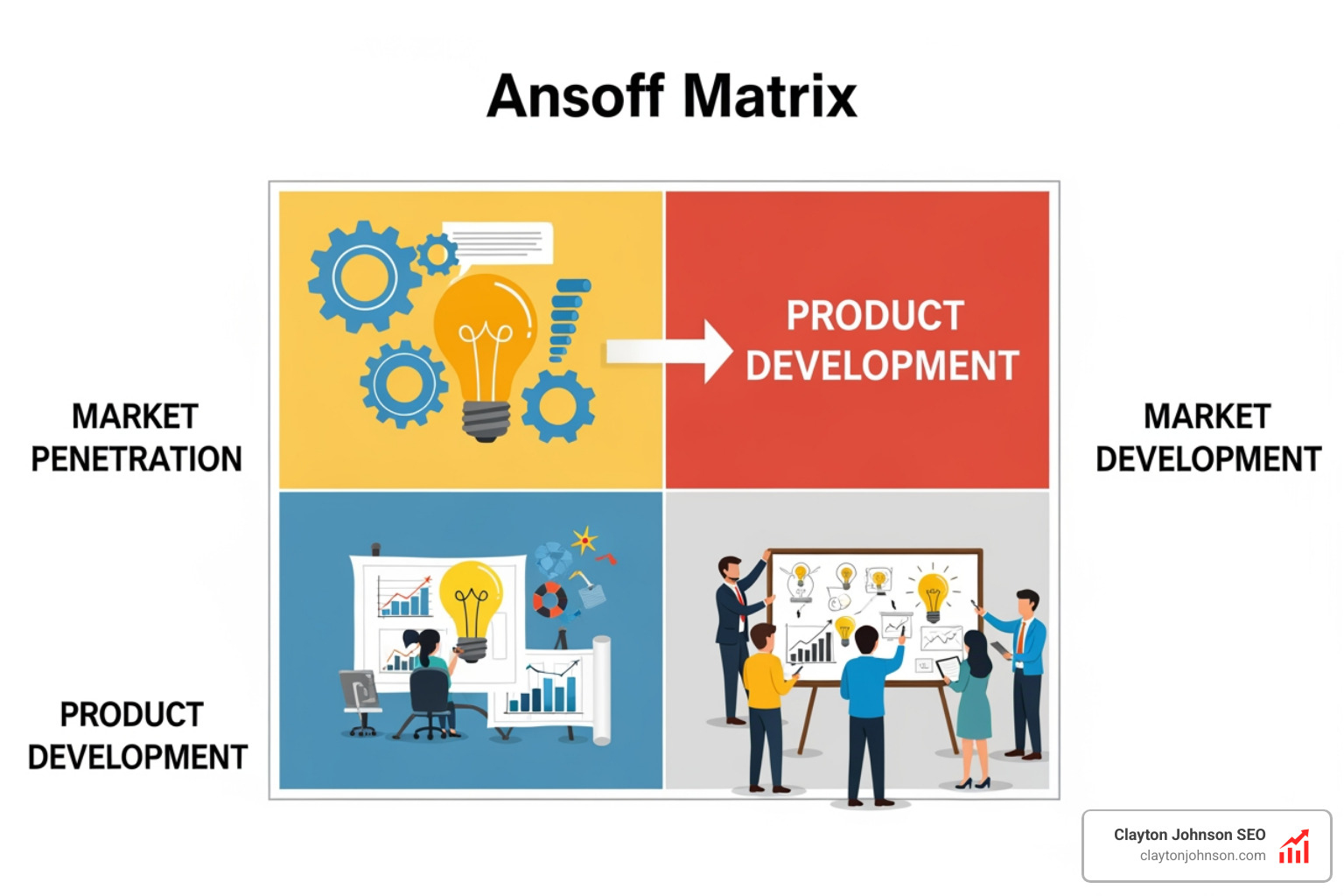
Ansoff matrix product development is a strategic growth approach where companies create new or improved products for their existing customer base. Here’s what makes it distinct:
- Definition: Developing new products or services while staying within your current market
- Risk Level: Medium-high (40-50% failure rate, but 2-3x higher success when targeting existing markets)
- Primary Advantage: Leverages established customer relationships, brand reputation, and market knowledge
- Expected Impact: 20-30% revenue growth potential, with new products contributing 30-40% of total revenue
- Key Difference: Unlike diversification (new products + new markets), product development keeps one variable constant—your market
Few businesses that stick to their traditional products and markets manage to grow long-term. The data tells a stark story: America’s most valued companies in Forbes’s top ten were completely different in 1917, 1967, and 2017.
The Ansoff Matrix, introduced by Igor Ansoff in his 1957 Harvard Business Review paper “Strategies for Diversification,” remains one of the most practical frameworks for evaluating growth options. The product development quadrant specifically addresses how to innovate within your comfort zone—serving customers you already understand with offerings you’re still figuring out.
The tension is real: Product development offers 15-25% higher ROI compared to diversification due to lower market entry risks, yet still carries substantial execution challenges. You’re not starting from scratch, but you’re not playing it safe either.
I’m Clayton Johnson, and I’ve spent years helping companies build structured growth systems that connect strategic frameworks like the Ansoff matrix product development quadrant to actual execution. This guide breaks down when, why, and how to use product development as your primary growth lever—backed by real data, not consultant speak.
Decoding the Ansoff Matrix Product Development Quadrant
To understand how to grow, we first have to look back at the man who started it all. Igor Ansoff, a Russian-American mathematician and business manager, changed the way we think about strategy when he published Strategies for Diversification in the 1957 Harvard Business Review. He realized that a company’s growth isn’t just about “selling more stuff”; it’s about the relationship between products and markets.
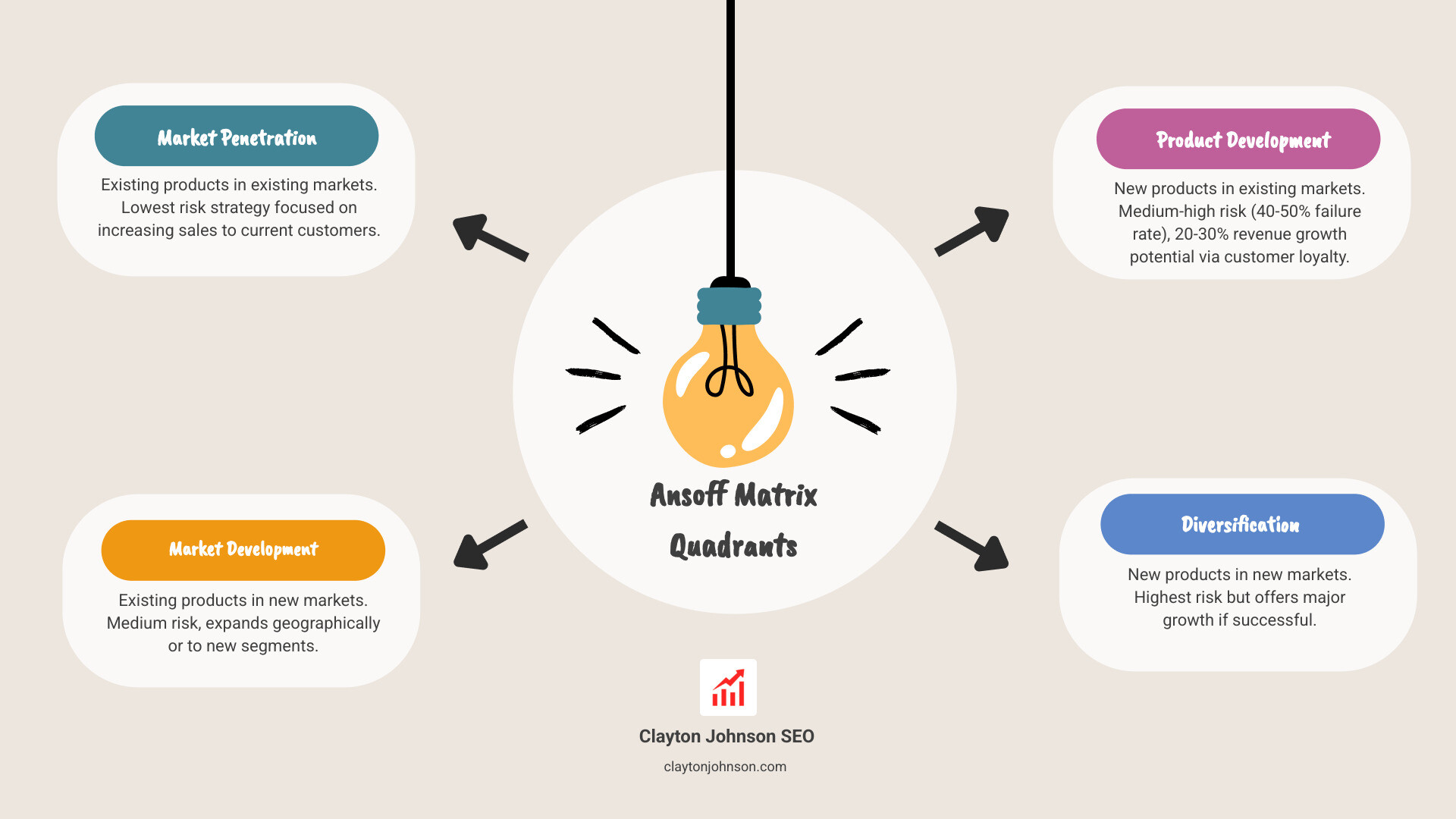
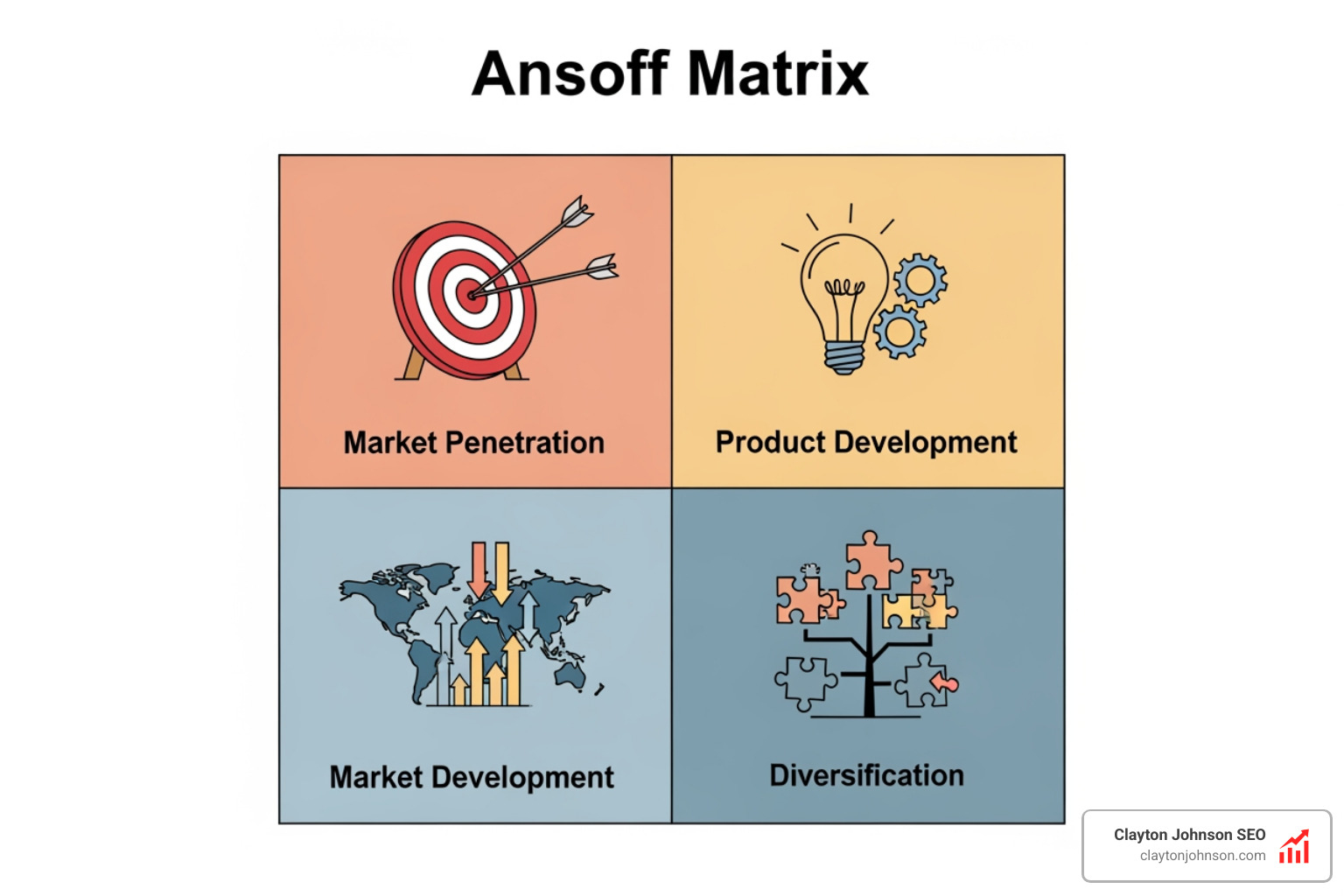
The Ansoff matrix (directional matrix) is a 2×2 framework that plots “Products” on one axis and “Markets” on the other. Within this grid, the Product Development quadrant sits at the intersection of New Products and Existing Markets.
This means your mission remains the same—serving the same people—but you are innovating your product line to improve your mission performance. You aren’t chasing strangers in new countries; you’re asking your current fans, “What else can I do for you?”
Defining the Product Development Growth Strategy
In simple terms, this strategy is about offering new or improved products to current customers to increase market share and loyalty. This isn’t just a minor tweak; it often involves significant innovation, R&D, and design.
By focusing on ansoff matrix product development, we leverage our existing brand reputation and customer loyalty. If people already trust us for one thing, they are much more likely to buy the “next big thing” from us. This strategy often requires a heavy investment in technology and a deep understanding of innovation frameworks to ensure the new offering actually solves a problem for our audience.
Risk and Focus: Product Development vs. Other Strategies
When we look at the The Ansoff Matrix: A Powerful Tool for Business Strategy and Growth, we see that not all growth is created equal. Product development is often considered “medium-high risk.” Why? Because while you know the market, you are building something that has never existed before.
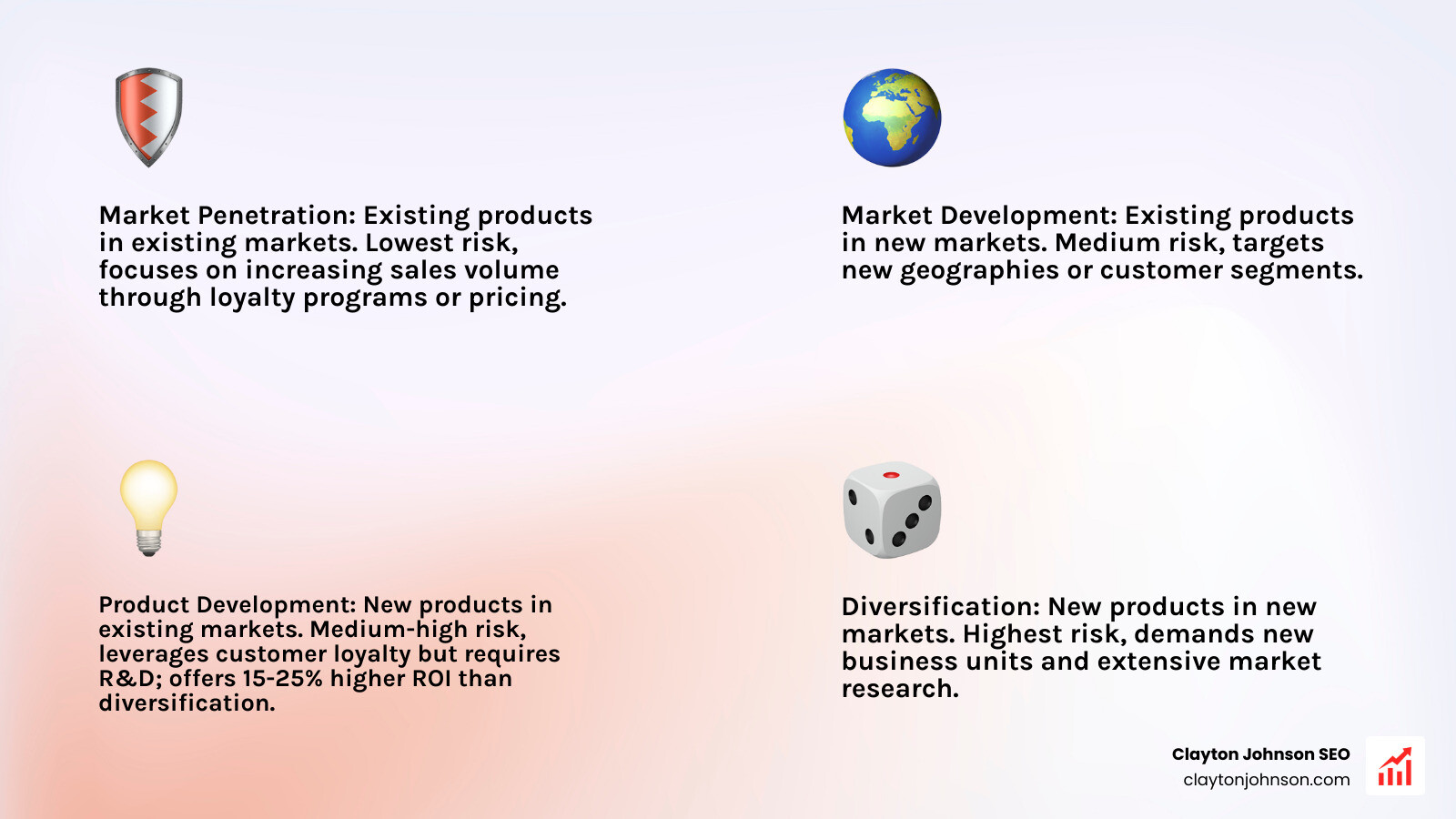
Compared to the other strategies:
- Market Penetration: The safest bet. You sell your existing products to your existing market (think: a loyalty program or a price cut).
- Market Development: You take your existing product to a new market (think: opening a Minneapolis-based shop in a new city).
- Diversification: The “danger zone.” New products for new markets.
The beauty of ansoff matrix product development is that it offers a 15-25% higher ROI than diversification. Because we don’t have to learn a new market from scratch, our marketing costs are lower, and our success rate is 2-3x higher than if we went into “uncharted territory.”
The Strategic Benefits and Risks of Ansoff Matrix Product Development
Why do companies take the leap into product development? Because the rewards are massive. Industry benchmarks show that companies pursuing this strategy can achieve up to 20-30% revenue growth from new products within their existing markets. Furthermore, for firms that master this, new product development contributes to an average of 30-40% of total revenue.
By innovating, we create a competitive advantage that makes it harder for others to steal our customers. We also open the door for cross-selling—if a customer buys Product A, they are the perfect candidate for the new Product B. This is the essence of maintaining a strong market foothold, as detailed in this Ansoff Matrix Overview.
Key Advantages of an Ansoff Matrix Product Development Approach
- Customer Retention: By evolving with your customers’ needs, you give them no reason to look elsewhere.
- Portfolio Expansion: You aren’t a “one-hit wonder.” A broader portfolio makes your business more resilient.
- Leveraging Market Knowledge: You already know what your customers hate, what they love, and what they’re willing to pay.
- Lower Acquisition Costs: It is much cheaper to sell a new product to an old customer than to find a brand-new customer for an old product. This is a core concept in building a scalable tech startup template.
Mitigating Risks in Ansoff Matrix Product Development
We can’t ignore the elephant in the room: the 40-50% failure rate for new products. Innovation is expensive, and technical uncertainty is a constant shadow. There is also the risk of cannibalization—where your new product simply steals sales from your old one instead of growing the total pie.
To fight these risks, we recommend a “Lean” approach. By blending Lean Startup methods with the Business Model Canvas, you can test your ideas before spending millions.
- Prototype Testing: Build a “Minimum Viable Product” (MVP).
- Beta Validation: Let your most loyal customers try it first and give you raw, honest feedback.
- Iterate: Use that feedback to fix the product before the big launch.
How to Implement an Ansoff Matrix Product Development Strategy
Implementation isn’t just about a “good idea.” It requires a blueprint for scalable marketing and a disciplined workflow. You have to start with customer insights. What are the unmet needs that your current products aren’t solving?
Essential Steps for Successful Product Development
- Ideation: Use surveys, interviews, and social listening to find gaps in the market.
- Feasibility Study: Can we actually build this? Does the math work?
- Prototype Development: Create a version of the product to test the “quality and differentiation.”
- Go-to-Market Plan: Use your existing channels (email lists, current sales team) to reach your audience.
- Performance Monitoring: Track the data. Is it selling? Is it getting good reviews?
- Iteration: Don’t be afraid to pivot. Using the Business Model Canvas for digital innovation helps you visualize where the model might be breaking.
Role of R&D and Modern Technology in Product Development
In the modern era, ansoff matrix product development is powered by R&D and digital transformation. We aren’t just guessing anymore; we use AI-assisted workflows and predictive analytics to see trends before they happen.
Collaboration is also key. Whether it’s partnering with suppliers for better materials or using open-source frameworks to speed up software development, you can steal successful business models legally by observing what works in other industries and applying it to your own.
Real-World Successes and Contemporary Evolutions
We see ansoff matrix product development in action every day. Look at the Ansoff Matrix Wikipedia examples:
- Apple: They didn’t just stop at the Mac. They developed the iPhone, iPad, and Apple Watch for their existing ecosystem of users.
- Starbucks: By introducing Nitro Cold Brew and seasonal lattes like the Pumpkin Spice Latte, they keep their existing coffee-loving customers coming back for something new.
- Netflix: They started as a DVD-by-mail service but developed “Netflix Originals” to keep their streaming subscribers engaged.
These companies often choose between being a pioneer (the first to create something entirely new) or a follower (improving on an existing idea that is new to the company).
Product Development in the Digital Economy
In today’s “information society,” the game has changed. We deal with “infopollution”—too much data and not enough insight. Modern ansoff matrix product development in information services is about filtering that noise.
The “platform paradigm” allows companies to execute multiple strategies at once. For example, a software company might use agile strategy and “minimum viable experiments” to launch a new feature to 5% of its users, gather data, and then roll it out to everyone. This lowers the risk of a total flop.
Measuring Success: KPIs for Product Innovation
You can’t manage what you don’t measure. When we help companies in Minneapolis and beyond, we look at these key metrics:
- Time-to-Market: How long does it take from “idea” to “on the shelf”?
- Adoption Rates: What percentage of your existing customers are trying the new product?
- ROI: Is the revenue generated covering the high R&D costs?
- Customer Feedback Loops: Are the reviews positive, and are we acting on them?
- Revenue from New Products: Ideally, this should be 30-40% of your total.
Frequently Asked Questions about Ansoff Matrix Product Development
When is product development the most appropriate strategy?
It’s best when your current market is growing or stable, but your current products are reaching “maturity” (sales are leveling off). If you have a strong brand and deep customer insights, it’s time to innovate.
How does product development differ from diversification?
Product development keeps you in your “home turf” (existing market). Diversification is like moving to a new planet—new products AND new customers. Diversification is much riskier because you have no established reputation to lean on.
What are the most common pitfalls in product development?
The biggest mistakes are ignoring customer feedback, over-engineering a product that nobody wants, and failing to account for “cannibalization.” If your new product kills your old one without adding new profit, you’re just running in place.
Conclusion
At the end of the day, ansoff matrix product development is about alignment. Your new products must align with your overall business goals, your mission, and your long-term vision. It’s a bold move, but when executed with a structured framework, it’s the most powerful way to ensure your business doesn’t become a relic of the past.
At Clayton Johnson SEO, we don’t just talk about growth; we build the systems that make it happen. Whether you need to refine your positioning or build an AI-assisted workflow for your next launch, we’re here to help you navigate the matrix. Explore our digital marketing pillars to see how we can turn your product expansion into a measurable success.