Zero-Click Search Strategies: How to Win When Nobody Clicks

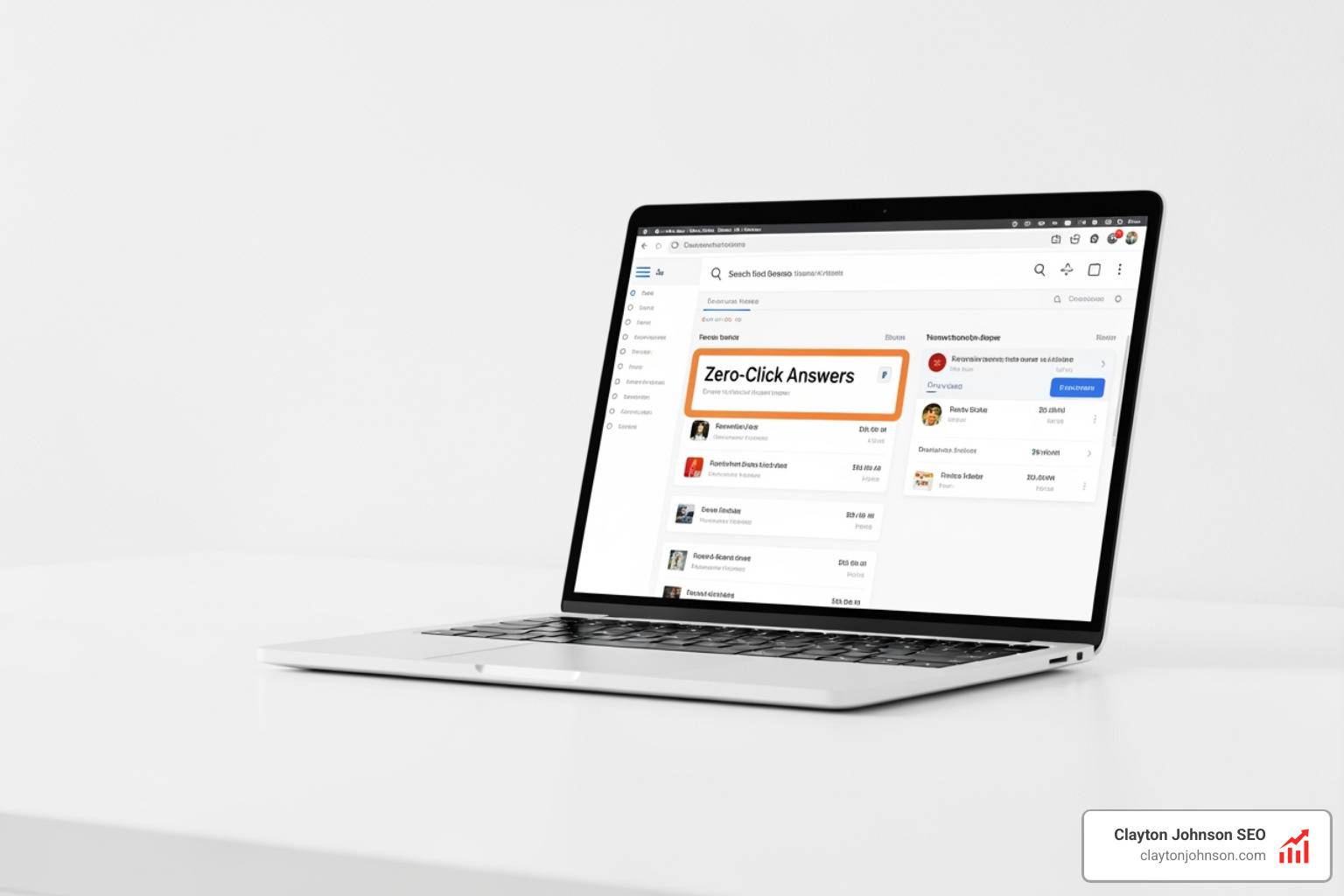
Why Zero-Click Search Strategies Are Now Essential for Growth
Zero click search strategies are how modern marketers maintain visibility and drive business results when users never leave the search results page.
Here’s what you need to know right now:
- Optimize for SERP features — target featured snippets, People Also Ask, and knowledge panels with structured, concise answers
- Use schema markup — FAQ, HowTo, and LocalBusiness schema help search engines extract and display your content
- Build topical authority — deep, entity-rich content signals expertise to both Google and AI answer engines
- Shift your success metrics — track impressions, brand mentions, and AI visibility, not just clicks
- Format for extraction — lead with 40–60 word direct answers, use headers, lists, and tables
- Optimize for local — a complete Google Business Profile captures zero-click local searches and drives foot traffic
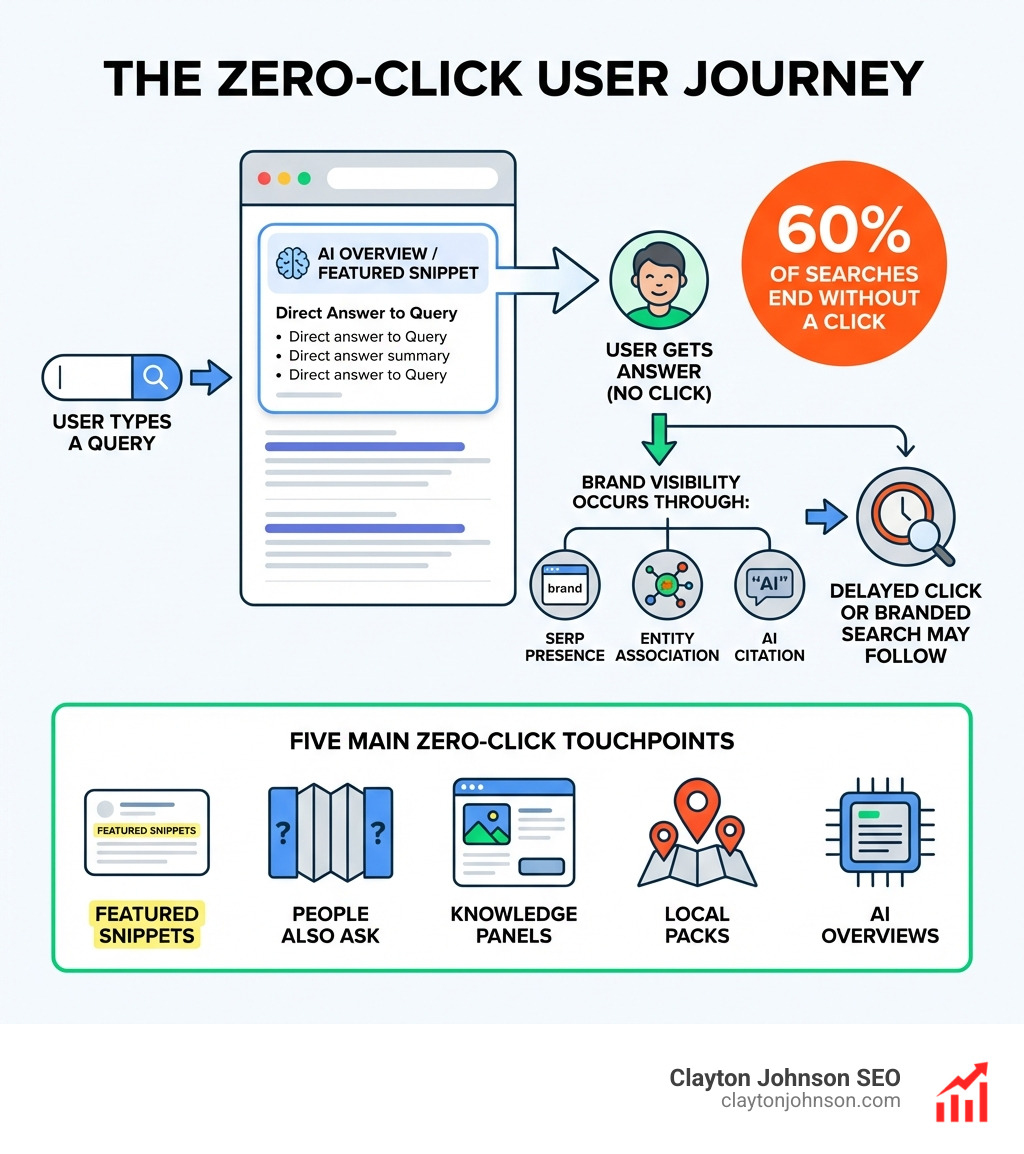
Currently, about 60% of Google searches end without a single click to an external website. That means the majority of your potential audience is getting their answer directly on the results page — and never visiting yours.
This is not a temporary glitch. It’s a structural shift driven by AI Overviews, featured snippets, knowledge panels, and voice search. Google has evolved from a search engine into an answer engine. And the brands that understand this are quietly building authority and pipeline while others watch their traffic numbers fall.
The old game was: rank high, earn clicks, convert visitors. The new game is: be the answer — so your brand is what users see, trust, whether or not they ever land on your site.
I’m Clayton Johnson, an SEO strategist who specializes in building scalable traffic systems and structured content architectures — including implementing zero click search strategies that turn SERP visibility into compounding brand authority. This guide gives you the exact frameworks I use to help founders and marketing leaders win in a world where the click is no longer the prize.
Know your zero click search strategies terms:
The Rise of the Answer Engine: Why Clicks are Vanishing
We used to think of Google as a librarian—someone who points you to the right book on the shelf. Today, Google is more like an expert who has already read every book and just gives you the summary. This transition from a search engine to an “answer engine” is the primary reason why clicks are vanishing.
A Zero-Click search occurs when a user’s query is resolved directly on the search engine results page (SERP). Whether it is a quick unit conversion, a weather update, or a complex “how-to” guide, the information is presented in a way that makes clicking through to a website unnecessary.
Several factors are accelerating this trend:
- AI Overviews: These generative AI summaries synthesize information from multiple sources. They now appear in approximately 30% of informational queries, providing a comprehensive answer at the very top of the page. You can learn what are AI overviews to better understand how they aggregate your content.
- Mobile Search: Mobile users want answers fast. Nearly 60% of Google searches on mobile now end without a click because the small screen real estate is dominated by instant answers.
- Voice Search: When you ask a smart speaker a question, it doesn’t read you a list of links. It gives you one answer, usually pulled directly from a featured snippet.
- Knowledge Panels and Snippets: For branded or factual queries, Google’s Knowledge Graph provides a sidebar of information that satisfies the user’s intent instantly.
This shift represents a move toward instant gratification. Users no longer want to hunt for information; they want it served to them. As marketers, we have to stop fighting for the click and start fighting for the citation.
The Impact on Organic SEO and PPC
The rise of zero-click behavior isn’t just an organic SEO problem; it’s a search marketing problem. When Google provides the answer, the “click pool” shrinks for everyone.
For organic SEO, this often leads to a “traffic plateau.” You might see your rankings and impressions stay steady or even increase, while your actual click-through rate (CTR) takes a nosedive. Recent research on search click behavior shows that just 36% of searches result in clicks to the open web in the US.
In PPC, zero-click behavior can quietly drive up costs. As the number of available clicks decreases, competition for the remaining high-intent clicks intensifies. This often leads to CPC inflation and CTR suppression. However, there is a silver lining: the clicks that do happen are often “super clicks.” These are users who have already seen the AI summary or featured snippet and are now clicking through because they have a high intent to purchase or dive deeper.
By implementing zero click search strategies, we pre-qualify our traffic. We aren’t just getting visitors; we’re getting informed leads who already recognize our brand as the authority.
Implementing Effective Zero Click Search Strategies
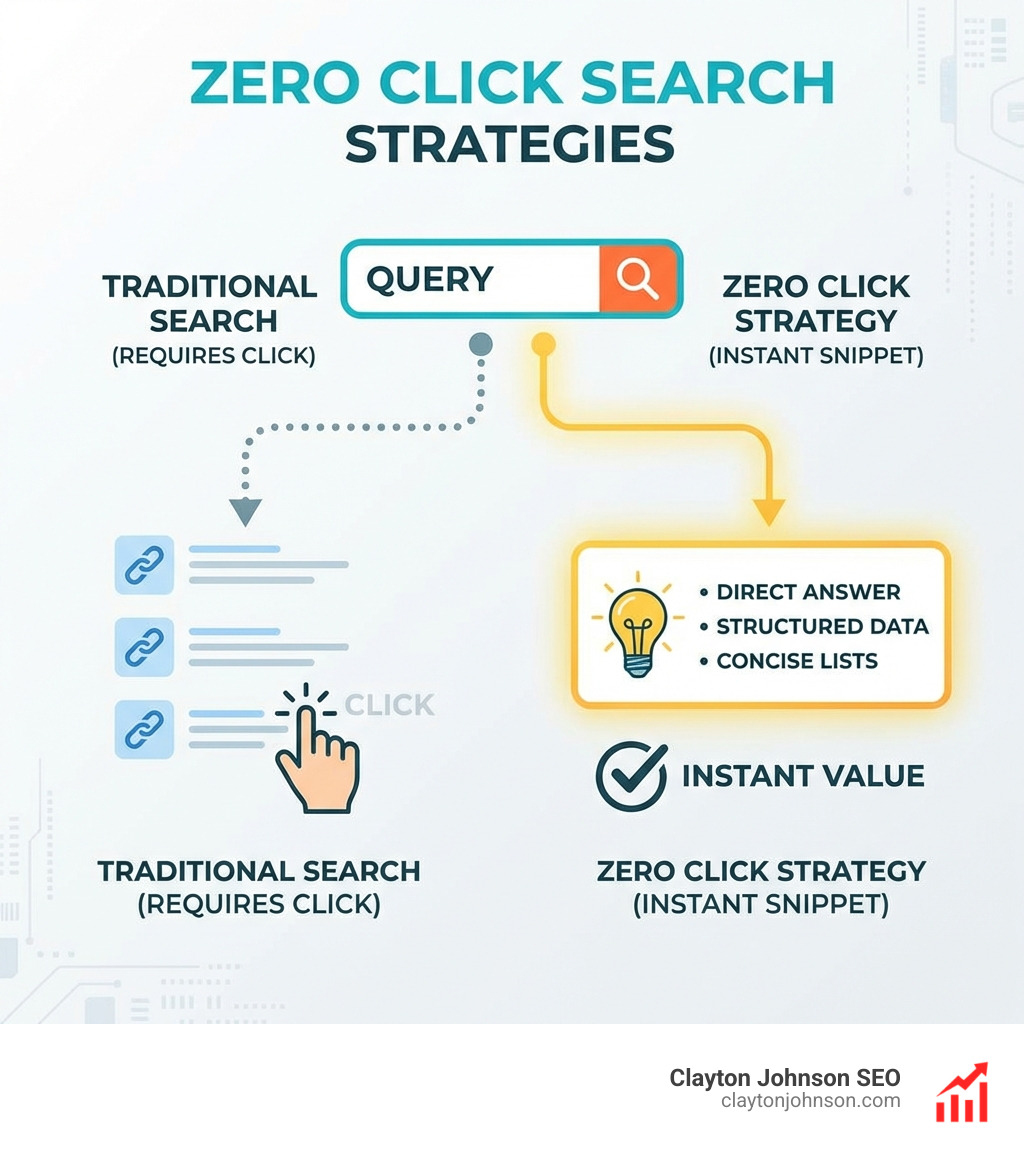
To win in this environment, our content must serve a dual purpose: it must be a standalone resource for those who click, and a perfect “data nugget” for the AI engines to extract. This requires a shift in how we approach topical authority and keyword selection.
Topical Authority and E-E-A-T
Google and AI models prioritize sources that demonstrate Experience, Expertise, Authoritativeness, and Trustworthiness (E-E-A-T). We don’t just want to rank for a keyword; we want to own the “entity.” This means creating a cluster of content that covers every facet of a topic. When we build this level of depth, we become the preferred source for AI Overviews and featured snippets.
Zero Search Volume Keywords
One of our favorite zero click search strategies is targeting “zero search volume” (ZSV) keywords. Most SEO tools rely on clickstream data that misses 40-60% of real-world queries. These hyper-niche, long-tail questions often have massive conversion potential because they address specific user pain points. While a tool might say they have “zero” volume, they actually drive high-intent traffic that is easier to capture because competitors are ignoring it. You can explore more about this in our advanced keyword strategy guide.
Content Formatting for Zero Click Search Strategies
If you want your content to be featured as the answer, you have to make it easy for Google to “copy and paste” it into the SERP. We call this winning the no-click game.
Here are the formatting rules we live by:
- The 40-60 Word Rule: For paragraph snippets, provide the direct answer in a concise block of 40 to 60 words. Lead with the answer, then elaborate.
- The Inverted Pyramid: Put the most important information (the answer) at the top of the section. Don’t make the user—or the AI—dig for it.
- Bulleted and Numbered Lists: For “how-to” queries or lists of items, use clean HTML lists. Google loves to pull these into the “Position Zero” spot.
- Comparison Tables: When users search for “X vs Y,” a table is the most extractable format. It provides immediate value and often earns a large featured snippet.
- H2/H3 Optimization: Use your subheaders to mirror the exact questions users are asking (e.g., “What are zero click search strategies?”).
Technical Schema for Zero Click Search Strategies
Schema markup is the “behind-the-scenes” language that tells search engines exactly what your content represents. Without it, you’re leaving your visibility to chance. If you’ve wondered why your clicks are ghosting you, it might be a lack of structured data.
- FAQ Schema: This allows your questions and answers to appear directly in the SERP, expanding your real estate and providing instant answers.
- HowTo Markup: Essential for step-by-step guides. It helps your content appear in visual carousels and voice search results.
- LocalBusiness Data: For companies in Minneapolis or elsewhere, this is non-negotiable. It ensures your address, hours, and services are correctly displayed in the Local Pack.
- SameAs Properties: This connects your website to your social profiles and other authoritative entities, helping Google build a stronger Knowledge Graph for your brand.
By optimizing for LLM (Large Language Model) crawlability, we ensure that when an AI agent looks for a source, our structured data makes our content the easiest to digest and cite.
Answer Engine Optimization (AEO) vs. Traditional SEO
While traditional SEO focuses on driving traffic to a website, Answer Engine Optimization (AEO) focuses on providing the best answer wherever the user is.
| Feature | Traditional SEO | Answer Engine Optimization (AEO) |
|---|---|---|
| Primary Goal | Website Traffic | Brand Visibility & Citations |
| Key Metric | Click-Through Rate (CTR) | Answer Inclusion Rate |
| Content Focus | Long-form Engagement | Concise, Extractable Answers |
| Format | Blog Posts & Landing Pages | Snippets, Schema, & Entities |
| Success Driver | Backlinks & Keywords | Authority & Entity Strength |
AEO requires us to think about “Search Everywhere Optimization.” We want our brand mentioned in AI Overviews, cited in ChatGPT responses, and heard in voice search. This is about building AI-search/SEO synergy where your site remains the “source of truth” even if it isn’t the final destination.
Optimizing for Local Packs and Knowledge Panels
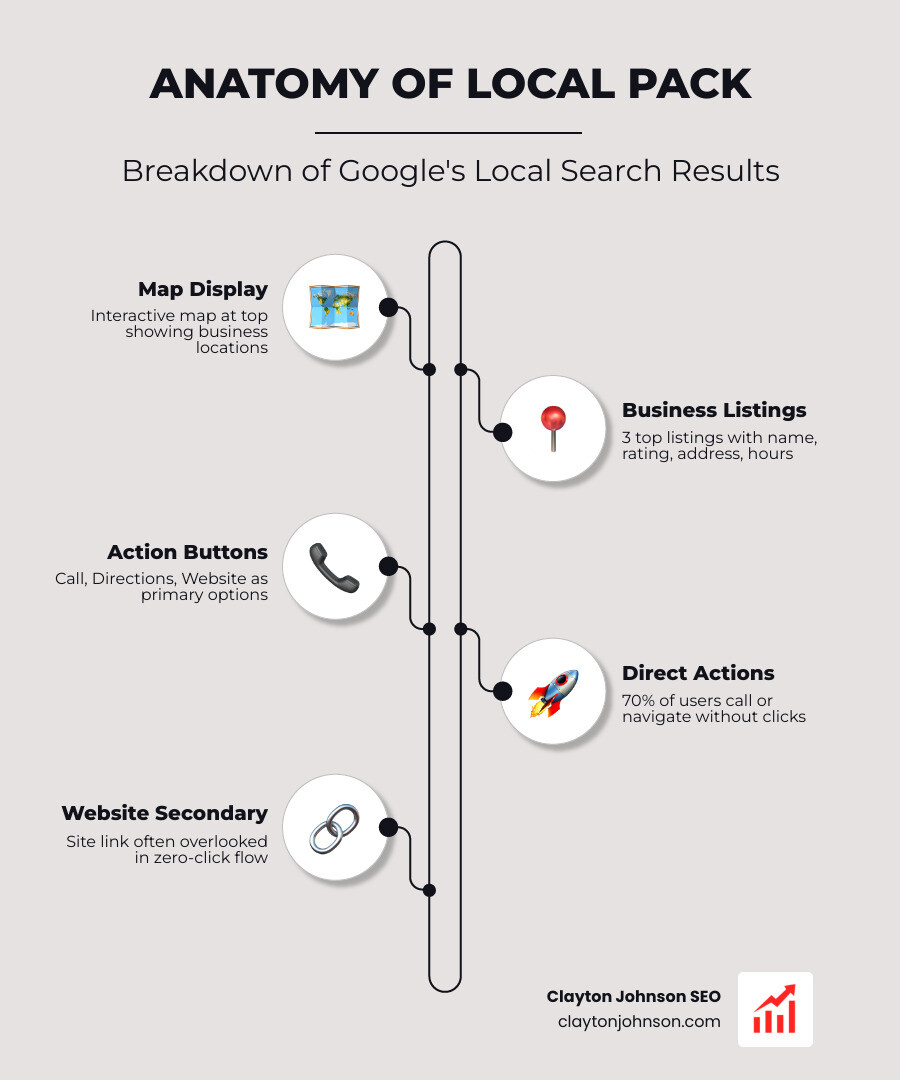
For local businesses, zero-click search is actually a massive opportunity for foot traffic. When someone searches for “SEO services in Minneapolis,” they often see the Local Pack first.
To dominate this area, we focus on:
- Google Business Profile (GBP) Optimization: Keeping your profile 100% complete with high-quality photos and updated posts.
- Review Sentiment: It’s not just about the number of stars; it’s about what the reviews say. Google analyzes review text to see if you are a relevant answer for specific queries.
- NAP Consistency: Your Name, Address, and Phone number must be identical across the web to build entity trust.
Measuring ROI Beyond the Click
If we only measure clicks, our SEO reports will look like a disaster even when our brand is thriving. We have to redefine what success looks like in a zero-click world. We call this moving goodbye-clicks-and-hello-answers.
New KPIs for the zero-click era include:
- Search Impressions: How many people saw your brand as the answer?
- Share of Voice (SOV): What percentage of the SERP features in your niche do you own?
- Brand Mention Sentiment: How is your brand being described by AI Overviews?
- AI Visibility Score: How often is your content cited as a source in generative summaries?
- Assisted Conversions: Tracking users who saw a zero-click result and later searched for your brand directly to convert.
Success Across Different Industries
The “win” looks different depending on what you sell:
- Ecommerce: Appearing in product carousels and “Best of” AI summaries.
- Publishers: Shifting to newsletters and interactive tools to “own” the audience after the initial zero-click discovery.
- B2B: Using zero-click visibility to establish thought leadership, leading to high-value branded searches later in the buyer journey.
- Local Services: Driving phone calls and “Get Directions” requests directly from the SERP.
Frequently Asked Questions about Zero-Click SEO
What is the difference between a featured snippet and an AI Overview?
A featured snippet is a direct excerpt from a single webpage, usually appearing for simple factual or “how-to” queries with a clear link to the source. An AI Overview is a generative summary that synthesizes information from multiple websites (often 7 or more) to answer more complex, nuanced questions.
Will zero-click searches kill organic SEO?
No, but they are changing it. SEO is no longer just about traffic; it’s about brand authority. While informational traffic may drop, the intent of the remaining clicks is often much higher. SEO is evolving into a demand-generation engine rather than just a traffic-filler.
How do I track my brand’s visibility in AI search results?
Standard tools are still catching up, but you can monitor your “Impressions” and “Average Position” in Google Search Console for queries that trigger AI Overviews. Additionally, using “Brand Radar” tools or manual checks for key high-intent queries can help you see if you are being cited.
Conclusion
The era of the “guaranteed click” is over. As search engines prioritize user experience and instant answers, our role as marketers must shift from being a destination to being the definitive answer.
Winning with zero click search strategies requires a combination of deep topical authority, precise technical schema, and a willingness to measure success by brand influence rather than just sessions. This is where the Demandflow.ai philosophy comes in. We believe that clarity and structure lead to leverage and compounding growth.
At Clayton Johnson SEO, we don’t just provide tactics; we build structured growth architecture. Whether you are a founder in Minneapolis or a marketing leader looking to future-proof your digital presence, the goal remains the same: dominate the SERP, own the entity, and be the answer.
Ready to adapt? Start mastering zero-click search today and turn the “traffic apocalypse” into your greatest competitive advantage.