Why Your Startup Needs a Defensible Competitive Moat
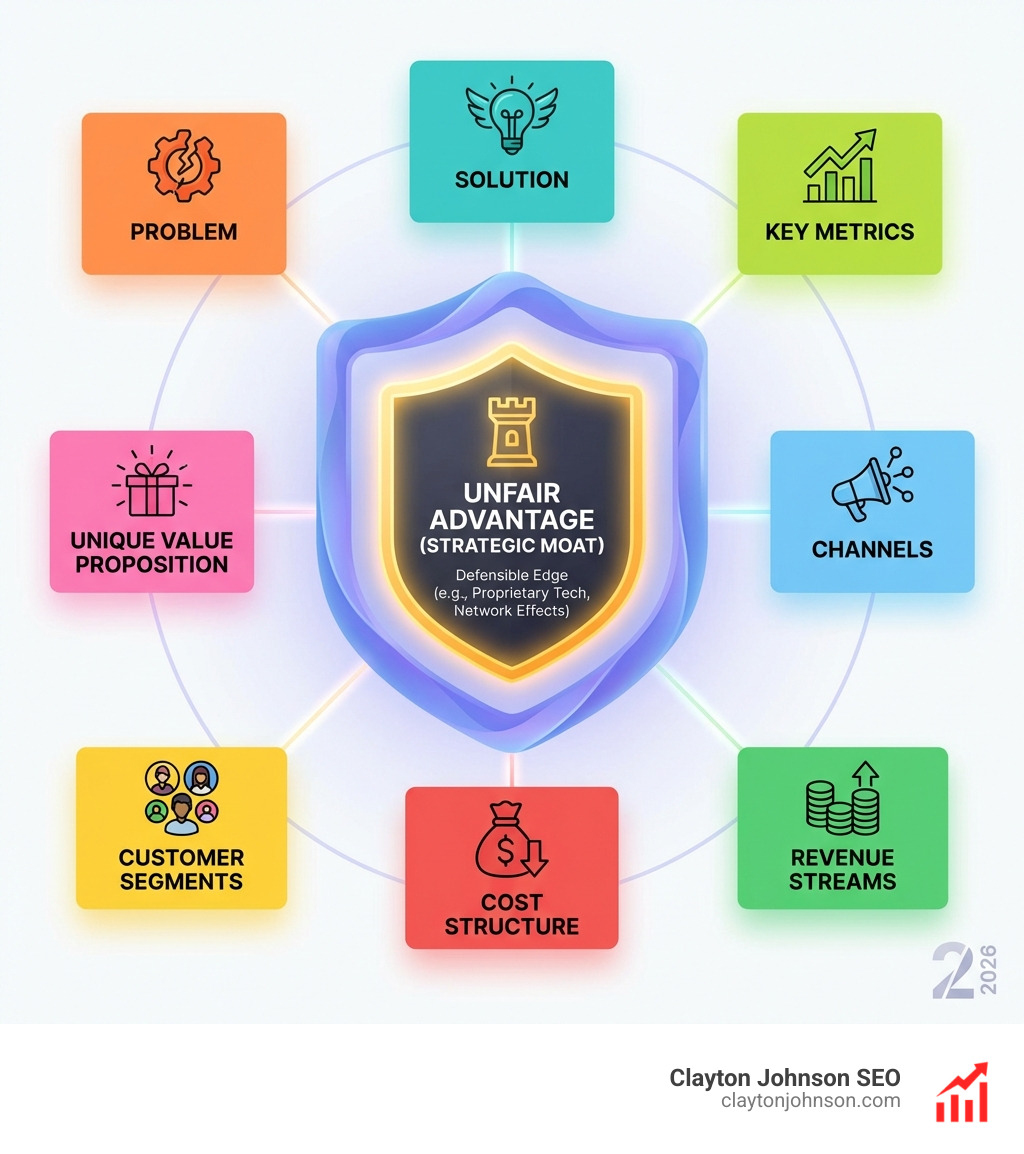
Lean Canvas unfair advantage is the box on Ash Maurya’s one-page business model that defines what makes your business defensible—the hard-to-replicate edge that keeps competitors from copying your success. It’s not about being slightly better. It’s about owning something others can’t easily buy, build, or imitate.
Quick definition:
- What it is: A unique strength or resource that cannot be easily copied or bought by competitors
- What it’s not: Generic statements like “we work harder” or product features that can be replicated
- Common sources: Proprietary technology, team expertise, exclusive partnerships, network effects, regulatory mastery, brand loyalty
- Key distinction: Unlike your Unique Value Proposition (which focuses on customer benefits), your unfair advantage focuses on business defensibility and competitive positioning
Most founders struggle with this box. They confuse features with advantages. They undervalue their team’s expertise. They claim “customer focus” as an edge when every competitor says the same thing.
The reality is simpler: 42% of startups fail due to “no market need”—a problem that systematic validation using frameworks like Lean Canvas helps prevent. But even with market need, you need something defensible to win long-term.
Here’s why this matters: competitors can copy your product, your marketing, even your pricing. What they can’t copy is a proprietary dataset trained over years. A founding team with insider industry connections. A regulatory moat that takes competitors 24 months to navigate. A network effect that makes your platform more valuable with each new user.
I’m Clayton Johnson, and I’ve spent years helping founders build scalable growth systems anchored in strategic frameworks like Lean Canvas. Understanding and articulating your Lean Canvas unfair advantage isn’t just about filling a box—it’s about identifying the core asset that makes your business model defensible and your growth compounding.
Simple guide to Lean Canvas unfair advantage:
Defining the Lean Canvas Unfair Advantage
In business modeling, the Lean Canvas unfair advantage is often described as your “competitive moat.” While the original Business Model Canvas focused on “Key Activities” and “Key Resources,” Ash Maurya adapted this box to specifically address the reality of startups: if you find a profitable market, people will try to copy you.
An unfair advantage is something that is hard-to-replicate. It is the “golden ticket” in the business realm, signifying a distinct edge that often comes from a blend of unique resources and strategic positioning. By mastering the lean startup model canvas for new ventures, entrepreneurs can pinpoint exactly where their barrier to entry lies.
This component is critical because it directly impacts:
- Long-term profitability: High margins are protected when competitors can’t undercut you.
- Investor confidence: Investors want to know why a giant like Google or Amazon can’t just build your product tomorrow and put you out of business.
- Sustainable growth: It allows you to focus on scaling rather than constant defensive maneuvering.
Lean Innovation is about optimizing resources. If you don’t know your unfair advantage, you might waste resources building “fair” advantages that are easily neutralized by the competition.
Unfair Advantage vs. Unique Value Proposition (UVP)
One of the most common mistakes we see is founders putting their UVP in the Unfair Advantage box. They are fundamentally different concepts.
| Feature | Unique Value Proposition (UVP) | Unfair Advantage |
|---|---|---|
| Focus | Customer-centric | Competitor-centric |
| Purpose | Why the customer should buy | Why you are hard to copy |
| Example | “The fastest way to book a dog walker.” | “Exclusive partnership with the national kennel club.” |
| Visibility | Public-facing marketing | Often internal or operational |
The UVP lists the differentiators of your solution—how it’s better than the alternatives currently available to the customer. The Unfair Advantage focuses on the business’s defensibility. As noted in Why the Lean Start-up changes everything, the lean approach is about searching for a business model that works; the unfair advantage ensures that once you find it, you can keep it.
Why the Unfair Advantage is a Critical Component
Without a solid Lean Canvas unfair advantage, your startup is essentially a “sitting duck.” Once you validate your Problem and Solution, you’ve essentially done the market research for your competitors. They can see what works and build a “me-too” product.
A strong advantage allows for strategic pivots. If the market shifts, but you still own the proprietary data or the exclusive distribution channel, you can pivot your product while keeping your moat intact. It also acts as a form of risk mitigation. When you know how to blend lean startup and BMC for success, you understand that the highest risk isn’t just building the wrong product—it’s building the right product but having no way to defend your market share.
Core Sources of a Sustainable Competitive Edge
What actually constitutes an “unfair” advantage? It has to be something that cannot be easily bought or copied. Here are the primary types:
- Proprietary Technology: This isn’t just “good code.” It’s proprietary algorithms and AI that perform significantly better than off-the-shelf solutions.
- Team Expertise: If your founding team includes the world’s leading expert in a niche field, that is a massive head start.
- Network Effects: This occurs when a product becomes more valuable as more people use it (e.g., Airbnb, Facebook).
- Exclusive Partnerships: Having a signed, exclusive contract with a key supplier or distributor that your competitors cannot access.
- Regulatory Mastery: In highly regulated industries (like fintech or healthcare), having the necessary licenses and a deep understanding of compliance can take years for a competitor to replicate.
- First-Mover Advantage: While not always a moat on its own, first-mover advantage can be potent if it leads to established customer loyalty and high switching costs.
Using digital innovation via the business model canvas helps founders visualize how these sources connect to their overall value delivery.
Leveraging Data as a Lean Canvas Unfair Advantage
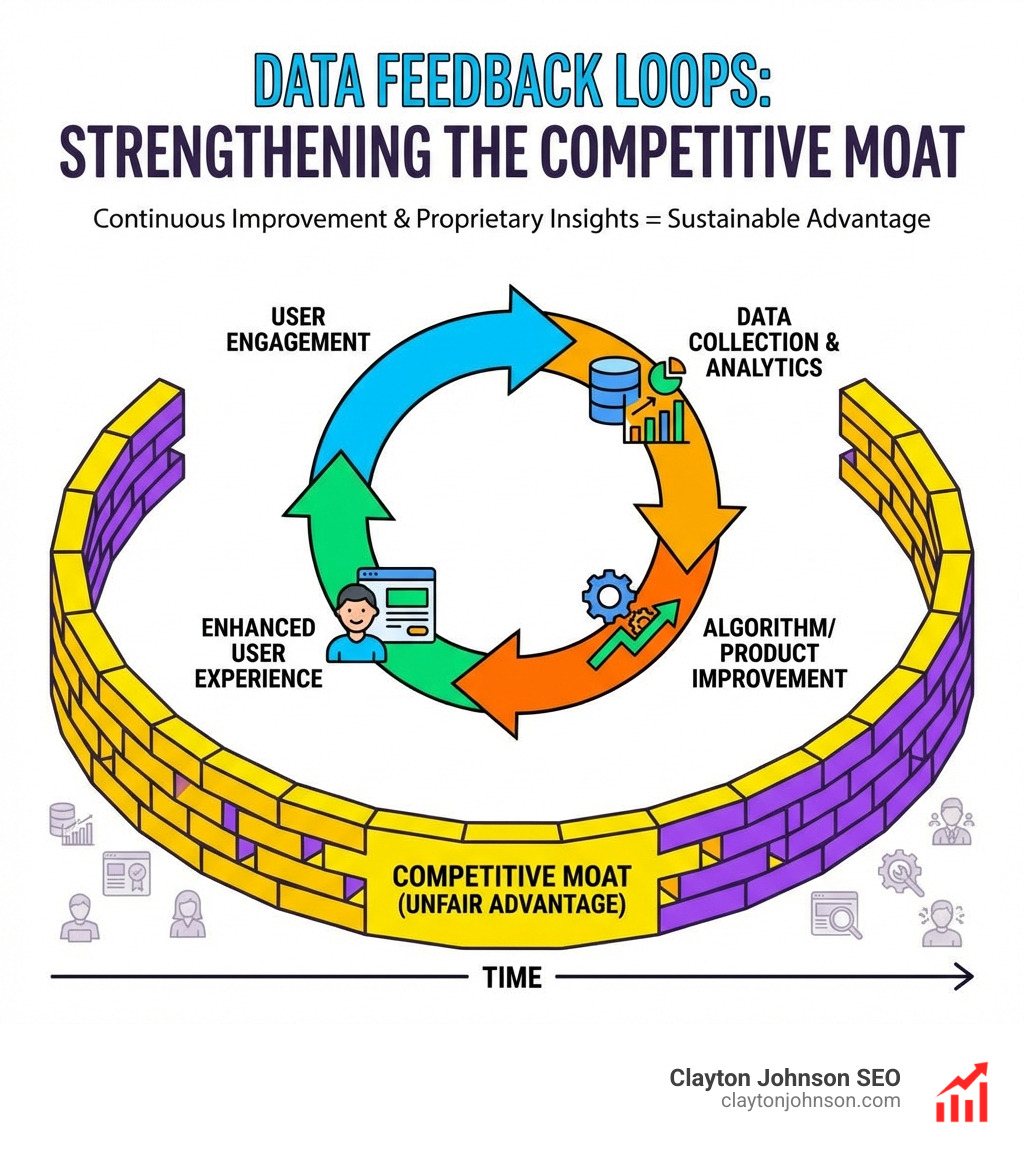
In the modern economy, data is often the strongest moat. Proprietary data and advanced analytics allow companies to make informed decisions that competitors simply can’t.
If your system uses machine learning, the feedback loops created by your users become an asset. The more they use your product, the better the algorithm gets, and the harder it is for a new player to catch up. When tracking the metrics that make or break your lean canvas, look for “compounding” data assets.
Real-World Examples of Defensible Moats
- Tesla: Their Lean Canvas unfair advantage isn’t just “electric cars.” It’s their years of mastery over battery technology and their proprietary Supercharger network.
- Netflix: Beyond content, their edge is data-driven personalization. Their recommendation engine is fed by billions of hours of viewing data that no new streaming service can replicate overnight.
- Airbnb: They benefit from massive network effects. Travelers go there because that’s where the hosts are; hosts go there because that’s where the travelers are.
- Patagonia: Their edge is rooted in Patagonia’s environmental commitment. Founder Yvon Chouinard’s values are so deeply baked into the brand and supply chain that a competitor “acting” sustainable looks like a cheap imitation.
- Coca-Cola: Their secret recipe and global distribution network are legendary examples of an unfair advantage.
- Spotify: Their “secret sauce” lies in their proprietary streaming protocols and discovery algorithms that keep users locked into their ecosystem.
How to Identify and Validate Your Secret Sauce

Identifying your advantage requires a bit of soul-searching and an honest audit of your resources. Start by asking: “What do we have that a competitor with $10 million in funding still couldn’t buy?”
- Audit Team Skills: Look for rare skillsets or deep industry experience.
- Resource Mapping: Do you have access to a specific dataset, a unique location, or a key mentor?
- Customer Interviews: Sometimes your customers see your advantage more clearly than you do. Ask them, “Why did you choose us over [Competitor X]?”
- SWOT Analysis: Use a traditional SWOT to find the “S” (Strengths) that are also “I” (Inimitable).
Once identified, you must validate it. Just because you think your tech is proprietary doesn’t mean it is. Use the definitive bmc tech startup template for scalable growth to test your assumptions against market reality.
Common Pitfalls to Avoid
When we review Lean Canvases, we see the same mistakes in the Unfair Advantage box:
- Generic Statements: “We work harder,” “We care more,” or “We have great customer service.” These are not unfair advantages because a competitor can (and will) claim the same thing.
- Feature Lists: “Our app has a dark mode.” Features can be coded by anyone in a weekend.
- The “First Mover” Trap: Being first is only an advantage if you use that time to build a real moat (like network effects).
- Over-focusing on Competitors: If your “advantage” is just being 10% cheaper, you’re in a race to the bottom, not building a moat.
When to Revisit Your Lean Canvas Unfair Advantage
Your Lean Canvas unfair advantage is not static. It should evolve as your company grows. We recommend revisiting this box:
- During Annual Strategy Reviews: Does your edge still hold up against new market entrants?
- After Achieving Product-Market Fit: Now that you know people want the product, how will you stop the “fast followers” from stealing your thunder?
- When Launching New Offerings: Does your current advantage extend to the new product, or do you need to build a new one?
- Significant Market Shifts: If a new technology (like Generative AI) makes your proprietary tech obsolete, you need to find a new moat immediately.
Frequently Asked Questions about Unfair Advantage
Can a patent be an unfair advantage?
Yes, but with caveats. In industries like biotech, patents are essential and serve as a massive barrier to entry. However, in the software world, patents are often hard to defend and can sometimes be worked around. Intellectual property is a “legal safeguard,” but it shouldn’t be your only advantage.
Is being first to market an unfair advantage?
It depends. First-mover dominance is only an advantage if it allows you to capture the market and build high switching costs or network effects. Many first movers fail because they do the hard work of educating the market, only for a “second mover” to come in, learn from the first mover’s mistakes, and build a better version.
How does the unfair advantage influence revenue streams?
A strong advantage gives you pricing power. If you are the only company that can provide a specific result (due to your proprietary data or tech), you can charge based on value rather than cost. It also shapes your monetization strategies; for example, if your advantage is a network effect, you might prioritize user growth over immediate revenue to strengthen the moat.
Conclusion
Formulating a Lean Canvas unfair advantage strategy is the difference between building a temporary product and building a lasting business. It’s about finding that “secret sauce” that makes your competition irrelevant.
At Clayton Johnson SEO, we focus on building these defensible systems through strategic growth and actionable frameworks. Whether it’s through content systems that create a brand moat or technical SEO strategies that provide a long-term visibility edge, your vision needs a foundation that can’t be easily shaken.
Ready to find your defensible edge? Explore our SEO Consultant Services and let’s build your competitive moat together.