Why AI Search Is Reshaping Brand Visibility
An AI SEO positioning guide helps you ensure your brand appears in AI-generated search results—not just traditional rankings. Here’s what you need to know:
Core Components:
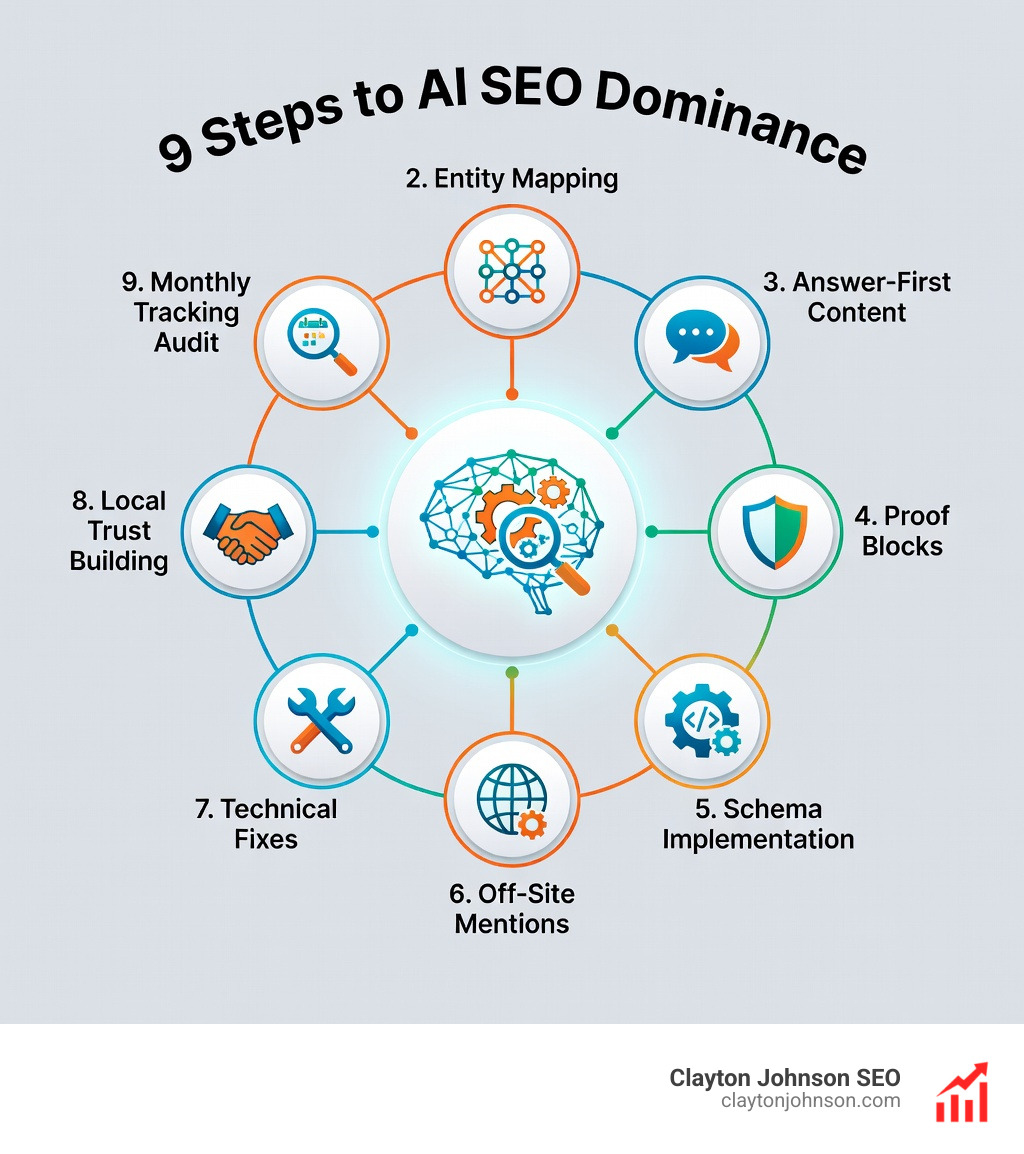
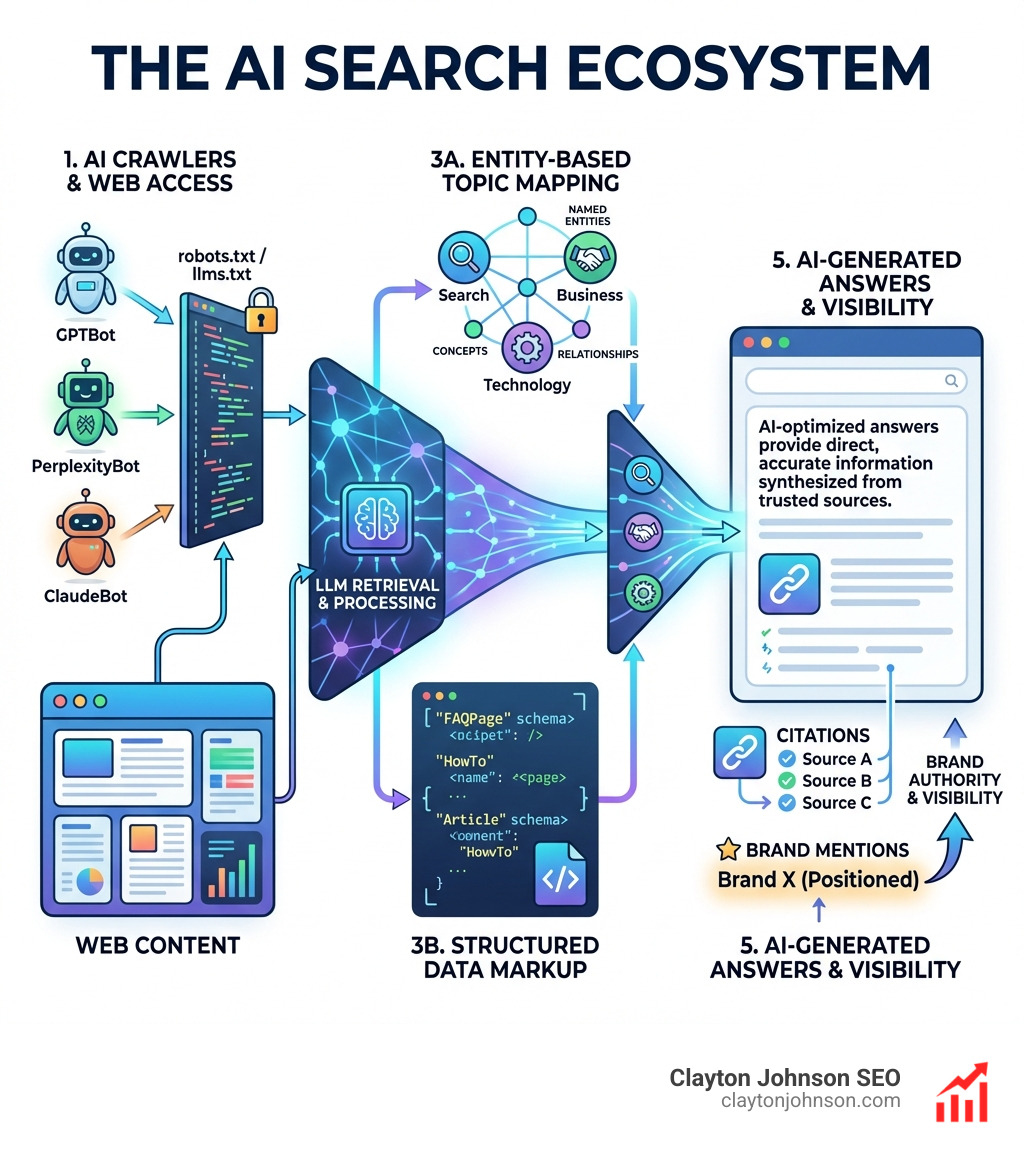
- Crawler accessibility – Allow GPTBot, PerplexityBot, and ClaudeBot via robots.txt and llms.txt
- Content structure – Use answer-first blocks, semantic HTML, and scannable formatting
- Entity mapping – Build topical authority around named entities, not just keywords
- Schema markup – Implement FAQPage, HowTo, and Article schemas for machine readability
- Authority signals – Earn third-party mentions and citations from trusted sources
- Measurement – Track citation frequency, brand mention rate, and share of voice in AI responses
Industry forecasts suggest that a significant majority of searches in US markets will begin on AI conversational platforms. Over 65% of searches already end without a click, with AI Overviews cutting website clicks by more than 30% while increasing impressions. This isn’t a future trend—it’s happening now.
The fundamental shift: AI search engines don’t rank pages in a list. They select content to synthesize into answers, citing 2-5 verified sources. Your content must be understood, retrievable, and trustworthy enough to quote.
Rankings aren’t the win anymore. The win is being cited in AI answers while still capturing high-intent clicks from users who want to go deeper.
Traditional SEO focused on blue links. AI search focuses on being the answer—or at least being credited for it. That requires a different approach to content structure, technical optimization, and authority building.
This guide walks through the systematic framework for positioning your brand in AI search engines. We’ll cover how AI crawlers work, what content structures they prioritize, how to engineer for LLM selection, and how to measure visibility when clicks aren’t the only metric that matters.
I’m Clayton Johnson, and I’ve spent the past several years helping companies build scalable SEO systems that adapt to algorithmic shifts—including the rise of AI search. My AI SEO positioning guide approach combines technical SEO depth with strategic positioning frameworks to help brands earn visibility where their customers are actually searching.
AI SEO positioning guide vocab explained:
The Core Pillars of an AI SEO Positioning Guide
The transition from traditional search to AI-driven discovery is the most significant change since Google’s arrival. In the old days, we optimized for “ten blue links.” Today, we optimize for synthesis.
Generative Engine Optimization (GEO) vs. Traditional SEO
While traditional SEO focuses on ranking as high as possible in a list, Generative Engine Optimization guidance emphasizes making your content “selectable” by Large Language Models (LLMs). This involves Answer Engine Optimization (AEO)—the practice of providing direct, factual answers that AI systems can easily parse.
The goal isn’t just to be found; it’s to be selected as a source. AI systems like Perplexity and Google’s AI Overviews pull from multiple sources to build a single answer. To be included, your site must offer machine-scannable data that provides high confidence to the model. For brands in Minneapolis, this means ensuring your local data and expert insights are formatted for machine consumption.
If you’re looking to overhaul your current approach, exploring specialized SEO services can help bridge the gap between human readability and machine scannability.
Understanding the AI Crawler Ecosystem
To get cited, AI bots must first see you. Unlike the standard Googlebot, the new wave of AI crawlers has different priorities:
- GPTBot (OpenAI): Gathers content for model training and real-time ChatGPT browsing.
- PerplexityBot: Focused on real-time information retrieval to provide cited answers.
- ClaudeBot (Anthropic): Crawls to improve the reasoning and knowledge base of the Claude models.
Many site owners unknowingly block these bots in their robots.txt files. To win in this landscape, you need an Anthropic Claude SEO Strategy that explicitly allows these agents.
Furthermore, a new proposed standard called llms.txt is emerging. This is a simple markdown file that provides a “TL;DR” of your site specifically for AI models, telling them which pages are best for training vs. which should be used for real-time citations.
Transitioning from Keywords to Entity-Based AI SEO Positioning
Keywords are dying; entities are taking over. An entity is a well-defined “thing” or concept—like a brand, a person, or a specific product. AI search engines use entity mapping to understand the relationship between your brand and the topics you cover.
Instead of stuffing “best dishwasher” into a page, you need to build a Knowledge Graph around your brand. This means showing how your brand relates to concepts like “energy efficiency,” “decibel levels,” and “installation services.” By creating an entity-based topic map, you signal to AI that you are a topical authority.
For a deeper dive into how this changes your workflow, check out The Future of Search with AI-Powered Keyword Research.
The Seen & Trusted (S&T) Framework for Brand Authority
Most brands suffer from a “visibility gap.” They are either mentioned but not cited (seen but not trusted), or cited but not mentioned (trusted but invisible). The S&T Framework solves this by running two playbooks simultaneously.
| Metric | “Seen” (Mentions) | “Trusted” (Citations) |
|---|---|---|
| Source | Social media, forums, Reddit | Official site, whitepapers, G2 |
| Goal | Brand awareness & sentiment | Verification & proof |
| AI Action | “Users recommend Brand X” | “According to Brand X’s data…” |
The Sentiment Battle: Getting “Seen”
AI models don’t just report facts; they report sentiment. If Reddit threads and G2 reviews say your product is “buggy but cheap,” that’s how the AI will characterize you. To improve your Sentiment/positioning metrics, you must engage in community discussions.
In Minnesota, local reputation matters. If you’re a Minneapolis-based SaaS, your presence on local business lists and community forums like Reddit or Quora directly influences how AI models perceive your brand authority. You aren’t just looking for backlinks; you’re looking for positive, unlinked brand mentions that associate your name with quality.
The Authority Game: Getting “Trusted”
To be the source that AI cites, you need to offer proprietary data or expert documentation. AI systems prioritize “Citation Cores”—a group of sites they trust implicitly (like Wikipedia, LinkedIn, or major industry publications).
By Using AI Competitive Insights to Outsmart Your Rivals, you can identify which “Citation Cores” your competitors are winning and target those same third-party platforms for your own expert quotes and guest features.
Technical Fixes for AI SEO Positioning Guide Success
Technical SEO isn’t just about page speed anymore; it’s about making your content “parsable.” If an AI crawler can’t easily extract your data, it will move on to a competitor who has a cleaner structure.
Schema Markup: The Language of AI
Google’s guidelines on structured data are your blueprint here. Schema markup (JSON-LD) acts as a translator for AI.
- FAQPage: Tells the AI exactly what questions you answer.
- HowTo: Breaks down complex processes into steps the AI can relay to users.
- Article: Defines the author, date, and core entities of a post.
Using these tags correctly helps AI systems understand the “who, what, and why” of your content without having to guess. If you aren’t sure where your site stands, performing AI-Driven SEO Audits can reveal technical gaps that are currently invisible to traditional tools.
Server Log Analysis
While Google Search Console is great, server logs are the “truth.” Log analysis reveals exactly how often GPTBot or PerplexityBot is hitting your site. If they are crawling your “About” page ten times a day but ignoring your “Services” page, you have a positioning problem. High crawl frequency is a leading indicator of future AI citations.
Engineering Content for LLM Selection
Writing for AI is different from writing for humans (though the two are merging). AI models “chunk” content into blocks of 300-500 tokens. If your answers are buried in a wall of text, the “chunk” becomes messy and the AI loses confidence.
The “Answer-First” Block
Every key section of your content should lead with a 40-60 word definition or direct answer. This is the “snippet” the AI is most likely to grab.
Bad Example: “When considering the various aspects of local SEO in the Twin Cities, it is important to first look at the historical context of search in Minneapolis before diving into the specific tactics used today…”
Good Example: “Minneapolis SEO is the process of optimizing a website to rank for local queries in the Minneapolis-St. Paul area. It requires a combination of Google Business Profile management, local entity mapping, and Minneapolis-specific content clusters.”
Scannability and Semantic Clarity
Use H2s and H3s as questions. Use bulleted lists for features and numbered lists for steps. This structure isn’t just for “readability”—it’s for extraction. Our AI Content Optimization Guide provides a step-by-step workflow for converting your existing blog posts into these machine-friendly formats.
Measuring Success in the Age of Zero-Click Search
If 65% of searches result in no click, how do you know if your SEO is working? You have to move beyond “Organic Sessions” as your primary KPI.
New AI Visibility Metrics
- Citation Frequency: How often do AI Overviews or ChatGPT cite your URL?
- Brand Mention Rate: How often is your brand name mentioned in a response, even without a link?
- Share of Voice (SoV): In a category query (e.g., “best marketing consultant in Minnesota”), what percentage of the time does the AI recommend you?
- Sentiment Score: Is the AI describing your brand as a “leader,” “affordable option,” or “risky choice”?
According to the zero-click searches overview, informational CTRs can drop by 34% when an AI Overview is present. This means your “brand impressions” inside the AI answer are becoming just as valuable as the click itself. You need to Stop Guessing and Start Ranking with These AI SEO Tools that can actually track these new-age metrics.
Frequently Asked Questions about AI SEO Positioning
How do I get cited in AI Overviews?
To get cited, you need to provide the “best” answer in a format that is easy to extract. This means leading with a direct 2-sentence answer, using structured data (Schema), and ensuring your page has high topical authority. AI engines also look for “consensus”—if multiple high-authority sites mention your brand in relation to a topic, the AI is much more likely to cite you as a trusted source.
What is the difference between SEO and GEO?
Traditional SEO (Search Engine Optimization) is about ranking a website in a list of search results. GEO (Generative Engine Optimization) is about influencing the content that an AI model generates. While SEO focuses on backlinks and keywords, GEO focuses on machine scannability, entity relationships, and providing “citable” facts that a model can use to synthesize a response.
Does schema markup help AI visibility?
Yes. While some debate its direct impact on traditional rankings, schema is essential for AI visibility. It provides the “metadata” that allows an LLM to verify facts. For example, using Product schema to list price and availability ensures the AI doesn’t have to “guess” or pull outdated info from a random forum thread. It provides a direct, authoritative source of truth for the machine.
Conclusion
The era of manual SEO is over. We are now in the age of Automated SEO Positioning, where your brand’s authority is determined by how well machines can read, trust, and recommend you.
Whether you are a local business in Minneapolis or a global enterprise, the framework remains the same:
- Be Discoverable: Open your doors to AI crawlers.
- Be Scannable: Structure your content for machine extraction.
- Be Trusted: Earn mentions on the platforms AI engines use for verification.
At Clayton Johnson SEO, we don’t just guess what the algorithms want—we use data-driven frameworks to ensure your brand dominates both traditional and AI search landscapes. If you’re ready to stop chasing rankings and start building real brand authority, let’s talk.
If you need a partner to navigate this shift, I offer services as an SEO Consultant to help you diagnose growth problems and implement the AI-assisted workflows necessary for modern marketing success.