Why Financial Advisor Lead Generation Determines the Future of Your Practice
Financial advisor lead generation is the process of finding, attracting, and connecting with people who may need wealth management services — before they hire someone else.
Here’s a quick breakdown of the most effective methods:
| Strategy | Best For | Effort Level |
|---|---|---|
| Referral networks | Warm, high-trust leads | Low-Medium |
| LinkedIn & social media | Building visibility | Medium |
| Content & lead magnets | Long-term inbound flow | Medium-High |
| Webinars & seminars | High-intent prospects | Medium |
| Lead generation services | Fast pipeline volume | Low (paid) |
| Email & CRM automation | Nurturing existing leads | Medium |
| Predictive intelligence tools | Targeting pre-wealth events | High |
The stakes are real. According to a 2024 Broadridge survey, financial advisors with a defined marketing plan generate 168% more leads every month than those without one. Advisors with a strategy also onboarded 41 new clients in the past year — compared to just 17 for those flying without a plan.
Yet most advisors still rely almost entirely on word-of-mouth and hope.
That’s a fragile growth model. Referrals are unpredictable. Markets shift. And competition from larger firms with bigger marketing budgets is growing.
The good news? You don’t need a massive budget to compete. You need a system — one that combines the right mix of digital tools, relationship-building, and smart targeting to keep your pipeline full consistently.
This guide breaks down every major strategy, from building referral networks to using AI-powered prospecting tools, so you can find what works for your practice and start acting on it.
Core Strategies for Financial Advisor Lead Generation
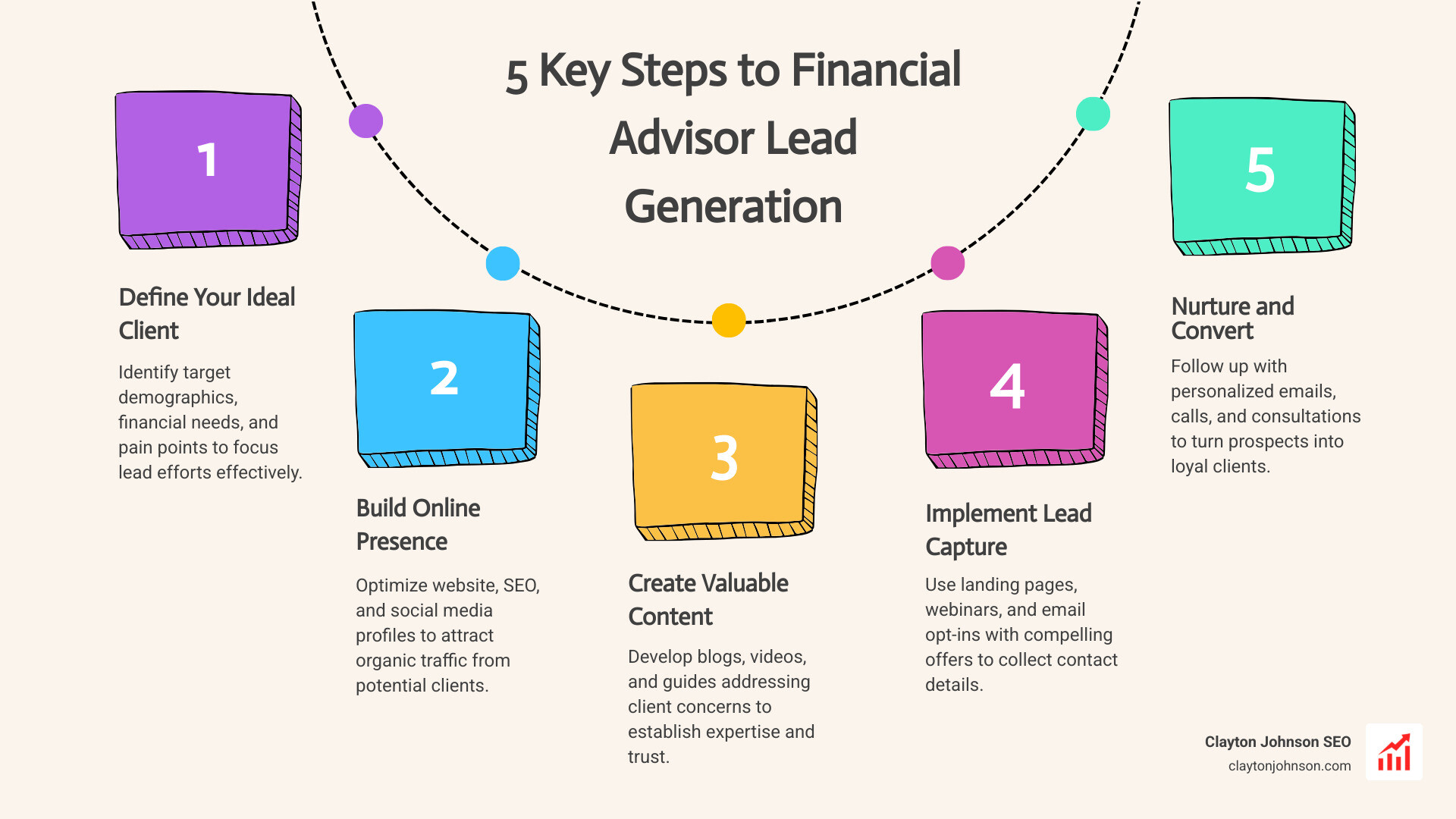
To build a sustainable practice, we have to look beyond the “low-hanging fruit.” While many advisors start with their immediate friends and family, true scaling happens when you build a repeatable engine. This engine is fueled by financial advisor lead generation strategies that balance traditional relationship-building with modern digital precision.
One of the most powerful foundations is the referral network. Research from Wharton shows that referred clients have a lifetime value that is 16% higher than non-referred clients. They stay longer, trust more, and often bring in more assets because the “social proof” has already been established by someone they trust.
However, relying only on referrals can be a trap. It’s passive. To take control, we recommend a multi-channel approach. This includes improving your wealth manager SEO to ensure that when a prospect hears your name, they find a professional, high-ranking digital presence that validates your expertise. Strategic partnerships with other professionals also serve as a “force multiplier,” sending a steady stream of qualified prospects your way without you having to hunt for every single one.
Maximizing Referrals and Word-of-Mouth
If you want more referrals, you have to stop waiting for them to happen by accident. As Alvin Carlos from District Capital Management points out, clients have busy lives. Even if they love your work, they might not realize you are actively looking for new business. He suggests a simple, direct approach: tell your clients you are looking to help a specific number of new people (e.g., “I’m looking to help 10 new families this year”).
To maximize this channel, consider these “active” tactics:
- CPA and Attorney Partnerships: These professionals are the “financial quarterbacks” for high-net-worth individuals. By establishing a reciprocal relationship, you can become their go-to recommendation for investment and retirement needs.
- Incentive Programs: While you must stay compliant with fee-sharing regulations, you can offer “soft” incentives like exclusive client appreciation events or educational dinners where clients are encouraged to bring a guest.
- Newsletter Prompts: Include a small, friendly “Who do you know?” section in every monthly update.
Leveraging Social Media for Financial Advisor Lead Generation
Social media isn’t just for teenagers anymore; it’s where the wealth is moving. Four in 10 advisors have added new clients through social media, and according to a 2024 Broadridge survey, 41% of advisors landed a client via social platforms—a significant jump from just a few years ago.
LinkedIn is the undisputed king for B2B and high-net-worth prospecting. To win here, you need more than a resume-style profile. You need a “Value-First” profile. Your headline shouldn’t just say “Wealth Manager”; it should say “Helping Business Owners Reduce Tax Liability and Secure Their Legacy.”
Market research is also easier on social media. You can join groups where your ideal clients hang out (like “Exit Planning for Founders”) and provide helpful, non-salesy advice. This builds “demand generation” before you ever ask for a meeting.
Digital Marketing and Content Authority
Your website is your storefront. But a storefront without a “hook” is just a window people walk past. This is where financial advisor lead generation meets content marketing. By creating high-value resources, you position yourself as an authority rather than a salesperson.
Lead magnets—like a “Retirement Readiness Checklist” or an “Estate Planning Guide for Tech Executives”—are essential. These are educational resources that prospects can access in exchange for their email address. Shawn Plummer, CEO of The Annuity Expert, has successfully used this strategy to capture a massive audience by providing specific, expert-level content that answers the exact questions his prospects are searching for.
Building this kind of authority is a marathon, not a sprint. To understand how this fits into your broader business goals, check out our essential guide to demand generation.
High-Impact Webinars and Educational Events
People trust advisors who teach. In fact, LeadingResponse data suggests that in 2026, education-based marketing is outperforming transactional lead buying for long-term ROI.
Webinars and local workshops allow you to demonstrate your personality and expertise simultaneously. While a digital lead from a Facebook ad might be “cold,” someone who sits through a 45-minute presentation on “Maximizing Social Security” is a “hot” lead with high intent.
- Virtual Q&As: These are low-cost and allow you to reach prospects outside your local community. 27% of the average advisor’s business now comes from clients outside their local area.
- Retirement Workshops: Traditional in-person seminars still convert at incredibly high rates for the 55+ demographic because they value the face-to-face connection.
Data-Driven Targeting and Predictive Intelligence
Why wait for a prospect to realize they need an advisor? With predictive intelligence, you can find them before the wealth event happens. McKinsey research shows that data-driven and AI-powered tools can increase lead generation by 50% or more.
Tools like Crunchbase and Altrata allow you to track “prospecting signals.” For example, if a local tech company just received a massive Series C funding round, the founders and early employees are likely heading toward a liquidity event. By reaching out with specialized advice on stock option planning before the IPO, you are miles ahead of the competition.
Evaluating Professional Lead Generation Services
Sometimes, you just need to turn on the tap. Professional lead generation services can provide a steady volume of prospects, but they aren’t all created equal.
| Platform | Model | Best For | Typical Cost |
|---|---|---|---|
| SmartAsset | Lead Aggregator | Volume & Scale | $50 – $150 per lead |
| Zoe Financial | Matching Service | High-Net-Worth | Revenue Share |
| Callbox | Outbound B2B | Business Owners/CFOs | Monthly Retainer |
When evaluating these services, you must weigh “Quality vs. Quantity.” A service that sends you 50 leads a month might sound great, but if 48 of them don’t have the assets to meet your minimums, it’s a waste of time. To learn more about how these costs impact your bottom line, see our resources on financial services marketing.
Pros and Cons of Third-Party Platforms
Using a service like SmartAsset AMP can put your prospecting on autopilot. The “pro” is obvious: you spend less time hunting and more time closing. However, the “con” is that these leads are often shared with other advisors, making speed-to-dial critical.
Zoe Financial, on the other hand, is much more exclusive. They have strict requirements (often 5+ years of experience and certifications like the CFP® or CFA®) and use a revenue-sharing model. This means you only pay if you win the client, but you’ll be sharing a portion of that revenue for the life of the relationship.
For fee-only advisors, joining the National Association of Personal Financial Advisors (NAPFA) is another way to gain visibility through their “Find an Advisor” search tool, which acts as a built-in lead generator for ethical, fee-only practices.
Nurturing Leads with Email and CRM Automation
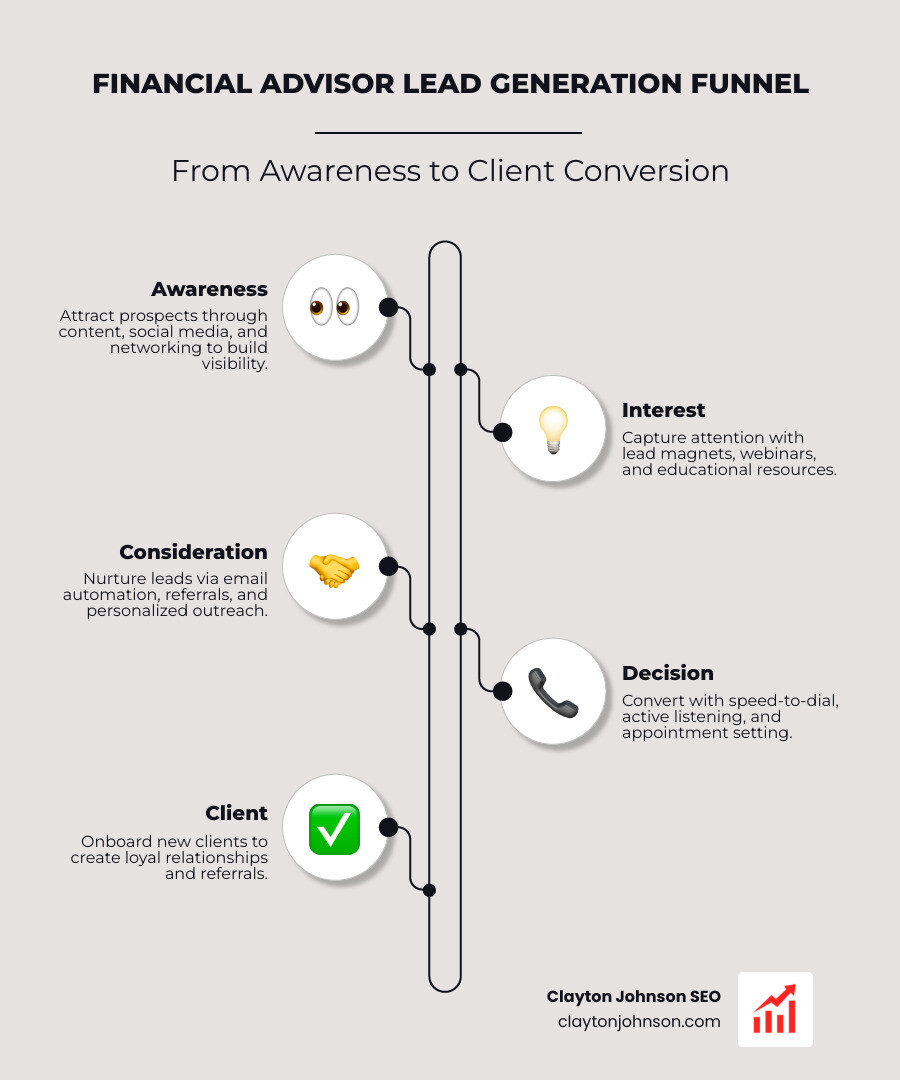
A lead isn’t a client until the paperwork is signed. Most leads require 5 to 7 “touches” before they are ready to book a meeting. This is where automation tools like AdvisorStream become invaluable.
Instead of manually emailing every prospect, you can set up “drip sequences”—a series of automated, personalized emails that share market updates, tax strategies, and success stories. A Fidelity client segmentation study found that advisors who segment their clients and personalize their content see significantly higher growth in AUM. If you aren’t personalizing your outreach, you’re leaving money on the table.
Best Practices for Converting Leads into Clients
Landing the lead is only half the battle. The “speed-to-dial” is perhaps the most important metric in financial advisor lead generation. If a prospect fills out a form on your site or an aggregator’s site, their interest is at its peak right now. Waiting 24 hours to call often results in a 50% drop in conversion rates.
You also need to ensure your sales and marketing are aligned. This means having clear financial value metrics to track which lead sources are actually profitable.
Mastering the Financial Advisor Lead Generation Sales Process
When you finally get that lead on the phone, don’t start with a pitch. Start with active listening. Top advisors use the “80/20 rule”—let the prospect talk 80% of the time.
The Advisor.com matching process emphasizes that successful advisors demonstrate an immediate understanding of the prospect’s specific pain points (e.g., “I see you’re concerned about the tax implications of your RSU vestings”). Once the meeting is set, your onboarding process should be seamless, reinforcing the professional image you built during the lead-gen phase.
Scaling Growth with Emerging AI Trends
AI is no longer science fiction; it’s a productivity tool. AI receptionists can now handle initial lead qualification and appointment setting 24/7, ensuring you never miss a weekend inquiry.
Furthermore, McKinsey data shows that personalization can grow revenues by 10% to 15%. AI can help you achieve this by analyzing prospect data to suggest the exact piece of content or “trigger” message that will resonate with a specific lead based on their career history or life stage.
Frequently Asked Questions about Financial Lead Gen
What is the average cost per lead for financial advisors?
Costs vary wildly by channel. A “shared” digital lead from an aggregator might cost $50 to $150. A “highly qualified” exclusive lead or a seminar attendee might cost $300 to $500. However, the more expensive leads often have a much higher conversion rate, leading to a lower overall Customer Acquisition Cost (CAC).
How do I ensure lead quality and compliance in financial services?
Compliance is non-negotiable. Always ensure your lead generation tactics—especially social media and email—include the necessary disclaimers and avoid “promissory” language. Using reputable platforms that have built-in compliance filters (like SmartAsset AMP) can help mitigate risk.
Are exclusive leads better than shared leads for wealth managers?
Exclusive leads eliminate competition, which is a huge advantage. However, they are significantly more expensive. Shared leads can be highly profitable if you have a system for “speed-to-dial” and a robust automated follow-up sequence to stay top-of-mind.
Conclusion
The difference between a stagnant practice and a thriving one often comes down to a single document: a marketing plan. Advisors with a defined strategy don’t just work harder; they work smarter, leveraging financial advisor lead generation systems that work even when they aren’t in the office.
As we look toward the future, the integration of AI, predictive intelligence, and specialized SEO will separate the leaders from the laggards. At Clayton Johnson SEO, we specialize in helping wealth management firms navigate this complex landscape. We don’t just want you to get “more leads”—we want you to get the right leads.
Ready to stop relying on luck and start building a predictable pipeline? Explore our specialized SEO services for wealth managers and let’s start growing your practice together.