Why a Long Tail Keyword Checklist Is Your Fastest Path to SEO Rankings
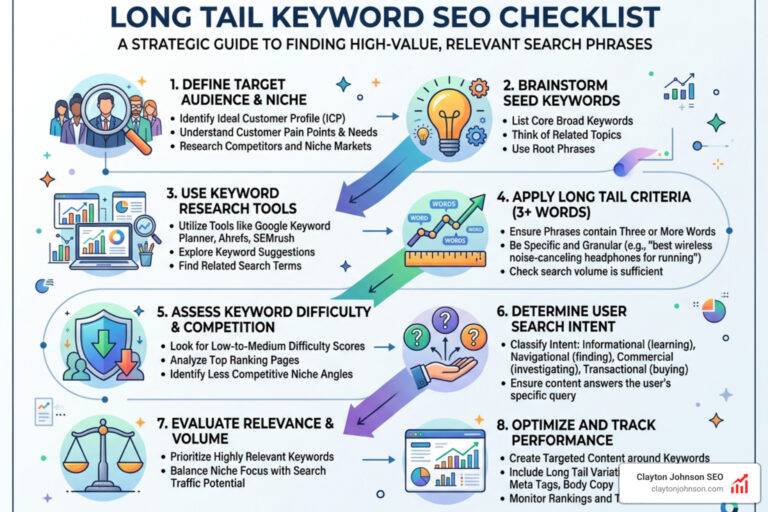
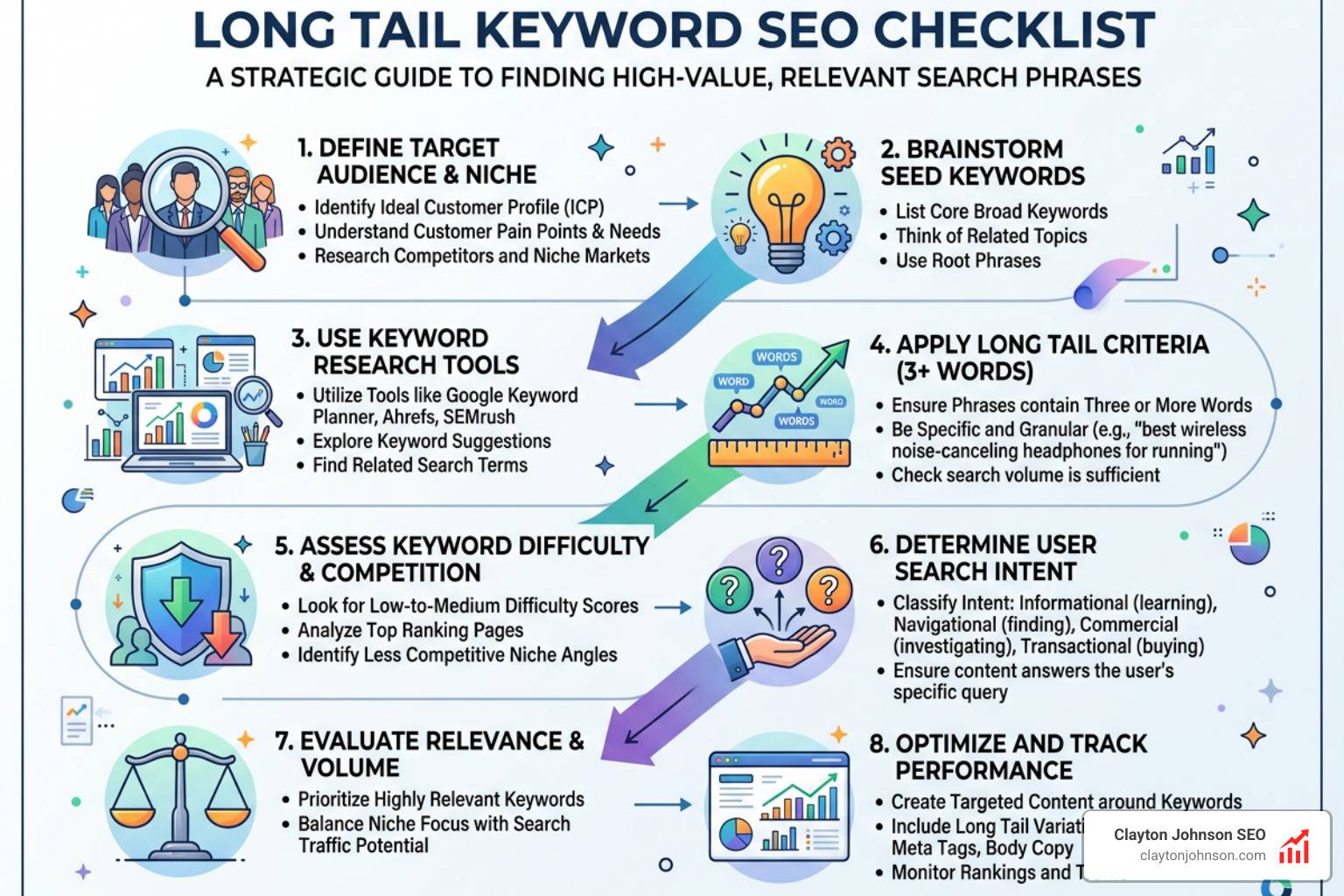
A long tail keyword checklist is the step-by-step framework SEOs use to find, validate, and target specific multi-word search phrases that drive qualified traffic with less competition. Here’s a quick overview of what a complete checklist covers:
- Define criteria – 3+ words, low competition, clear search intent
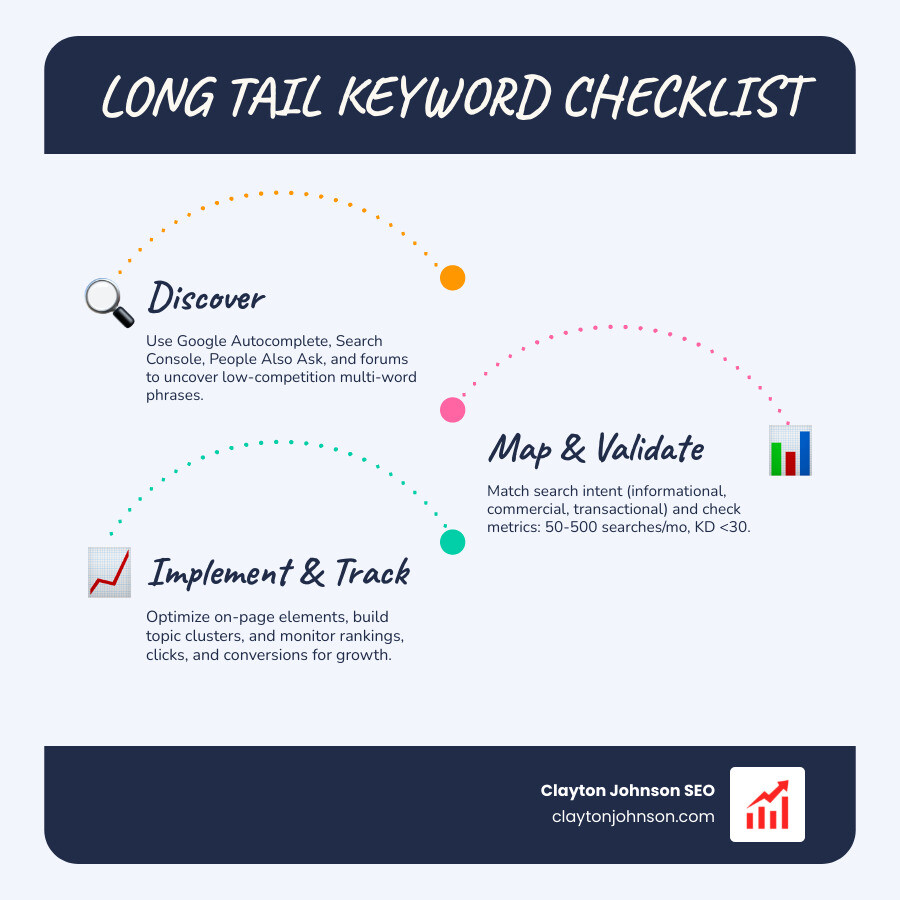
- Discover keywords – Google Autocomplete, Search Console, People Also Ask, forums
- Map intent – informational, commercial, or transactional
- Evaluate metrics – search volume (50-500/mo), keyword difficulty (under 30), CPC
- Implement on-page – title tags, H1/H2 headers, meta descriptions, body content
- Build clusters – group related keywords by topic and intent
- Track performance – monitor rankings, impressions, clicks, and conversions
Most business owners chase the same high-volume keywords as everyone else. They compete against massive brands, spend months waiting for results, and wonder why traffic never comes.
Long-tail keywords solve that problem.
They account for roughly 70% of all web searches. They convert at 2.5x the rate of short-tail keywords. And yet most businesses ignore them entirely.
Why? Because without a clear process, finding and using them feels overwhelming.
That’s exactly what this guide fixes.
I’m Clayton Johnson, an SEO strategist with nearly two decades of experience building keyword frameworks and content systems that generate measurable organic growth. I’ve used a long tail keyword checklist to help businesses across industries move from invisible to ranking — and I’ll walk you through the exact process here.
Long tail keyword checklist word list:
The Essential Long Tail Keyword Checklist for Modern SEO
To win at SEO today, we have to stop thinking about keywords as isolated strings of text and start seeing them as reflections of human needs. The “long tail” isn’t just a category; it is a distribution. If you look at a search demand curve, the “head” terms (like “shoes”) have massive volume but astronomical competition. The “tail” consists of billions of unique, lower-volume queries that, when added together, make up the vast majority of search traffic.

When we use a long tail keyword checklist, we are essentially choosing to play a game we can actually win. Instead of fighting for “marketing,” we target “email marketing strategy for small boutique hotels.” The latter has fewer people bidding on it, fewer massive websites dominating the results, and a much higher likelihood of converting a visitor into a lead.
| Feature | Short Tail Keywords | Long Tail Keywords |
|---|---|---|
| Word Count | 1-2 words | 3+ words |
| Search Volume | Very High | Low to Moderate |
| Competition | Very High | Low |
| Conversion Rate | Low (Browsing) | High (Buying) |
| Specificity | Vague | Highly Specific |
Targeting these terms is a strategic move. As we’ve noted in our guide on why long-tail keywords are your secret weapon, these phrases allow smaller sites to outmaneuver larger competitors by being more relevant to the specific question being asked.
Defining Your Long Tail Keyword Checklist Criteria
How do we actually define a “long tail” term? It is a common misconception that it is strictly about word count. While most are three words or longer, the true definition is based on search volume and specificity.
- Word Count: Generally 3 to 7 words. However, with the rise of voice search, some queries can be full sentences.
- Search Volume: We typically look for terms with 50 to 500 searches per month. While that sounds low, about 70% of search demand comes from long tail keywords across the web.
- Search Intent: This is the “why” behind the search. Does the user want to learn (Informational), find a specific site (Navigational), compare products (Commercial), or buy right now (Transactional)?
- Competition: We aim for a Keyword Difficulty (KD) score of under 30. This helps us avoid going head-to-head with the most dominant sites in the results from the start.
By following this criteria, we can find untapped keywords like a search engine ninja and identify the gaps where competitors are sleeping.
Discovery Methods for Your Long Tail Keyword Checklist
Finding these gems does not require a crystal ball; it requires using the tools already at our disposal. Here are the primary methods we include in our long tail keyword checklist:
- Google Autocomplete: Start typing your head term into the search bar. The suggestions that pop up are real queries people are searching for right now.
- Google Search Console (GSC): This is a goldmine. Look for phrases you already rank for on pages 2 or 3. These are low-hanging opportunities that may only need better optimization to reach page 1.
- People Also Ask (PAA): These boxes show related questions. Each question is a potential long-tail keyword or a sub-header for your content.
- Community Forums: Sites like Quora and Reddit are where people go to ask specific, nuanced questions. If someone is asking it there, they may also be searching for it on Google.
- Keyword Research Tools: Use established keyword tools to filter by word count, intent, and difficulty so you can identify opportunities faster.
Understanding why your SEO strategy needs these long-tail keyword tools is the difference between guessing and growing.
Mapping Search Intent and Buyer Personas
A keyword is useless if it does not align with your business goals. We use our long tail keyword checklist to map phrases to specific stages of the buyer’s journey.
- Informational (Top of Funnel): “How to improve conversion rates on Shopify.” These users are looking for answers. They might not buy today, but they are becoming aware of your brand.
- Commercial (Middle of Funnel): “Best email marketing tools for startups.” These users are comparing options. They know they have a problem and are looking for the best solution.
- Transactional (Bottom of Funnel): “Buy organic dog food for small breeds free shipping.” These users have their wallets out.
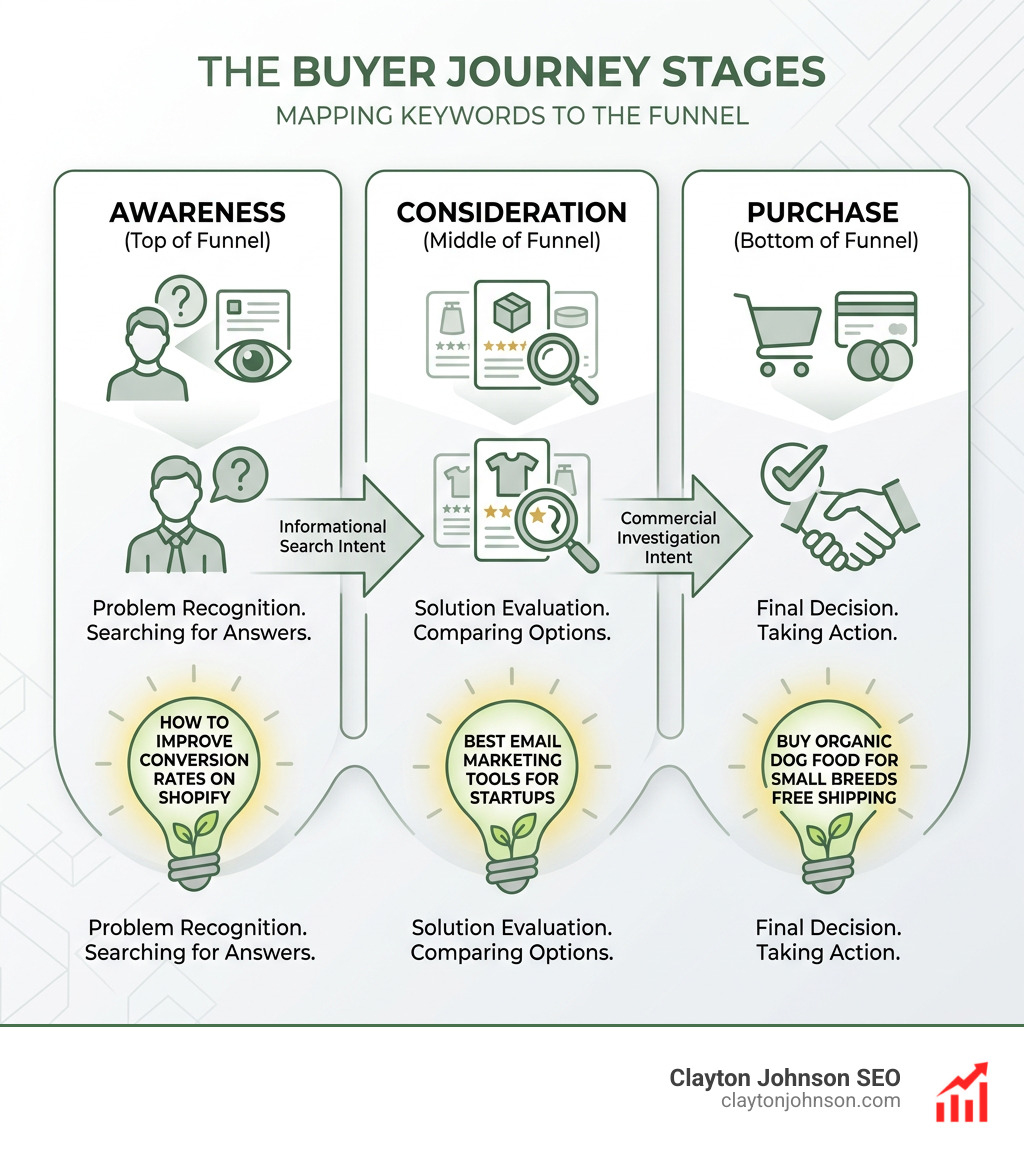
By mastering search intent targeting, we ensure that we attract qualified leads who are actually interested in what we offer, rather than just random traffic that bounces.
Implementing and Scaling Your Long Tail Strategy
Once we have our list, the next step in the long tail keyword checklist is implementation. In the era of AI search and semantic SEO, simply mentioning a keyword is not enough. We need to build topical authority. This means proving to search engines that we are not just optimized for a word; we are an expert on the subject.
Search behavior continues to reward intent and context. As covered in winning the AI search era, search engines now group related terms together. If you rank for “best hiking boots for wide feet,” you may also rank for “comfortable hiking shoes for broad feet” because Google understands they mean something similar.
On-Page Optimization and Content Placement
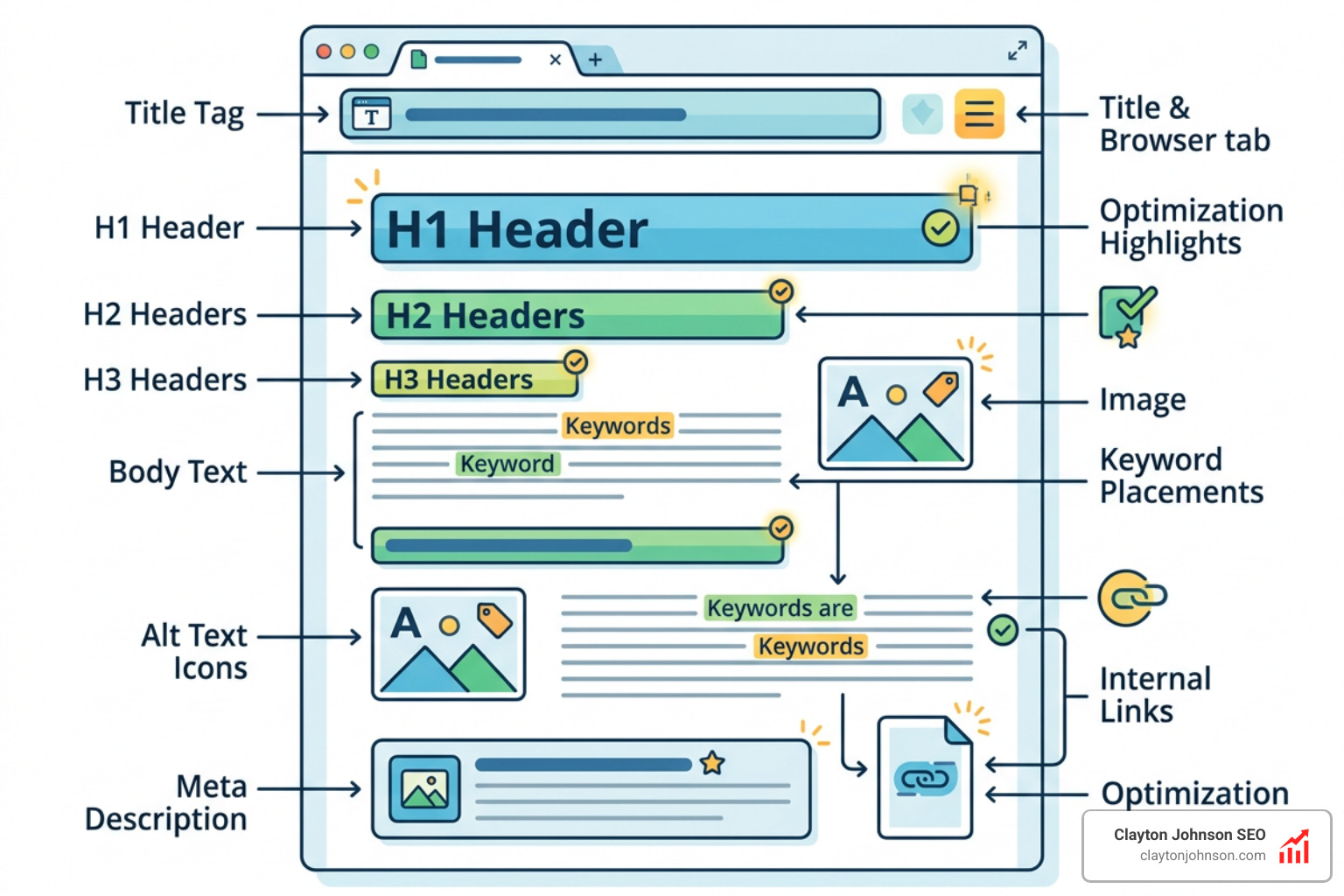
To make our long tail keyword checklist effective, we must place our keywords strategically without falling into the trap of keyword stuffing. Search engines penalize content that feels unnatural.
- Title Tags & H1s: Place your primary long-tail keyword here. It should be clear and compelling.
- Subheaders (H2s & H3s): Use secondary long-tail keywords or PAA questions as subheaders. This helps with skimmability and featured snippets.
- Meta Descriptions: While not a direct ranking factor, a well-placed long-tail keyword here can improve your Click-Through Rate (CTR).
- Body Text: Use the keyword naturally in the first 100 words and then sprinkle variations throughout.
- Images: Do not forget the alt text. Describe the image using a relevant long-tail phrase.
We have found that finding keywords with AI can make this process faster, as tools can suggest natural-sounding variations that fit smoothly into your narrative.
Building Topical Authority with Keyword Clusters
If you want to dominate a niche, you cannot just write one article. You need a system. We recommend the Hub-and-Spoke model (also known as topic clusters).
- The Hub: A comprehensive pillar page targeting a broad head term (e.g., “The Ultimate Guide to SEO”).
- The Spokes: Multiple smaller articles targeting specific long-tail keywords (e.g., “How to use a long tail keyword checklist“).
- Internal Linking: Link all the spokes to the hub and vice-versa. This tells Google that your site is a deep resource for that topic.
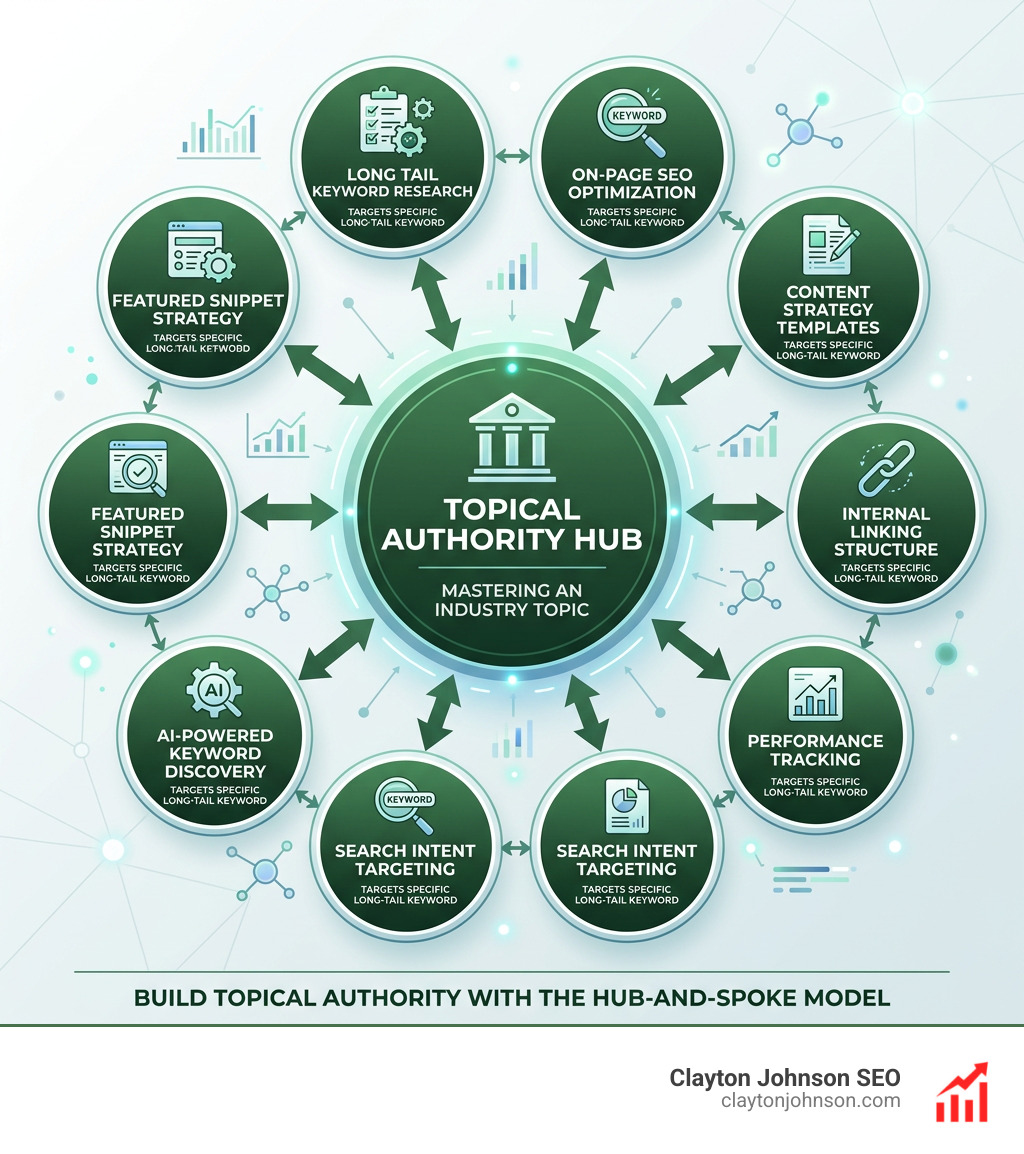
This approach is the core of a solid and growing SEO strategy. By mastering your keyword strategy, you create a web of content that is much harder for competitors to displace than a single standalone post. You can even use keyword strategy templates to standardize this across your entire content calendar.
Measuring Performance and Compounding Growth
The final step in our long tail keyword checklist is tracking. We do not just look at rankings; we look at business impact.
- Google Search Console: Monitor your Average Position and Impressions. If impressions are up but clicks are down, your title tag might need work.
- Google Analytics: Track the conversion rate of your long-tail pages. Because these users have higher intent, you should often see stronger conversion performance than on broader pages.
- ROI: Calculate the value of the traffic. If a long-tail keyword has a high CPC in paid search, ranking for it organically can function like ongoing earned visibility.
At Clayton Johnson SEO, we specialize in building these durable systems. We do not just chase vanity metrics; we build low-volume keyword strategies for high-volume profits. Our philosophy is simple: Clarity leads to Structure, which creates Leverage, resulting in Compounding Growth.
If you are ready to stop guessing and start building a scalable traffic engine, we can help. Whether it is technical content architecture or AI-augmented marketing workflows, we focus on the systems that drive measurable outcomes.
Learn more about our SEO services and how we can implement a custom long tail keyword checklist for your business.
Common Mistakes to Avoid with Long Tail Keywords
Even with a great long tail keyword checklist, it is easy to stumble. Here are the pitfalls we see most often:
- Ignoring Search Intent: Do not target a keyword just because it has volume. If someone searches “how to make a website” and you send them to a pricing page, they will leave immediately.
- Keyword Cannibalization: This happens when you have more than one page competing for the same keyword. It confuses Google and dilutes your ranking power.
- Over-Optimization: Trying to force an exact-match long-tail keyword into a sentence where it does not fit makes your writing look robotic. Always prioritize the reader.
- Neglecting the “Tail” of the Tail: Sometimes the best keywords have zero search volume in tools but show up in GSC. Trust your data over third-party tool estimates.
Real-World Success: Long Tail Keywords in Action
To wrap things up, let’s look at how this works in different industries:
- SaaS: Instead of “accounting software,” a company targets “free accounting software for non-profits.” This niche focus allows them to rank top 3 and attract users who are exactly the right fit for their specialized features.
- Ecommerce: A shoe retailer creates a guide for “best shoes for standing on concrete all day.” By addressing a specific pain point, they created a product round-up that converts significantly higher than their general “running shoes” category.
- Local Business: A plumber targets “emergency water heater repair in Austin open Sunday.” This specific query matches a high-urgency user who is ready to book a service call immediately.
The power of a long tail keyword checklist is that it levels the playing field. You don’t need a million-dollar budget to win; you just need to be the most helpful answer to a specific question.
By focusing on clarity and structure, you can turn a fragmented marketing effort into a coherent growth engine. Start with your first seed keyword today, follow the checklist, and watch your organic authority compound over time.