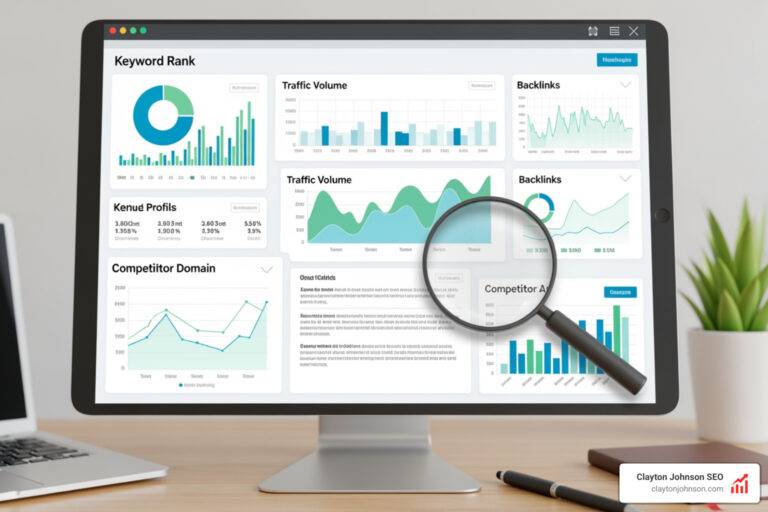
An SEO strategy is your step-by-step plan for getting more of the right people to find your business through search engines — without paying for ads.
Here’s what a solid SEO strategy covers:
- Keyword research — finding the words your customers actually type into search
- Content creation — publishing pages that answer those searches better than anyone else
- Technical SEO — making sure search engines can crawl and index your site
- Off-page authority — earning backlinks and mentions that build trust
- Generative engine optimization (GEO) — getting cited in AI search tools like ChatGPT and Google AI Overviews
- Tracking and refinement — measuring what works and improving over time
The payoff is real. Research shows that for every dollar spent on SEO, businesses earn an average of more than $22 back. One acupuncture clinic in New York City quadrupled its revenue within two years of committing to SEO. And with 69% of all clicks going to just the first five organic results, where you rank genuinely determines whether customers find you — or your competitor.
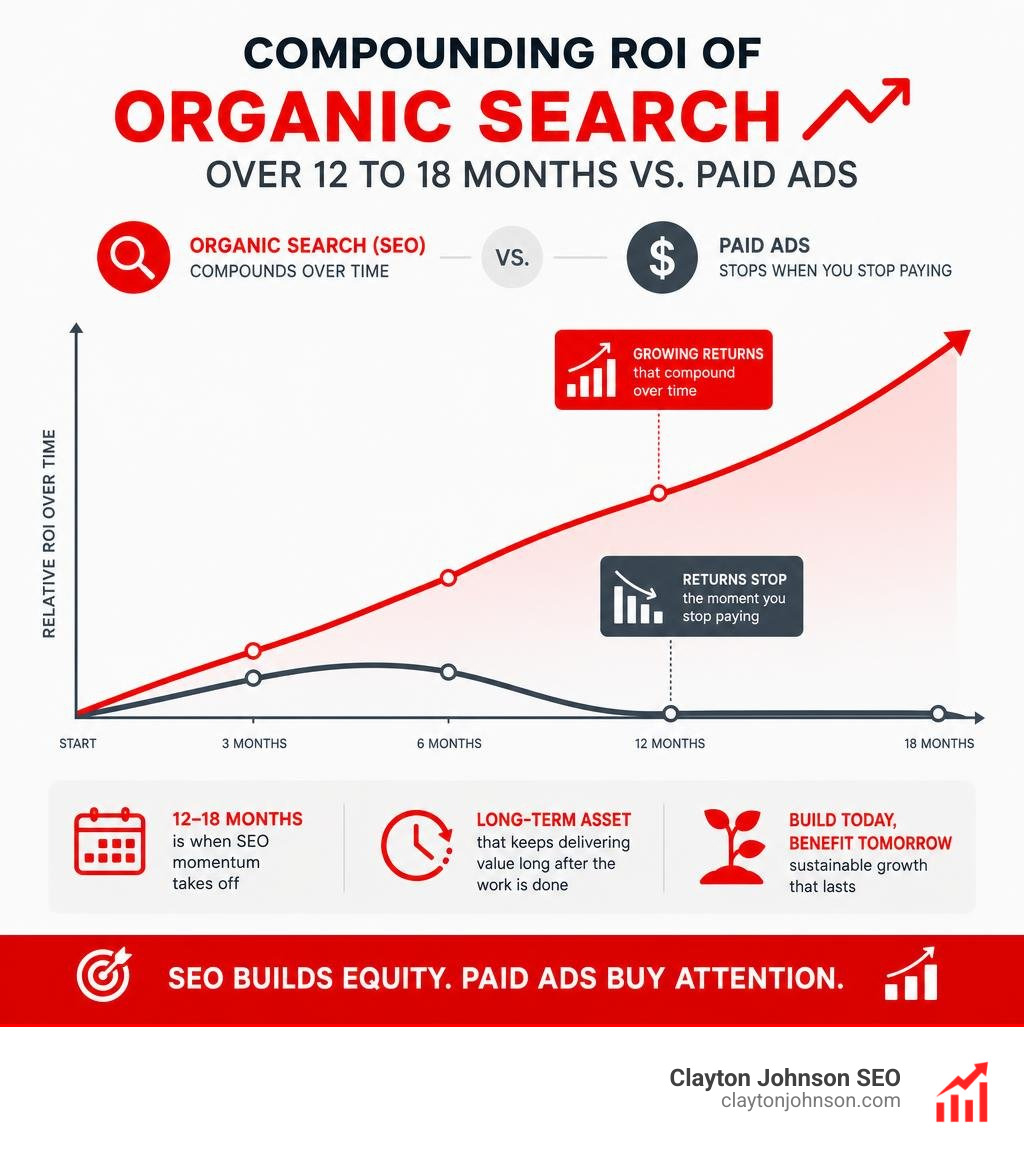
What makes SEO different from other marketing? It compounds. A paid ad stops the moment you stop paying. A well-optimized page keeps earning traffic for months or years.
But here’s the honest truth: most small businesses don’t have a strategy. They publish a few blog posts, tweak a title tag here and there, and wonder why nothing moves. That’s not SEO — that’s guessing.
This guide walks you through everything you need to build an SEO strategy that actually works, including how to adapt for the AI-powered search landscape of 2026.
I’m Clayton Johnson, founder of Clayton Johnson SEO, and I’ve spent more than a decade building SEO strategies for small businesses, local service providers, and growing brands — helping them turn search visibility into real, measurable revenue. In this guide, I’ll share the same framework I use with my own clients, so you can build a system that works long after you publish it.
What is an SEO Strategy and Why Does It Matter?
At its core, an seo strategy is a documented, long-term roadmap. It is the architectural plan that guides how we structure, write, and promote our digital assets to align with search engine algorithms and user expectations. Without a clear strategy, actions like keyword research and content creation become isolated tasks that rarely move the needle on your bottom line.
To build sustainable search engine visibility, you must look at search as a complete ecosystem. A well-constructed strategy ensures that every page you publish has a clear purpose, connects logically to your other content, and serves a specific stage of your buyer’s journey.
When you treat organic search as a systematic channel rather than a series of quick tricks, you build a sustainable moat around your brand. To understand how all these moving pieces fit together, check out The Only Complete Guide to Search Engine Optimization You’ll Ever Need.
SEO Strategy vs. Content Marketing
Many marketers use “content marketing” and “SEO strategy” interchangeably, but they are distinct disciplines that must work in tandem.
- Content Marketing is the broader practice of creating and distributing valuable, relevant, and consistent content to attract and retain a clearly defined audience. Its primary goals are building brand equity, fostering audience trust, and nurturing customer relationships.
- An SEO Strategy is the technical and structural framework that ensures this content is actually discoverable on search engine results pages (SERPs). It focuses on site architecture, crawlability, search intent matching, and domain authority.
If you publish high-quality content without an SEO strategy, your pages remain isolated islands that search engines may never index or rank. Conversely, if you optimize your site for search engines without creating valuable content, users will immediately bounce, destroying your rankings anyway. To dive deeper into these foundational concepts, explore our guide on SEO 101.
The Compounding Value of Organic Search in 2026
In July 2026, the digital advertising landscape is more expensive and fragmented than ever. Google continues to dominate, garnering over 70% of US traditional search ad spending—which is roughly ten times the size of Microsoft’s share. This concentration makes pay-per-click (PPC) campaigns incredibly costly for competitive terms.
Organic search engine marketing, however, offers compounding value. While paid ads stop delivering traffic the second your budget runs out, a well-ranked organic page continues to capture high-intent visitors day after day. For eCommerce brands, this channel is vital: approximately 39% of global traffic to eCommerce websites originates from search engines.
Furthermore, organic search leads boast exceptionally high conversion rates compared to cold outbound channels. By aligning your business goals with user search patterns, you build a marketing engine that grows more efficient over time. To learn how to turn this traffic into revenue, read The Ultimate Guide to SEO Marketing Success.
The Core Pillars of a Modern SEO Strategy
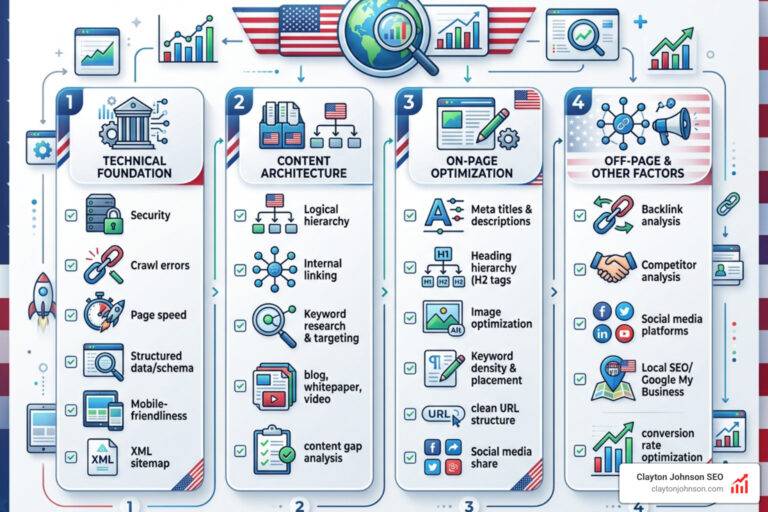
A successful seo strategy in 2026 is built on four core pillars. To achieve long-term rankings, you cannot rely on just one of these areas; they must work together as a unified system. For an introduction to these core concepts, refer to An Absolute Beginner’s Guide to Mastering Core SEO.

Technical SEO: The Foundation of Crawlability
Technical SEO is the infrastructure of your website. If search engine crawlers cannot access, read, and index your pages, even the most brilliant content will remain invisible.
The primary technical elements we must monitor and optimize include:
- Crawl Budget and Indexation: Ensuring search engines can efficiently navigate your site. We use clean XML sitemaps and configure robots.txt files to guide crawlers away from low-value utility pages.
- Mobile-First Indexing: With 58% of global searches coming from mobile devices, search engines prioritize the mobile version of your site for indexing and ranking. Responsive design is no longer optional; it is the baseline.
- Core Web Vitals: Google measures user experience through metrics like Largest Contentful Paint (LCP), First Input Delay (FID), and Cumulative Layout Shift (CLS). Optimizing images, leveraging browser caching, and minimizing heavy scripts can yield traffic improvements of 18% to 25% on content-heavy sites.
- Security: Serving your site over HTTPS is a standard security requirement that search engines expect.
For official technical requirements and documentation, keep an eye on the updates provided by Google Search Central.
On-Page Optimization and Content Quality
On-page SEO involves optimizing individual web pages to rank higher and earn more relevant traffic. Today, search engines prioritize helpful, human-first content that demonstrates deep subject-matter expertise.
- E-E-A-T Framework: Evaluated heavily in Google’s Search Quality Rater Guidelines, this framework looks for Experience, Expertise, Authoritativeness, and Trustworthiness. We optimize for this by including verified author bios, citing credible primary sources, and presenting original data.
- HTML Elements: Every page must feature a descriptive, front-loaded title tag (kept under 60 characters) and an engaging meta description (140 to 160 characters) that acts as ad copy to improve click-through rates (CTR).
- Heading Hierarchy: Using a logical hierarchy (H1, H2, H3) helps search engines parse the structure of your content.
- Internal Linking: Strategically linking your pages distributes page authority (PageRank) across your site and helps search engines understand topical relationships. To design a robust system, read The Ultimate Guide to Internal Linking Strategy.
Off-Page Authority and Trust Building
Off-page SEO focuses on activities outside your website that signal credibility and authority to search engines. Think of off-page optimization as the digital equivalent of word-of-mouth referrals.
- Backlinks: High-quality links from authoritative, relevant websites remain one of the most powerful ranking signals. A single editorial backlink from a highly respected industry publication moves the needle far more than dozens of low-quality directory links.
- Digital PR: Earning organic mentions by contributing expert commentary to journalists (using platforms like Qwoted or Help a B2B Writer) or publishing original research reports that industry blogs naturally want to cite.
- Brand Mentions: Even unlinked brand mentions on reputable sites help search engines associate your business with specific topics, boosting your entity authority.
Step-by-Step Framework to Build Your SEO Strategy
Now that we understand the core pillars, let’s look at the step-by-step framework to execute this in your business. This process works whether you are a local service provider or managing an enterprise-level site. For larger organizations, we have tailored our approach in SEO Strategy for Enterprises.
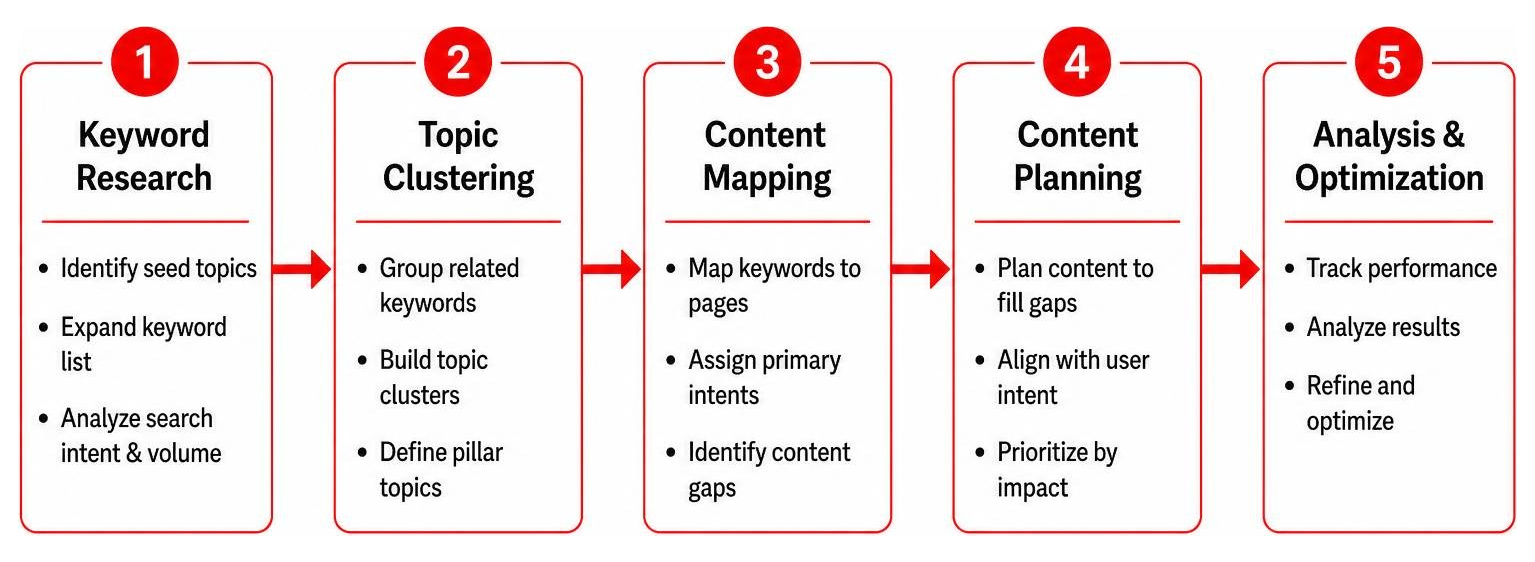
Step 1: Keyword Research and Topic Clustering
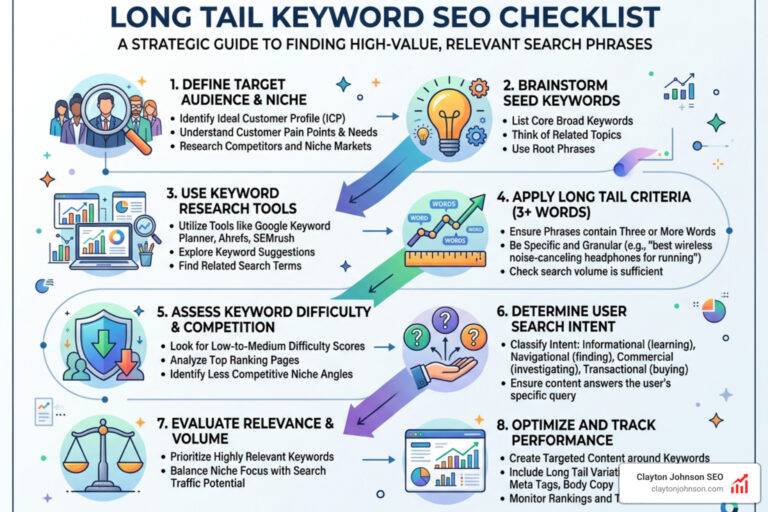
The foundation of any search strategy is finding out exactly what your target audience is looking for. We begin by identifying 5 to 15 core “seed” topics that represent your business’s primary offerings.
From there, we expand these seeds into comprehensive topic clusters:
- Find Long-Tail Keywords: Long-tail keywords (phrases containing 3 to 6 words) account for over 70% of all search volume. They typically have lower keyword difficulty and higher conversion intent.
- Evaluate Search Volume vs. Difficulty: Target highly relevant, lower-competition terms first to build early momentum.
- Group by Topical Authority: Instead of writing separate, disjointed articles for every single keyword variation, group related terms into intent clusters. This allows you to build a comprehensive map of your niche.
To master this step, read our complete guide on The Ultimate Guide to Keyword Strategy.
Step 2: Aligning Search Intent with Your SEO Strategy
Search intent is the why behind a user’s search query. If your page does not match the exact intent of the searcher, it will not rank.
To align your seo strategy with user expectations, we divide search queries into four primary intent types:
- Informational Intent (52.65% of searches): The user is looking for answers, guides, or definitions (e.g., “how to build an SEO strategy”). We target these with comprehensive blog posts, guides, and tools.
- Navigational Intent (32.15% of searches): The user is looking for a specific website or brand (e.g., “Clayton Johnson SEO login”).
- Commercial Intent (14.51% of searches): The user is investigating products or services but isn’t quite ready to buy yet (e.g., “best SEO agencies in 2026” or “Ahrefs vs Semrush”). We target these with comparison guides, reviews, and listicles.
- Transactional Intent (0.69% of searches): The user is ready to make a purchase or sign up immediately (e.g., “hire SEO agency”). We target these with optimized service, product, and landing pages.
To ensure your content matches what users are looking for, read The Ultimate Guide to Mastering Search Intent Targeting.
Step 3: Creating and Optimizing High-Value Content
Once you have mapped your keywords to specific search intents, it’s time to create your content.
We utilize a pillar-and-cluster model:
- Pillar Pages: Comprehensive, high-level guides (typically 2,500 to 5,000 words) that cover an entire topic broadly.
- Cluster Articles: In-depth satellite pieces (1,500 to 3,000 words) that dive deep into specific subtopics and link back to the pillar page.
When writing, we must prioritize depth over sheer volume. The “publish 20 thin posts a month” model is dead. Instead, focus on publishing 4 to 6 incredibly thorough, high-quality resources.
Include first-party evidence like real screenshots, original data, and case studies. Finally, updating existing content is often your highest-ROI activity; refreshing underperforming pages with new stats and updated intent matches can double your traffic in a fraction of the time it takes to write new content from scratch.
Advanced Tactics: Generative Engine Optimization (GEO)
As we navigate 2026, the search landscape is undergoing a massive shift. Generative search engines and AI platforms are changing how users find information online.
At least two-thirds of buyers now start their research with AI tools. To capture this highly valuable traffic, we must optimize for generative engine visibility alongside traditional search. For a complete look at this shift, read The No-Nonsense Guide to AI SEO.

Optimizing for LLMs and AI Overviews
Generative Engine Optimization (GEO) focuses on making your content easily readable, synthesizable, and citeable by Large Language Models (LLMs) like ChatGPT, Gemini, and Claude.
To increase your citation share in AI-generated answers, implement these targeted tactics:
- Provide Direct Answers Upfront: Place clear, factual, and direct answers in the first 200 words of your informational pages. AI crawlers have a strong recency bias and pull heavily from the top of the page.
- Leverage Structured Data: Implement schema markup (such as Article, Product, Organization, and FAQ schema) to help AI engines easily identify entities and relationships.
- Use Clear, Entity-Rich Language: Write with precise noun phrases and clear structures (tables, bullet lists, and comparison frameworks) that LLMs can easily parse and display.
- Maintain an llms.txt File: Creating a clean text file at your root directory helps signal to AI crawlers which parts of your site contain the most authoritative, up-to-date data.
Measuring and Refining Your SEO Strategy
As search evolves, our tracking methods must evolve too. We can no longer rely solely on traditional rank-tracking charts. Instead, we use Google Analytics 4 (GA4) and Google Search Console (GSC) to monitor business-aligned KPIs.
| Metric Type | Traditional SEO Metrics | AI-Era Search Metrics |
|---|---|---|
| Visibility | Keyword Rankings, Total Organic Impressions | AI Citation Share, Share of Voice across topic clusters |
| Acquisition | Organic Click-Through Rate (CTR) | Assisted Conversions, Branded Search Volume Trends |
| Behavior | Bounce Rate, Session Duration | Core Web Vitals, User Engagement Rate |
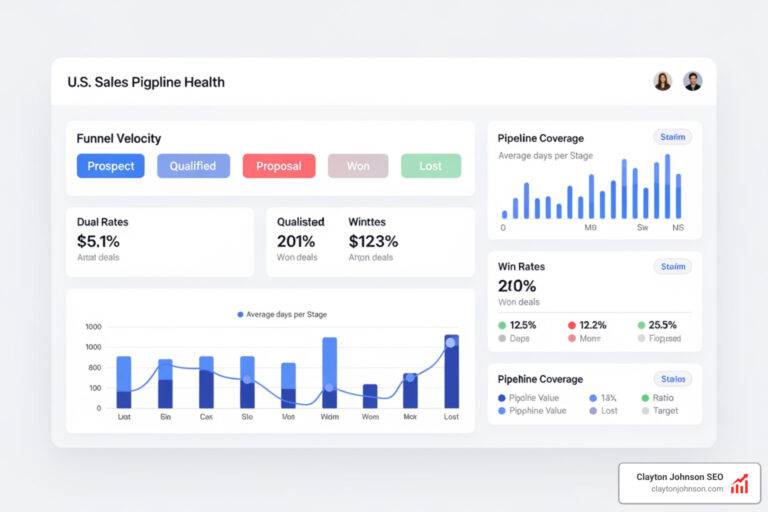
| Business Impact | Last-Click Conversions | Organic Pipeline Value, CRM-attributed Revenue |
Frequently Asked Questions about SEO Strategy
How long does it take to see results from an SEO strategy?
Most businesses begin to see early movement in search rankings within 3 to 6 months of executing a structured strategy. Technical fixes and content updates can show results in a matter of weeks, while building high-authority backlinks and dominating competitive, high-volume keywords typically requires a consistent effort over 6 to 12 months.
Does AI-generated content hurt search engine rankings?
No, search engines do not inherently penalize AI-generated content. What hurts rankings is low-quality, generic, or repetitive content that fails to provide real value to the user. To rank consistently, you must apply human editorial oversight to ensure accuracy, add unique insights, and incorporate personal brand experience (E-E-A-T).
What is the difference between SEO and GEO?
Traditional SEO optimizes your website to rank in the classic “blue links” of search engine results pages. Generative Engine Optimization (GEO) focuses on getting your brand cited, summarized, and recommended within AI-synthesized search results and conversational LLM responses.
Conclusion
Building a successful seo strategy in 2026 requires balancing technical health, high-quality human-first content, off-page authority, and cutting-edge AI visibility. When these pillars work in harmony, they build a compounding marketing asset that drives consistent, high-intent traffic to your business for years to come.

At Clayton Johnson SEO, we help businesses map and understand their target audiences through strategic content and high-impact search services. We design custom search systems that bridge the gap between technical execution and real business revenue.
Ready to build an organic engine that scales? Explore The Ultimate Guide to AI-Driven SEO Strategy and Systems and let’s start growing your digital footprint today.