Why a Positioning Map SEO Strategy Changes How You Compete Online
A positioning map SEO strategy is one of the most powerful tools a small business owner can use to stop guessing and start winning in search results.
Here’s what it means in plain terms:
- A positioning map is a visual framework that shows where your content, brand, and pages sit relative to competitors in search results
- It maps your topics, keywords, and pages by search intent, content gaps, and competitive overlap
- It replaces scattered keyword lists with a clear, connected picture of your entire niche
- It helps you find uncontested content spaces where you can rank faster and with less effort
Why it matters right now: Organic search results capture roughly 99% of all search clicks — about 4.6 billion per day — while paid ads receive just 16.4 million. The businesses that build a structured, strategic presence in organic search win a disproportionate share of that attention.
Traditional keyword research hands you a flat list of terms. A positioning map shows you how those terms connect, which ones your competitors own, and exactly where the open territory is.
Think of it like this: a keyword list is a grocery receipt. A positioning map is the store layout — and knowing the layout is what helps you move faster than everyone else.
Most SEO strategies fail not because of bad content, but because there’s no unified view of how everything fits together. Keyword spreadsheets, content calendars, and competitor notes all live in separate tabs with no clear picture of the whole.
A positioning map fixes that.
I’m Clayton Johnson SEO, an SEO strategist and founder of SmallBizSEO with over a decade of experience helping small and local businesses build durable search visibility through structured content systems — including developing and executing positioning map SEO strategy frameworks for businesses across competitive markets. This guide pulls from that experience to give you a practical, step-by-step path from scattered keywords to a connected, authoritative content presence.
Defining the Positioning Map SEO Strategy
To understand how a positioning map SEO strategy works, we must first look at what traditional keyword research gets wrong.
Traditional keyword research is linear. It generates flat spreadsheets of keywords sorted by search volume and keyword difficulty. This approach treats search queries as isolated targets. It tells you what people are searching for, but it hides the relationships between those topics, how they align with your brand perception, and where your competitors have established their market share.
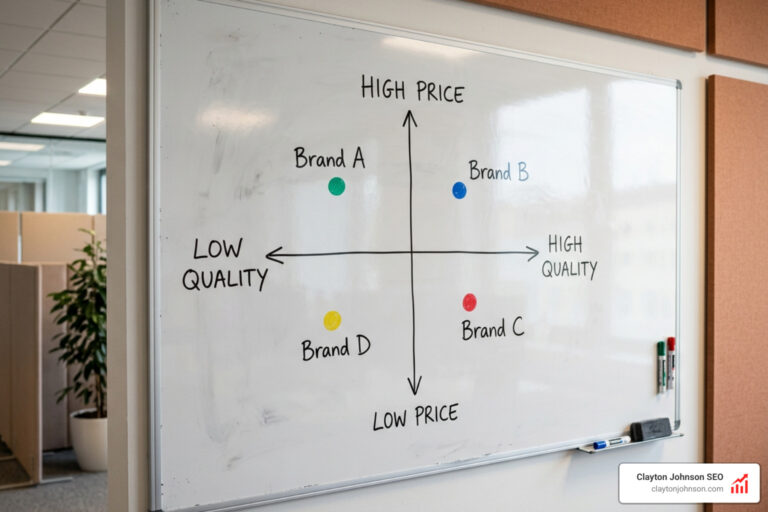
An SEO positioning map, by contrast, is a multidimensional planning model. It visualizes your search landscape across two or more strategic axes—such as user intent depth (from broad informational queries to high-intent commercial terms) versus competitive density. By plotting your existing content and your competitors’ pages on this matrix, you can see exactly where you stand in the minds of searchers and search engine algorithms.
This approach bridges the gap between traditional brand positioning and modern technical SEO. It forces us to ask: What unique space does our brand own in search, and how do we build the exact topical authority needed to claim it?
To dive deeper into how visual maps clarify your market position, read our guide on Competitive Positioning Map Demystified. If you want to explore the broader strategic frameworks that govern how brands establish their unique value, check out The Ultimate Guide to Market Positioning Models.
Core Components of an SEO Positioning Map
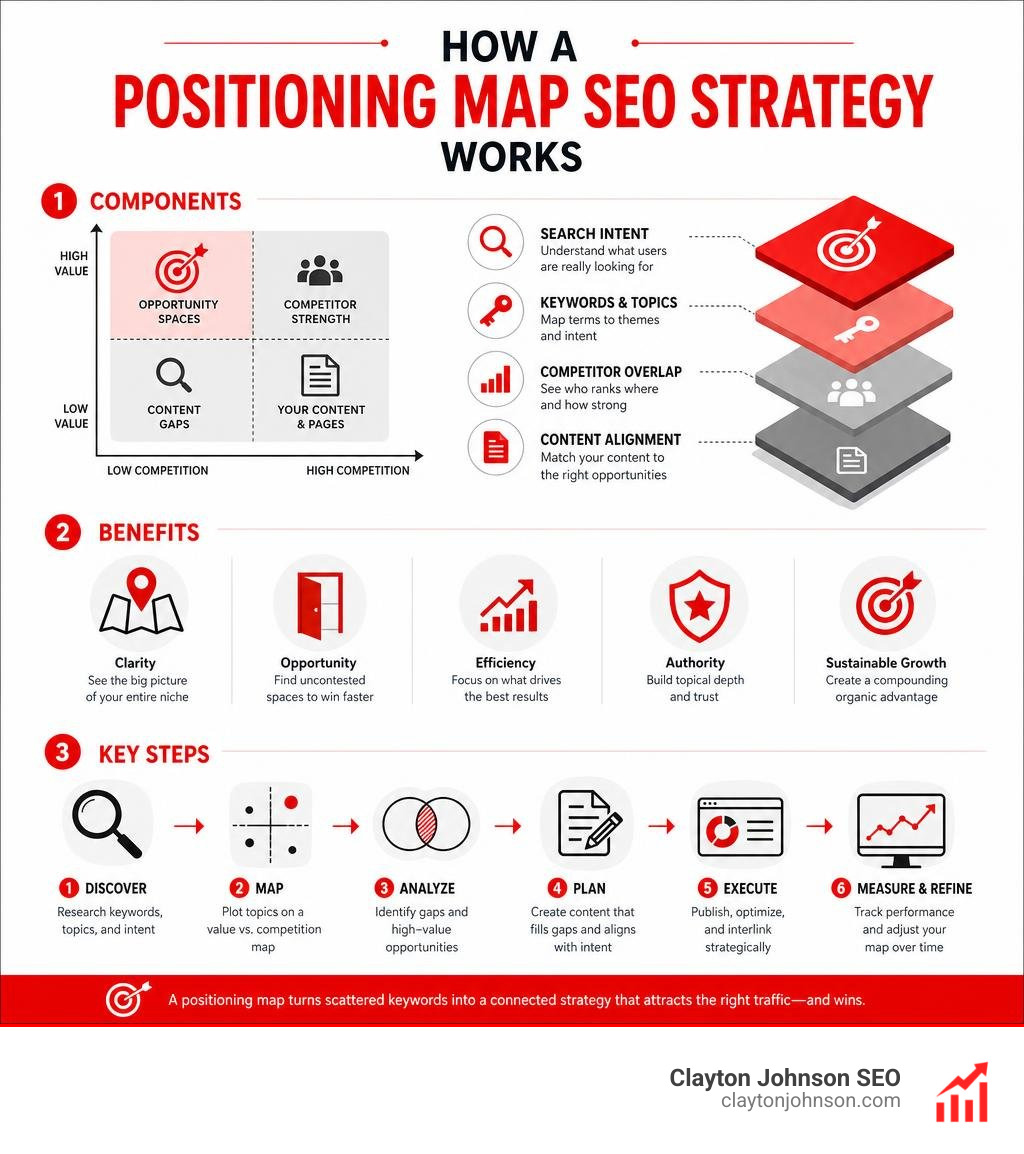
A high-performing SEO positioning map relies on a structured, interconnected framework rather than a random collection of articles. When we build these maps for our clients, we focus on four primary pillars:
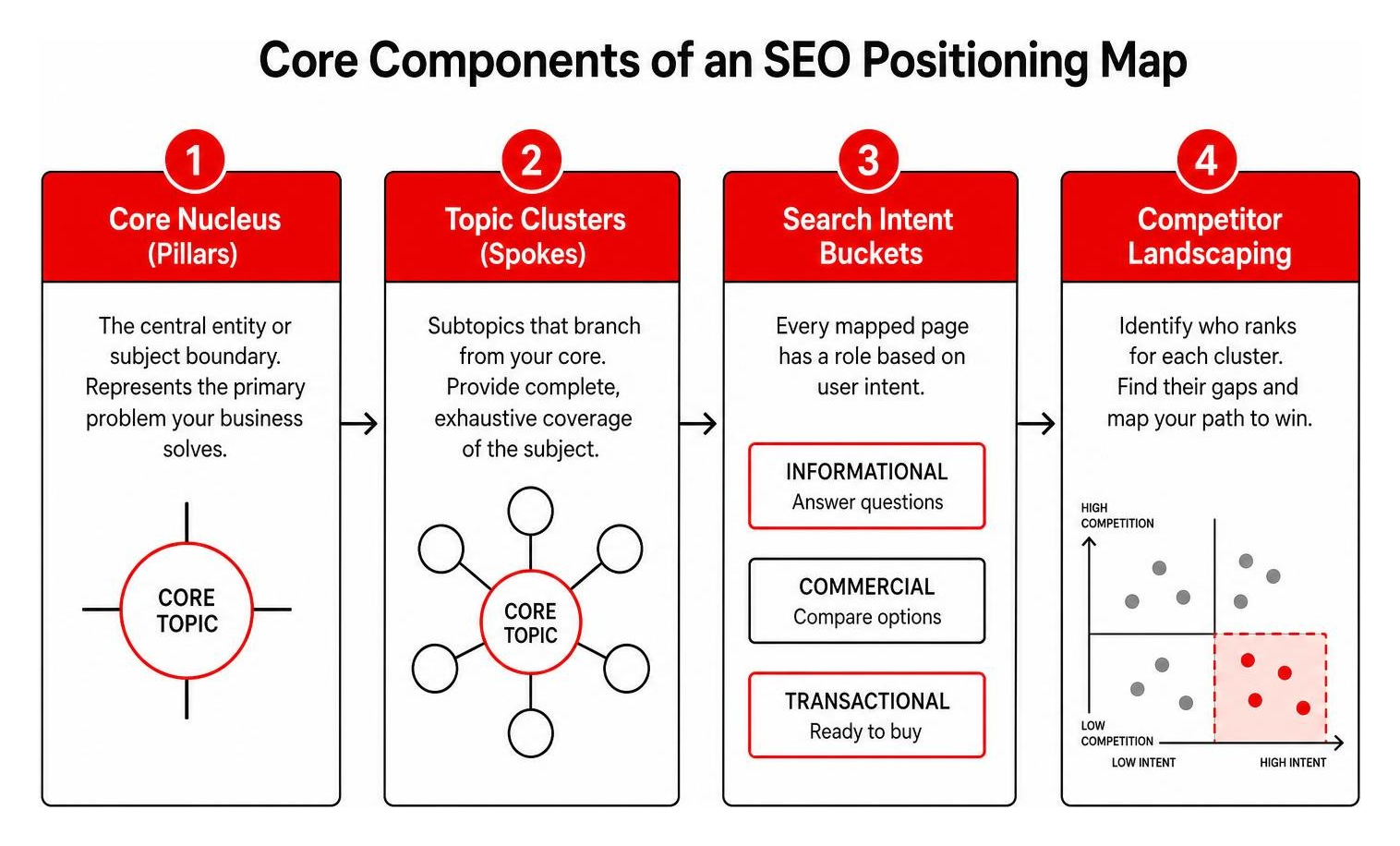
- The Core Nucleus (Pillars): This is the central entity or subject boundary of your business. It represents the primary problem your business solves, rather than just the products you sell.
- Topic Clusters (Spokes): These are the subtopics that branch out from your core nucleus. They provide complete, exhaustive coverage of the subject.
- Search Intent Buckets: Every mapped page must be assigned a specific role based on user intent—whether it is informational (answering questions), commercial (comparing options), or transactional (ready to buy).
- Competitor Landscaping: This layer identifies who currently ranks for these clusters and highlights where they are weak, allowing you to visually map out your path to victory.
By organizing your site this way, you create a cohesive semantic network. This structure makes it incredibly easy for search engines to understand your site’s relevance and authority.
To see how this visual structure compares to classic business frameworks, read about Visualizing Your Competitive Edge with a Strategy Canvas. Once you are ready to translate these visual insights into real-world marketing assets, our guide on Positioning Strategy from Development to Communication will walk you through the process.
Identifying Content Gaps and Niche Opportunities
The primary benefit of a visual positioning map is its ability to highlight what isn’t there. When you plot your competitors’ content on a matrix of content depth versus search intent, you will quickly notice empty quadrants.
These empty quadrants represent your market opportunities. For example, you might find that while your competitors have written dozens of shallow, high-volume blog posts targeting informational keywords, none of them have created a comprehensive, step-by-step procedural guide that addresses middle-of-funnel buyers.
By identifying these content gaps, you can focus your resources on creating high-value, differentiated content that addresses underserved user needs. This is how smaller websites consistently outrank massive competitors: they find the open spaces and cover them with unmatched depth.
To learn more about finding your unique competitive angle, read our guide on The Art of Being Different and Better. If you want a step-by-step playbook on how to use these gaps to outperform your search rivals, check out How to Position Your Brand So Competitors Cry.
Aligning Content with User Intent and Business Goals
An SEO strategy that generates millions of visits but zero revenue is a failure. A successful positioning map ensures that every piece of content you plan has a clear, documented path to a commercial outcome.
We must map our content directly to the buyer’s journey. Consider this: 47% of B2B buyers consume three to five pieces of content before they ever engage with a salesperson. If your content only answers basic, top-of-funnel questions, those buyers will leave your site and convert on a competitor’s site when they are actually ready to buy.
Your positioning map should clearly outline how a user moves from an informational guide, to a comparison checklist, and finally to a high-converting product page. By defining these internal linking pathways at the architectural stage, you guide the user naturally through their buying journey while boosting your conversion rates.
For a comprehensive look at establishing a brand position that resonates with your ideal audience, see our detailed guide, Stop Blending In: A Guide to Developing and Establishing a Brand Positioning.
How to Build and Execute Your SEO Positioning Map
To help you visualize the shift from old-school SEO tactics to a modern positioning map approach, let’s compare the two models directly:
| Feature | Traditional Keyword Mapping | SEO Positioning Map Strategy |
|---|---|---|
| Primary Format | Linear spreadsheet of keywords | Multidimensional visual matrix and semantic network |
| Core Focus | Individual search volume and rankings | Topical authority, entity coherence, and user intent |
| Competitor Analysis | Checking individual keyword difficulties | Mapping competitor content coverage to find gaps |
| Internal Linking | Added retroactively or randomly | Designed into the architecture from day one |
| AI Resilience | Low (susceptible to AI search summaries) | High (built on complex, interconnected expertise) |
To successfully execute this strategy, you need the right tools and templates. While visual mind-mapping software can help you brainstorm your core nucleus and topic branches, the real work happens in a dedicated tracking document—typically a structured Google Sheet or Airtable. This document serves as your single source of truth, tracking everything from target search intent and competitor URLs to internal linking rules and publication status.
For a deeper dive into integrating these concepts into your overall digital marketing framework, explore our article on Strategic Positioning SEO Strategy. To master the high-level principles behind this approach, read The Definitive Guide to Competitive Positioning.
Step-by-Step Execution of a Positioning Map SEO Strategy
Building your first SEO positioning map doesn’t have to be overwhelming. Here is our step-by-step process to get you started:
- Define Your Subject Boundary: Identify the core problem your business solves. Ensure it is narrow enough to own, but broad enough to support 15 to 30 highly related pages.
- Gather Market Intelligence: Collect search queries, customer questions, and competitor sitemaps. Look beyond traditional keyword tools—pull data from sales calls, support tickets, and online forums.
- Cluster Keywords by SERP Overlap: Group your keywords based on actual search engine results. If Google displays 4 to 6 of the same URLs in the top 10 results for two different keywords, those keywords share the same user intent and should be targeted on a single page.
- Assign Page Roles and Owners: For each cluster, define its search intent, assign a specific page role (e.g., pillar page, comparison guide, procedural checklist), and designate a single “owner” URL to prevent keyword cannibalization.
- Design the Internal Linking Structure: Draw clear paths between your supporting cluster pages and your main commercial pillars. Ensure your anchor text is descriptive and intent-driven.
To learn how to analyze your search rivals and find the best opportunities to target, read our guide on How to Use Competitive Research to Crush Your Search Rivals.
Defending Against AI-Generated Content and Building Topical Authority
The rise of AI search engines has changed the rules of SEO. In 2026, search engines are increasingly focused on entity coherence and topical authority. They reward websites that cover a subject comprehensively rather than those that write isolated, high-volume articles.
Furthermore, AI search summaries now answer basic, informational queries directly on the search results page. This means simple, definitional content is losing click-through rates. To defend your search visibility against AI-generated competition, your positioning map must prioritize deep, procedural, and comparison-based content.
In fact, 51% of companies plan to increase their investment in AI search optimization in 2025 and 2026, compared to just 14% for traditional SEO. By building a highly structured, interconnected network of real expertise—where every page reinforces the topical authority of the next—you create a content moat that simple AI models cannot easily replicate.
For a strategic look at how artificial intelligence is changing brand positioning, read What is an AI Positioning Model Anyway?. To understand the fundamentals of optimizing your brand for AI search ecosystems, check out AI Positioning Model 101.
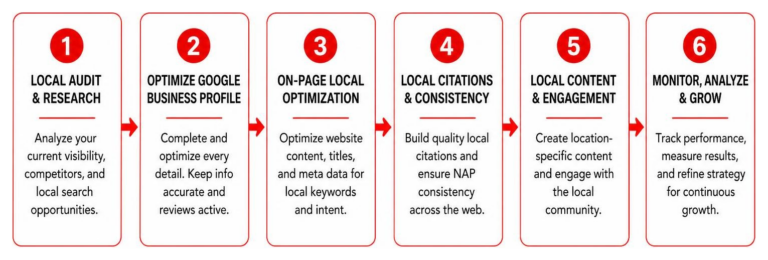
Integrating Local SEO and Google Business Profile with Your Map
If you run a local or storefront business, your SEO positioning map must account for physical geography. For local businesses, ranking in Google’s local 3-pack is critical: the map pack typically captures 40% to 60% of all clicks on local queries, appearing above traditional organic results.

To win these highly competitive positions, you must align your on-page content strategy with your Google Business Profile (GBP). This means embedding Google Maps on your contact and location pages to signal your physical association with your service area, and ensuring that the services listed on your website match your GBP categories exactly.
For local search intent, searches on mobile devices for businesses that are open and nearby have increased by over 200% in recent years. If your positioning map does not connect your local content with your physical locations, you are missing out on your most valuable customers.
To learn the exact tactical steps required to claim these top positions, read our guide on Map pack optimization — SEOTopSecret .
Optimizing the Map Pack for Local Positioning Map SEO Strategy
To dominate the local map pack, your local positioning map strategy must focus on three core ranking signals:
- Proximity: While you cannot change your physical location, you can optimize your content to target specific neighborhoods and surrounding suburbs within your service area.
- Review Velocity and Engagement: Google rewards active profiles. You must establish a consistent process for generating new customer reviews and maintain a 100% response rate to those reviews.
- NAP Consistency: Your Business Name, Address, and Phone number (NAP) must be identical across your website, your Google Business Profile, and all major local directories and citations.
By treating your local citations and GBP optimization as core branches of your overall SEO positioning map, you ensure that your business is visible precisely when local customers are ready to buy.
Measuring Success and Maintaining Your SEO Positioning Map
Once your positioning map is live and your content is rolling out, you must track the right metrics to measure your success. Traditional SEO often focuses on keyword rankings as a primary KPI, but these can be lagging indicators.
Instead, we recommend focusing on:
- Topical Coverage Rate: The percentage of mapped subtopics and clusters you have fully published.
- Query Breadth per Hub: The total number of unique search terms driving traffic to each content cluster.
- Call-to-Action (CTA) Engagement: The conversion rate of users moving from informational cluster pages to commercial pages.
- Revenue Attribution: The actual business value and leads generated from your organic search traffic.
Only 27% of organizations say their go-to-market (GTM) teams are fully integrated across strategy, KPIs, and execution. By aligning your SEO metrics directly with business revenue and lead generation, you position search as a primary growth driver rather than a secondary brand play.
To learn how to build a comprehensive measurement framework, read our Market Positioning Strategy Complete Guide. If you want to refine your tracking using competitive intelligence, see Stop Guessing and Start Positioning with Competitive Intelligence.
Avoiding Common Pitfalls in SEO Positioning
When building an SEO positioning map for the first time, it is easy to make mistakes that can stall your progress. The most common pitfall is choosing a core topic that is too broad. If your subject boundary is too wide, you will struggle to build meaningful topical authority and end up competing against massive, established websites.
Another common issue is keyword cannibalization, which occurs when multiple pages on your site target the same search intent. A well-designed positioning map solves this at the architectural level by enforcing a strict “one-intent, one-owner” rule. If you discover two pages ranking for the same keyword, merge them into a single, comprehensive guide to consolidate your ranking power.
To understand how search engines analyze and crawl web content to build their datasets, check out our guide on The Art of Turning the Web into AI Datasets.
Frequently Asked Questions about SEO Positioning Maps
How does an SEO positioning map differ from a standard keyword list?
A standard keyword list is a flat, linear spreadsheet that focuses solely on search volume and keyword difficulty. An SEO positioning map is a multidimensional planning framework that organizes keywords into semantic topic clusters, maps them to specific user intent stages, and visualizes content coverage relative to your competitors.
How often should you update your SEO positioning map?
We recommend reviewing your positioning map at least quarterly. However, you should trigger an immediate review if you experience major search engine algorithm updates, notice significant moves from your top competitors, or make changes to your core product or service offerings.
Can a positioning map help with AI Overview visibility?
Yes. AI search engines rely on entity coherence and structured data to generate their summaries. By using a positioning map to build highly organized, interconnected topic clusters, you make it much easier for AI models to understand your site’s expertise, which increases your chances of being cited as an authoritative source in AI Overviews.
Conclusion
Building a positioning map SEO strategy is the single best way to transition your search marketing from a series of random blog posts into a highly structured, revenue-generating acquisition engine. By visualizing your niche, identifying content gaps, and organizing your site around topical authority and user intent, you build a sustainable search presence that stands up to both competitor moves and AI search updates.
At Clayton Johnson SEO, we help businesses map their markets, understand their target audiences, and execute strategic content systems that drive real business growth.
Ready to stop guessing and start claiming your market share? Read our comprehensive guide on Competitive Positioning Map Demystified to start building your visual search strategy today.