Why Most Businesses Are Flying Blind Without an SEO Position Mapping Strategy
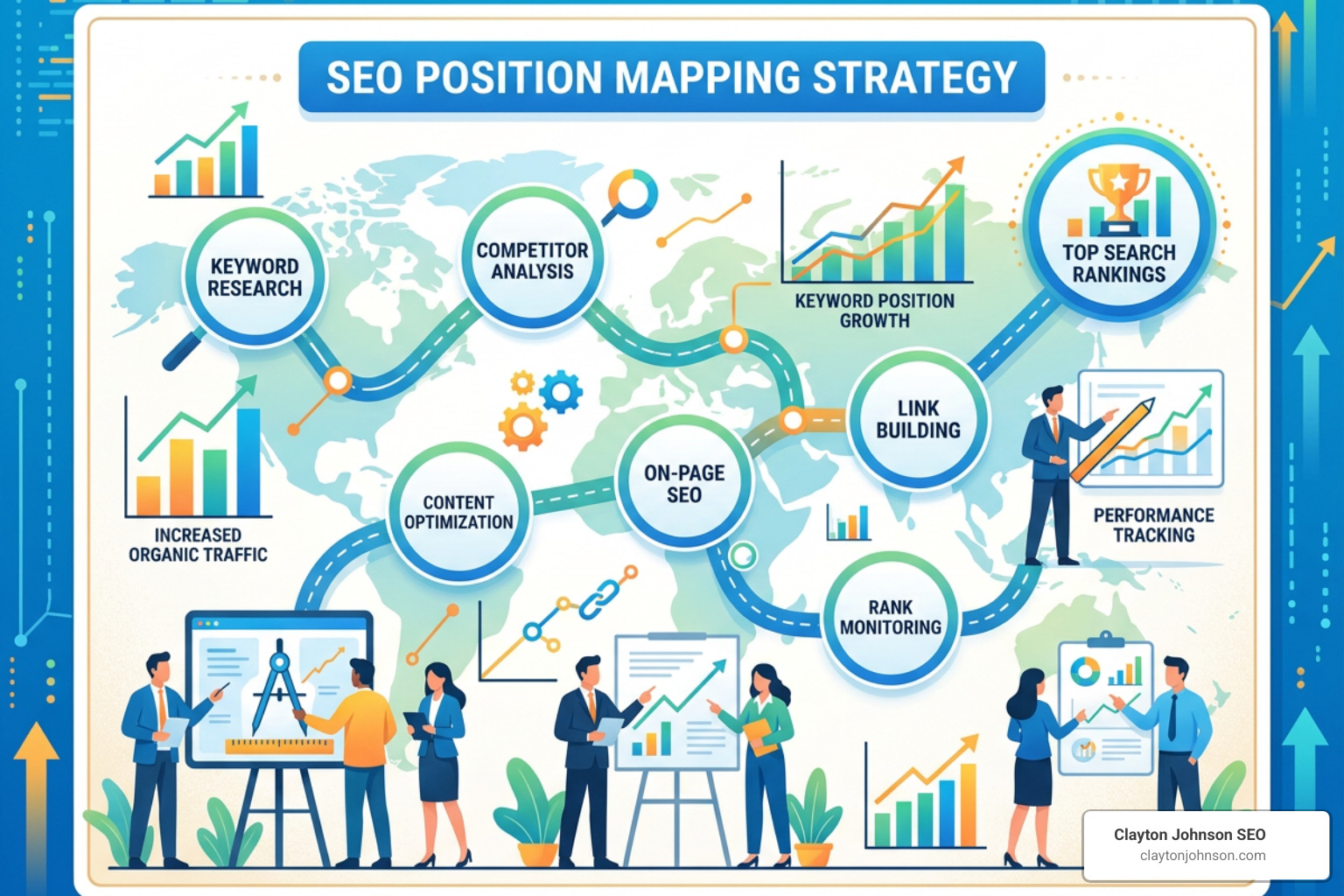
An SEO position mapping strategy is the process of assigning every keyword your business targets to a specific URL, then tracking where that URL ranks across different search surfaces — including Google Search, Google Maps, AI Overviews, and generative engines — so you always know exactly where you stand and what to fix next.
Quick answer: What is an SEO position mapping strategy?
- Research — Identify all keywords relevant to your business and audience
- Cluster — Group keywords by search intent into semantic clusters
- Assign — Map each cluster to one specific URL to prevent keyword cannibalization
- Track — Monitor rankings across search types, devices, and geographic locations
- Update — Review monthly and adjust when rankings shift, content changes, or competitors move
Here is why this matters right now.
According to Semrush, 60% of searches end without a click in 2025. Google’s AI Overviews appear on roughly 40% of informational queries. The window for organic visibility is narrowing fast — and if your pages are competing against each other for the same keywords, you are losing ground to competitors who have their content architecture locked in.
Most early-stage businesses fall into the same trap. They build a keyword list, publish content, and hope rankings follow. What they are actually doing is creating a fragmented site where multiple pages fight for the same search terms, signals get split, and nothing ranks as well as it should.
Position mapping solves this at the root level — before the problem compounds.
Consider this: position 1 on Google captures around 34% of clicks on desktop. Page 2 captures roughly 0.78%. The difference between a structured position map and a scattered content approach is often the difference between those two numbers.
I’m Clayton Johnson, founder of Clayton Johnson SEO, and I’ve spent more than a decade building SEO position mapping strategies for businesses that needed a clear, systematic path from scattered visibility to predictable search growth. The framework in this guide reflects that hands-on experience.
What is an SEO Position Mapping Strategy and Why Does It Matter?
Before we dive into the nuts and bolts, let’s clear up a common point of confusion. Many marketers treat keyword research, keyword mapping, and position mapping as interchangeable terms. They aren’t.
- Keyword Research is the act of discovery. It’s how you find valuable search terms that your target audience uses to solve their problems.
- Keyword Mapping is the act of assignment. It takes those discovered terms and assigns them to specific URLs on your website.
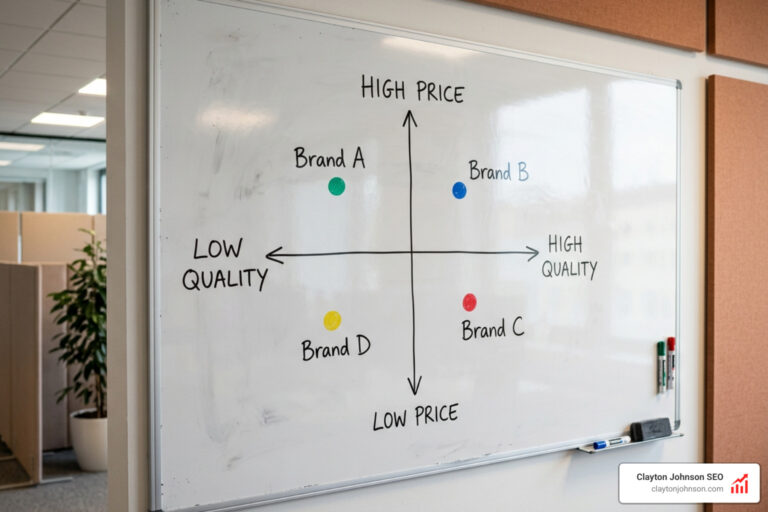
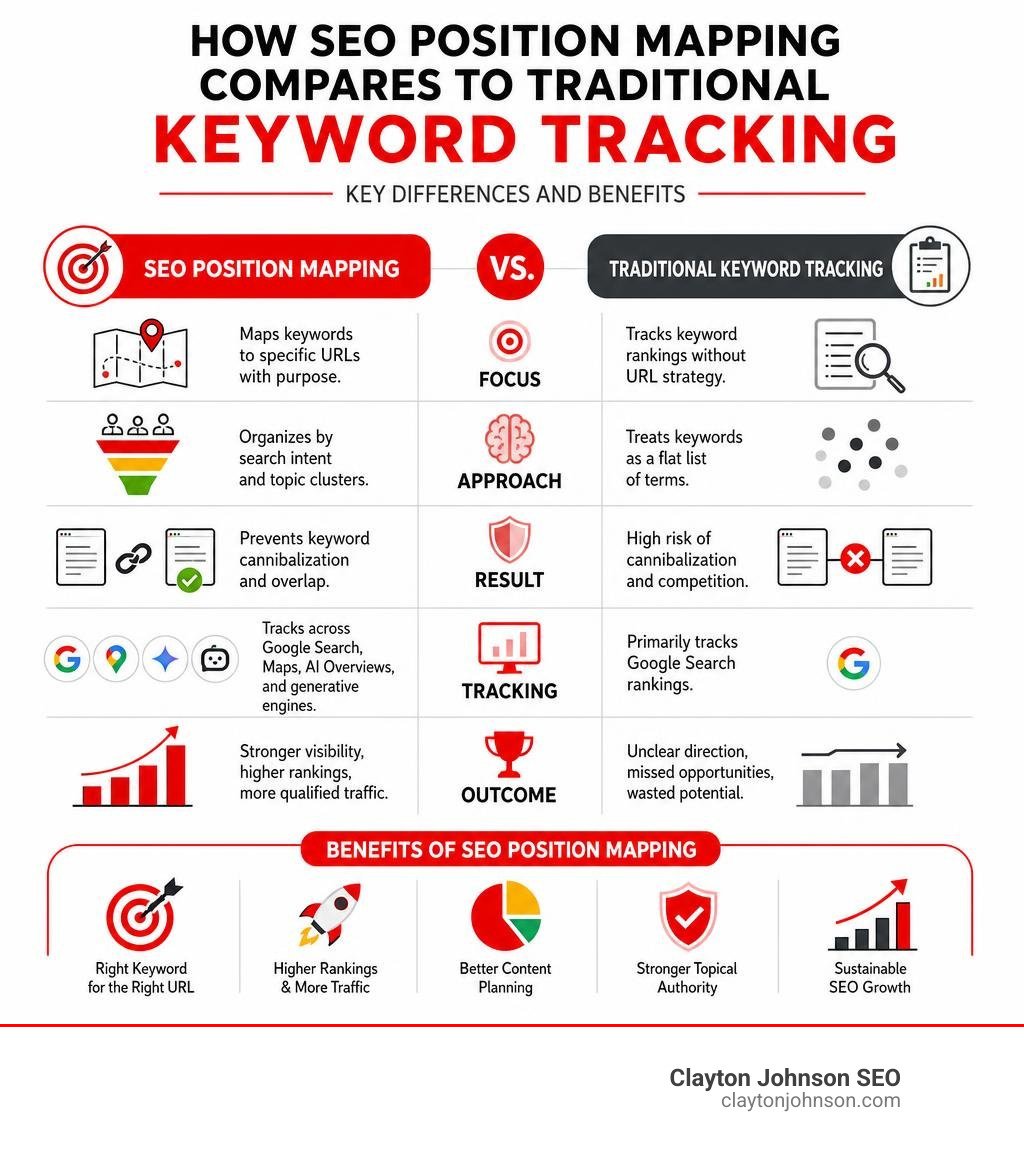
- SEO Position Mapping is the strategic, ongoing management of those assignments. It maps your pages across the entire search landscape, tracking performance not just as a single average number, but as a coordinate-based visual system that monitors search intent, AI engine visibility, and geographic variations.
To get a clearer sense of how these concepts differ, look at our comparison table below:
| Feature / Dimension | Traditional Keyword Mapping | SEO Position Mapping |
|---|---|---|
| Primary Format | Linear spreadsheet with static keyword-to-URL lists | Multi-surface spatial map tracking coordinates and intent |
| Tracking Focus | Single-point national rank tracking | Geo-grid tracking, local pack, and AI search visibility |
| Handling of Intent | Broadly groups keywords by search volume | Groups keywords into semantic clusters based on precise intent |
| Cannibalization Control | Reactive (fixed only when issues are noticed) | Proactive (built into the architecture from day one) |
| Update Frequency | Quarterly or annually | Monthly or triggered by search engine updates |
Building a comprehensive roadmap requires a deep understanding of how your terms relate to each other. For a foundational look at keyword planning, check out The Ultimate Guide to Keyword Strategy.
The Shift from Keyword Lists to Spatial Position Mapping
We live in a multi-dimensional search world. In July 2026, a user’s search journey is rarely a straight line. They might start with a quick question on their phone while walking down the street, continue their research on a desktop at work, and finally make a purchase decision after seeing a local business map listing.
Because of this, tracking a keyword as a single national average rank is no longer sufficient. Spatial position mapping treats search visibility as coordinates on a map. By mapping your positions across different devices, search features, and physical locations, you get a realistic view of how users interact with your brand throughout their entire journey.
Why Traditional Keyword Mapping Fails in Modern Search
The old way of mapping keywords was simple: you took a giant spreadsheet, stuffed as many keywords as possible onto a page, and hoped for the best.
This linear approach fails today for three primary reasons:
- Ranking Volatility: Google’s algorithms now adjust results in real time based on user engagement signals, device type, and time of day. A static spreadsheet cannot account for these shifts.
- Search Intent Mismatch: Traditional mapping often pairs informational keywords with commercial pages, causing high bounce rates and poor conversions.
- Keyword Stuffing and Cannibalization: Without a spatial view of your content, you end up writing five different articles that all target the exact same primary search term, diluting your site’s authority.
The Role of Position Mapping in AI SEO and Generative Engine Optimization (GEO)
AI search engines and generative answers are reshaping the optimization landscape. As of July 2026, search engine results pages (SERPs) are dominated by AI Overviews and conversational answer engines.
To navigate this landscape, we must design content that satisfies both human readers and AI crawlers. For a detailed breakdown of how to build automated systems for this environment, explore The Ultimate Guide to AI-Driven SEO Strategy and Systems. Additionally, referencing Google’s Search Quality Rater Guidelines can help ensure your mapped content aligns with what search engines define as high-quality, helpful information.
How AI Search Engines Reshape Your SEO Position Mapping Strategy
With AI Overviews appearing on more than half of informational queries, the traditional organic click-through rate (CTR) is shifting. AI engines absorb quick, definitional queries, leading to a rise in zero-click searches.
However, this doesn’t mean SEO is dead; it means our targets must evolve. Instead of focusing solely on ranking first for broad informational terms, your position mapping strategy should target citations within AI-generated answers.
To win these citations, your content must be structured to explicitly answer complex, multi-part questions. This requires aligning your pages with the exact expectations of your audience. Learn more about matching these expectations in The Ultimate Guide to Mastering Search Intent Targeting.
Optimizing for Generative Engines with a Structured SEO Position Mapping Strategy
Generative Engine Optimization (GEO) requires a transition to semantic SEO. AI models understand the world through entities, attributes, and values (EAV).
For example, if the entity is “Minneapolis SEO Agency,” the attributes might include “services,” “location,” and “pricing,” while the values would be “local optimization,” “Minneapolis,” and “custom monthly retainers.”
Your position map must treat your website as a web of these connected entities. By systematically mapping out each attribute to a dedicated page, you build a structured content footprint that AI models can easily crawl, understand, and cite. To align your entity mapping with real buyer motivations, read The Mind Reader’s Guide to SEO Buyer Intent Profiling.
How to Build an SEO Position Map to Prevent Keyword Cannibalization
Keyword cannibalization occurs when multiple pages on your website target the same search intent. When this happens, Google doesn’t know which page is the authority, so it often ranks both lower than if you had one clear, consolidated resource.
An effective position mapping strategy acts as an architectural blueprint that prevents this dilution. To understand how to route authority through your site correctly, read The Ultimate Guide to Internal Linking Strategy.
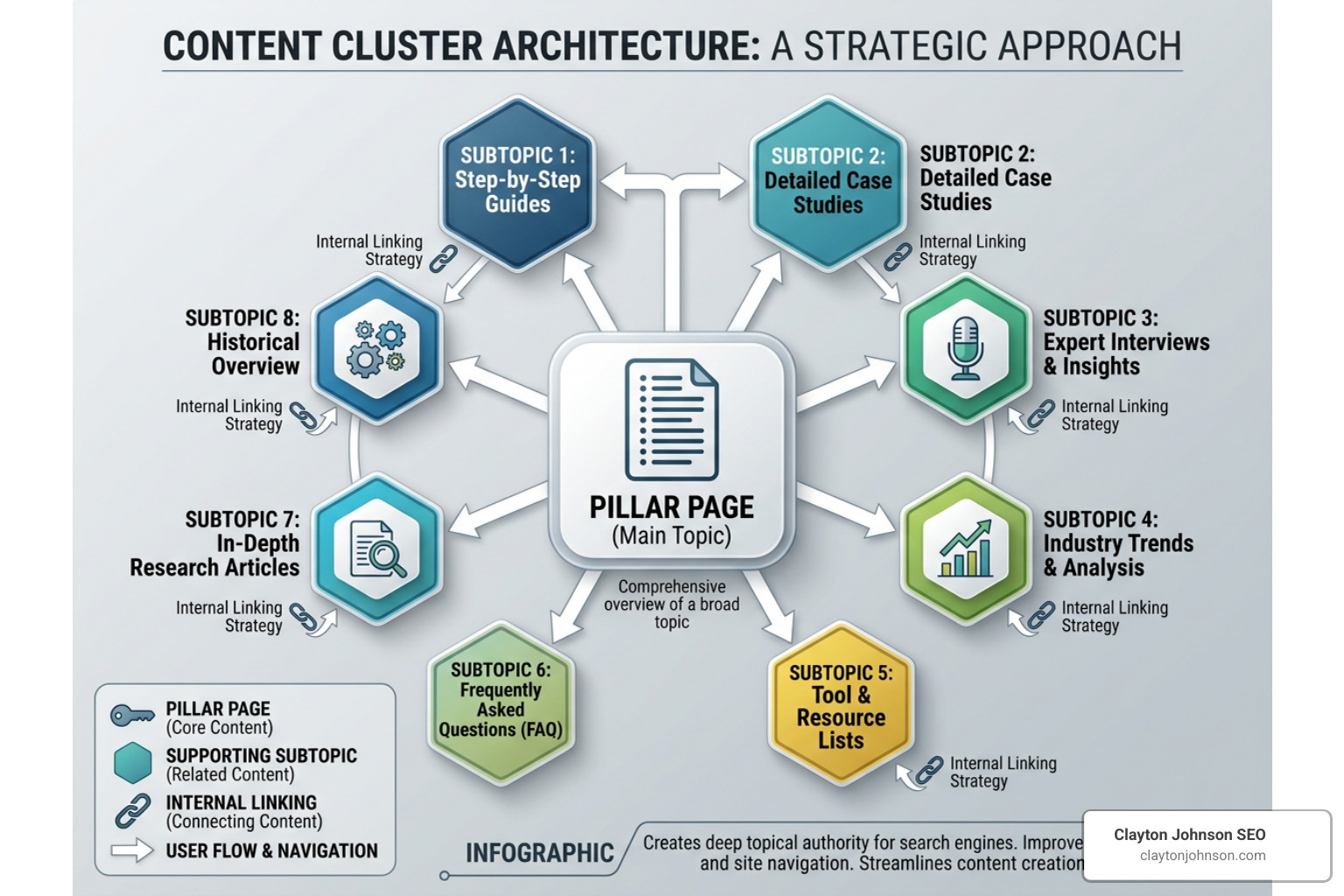
To build a cannibalization-free position map, follow this step-by-step process:
- Define your niche boundaries to keep your content focused on core business topics.
- Audit your existing content to identify duplicate intents and orphan pages.
- Group your keywords into tight semantic clusters based on shared SERP results.
- Assign one unique primary keyword and its secondary variations to a single owner URL.
- Establish clear internal linking rules to guide search engines through your hierarchy.
Step 1: Define the Niche Boundary and Core Entities
The first step in building your map is drawing a boundary around your subject. You cannot be everything to everyone. We recommend defining a “niche nucleus” that is narrow enough to dominate but broad enough to allow for natural subtopic expansion.
Once you have defined your boundary, identify your core entities. These are the main topics, products, or services that define your business. In the July 2026 search landscape, search engines prioritize domains that demonstrate deep, bounded topical authority over those that publish shallow content across unrelated subjects.
Step 2: Group Keywords into Semantic Clusters and Assign URLs
Once you have your raw keywords, group them into semantic clusters. A semantic cluster is a collection of search terms that all share the same underlying search intent.
A reliable way to test this is by checking the search engine results pages: if the top ten results for two different keywords show 4 to 6 of the same URLs, those keywords belong on the same page. If the results are completely different, they require separate URLs.
Each cluster should contain:
- One Primary Keyword: The main, high-volume term that represents the core topic.
- Five to ten Secondary Keywords: Long-tail variations, questions, and synonyms that add depth to the page.
To see practical examples of how to set up these spreadsheets, check out our Keyword Strategy Examples and Templates for SEO Success.
Step 3: Establish Internal Linking Rules and Authority Flow
Your position map is not complete without an internal linking blueprint. Internal links are the pathways that distribute authority (or “link juice”) across your site.
When linking pages within a cluster, follow the hub-and-spoke model:
- Supporting “spoke” pages should always link back to the main “hub” pillar page using descriptive anchor text.
- The pillar page should link out to supporting pages to help users explore subtopics in detail.
- Avoid linking unrelated spoke pages across different clusters, as this can dilute the semantic focus of your hubs.
For advanced tactics on structuring these pathways, read our Pro Tips for a Winning Internal Link Strategy.
Dominating Google Maps: Local SEO Maps and Geo-Grid Tracking
If you operate a local or multi-location business, your position mapping strategy must extend to Google Maps and the Local Pack. The Google Map Pack captures 70% of all clicks in local searches, and 78% of local mobile searches lead to an offline purchase.
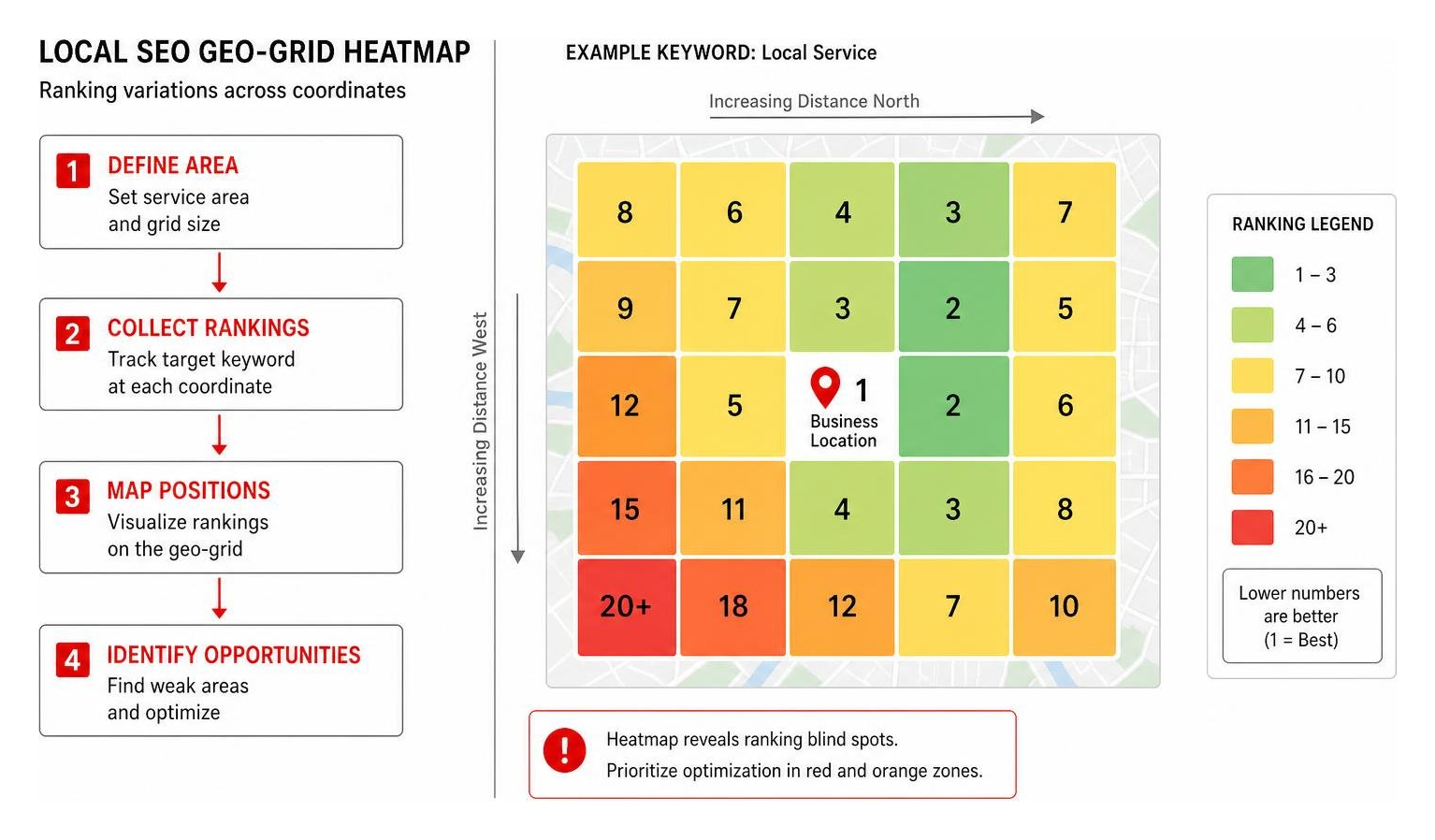
Traditional rank trackers fall short here because they only check rankings from a single point—usually the center of a ZIP code or your business address. In reality, your local search position shifts block by block.
Revealing Ranking Blind Spots with Geo-Grids
A local geo-grid tracker measures your rankings at multiple coordinates across your entire service area. This visualization reveals ranking blind spots that single-point tracking misses.
For example, you might rank #1 at your physical storefront, but drop to #12 just two miles away in a high-density neighborhood. By mapping these positions, you can identify exactly where you are losing visibility and adjust your local optimization efforts to win back your Share of Local Voice.
The Role of Reviews, Citations, and NAP Consistency
To improve your mapped positions across a local geo-grid, you must optimize the key local ranking signals:
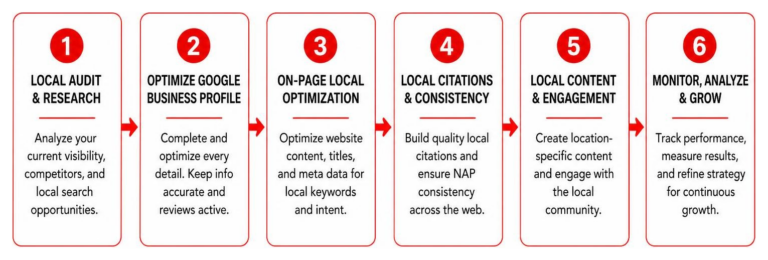
- NAP Consistency: Ensure your Name, Address, and Phone number are identical across your website, Google Business Profile, and all local directories.
- Review Velocity and Diversity: According to Forbes, 88% of consumers trust online reviews as much as personal recommendations. Additionally, moving from 3 to 5 stars on Google can generate 25% more clicks.
- Engagement Signals: Google monitors user actions such as requests for directions, phone calls, and direct messages to gauge the prominence of your business.
To see how local optimization fits into a complete marketing program, consult The Ultimate Guide to SEO Marketing Success.
Integrating Position Mapping with Broader SEO Strategies
A position map should not live in isolation. To drive business results, it must integrate with your broader technical, creative, and promotional marketing efforts.
For a comprehensive view of how these pieces connect, read The Only Complete Guide to Search Engine Optimization You’ll Ever Need.
To ensure search engines can easily parse your mapped pages, configure structured data according to Google’s Structured Data Guidelines.
- Content Audits: Use your position map to identify underperforming pages, merge duplicate articles, and update outdated statistics.
- Schema Markup: Add LocalBusiness, Product, or Article schema markup to your mapped pages to reinforce entity relationships.
- Backlink Building: Direct your link-building efforts toward your mapped pillar pages to distribute authority throughout your clusters.
Aligning Position Maps with Enterprise SEO
For enterprise websites with thousands of pages or multi-location brands with hundreds of local listings, governance is critical. An enterprise position map requires centralized coordination to prevent different regional branches from publishing competing content. By establishing clear ownership over target search terms and intent clusters, enterprise teams can maintain a clean, organized site architecture at scale. Learn how to manage these complex environments in our guide on SEO Strategy for Enterprises.
Frequently Asked Questions about SEO Position Mapping
What is the difference between keyword mapping and position mapping?
While traditional keyword mapping is a static process of assigning keywords to URLs in a spreadsheet, position mapping is an active, spatial tracking system. Position mapping monitors how those assigned URLs perform across multiple search surfaces, devices, and geographic coordinates over time.
How often should an SEO position map be updated?
We recommend reviewing your position map monthly. Search behaviors change, search engines roll out updates, and your own content library grows. A monthly review allows you to catch keyword cannibalization early, identify content gaps, and adjust your strategy to maintain search coverage.
Can service-area businesses use geo-grid tracking without a physical address?
Yes. If you operate a service-area business (SAB) without a physical storefront, geo-grid tracking is highly valuable. You can set a central point for your service area and track your visibility across your entire service radius to see where your brand appears to local searchers.
Conclusion
Building a sustainable organic presence requires a clear, organized blueprint. An SEO position mapping strategy ensures that every page on your website has a distinct purpose, every target keyword has a dedicated home, and your content architecture is built to withstand algorithm updates and AI search developments.
At Clayton Johnson SEO, we help startups and growing businesses map and understand their target audiences through strategic content and SEO services. By organizing your search footprint, we help you eliminate internal competition, claim topical authority, and turn search visibility into predictable revenue.