Why SEO for Law Firms Is the Most Important Marketing Decision You’ll Make This Year
SEO for a law firm is the practice of optimizing your website and online presence so your firm appears at the top of Google when potential clients search for legal help.
Here’s a quick summary of what it involves:
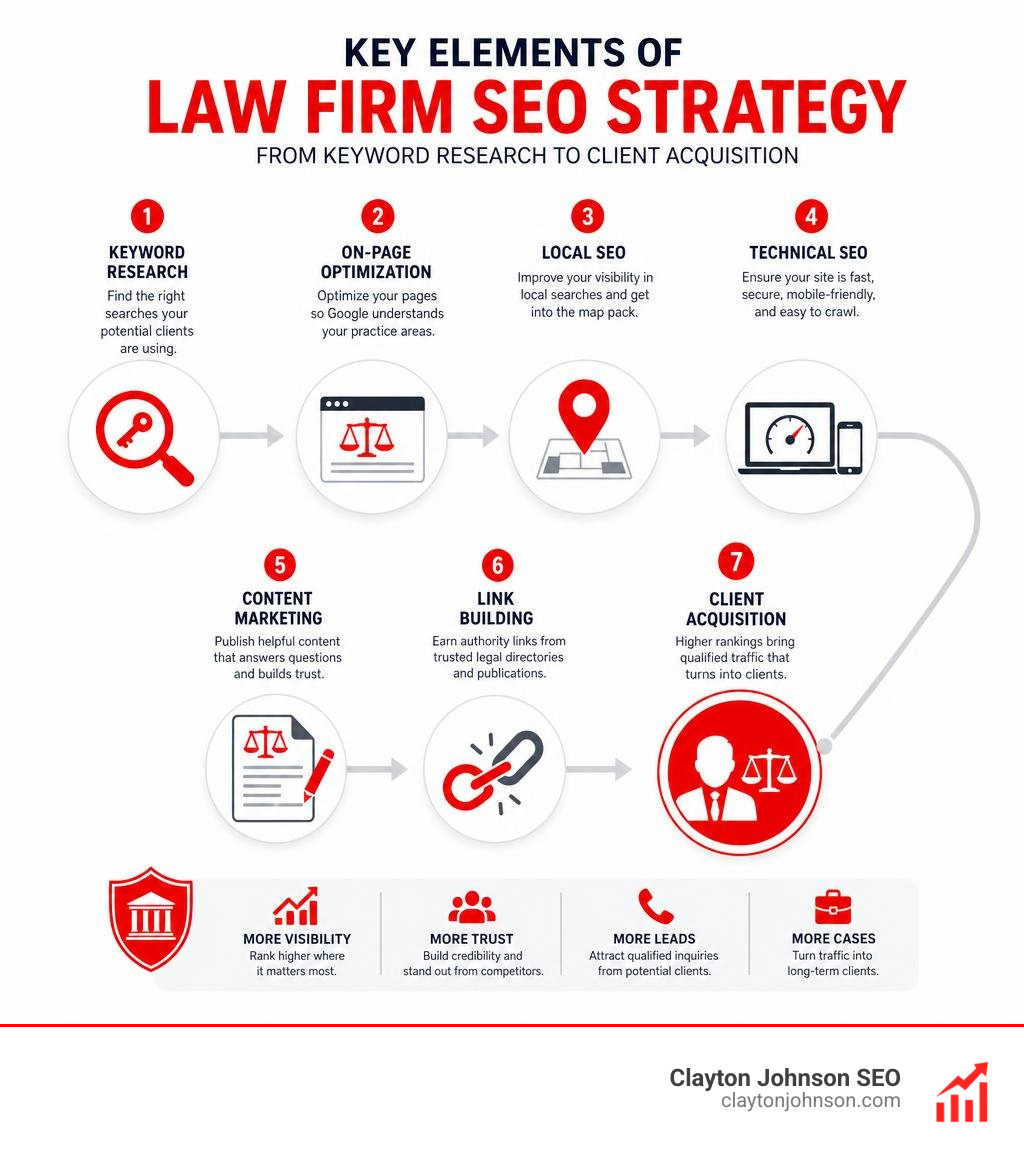
- Keyword research – targeting searches like “divorce attorney near me” or “car accident lawyer Houston”
- On-page optimization – structuring practice area pages so Google understands what you do
- Local SEO – getting your firm into Google’s map pack for location-based searches
- Link building – earning authority signals from legal directories and trusted publications
- Technical SEO – making sure your site loads fast and works on mobile
- Content marketing – publishing guides and answers that build trust before a client ever calls
Think about this: 96% of people seeking legal advice use a search engine at some point in their journey. And 37% of people who hired a lawyer found them through an online search — making Google the single largest client acquisition channel for most firms today.
Yet most law firm websites are invisible on Google. They’re buried behind competitors, legal directories, and paid ads.
That’s a serious problem, because the stakes are high on both sides. A client searching “personal injury lawyer” is often in crisis. They need help now. If your firm doesn’t show up, someone else gets that case.
And on your side? A single signed case can be worth tens of thousands of dollars. Getting your organic search right isn’t just a marketing tactic — it’s a revenue strategy.
Law firm SEO is also harder than regular SEO. Google classifies all legal content as YMYL (Your Money or Your Life), meaning it holds your website to a higher standard of quality, credibility, and accuracy. Attorney advertising rules add another layer of complexity most generic agencies don’t understand.
I’m Clayton Johnson, an SEO strategist and founder of Clayton Johnson SEO, with over a decade of experience helping businesses — including law firms — build dominant search visibility through technical SEO, content strategy, and local optimization specifically designed around seo for law firm campaigns. This checklist gives you everything you need to compete and win in organic search.
What is Law Firm SEO and Why is it Unique?
When we talk about seo for law firm sites, we aren’t just talking about regular digital marketing. We are talking about a highly specialized, competitive, and strictly regulated landscape.
If you run a e-commerce shop selling custom socks, the consequences of a bad piece of advice on your blog are minimal. If you run a law firm, however, a misleading blog post can lead to waived legal rights, missed filing deadlines, or disciplinary action from your state bar.
Because of this, search engines apply their highest standard of scrutiny, known as YMYL (Your Money or Your Life). Google’s quality raters hold legal websites to extreme standards of accuracy and authority. If your content is written by a generalist writer who doesn’t understand legal procedures, Google’s algorithms will actively filter it out of search results.
Furthermore, attorney advertising is highly regulated. For instance, claiming you are the “best” or “top-rated” attorney without verifiable, independent data can violate state bar rules on comparative superiority. We must weave compliance directly into our optimization.
Finally, the economics of legal search are unique. Legal keywords are among the most expensive in Google Ads, with “personal injury lawyer” averaging over $150 per click and highly competitive terms like “mesothelioma lawyer” exceeding $200 (and sometimes reaching $700+) per click. This extreme cost makes organic search a compounding, high-value asset. It is a high-value, low-volume acquisition model where a single signed client can completely fund your marketing budget for the year.
To understand the foundational mechanics of search before diving deep, take a look at our guide on SEO 101 or explore how search works for Law Firms specifically. For a deeper dive into the industry’s marketing landscape, read A Comprehensive Guide to Legal Industry SEO Marketing.
The Core Pillars of a Successful SEO for Law Firm Strategy
A successful SEO campaign for a law firm isn’t built on a single trick. It relies on a multi-layered framework that works in harmony to build trust with both search engines and potential clients.

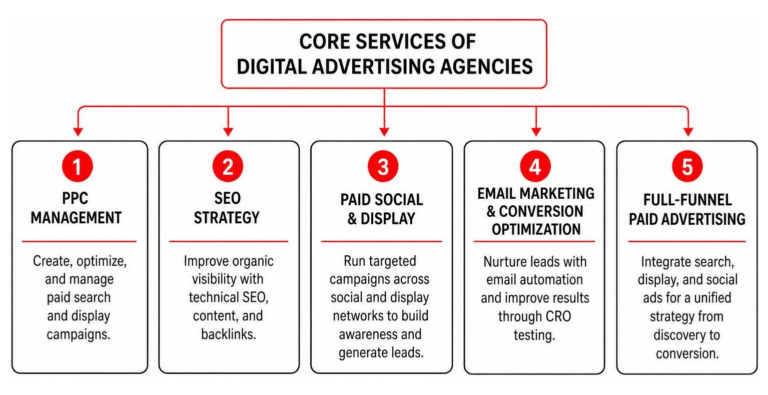
To build a solid foundation, we focus on five core pillars:
- Keyword Research: Identifying what your actual clients are searching for.
- On-Page Optimization: Structuring your pages so search engines and users understand your expertise.
- Local SEO: Dominating the local map pack where nearby clients look for immediate help.
- Link Building: Earning high-quality, ethical backlinks that act as votes of confidence.
- Technical SEO: Ensuring your site is fast, secure, and easily crawlable.
By executing these pillars consistently, we turn your website into a client acquisition machine. You can explore how these pillars fit into a broader marketing system in our A-Z Guide to SEO Strategy and The Ultimate Guide to SEO Marketing Success.
Keyword Research and the Case-Value Framework
Most law firm keyword research fails because it optimizes for raw search volume instead of case value. Ranking for a high-volume keyword like “what is a tort” might bring thousands of curious students to your site, but it won’t sign clients.
Instead, we use the Case-Value Keyword Framework. We segment keywords by search intent:
- Commercial Intent (Ready to Hire): “car accident lawyer near me” or “probate attorney Dallas”. These searchers have an immediate need and a high likelihood of converting.
- Informational Intent (Researching): “how is a lawsuit settlement taxed” or “what to do after a minor car wreck”. These users are early in their journey but can be nurtured into clients.
By targeting long-tail, high-intent keywords, we capture the exact cases your firm wants to handle. For a step-by-step walkthrough on how to find these terms, check out our guide to Stop Guessing and Start Ranking with Our Complete Keyword Research Guide.
On-Page Optimization and Practice Area Pages
A single “Practice Areas” page listing all of your services is an SEO dead end. Google cannot rank one page for multiple distinct legal intents. If someone searches for a “child custody lawyer,” they want to land on a page dedicated entirely to child custody — not a generic page that also talks about criminal defense and business contracts.
We recommend creating separate, dedicated pages of 1,500 to 2,500 words for every sub-practice area you handle.
Here is our standard on-page checklist for each practice page:
- Title Tag: Format as
[Practice Area] Attorney in [City] | [Firm Name](keep under 55-60 characters). - Meta Description: Write a compelling call-to-action under 155 characters that includes trust markers (e.g., “Facing DUI charges? 20+ years of trial experience. Free consultations.”).
- Header Tags (H1, H2, H3): Use a single H1 with your primary keyword, and use H2s/H3s to organize the content logically.
- Image Alt Tags: Keep under 125 characters and describe the image while naturally incorporating local keywords.
To speed up this process safely, read our guide on How to Use AI for On Page SEO That Actually Ranks.
How to Execute Local SEO for Law Firm Growth
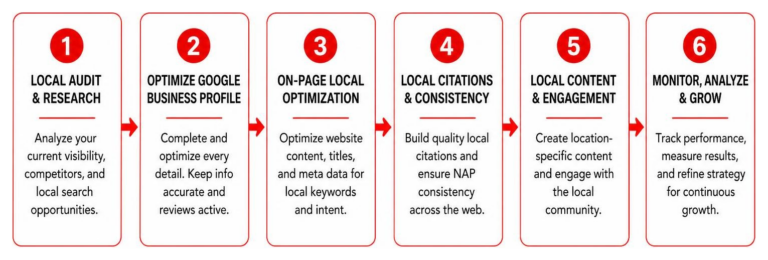
Because legal services are highly localized, local SEO is critical. 85% of people use online maps to find legal service locations in their area, and the Google local pack (the map with three business listings) captures 42% of all clicks for location-intent queries.
To capture this traffic, you must claim, verify, and fully optimize your Google Business Profile (GBP). Ensure your primary category matches your most valuable practice area (e.g., “Personal Injury Attorney” rather than just “Law Firm”).
Beyond your GBP, maintaining absolute NAP (Name, Address, Phone) consistency across the web is non-negotiable. If your address is listed as “Suite 100” on Google but “Ste. 100” on Avvo, search engines can get confused, which dilutes your local authority signals.
Ethical Link Building and Authority Signals
Backlinks are the currency of search engine authority. However, in the legal niche, search engines are incredibly sensitive to spammy link-building practices. Private blog networks (PBNs), purchased links, and mass directory submissions will get your site penalized.
Instead, we focus on ethical, high-authority link-building strategies:
- Legal Directories: Claiming listings on high-authority legal platforms like Avvo, Justia, FindLaw, and Martindale-Hubbell.
- Bar Associations: Securing links from state and local bar associations where you are a registered member.
- Digital PR: Using platforms like Qwoted or HARO (Help a Reporter Out) to provide expert legal commentary to journalists, earning links from major news outlets.
- Community Involvement: Sponsoring local charity events, youth sports teams, or offering college scholarships to earn local academic (.edu) and community (.org) links.
For a comprehensive guide on building authority the right way, read How to Build an Authority Site That Dominates the SERPs.
Technical SEO and Core Web Vitals
If your website is slow, confusing, or broken on mobile, your rankings and conversions will suffer. Over 60% of legal searches happen on mobile devices, and 88% of people are likely to leave a website and not return if they’ve had a bad first experience.
We must ensure your site passes Google’s Core Web Vitals, loading in under 3 seconds. Additionally, you should implement structured schema markup—specifically LegalService, Attorney, and FAQPage schema. This code helps search engines understand your firm’s hours, location, and practice areas, often resulting in rich snippets in search results.
Don’t forget your internal linking. A smart internal linking structure distributes authority across your site. Learn how to map this out in The Ultimate Guide to Internal Linking Strategy.
Optimizing for Google’s E-E-A-T and YMYL Standards
Because legal advice can alter the course of a person’s life, Google applies its E-E-A-T (Experience, Expertise, Authoritativeness, Trustworthiness) framework with extreme strictness to law firms.

To satisfy E-E-A-T, you must show Google that your content is written by actual legal experts:
- Author Bylines: Every article should have a clear author byline linking to a detailed attorney bio page.
- Attorney Bios: Your bio page shouldn’t read like a dry resume. It should showcase your licensed jurisdictions, years in practice, notable case results, bar numbers, and active professional associations.
- Verified Trust Markers: Display your physical address, contact details, and state bar badges prominently in your footer.
While AI tools can assist with research, publishing thin, unedited AI content is an E-E-A-T liability. To understand how to safely integrate AI into your marketing without triggering Google’s spam filters, explore The Smart Lawyer’s Guide to AI Marketing Services, The Ultimate Guide to AI Driven SEO Strategy and Systems, and our insights on AI Search.
Why Content Marketing is Essential in SEO for Law Firm Campaigns
Content marketing is how you build “topical authority.” If you want Google to rank you for “car accident lawyer,” you must prove you understand the entire topic of personal injury.
Instead of publishing generic, recycled blog posts (what Google refers to as “commodity content”), your pages must pass the Information Gain Test. Every page should offer unique value:
- Cite specific, up-to-date local statutes and court procedures.
- Share anonymized case studies or first-hand insights from your practice.
- Include interactive tools, like a child support calculator or a statute of limitations checker.
To keep your content library clean and authoritative, automate your tracking with Content Audit Automation Letting the Bots Do the Dirty Work.
Google Business Profile Optimization for Attorneys
Your Google Business Profile is often the very first thing a local client sees. To stand out in the highly competitive local 3-pack, you need a systematic review acquisition strategy.
Firms ranking in the local 3-pack typically have 40+ Google reviews with a 4.5+ star average. 87% of consumers read online reviews before hiring a local business.
Establish an ethical process to request reviews from satisfied clients at the point of peak satisfaction (e.g., right after a successful settlement or case resolution). Always respond professionally to every review—both positive and negative—without disclosing any confidential client information.
The Economics: Law Firm SEO Costs and ROI
How much does law firm SEO cost, and is it worth it? Because legal keywords are incredibly competitive, cheap SEO packages ($500/month) are a recipe for failure. They often rely on spammy tactics that can get your site penalized.
Here is a breakdown of typical industry pricing tiers and what they deliver:
| Firm Profile | Monthly Budget Range | Focus & Deliverables | Expected Lead Cost |
|---|---|---|---|
| Solo Practitioner / Small Market | $1,500 – $3,500 | Local SEO, GBP optimization, core practice area pages. | $100 – $200 |
| Mid-Sized Firm / Competitive Metro | $4,000 – $8,000 | Comprehensive content marketing, active link building, technical audits. | $75 – $150 |
| Large Statewide / Personal Injury | $10,000 – $25,000+ | Aggressive digital PR, statewide local landing pages, advanced conversion optimization. | $50 – $100 |
To learn more about how we structure our pricing and campaigns, check out our Services SEO Services and B2B SEO Services Ultimate Guide.
The Compounding Value of Organic Search
While Google Ads (PPC) can bring in immediate leads, it has zero compounding value. The moment you stop paying for ads, your lead flow drops to zero.
Over a 24-month period, firms that invest in SEO consistently report 40% lower client acquisition costs compared to PPC-only strategies. A mature SEO program can deliver high-quality leads for $50 to $100 each, and that cost decreases over time as your domain authority grows. SEO is a long-term business asset.
Learn more about this compounding effect in The Only Complete Guide to Search Engine Optimization You’ll Ever Need.
Measuring ROI and Conversion Tracking
You cannot manage what you do not measure. To prove the ROI of your campaign, you must set up conversion tracking. This means tracking:
- Form Submissions: Tracking when a user fills out a consultation form.
- Phone Calls: Using dynamic number insertion (DNI) to track which keyword or page generated the call.
- Live Chat: Implementing live chat on your website (which can increase lead volume by an average of 30%).
By integrating your website tracking with a legal CRM (like Clio or Filevine), you can track a lead from the initial search query all the way to a signed case, giving you an exact calculation of your SEO ROI.
Common Law Firm SEO Mistakes to Avoid
Even with a healthy budget, many law firms fail to see results because of easily avoidable mistakes.

Watch out for these common pitfalls:
- Using a single “Practice Areas” page instead of dedicated pages for each service.
- Thin, AI-generated content published without attorney review or local legal citations.
- Ignoring your Google Business Profile or failing to build reviews.
- Slow intake response times. A lead that isn’t contacted within 5 minutes is often lost to a competitor. Firms responding to leads within 5 minutes convert 400% better than those that take 30 minutes.
For practice-specific strategies to avoid these errors, read Family Law SEO Services 101 and The Complete Guide to Criminal Attorneys SEO.
Realistic Timelines for Organic Growth
SEO is not an overnight solution. Most law firms begin seeing measurable improvements in organic traffic within 3 to 6 months, with significant, consistent lead generation typically starting between months 6 and 12.
This timeline depends heavily on your local market competition, your starting domain authority, and your budget. However, once your rankings are established, they continue to generate leads with a much lower ongoing cost than paid advertising.
All of our strategies align strictly with search engine guidelines and professional standards, including American Bar Association guidelines regarding attorney advertising and client communication.
Frequently Asked Questions about Law Firm SEO
How long does it take to see results from law firm SEO?
Typically, firms see initial traffic improvements in 3 to 6 months. A predictable stream of signed cases usually develops within 6 to 12 months as your authority compounds.
How much does law firm SEO cost?
Depending on your market size and practice area, professional SEO campaigns range from $1,500 to over $10,000 per month. Highly competitive niches like personal injury in major metros require larger budgets to compete effectively.
Why should my law firm focus on organic SEO?
Organic SEO builds a permanent, compounding digital asset. Unlike PPC, where leads stop when your budget runs out, organic search delivers a lower cost-per-lead over time, establishing your firm as the trusted authority in your local market.
Conclusion
Winning in organic search requires a dedicated, compliant, and highly strategic approach. By focusing on the core pillars of keyword intent, local dominance, technical health, and strict E-E-A-T compliance, your firm can build a predictable pipeline of high-value cases.
At Clayton Johnson SEO, we help companies map and understand their target audiences through strategic content and technical SEO services. Ready to dominate your local market? Partner with Clayton Johnson SEO today to schedule your consultation.