Why So Many Products Fail Before They Ever Find an Audience
To validate product market fit is to answer the most important question a founder can ask: does anyone actually want this?
Here is a quick answer if you need it fast:
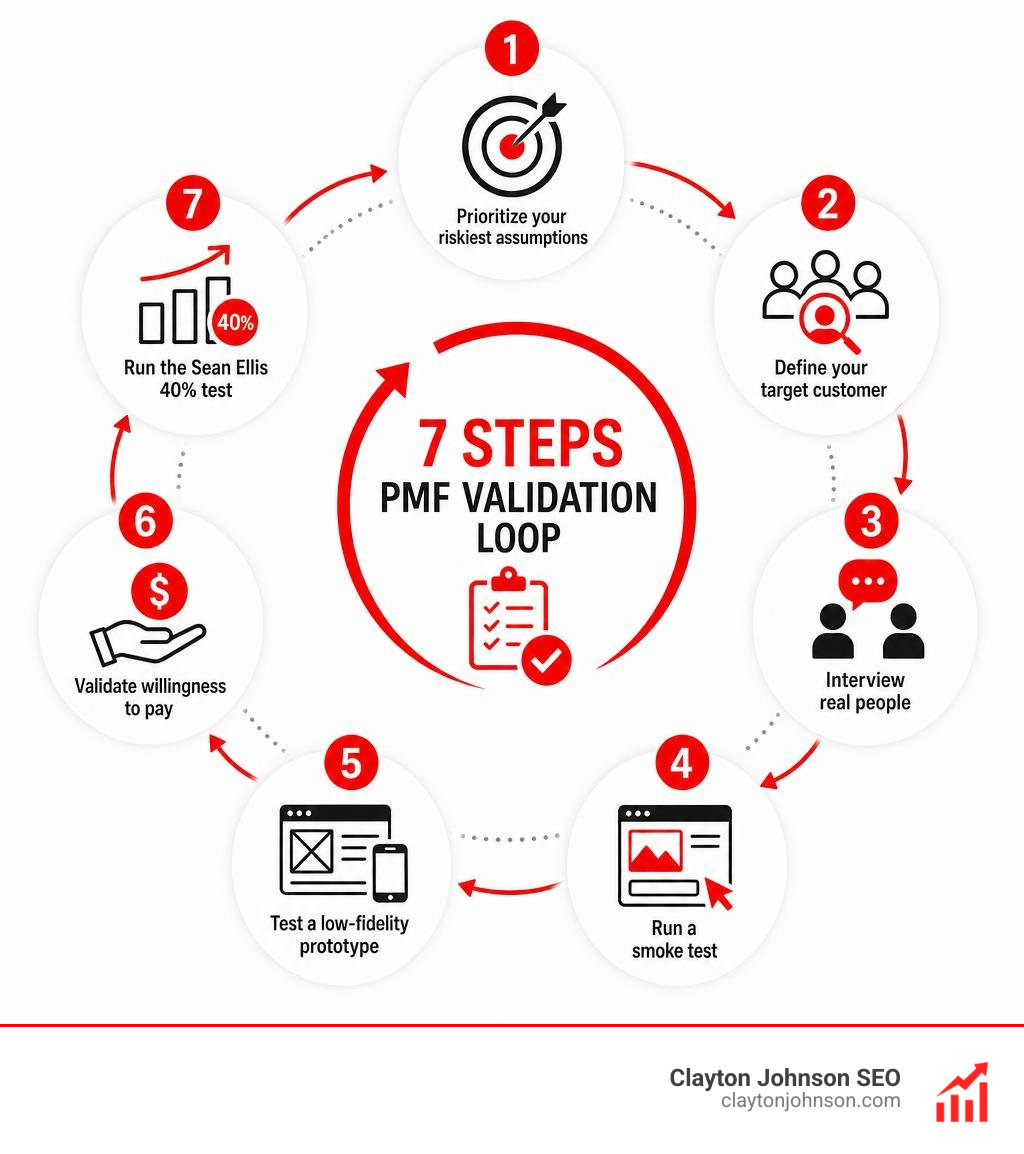
How to validate product-market fit (quick overview):
- Prioritize your riskiest assumptions — identify what must be true for your idea to work
- Define your target customer — narrow down to a specific segment, not “everyone”
- Interview real people — ask about past behavior, not hypothetical interest
- Run a smoke test — build a landing page and measure email sign-ups before writing code
- Test a low-fidelity prototype — wireframes or mockups, not a finished product
- Validate willingness to pay — get pre-orders or commitments, not just compliments
- Run the Sean Ellis 40% test — survey users on how they’d feel if your product disappeared
The stakes here are not small. 42% of startups fail because they build products nobody wants. Not because of bad timing, poor funding, or weak teams. They simply skipped the part where they checked whether a real market existed.
That is an expensive mistake. And it is almost entirely avoidable.
The good news? You do not need a finished product to find out if people want what you are building. Most of the validation work happens before a single line of code is written.
At Clayton Johnson SEO, I have spent over a decade helping businesses build digital systems that connect with real demand — which means understanding how to validate product market fit is central to everything I advise. This guide walks you through a practical, step-by-step framework that removes the guesswork and replaces it with evidence.
Why You Must Validate Product-Market Fit Before You Build
We have all heard the advice to “just build an MVP and iterate.” But building an MVP still takes time, money, and mental bandwidth. If we build on top of unvalidated assumptions, we are essentially building a beautiful house on a foundation of sand.
The term “product-market fit” (PMF) was originally coined by Andy Rachleff and later popularized by Marc Andreessen. Andreessen described PMF as being in a good market with a product that can satisfy that market. He noted that when PMF is happening, customers are buying the product just as fast as you can make it, and money is piling up in your checking account.
Conversely, when you do not have PMF, everything feels like a slog. Customers are not getting value, word of mouth is nonexistent, sales cycles are painfully long, and deals never seem to close.
To avoid this trap, we must first validate our “value hypothesis.” This is the core assumption about why a customer will use our product, what specific value they will get from it, and why they will pay for it. Jumping straight into scaling or heavy marketing before confirming this value hypothesis is what we call premature scaling—and it is the number one startup killer.
To learn more about the fundamentals of this journey, check out The Ultimate Guide to Finding Product Market Fit. For a deeper dive into how early-stage teams handle this transition, you can also explore Product-Market Fit: The Complete Founder’s Guide.
Red Flags That You Lack Product-Market Fit
- High Churn / Flat Retention: Users sign up but abandon the product within 30 days.
- Polite Interest, No Action: Interviewees say, “This is a great idea!” but refuse to pre-order or leave their email.
- Long, Dragging Sales Cycles: You have to push incredibly hard to make a single sale, and customers need constant hand-holding.
- No Organic Referrals: Your current users never recommend your product to colleagues or friends.
The 7-Step Framework to Validate Product Market Fit
Validation is not a single event; it is a structured, sequential process. We do not want to guess our way to success. Instead, we want to set up “validation gates” that our idea must pass through before we commit further resources.
By using a systematic approach, such as the one outlined in the Product-Market Fit Validation Framework: Complete Guide for Founders | Precode Insights, we can dramatically lower our risk. To keep your burn rate low while you do this, we recommend learning How to Use a Product Market Fit Template to Stop Burning Cash.
Let’s walk through the seven essential steps to validate product market fit systematically.

Step 1: Prioritize Your Core Hypotheses
Every new product is built on a mountain of assumptions. If we try to test all of them at once, we will overwhelm ourselves and our audience. Instead, we must isolate our riskiest assumptions—the ones that, if false, will completely kill the business.
We can write down our core hypothesis using a simple template:
“Our target segment experiences a specific problem when in a certain context, causing an unwanted outcome.” (For example: “Product managers experience difficulty tracking user retention when launching a new feature, causing them to waste development resources on unused tools.”)
Once we have listed our hypotheses, we map them on a simple prioritization matrix:
- Impact: How critical is this assumption to our survival?
- Confidence: How much real evidence do we currently have to support it?
We focus our validation efforts strictly on the high-impact, low-confidence assumptions first.
Step 2: Define and Narrow Your Target Customer Segment
When we try to build for everyone, we end up building for no one. In the early stages, we do not want a broad, generic audience. We want “superfans”—early adopters who feel the pain so acutely that they are actively looking for a solution and are willing to use a buggy, unpolished product just to get some relief.
To narrow down our target segment, we look for:
- High Pain Urgency: The problem must be a “hair-on-fire” issue, ranking in their top 3 to 5 daily frustrations.
- Active Workarounds: Are they already spending money or stitching together complex tools to solve this?
- Accessibility: Can we easily reach 100 of these people for interviews without spending thousands on ads?
For a comprehensive guide on aligning your problem and solution before writing code, see Achieving Problem Solution Fit Before You Build.
Step 3: How to Conduct Interviews to Validate Product Market Fit
Customer discovery interviews are incredibly powerful, but only if we ask the right questions. The biggest mistake founders make is asking hypothetical questions: “Would you buy a product that does X?” or “How much would you pay for this?”
People want to be polite, so they will say yes. But polite interest is a false positive that leads to empty bank accounts.
Instead, we use the principles of The Mom Test by asking about actual past behavior:
- “Tell me about the last time you tried to solve this problem.”
- “What was the hardest part about that?”
- “What tools or workarounds are you currently using to fix this?”
If they haven’t tried to solve the problem in the last 30 days, it is not a real pain point. We also look for “workaround stacks”—when users stitch together spreadsheets, manual emails, and Zapier integrations to solve a problem. This “complexity tax” is a massive green light that a dedicated product is highly needed.
Step 4: Using Smoke Tests to Validate Product Market Fit Early
A smoke test allows us to measure real, quantitative user intent before we build. We can set up a simple, high-converting landing page using tools like Carrd or Framer.
The landing page should feature:
- A clear, benefit-driven headline.
- A brief explanation of how the product solves the core pain point.
- A strong call-to-action (CTA) such as “Apply for Beta Access” or “Pre-order Now.”
To get clean data, we drive 100 highly targeted visitors to the page (using niche communities, direct outreach, or targeted ads). A 10% to 20% email capture rate on a landing page is considered a strong early validation metric for product-market fit. If we cannot get people to give us their email address for a solution, they certainly won’t give us their credit card later.
Step 5: Build a Low-Fidelity Prototype
Once we have validated the problem and captured early interest, we design a low-fidelity prototype. This could be simple black-and-white wireframes, interactive Figma mockups, or even a paper sketch.
Using low-fidelity designs is a deliberate strategy. If we show users a highly polished, beautiful design, they will comment on the colors, fonts, and button placements. If we show them a simple wireframe, they are forced to focus strictly on the utility and workflow of the solution.
We test our prototype with 10 to 15 target users. We give them specific tasks to complete and watch them interact with the design without our help. We look for:
- Task Completion Rate: Can they complete the core workflow unassisted? We should aim for an 80%+ unassisted completion rate.
- Time to Understand: Do they grasp what the product does in under 30 seconds?
- Aha! Moments: Do they express genuine excitement when they see how the solution works?
Step 6: Measure Willingness to Pay and Unit Economics
Compliments do not pay the bills. The ultimate validation of product-market fit is the exchange of currency. We must validate willingness to pay as early as possible.
We can do this through:
- Pre-orders: Asking customers to pay upfront for early access (often with a discount).
- Letter of Intent (LOI): For B2B products, getting a signed letter stating they will purchase the product once specific features are delivered.
- Concierge MVPs: Delivering the service manually behind the scenes while charging a standard software fee.
As we test pricing, we must keep our eye on unit economics. A healthy SaaS product should target a Customer Lifetime Value (LTV) that is at least 3x the Customer Acquisition Cost (CAC), with a payback period of under 12 months. If our acquisition costs are too high relative to what customers are willing to pay, we do not have a sustainable business model.
Step 7: Run the Sean Ellis 40% Test
Once we have a small group of active users, we can run the Sean Ellis PMF survey. This test asks users one simple, powerful question:
“How would you feel if you could no longer use this product?”
- A) Very disappointed
- B) Somewhat disappointed
- C) Not disappointed
If 40% or more of respondents answer ‘very disappointed’, it indicates strong product-market fit.
A classic example of this in action is Superhuman. When they first ran the survey, only 22% of their users said they would be “very disappointed” if the email client disappeared. By segmenting their feedback, focusing strictly on their most active “superfans,” and building the exact features those users wanted, Superhuman increased their product-market fit score to 58% and successfully unlocked rapid growth.
To run a deterministic check on your own product’s evidence base, you can use the Product-Market-Fit Assessment — Score Your PMF Signal | Gixo.ai .
Quantitative vs. Qualitative PMF Validation Methods
To successfully validate our product, we need a balance of both numbers (quantitative) and stories (qualitative). Quantitative data tells us what is happening, while qualitative data tells us why it is happening.
For example, we can use quantitative scanning (like analyzing search volume or trend data) to see if a market is growing. We then use qualitative mining (like reading forum posts or reviews) to understand the exact frustrations customers are experiencing.
Qualitative Mining: Finding the “Fire” Online
Before we even hop on a call with a customer, we can find unfiltered pain points by digging into online communities:
- Reddit & Quora Deep Dives: Use search operators like
site:reddit.com "how do I" "frustrated" marketing(replacing “marketing” with your specific industry) to find raw, unedited complaints. - Review Mining: Go to G2, Capterra, or Trustpilot and look specifically at 3-star and 4-star reviews of competitors. 5-star reviews are often too generic, and 1-star reviews are usually emotional rants. 3-star and 4-star reviews are goldmines because they usually start with “I love this tool, but I really wish it did X.” That “wish list” is your immediate product roadmap.
Quantitative Scanning: Cohort Retention Curves
Once our product is live, the single most important quantitative metric we can track is cohort retention. We group users by the week or month they signed up and plot their active usage over time.

| Validation Method | Best Stage | Pros | Cons |
|---|---|---|---|
| Qualitative (Interviews, Reviews) | Early Idea / Pre-MVP | Deep context, uncovers hidden pain points, reveals exact customer language | Hard to scale, potential for interviewer bias |
| Quantitative (Smoke Tests, Retention) | Post-MVP / Launch | Clear, objective metrics, removes emotional bias, proves actual behavior | Tells you what is happening, but not why users are leaving |
To make sure your survey data isn’t leading you astray, read Why Your Product Market Fit Survey Questions Might Be Lying to You. For additional tactical tips on combining these approaches, check out How to validate product-market fit | Basilisk Labs .
Beyond PMF: The Four Fits Framework for Sustainable Growth
Many founders believe that product-market fit is the only milestone that matters. But a great product alone will not save a startup if it cannot be acquired profitably or distributed efficiently.
According to the Four Fits Framework, sustainable growth requires aligning four distinct, interconnected fits simultaneously:
- Market-Product Fit: Solves a real, painful problem for a defined market segment.
- Product-Channel Fit: The product is designed to naturally leverage a specific distribution channel (e.g., built-in virality, SEO-friendly content, or integrations).
- Channel-Model Fit: Your pricing model (Average Revenue Per User, or ARPU) can support the cost of your acquisition channel. You cannot use enterprise sales reps to sell a $10/month product, and you cannot rely on SEO if your target market is tiny and highly specialized.
- Model-Market Fit: The total number of potential customers in your market, multiplied by your price, supports your business model’s revenue goals.

By looking at validation as a system of fits rather than a single checkbox, we can build a much more resilient business. To explore this holistic approach, take a look at The Four Fits Framework: Why Product-Market Fit Isn’t Enough (2026 Guide) | Datapile or review our strategic insights on Growth Systems/Product Market Fit.
Frequently Asked Questions About PMF Validation
What is the Sean Ellis 40% rule?
The Sean Ellis 40% rule is a benchmark used to measure product-market fit. It is calculated by surveying your active users and asking how they would feel if they could no longer use your product. If 40% or more of your users answer that they would be “very disappointed,” you have reached a critical threshold of emotional attachment and utility, indicating you have achieved product-market fit.
How long does it take to validate product-market fit?
The validation timeline varies depending on the complexity of your market and product. Using structured platforms and rapid smoke tests, early validation of the problem and value hypothesis can take as little as 4 weeks. However, achieving full product-market fit with a live product is an iterative process that typically takes anywhere from several months to a couple of years of constant feedback loops.
Can you lose product-market fit after achieving it?
Yes. Product-market fit is not a static milestone; it is a dynamic alignment. Markets change, customer expectations rise, and competitors evolve. If you stop iterating, expand into the wrong customer segments, or let your product quality slip, your alignment with the market will shift, and you can easily lose PMF.
Conclusion
Validating product-market fit is the ultimate reality check for any founder or product team. It forces us to step outside our comfort zones, put our assumptions to the test, and listen to what the market is actually telling us. By prioritizing our hypotheses, narrowing our audience, and using both qualitative interviews and quantitative smoke tests, we can stop guessing and start building with confidence.
At Clayton Johnson SEO, we help companies map out and deeply understand their target audiences. Through strategic content and SEO services, we help you align your digital presence with real, measurable search demand—ensuring that when you build a solution, your market can easily find it.
Ready to take the next step on your journey? Explore The Ultimate Guide to Finding Product Market Fit and let’s build something people truly love.