A Comprehensive Guide to Legal Industry SEO & Marketing


Why Legal Industry SEO & Marketing Determines Which Law Firms Win Online
Legal Industry SEO & Marketing is the practice of optimizing a law firm’s online presence so potential clients find you first — before your competitors — when searching for legal help.
Here’s a quick breakdown of what it involves and why it matters:
- Search visibility: Ranking on page one of Google for terms like “personal injury lawyer near me” or “family law attorney in [city]”
- Content strategy: Creating practice area pages, attorney bios, and blog posts that answer real client questions
- Local SEO: Optimizing your Google Business Profile and local citations so you appear in the local map pack
- Technical SEO: Making sure your site loads fast, works on mobile, and is easy for Google to crawl
- Trust signals: Building credibility through client reviews, backlinks, and E-E-A-T (Experience, Expertise, Authoritativeness, Trustworthiness)
- Off-page authority: Earning links from legal directories, media, and professional associations
The numbers make this impossible to ignore.
About 75% of people searching for an attorney start online. And nearly all of them — 98% — use Google or another search engine to research local lawyers. On top of that, search engines and online reviews together account for over half of all new client discoveries for law firms.
Yet most law firms are barely visible online.
The legal space is competitive. Legal keywords can cost $50–$500 per click in paid ads. That makes organic search — earned rankings through SEO — not just useful, but economically essential for sustainable growth.
The good news? Most law firm websites are leaving enormous opportunity on the table. This guide shows you exactly how to capture it.
The Core Pillars of Legal Industry SEO & Marketing
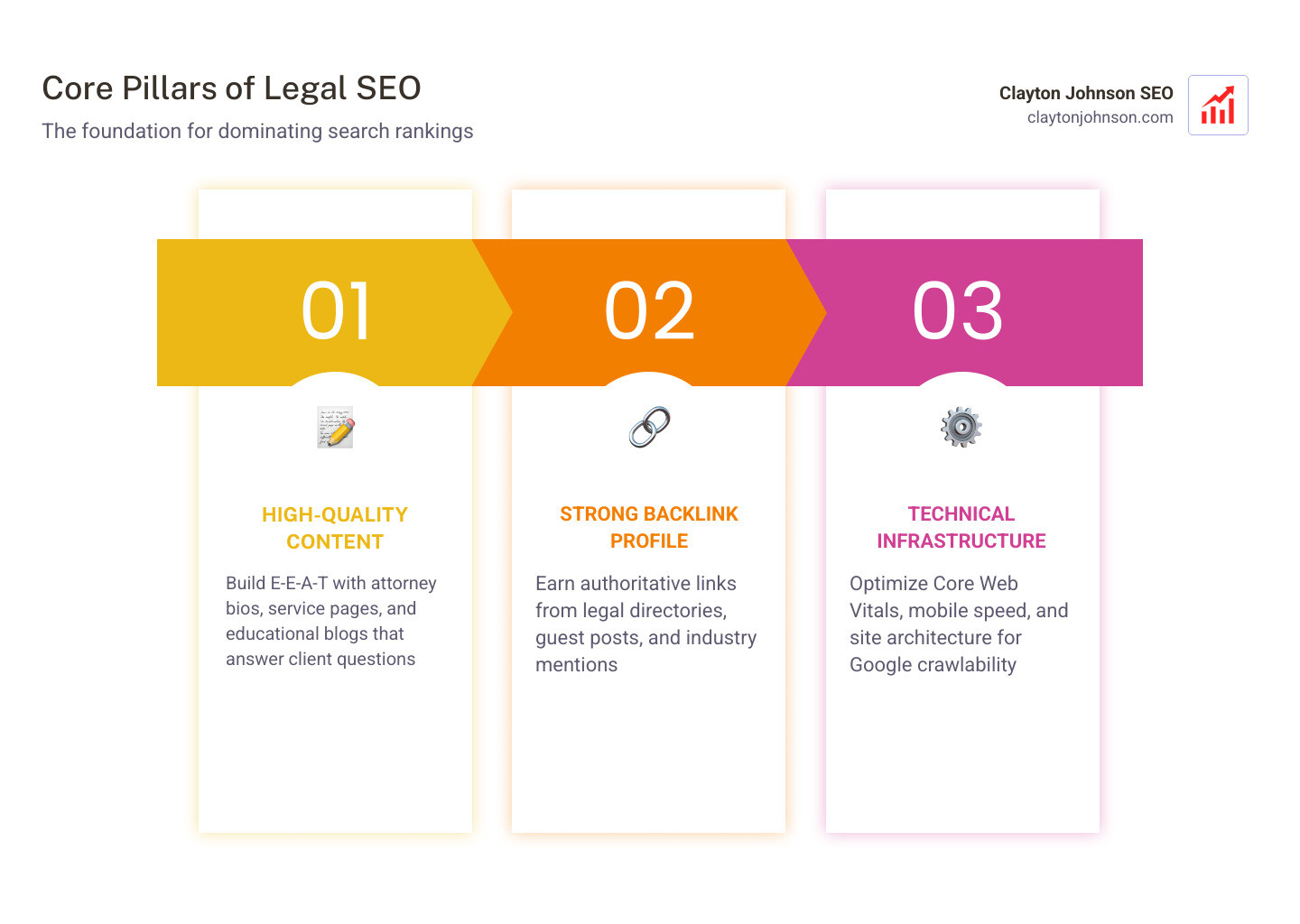
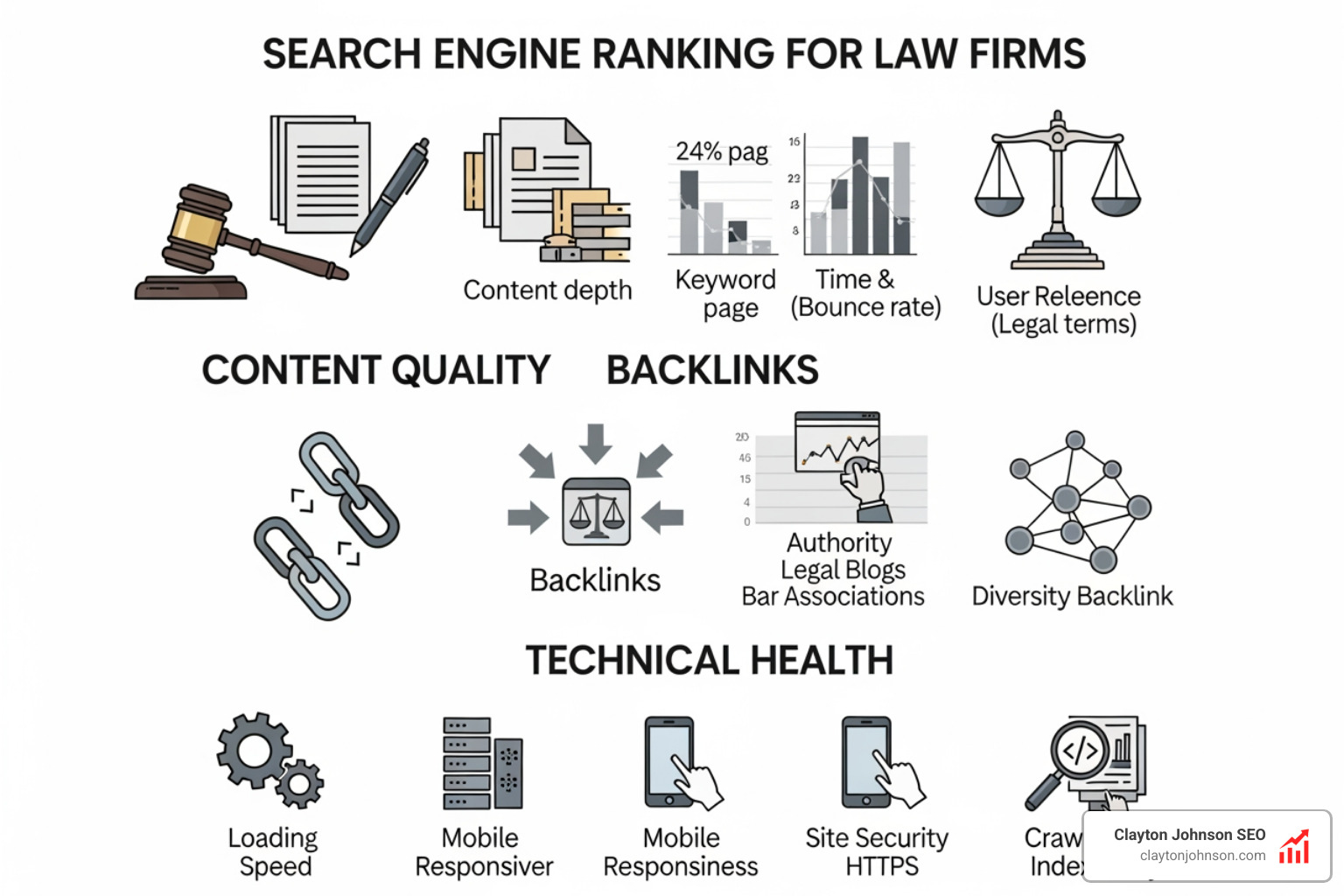
When we talk about Legal Industry SEO & Marketing, we aren’t just talking about “keywords.” We are talking about building a digital engine that consistently brings in cases. To do that, we focus on three main pillars: high-quality content, a strong backlink profile, and a rock-solid technical infrastructure.
Google evaluates over 200 ranking factors, but for law firms, the most important ones fall into the “Your Money or Your Life” (YMYL) category. Because legal advice can significantly impact a person’s future, Google holds law firm websites to a much higher standard of accuracy and transparency.
SEO vs. Paid Advertising
Many firms ask us if they should just stick to Google Ads. While paid ads provide immediate visibility, they are a “pay-to-play” model. The moment you stop paying, your leads disappear. SEO, on the other hand, is a compounding asset. Research shows that while a PPC click might cost hundreds of dollars, organic SEO can drive a much higher ROI over 12 to 18 months, with some firms seeing 40-60% of new cases coming from organic search.
To ensure your firm is playing by the rules, we always recommend familiarizing yourself with Google’s Webmaster Guidelines. If you’re looking for professional help to navigate these complexities, you can explore our SEO services designed specifically for high-stakes industries.
Strategic Keyword Research for Legal Industry SEO & Marketing
Keyword research is the foundation of everything we do. If you target the wrong terms, you’ll get traffic that doesn’t convert. For example, ranking for “how to file a lawsuit” might bring in students or DIYers, whereas “personal injury lawyer in Chicago” brings in potential clients.
We categorize keywords into three types:
- Head Terms: High-volume, high-competition terms like “divorce lawyer.”
- Long-Tail Terms: Specific phrases like “how to divide assets in a California divorce.” These have lower volume but much higher conversion rates.
- Geo-Targeted Terms: Phrases that include your city or neighborhood, such as “estate planning attorney in Minneapolis.”
There are about 3,000 searches each month for the term “law firm near me” and 2,800 for “personal injury law firms near me.” To capture this, you need to learn more about how to do keyword research using tools like KWFinder, Semrush, or Wordstream. We map these keywords to specific practice area pages to ensure every search intent is covered.
Building Authority through E-E-A-T and High-Quality Content
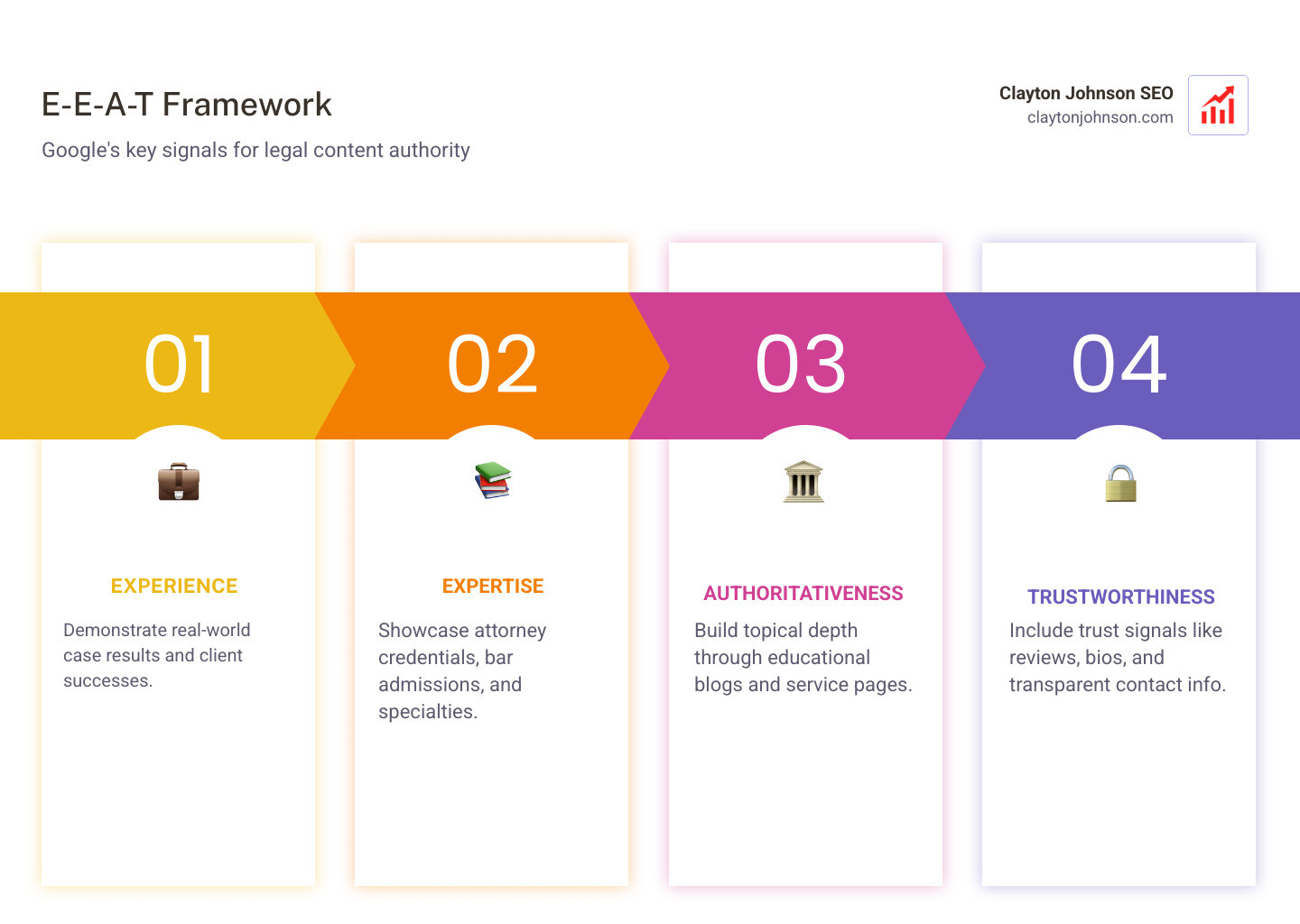
In the legal world, content isn’t just about filling pages; it’s about proving your authority. Google uses a framework called E-E-A-T: Experience, Expertise, Authoritativeness, and Trustworthiness.
- Service Pages: These should be at least 1,000 to 2,500 words and address the specific pain points of your clients. Include FAQs to capture “Position Zero” or featured snippets.
- Attorney Bios: These are often the most visited pages on a law firm site. They should highlight your credentials, awards, and specific case results.
- Educational Blogging: Blogs allow you to target those long-tail, informational questions your clients are asking.
According to research, 70% of potential clients visit multiple law firm websites before making a hire. If your content is thin or purely promotional, they will move on to a firm that provides real value. Our approach to SEO content marketing focuses on building this topical authority so Google sees you as the go-to expert in your niche.
Local SEO and Google Business Profile Optimization
For most attorneys, “local” is everything. You aren’t competing with the whole world; you’re competing with the firm three blocks away. This is where Local SEO comes into play.
The centerpiece of Local SEO is your Google Business Profile (GBP). This is what puts you in the “Local Pack” — the map and three business listings that appear at the top of many legal searches.
Key factors for Local SEO success include:
- NAP Consistency: Your Name, Address, and Phone number must be identical across the web (Google, Yelp, Avvo, Justia).
- Proximity: How close your office is to the person searching.
- Reviews: 26.5% of consumers find lawyers through reviews and directories. Client reviews are often cited as the most influential factor in getting hired.
- Local Citations: Mentions of your firm on local directories like the Better Business Bureau or local Chamber of Commerce.
If you are a firm in the Midwest, for example, focusing on Minneapolis SEO tactics can help you dominate your specific geographic market.
Technical SEO Infrastructure and Site Performance
You can have the best content in the world, but if your site takes 10 seconds to load, no one will ever see it. Technical SEO is the “behind-the-scenes” work that helps search engines crawl and index your site correctly.
We prioritize these elements:
- Core Web Vitals: Google’s metrics for measuring user experience, including loading speed and visual stability. Aim for a load time under 2.5 seconds.
- Mobile-First Indexing: With 63% of legal searches happening on mobile devices, your site must be fully responsive.
- Schema Markup: This is a snippet of code (JSON-LD) that tells Google exactly what your site is about — your practice areas, your reviews, and your office locations. This helps generate “Rich Snippets” in search results.
- Sitemaps: These act as a roadmap for Google’s crawlers. You can find more scientific research on Sitemaps to understand how they impact indexation.
Off-Page Authority and Ethical Link Building
In the eyes of Google, a backlink is a “vote of confidence.” If a high-authority site like the New York Times or the American Bar Association links to your site, your rankings will climb.
However, the legal industry has strict ethical rules. You should never “buy” links. Instead, focus on:
- Legal Directories: Sites like Avvo, Martindale-Hubbell, and Justia.
- Guest Posting: Writing for legal publications or local news outlets.
- Unlinked Mentions: Finding places where your firm is mentioned but not linked, and asking for a link.
- HARO (Help A Reporter Out): Providing expert quotes to journalists in exchange for a backlink.
Research shows that 66% of web pages have zero backlinks. By building even a few high-quality links, you can easily outpace the majority of your competitors.
Measuring Success in Legal Industry SEO & Marketing
You can’t manage what you don’t measure. We move away from “vanity metrics” like raw traffic and focus on what actually moves the needle: leads and cases.
| Metric | SEO | PPC (Ads) |
|---|---|---|
| Initial Cost | Moderate to High | Low to Moderate |
| Time to Results | 3 – 6 Months | Immediate |
| Long-term ROI | High (Compounding) | Low (Linear) |
| Sustainability | High | Zero (Stops when budget ends) |
| Lead Quality | Very High (Intent-based) | High |
We track performance using Google Analytics and Search Console. Key KPIs include organic sessions, keyword rankings for “money” terms, click-through rate (CTR), and conversion rate. For a deeper dive into how we handle these numbers, check out our analytics and data framework.
Implementing a Scalable Growth System for Law Firms
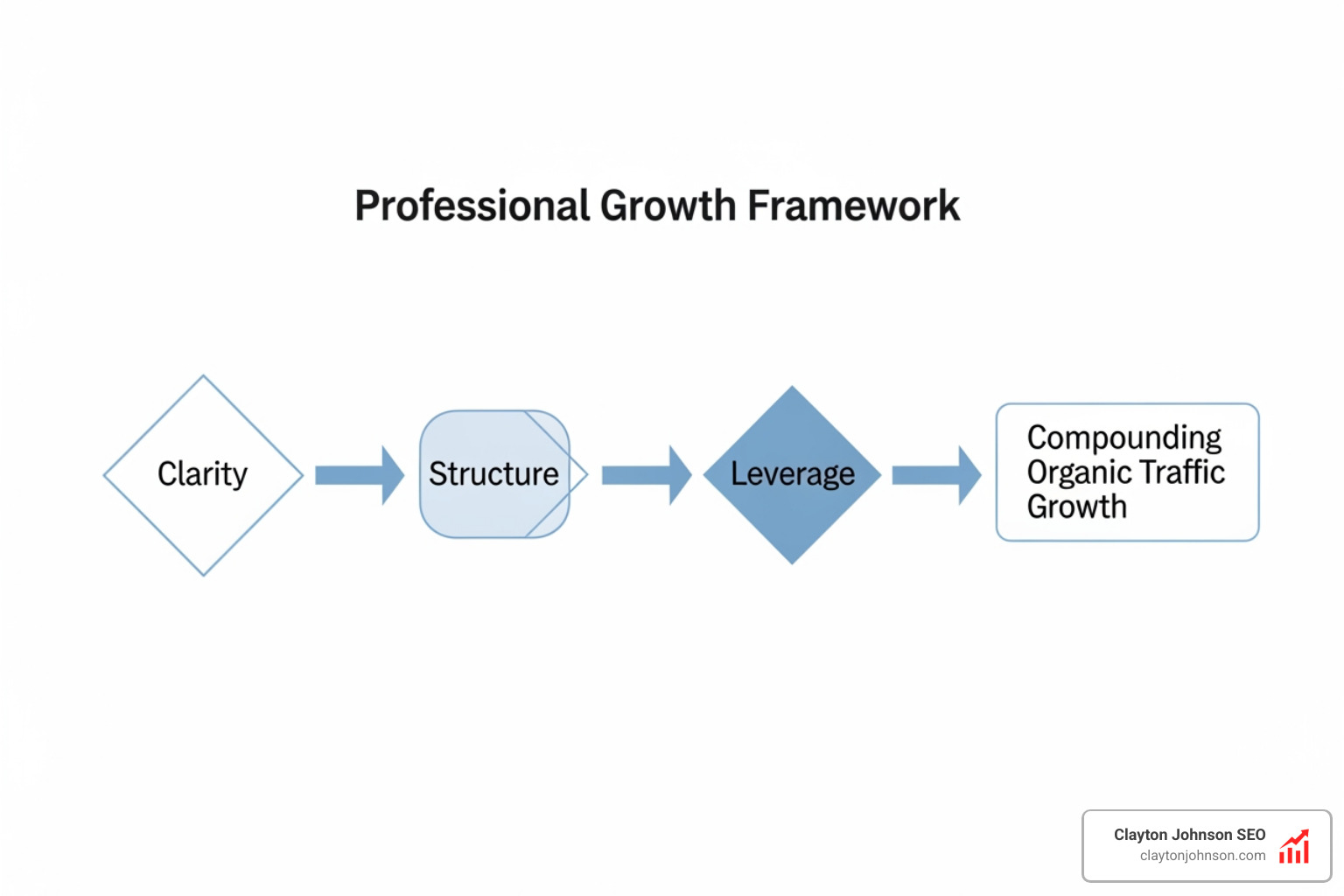
At Clayton Johnson SEO, we don’t believe in chasing the latest “hack.” We believe in building systems. Our philosophy is simple: Clarity → Structure → Leverage → Compounding Growth.
The legal market is more crowded than ever, with over 85% of law firms maintaining their own websites. To stand out, you need a strategy that aligns your technical foundation with a content ecosystem that speaks directly to search intent. We don’t just “do SEO”; we build durable growth engines that turn fragmented marketing efforts into coherent systems.
Whether you are a solo practitioner or a large multi-location firm, the path to the top of the search results requires patience and precision. SEO is a marathon, not a sprint, but it is the most effective way to build a brand that lasts.
If you’re ready to stop guessing and start growing, contact us to start your strategy. We’ll help you build the systems that operationalize your growth and ensure your firm is the one potential clients see first.