A – Z Guide to Change Management & Adaptability

Why Change Management & Organizational Adaptability Define Business Survival
Change Management & Organizational Adaptability are no longer optional business capabilities—they’re survival mechanisms. In today’s environment, where 70% of organizational change efforts fail and 71% of employees report feeling overwhelmed by workplace changes, the ability to navigate transformation effectively separates thriving companies from those struggling to stay relevant.
Quick Answer: What You Need to Know
- Change Management is the structured process of guiding organizational transitions from current to future states
- Organizational Adaptability is the capacity to adjust processes and systems in response to dynamic environments
- The Connection: Research shows change management explains 20.8% of organizational adaptability (R² = 0.208)
- Why It Matters: Organizations with high change capability are 2.2x more likely to become industry “Reinventors” and see up to 5 percentage points higher annual revenue growth
The New Reality
The pace of required adaptation has shifted dramatically. Where blacksmith foundries once adapted over centuries and car companies over decades, today’s organizations must respond to disruption in months or weeks. Post-pandemic hiring shortages, generative AI disruption (impacting 44% of working hours), and continuous digital transformation mean change is now constant rather than episodic.
Yet most organizations still rely on industrial-age change management approaches designed for stability, not continuous evolution. Only 30% of C-suite leaders feel confident about their change capabilities, despite 96% dedicating more than 5% of revenue to change projects.
The Human Cost
Employees now experience an average of ten planned change programs per year—a fivefold increase from a decade ago. This creates change fatigue, with 41% resisting change due to distrust in leadership and 26% citing ineffective top-down communication. Organizations that fail to address these human factors see their technical implementations succeed but their transformations fail.
I’m Clayton Johnson, and through building strategic frameworks and growth systems across multiple industries, I’ve seen how effective Change Management & Organizational Adaptability transforms fragmented efforts into coherent, resilient operations. This guide synthesizes research-backed frameworks with practical strategies you can implement immediately.
Defining Change Management & Organizational Adaptability
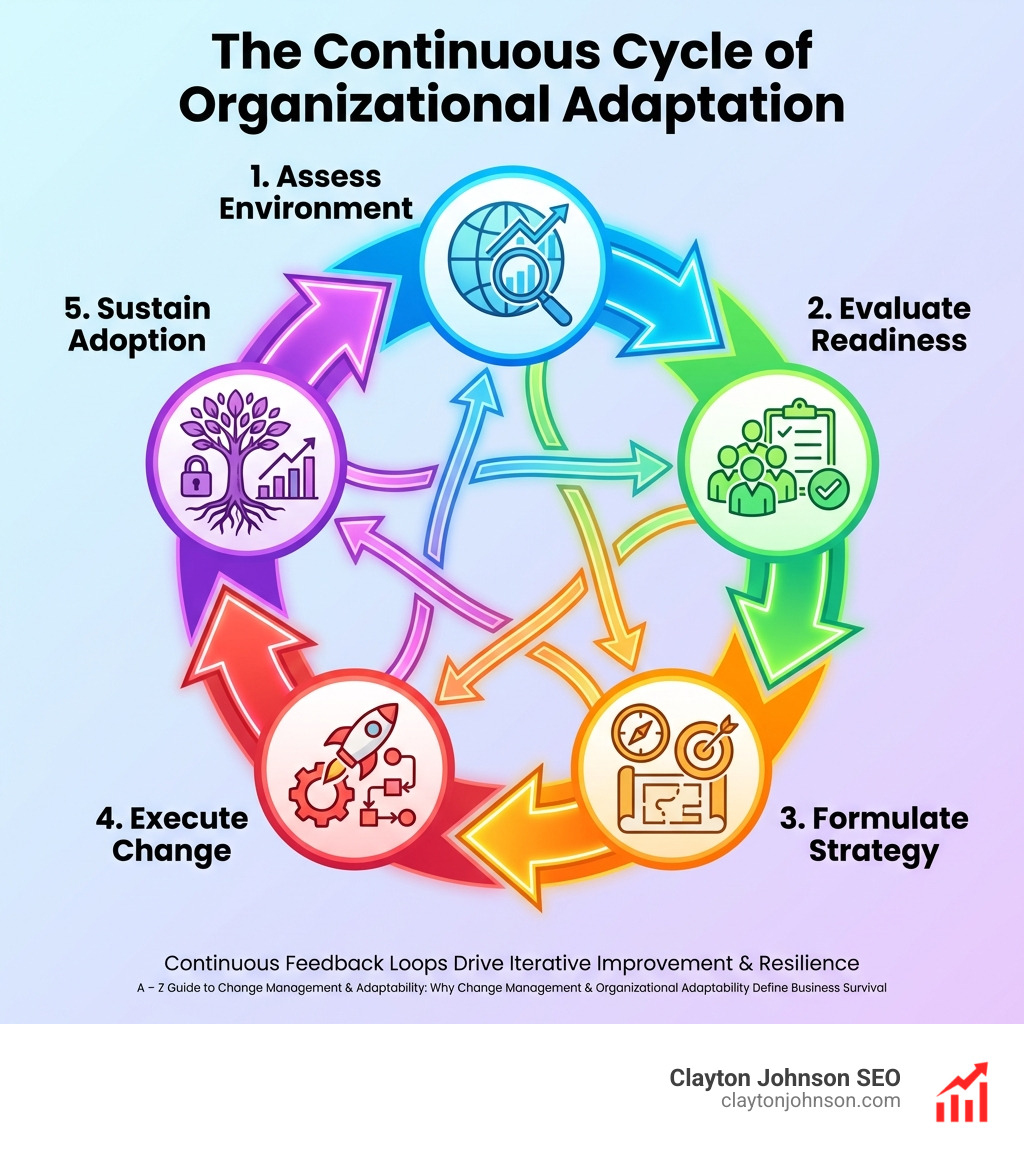
To master the art of the pivot, we first need to define what we’re actually talking about. Many people use these terms interchangeably, but they represent two sides of the same coin.
Scientific research on the influence of change management confirms that change management is the “how,” while adaptability is the “result.” In a recent study involving 110 respondents across various organizations, data showed that Change Management explains 20.8% of the variation in Organizational Adaptability (R² = 0.208). While 20% might sound small, in the complex world of business psychology, it’s a massive lever that leaders can actually control.
We must view Change Management & Organizational Adaptability through the lens of environmental dependence. An organization doesn’t just “adapt” in a vacuum; it adjusts its internal processes to achieve goals based on a shifting external landscape.
| Feature | Episodic Change | Continuous Change |
|---|---|---|
| Frequency | Infrequent, discontinuous | Ongoing, evolving |
| Trigger | External shocks or failure | Constant modifications |
| Metaphor | Punctuated equilibrium | Improvisation & learning |
| Role of Agent | Prime mover (creates change) | Sense maker (redirects change) |
| Goal | Replacement of old systems | Cumulative refinement |
The Core Relationship Between Change Management & Organizational Adaptability
The bridge between these two concepts is built on five pillars identified in recent research:
- Readiness to Change: The psychological and physical preparation of the workforce.
- Company Support: The resources, tools, and “safety nets” provided by leadership.
- Organizational Structure: Whether your hierarchy helps or hinders the flow of new ideas.
- Technical Work: The actual training and skills required to use new tools.
- Responding Skills: The agility of the team to move when the market moves.
When we strengthen our change management practices, we are essentially “working out” our organizational muscles. The stronger the muscle, the better the athlete—or in our case, the more adaptable the business.
Why Adaptability is Essential in Modern Business
We live in the “Technological Era,” a fancy way of saying things are moving faster than our brains were originally designed to handle. Digitalization, automation, and the Internet of Things (IoT) are no longer futuristic concepts; they are the baseline.
Consider the post-pandemic hiring landscape. Two-thirds of global companies have struggled to hire qualified workers. The companies that survived didn’t just wait for the market to fix itself; they adapted. They implemented flexible work arrangements, upskilled existing staff, and redesigned their value propositions. This is Change Management & Organizational Adaptability in action.
Why Traditional Change Management Fails (and How Adaptability Wins)
If change management is so well-studied, why do 70% of efforts still hit a brick wall? The answer usually lies in the difference between “compliance” and “commitment.”
Traditional models often focus on the technical side—installing the software, moving the desks, or changing the org chart. But they ignore the biological reality of the human beings involved. Humans are biologically biased toward stability. We like knowing where our “cheese” is. When we feel that stability is threatened without a clear purpose, we resist.
Psychological Barriers to Change Management & Organizational Adaptability
Change fatigue is a real productivity killer. When 71% of employees feel overwhelmed, they don’t just work slower; they start to check out. Our research highlights several key friction points:
- Distrust in Leadership (41%): If employees don’t trust the person at the helm, they won’t follow them into a storm.
- Ineffective Communication (26%): Top-down “decrees” rarely work. People need to know why the change is happening, not just what it is.
- Feeling Excluded (23%): When change is “done to” people rather than “with” them, resistance is the natural response.
- The Alpha Attitude: We often see leaders who want to initiate change but struggle to follow others’ initiatives. This creates a “Not Me” culture where leaders blame “the culture” for failures they actually authored.
To win, we must strengthen our change muscle by debunking industrial-age myths—like the idea that detailed policies provide clarity. In reality, rigid policies often act as anchors that prevent us from floating when the tide rises.
Moving from Change Management to Change Strategy
We need to stop treating change as a “management exercise” and start seeing it as a strategic challenge. A research-based guide on change strategy from BCG suggests using agent-based simulations to test how change will actually spread through an organization.
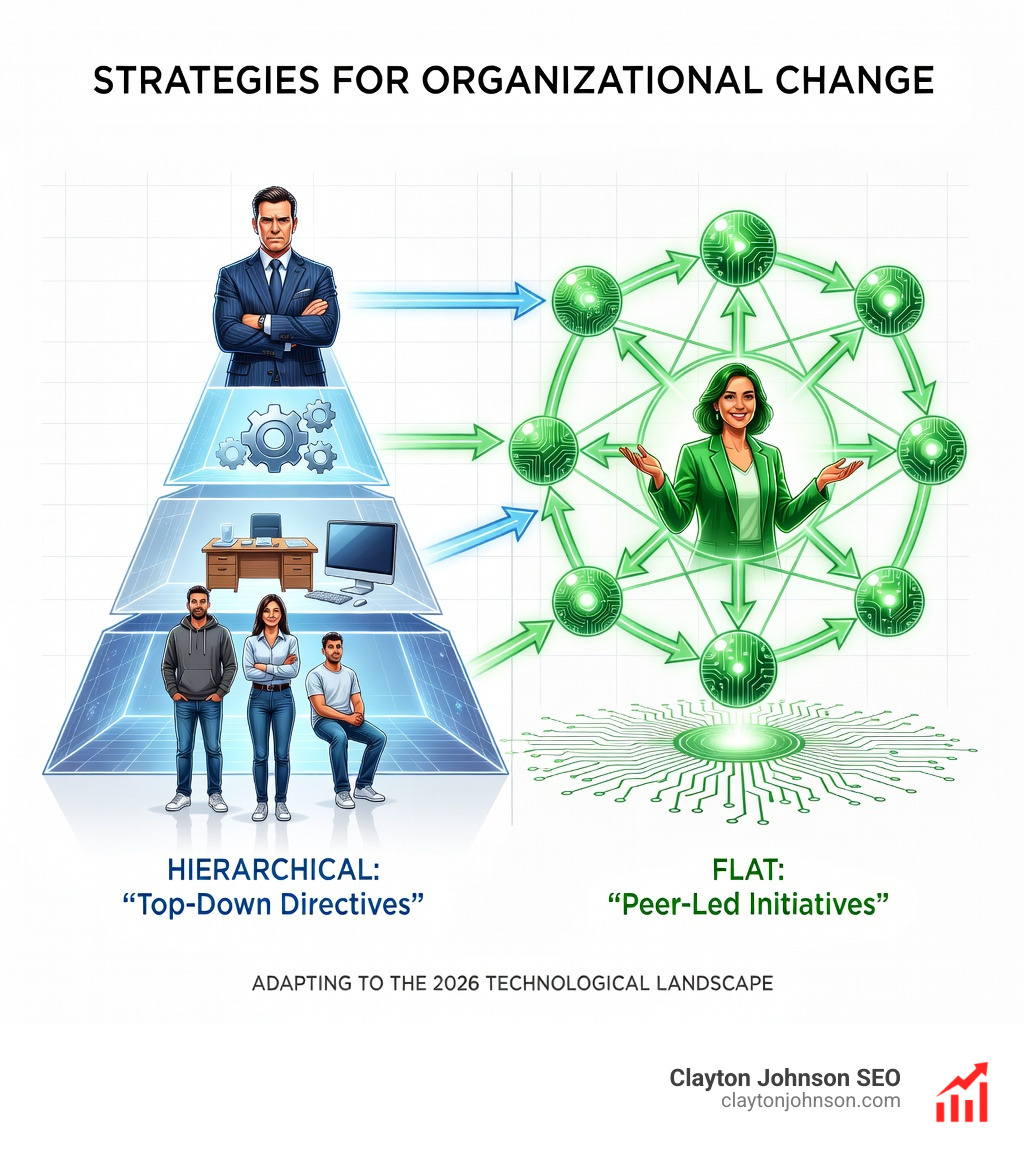
Not all organizations are built the same:
- Hierarchical Structures: These respond well to “leadership amplification”—the CEO setting a clear, loud tone.
- Flat/Decentralized Structures: These require “champions” or influencers. If you want a flat org to change, you have to convince the popular kids in the office first.
Proven Frameworks for Navigating Change Management & Organizational Adaptability
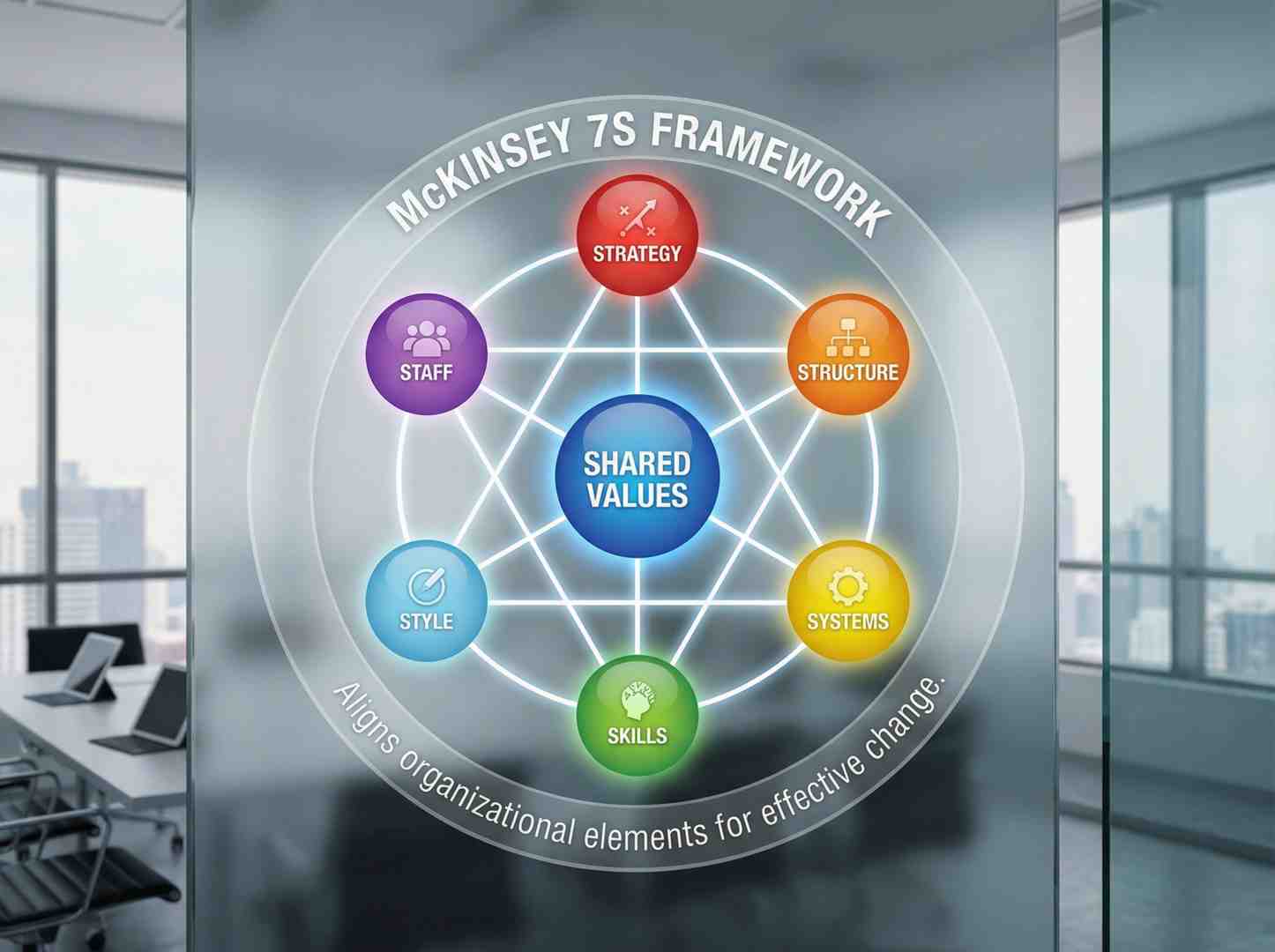
You don’t have to reinvent the wheel. Several time-tested frameworks can provide the “railings” for your transformation journey.
The Heavy Hitters: Kotter, ADKAR, and Lewin
- Kotter’s 8-step process: This is the gold standard for transformational change. It starts with creating a sense of urgency and ends with anchoring new approaches in the culture.
- ADKAR Model: Focuses on the individual journey—Awareness, Desire, Knowledge, Ability, and Reinforcement.
- Lewin’s Model: The classic “Unfreeze-Change-Refreeze” approach. It’s simple, but effective for episodic shifts.
- ACMP Global Standard: This provides a professional, rigorous process for evaluating impact and executing plans.
Applying DMAIC and Process Improvement to Adaptability
At Clayton Johnson SEO, we love data. That’s why we advocate for using Six Sigma tools like DMAIC (Define, Measure, Analyze, Improve, Control). You can stop guessing with DMAIC strategies and start using process improvement scoring 101 to see where your adaptability is lagging.
By measuring things like “Technical Training” mean scores (which research shows is often the lowest-scoring area in change efforts), you can pinpoint exactly where your team needs help.
Nicolaj Siggelkow’s Guidelines and Complexity Leadership
Adaptability isn’t just about following a checklist; it’s about creating “Adaptive Space.” This concept, rooted in complexity leadership, suggests that organizations need three types of leadership:
- Entrepreneurial Leadership: The people coming up with wild, new ideas.
- Operational Leadership: The people keeping the lights on and making things efficient.
- Enabling Leadership: The bridge-builders who create the “Adaptive Space” where the other two groups can clash and create something new.
This “enabling” role is what allows for Change Management & Organizational Adaptability to flourish. It’s about managing the tension between the “need to innovate” and the “need to produce.”
Practical Strategies to Boost Organizational Adaptability
Knowing the theory is great, but how do we actually do this on a Tuesday morning? It starts with alignment.

We recommend using operational alignment frameworks and execution roadmaps to ensure every department is moving in the same direction. Without this, you get “siloed adaptability,” where Marketing is moving at light speed but IT is still using a horse and buggy.
Leadership Humility and Purpose-Driven Communication
Effective adaptive leadership tips often center on one surprising quality: humility. Humble leaders exhibit “deliberate calm.” They don’t pretend to have all the answers. Instead, they foster two-way dialogue and transparency.
When communicating change, we must:
- Define short-term and long-term goals: Don’t just say “we’re changing.” Say “we’re doing X this month to achieve Y by next year.”
- Listen actively: If your team says a new process is broken, believe them.
- Use “Future-Back” Thinking: Imagine the successful future state and work backward to today.
The Role of HR in Fostering a Culture of Adaptability
HR is the secret weapon in Change Management & Organizational Adaptability. In fact, 75% of employees see HR as central to successful change. When HR focuses on promoting a culture of adaptability, the results are staggering.
Organizations with engaged employees are 21% more profitable. Why? Because engaged employees feel “psychologically safe.” They know they can experiment, fail, and learn without losing their jobs. This safety is the fertile soil where adaptability grows.
Overcoming Resistance: From Change Fatigue to Readiness
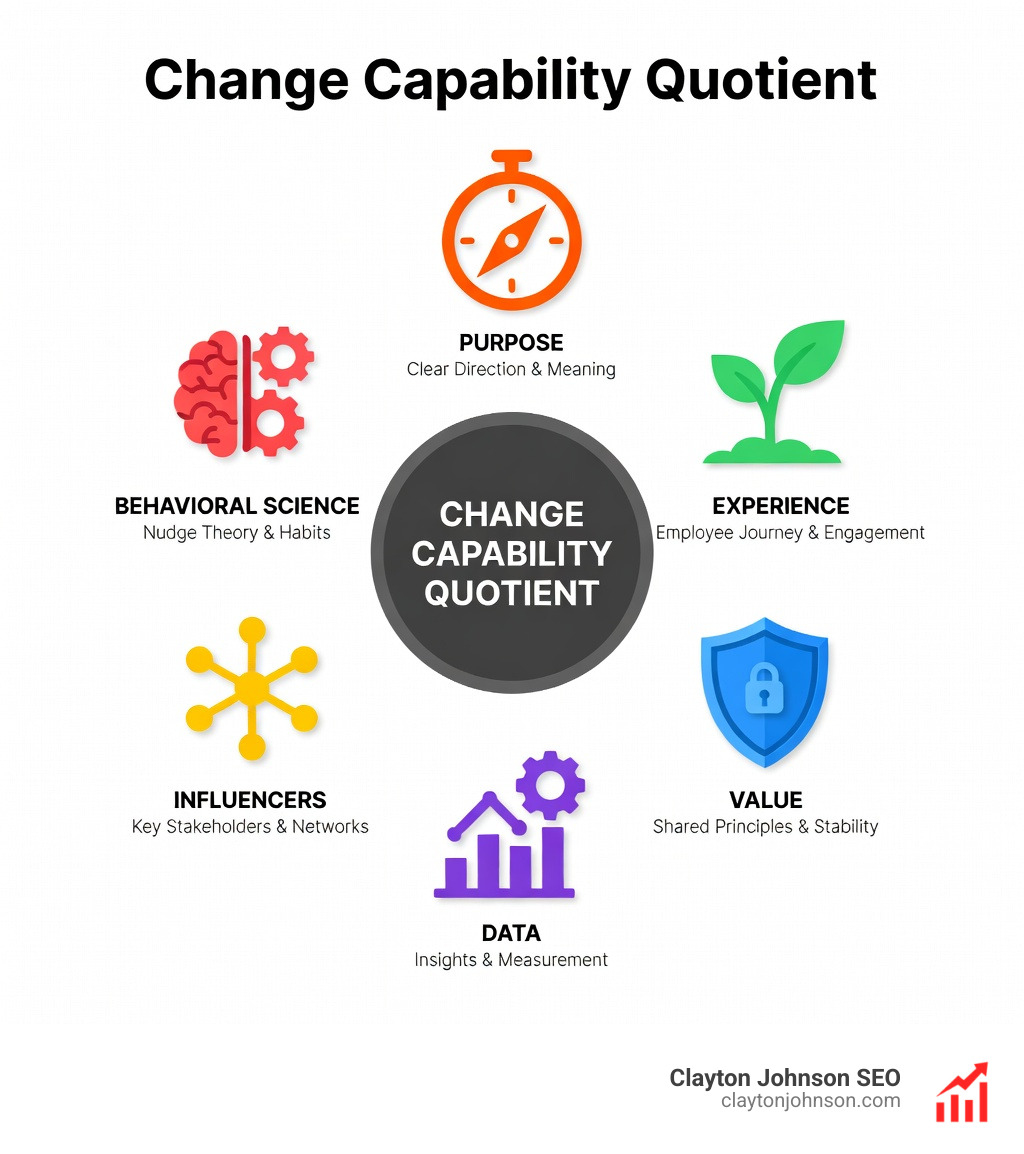
Resistance isn’t a sign that your team is “bad.” It’s a sign that they are human. To move from fatigue to readiness, we can use behavioral science and “Nudge Theory.”

Transforming Resistance into Engagement
The most important question any employee has during a change is “WIIFM” (What’s In It For Me?). If you can’t answer that, you’ve already lost.
- Involve them early: Involving employees in decision-making boosts success by 15%.
- Personality Insights: Use “color energies” or personality assessments to tailor your communication. A data-driven person needs stats; a people-oriented person needs to know how it affects the team.
- Identify Influencers: Find the “respected skeptics” in your office. If you can win them over, they will bring the rest of the team with them.
Building Long-Term Resilience and Stability
Adaptability requires a foundation of stability. This sounds like a paradox, but it’s true. If everything is changing, nothing is changing. You need a stable company culture and core values to give people the confidence to navigate shifting processes.
This is what we call adaptability as the secret sauce. It requires:
- Unlearning and Relearning: Being willing to let go of “how we’ve always done it.”
- Grit: The persistence to stick with a change when the “dip in performance” hits.
- Continuous Learning: Treating every transformation as a classroom, not a courtroom.
Frequently Asked Questions about Change Management & Organizational Adaptability
What is the difference between change management and organizational adaptability?
Change management is the set of tools and processes used to manage a specific transition (the “action”). Organizational adaptability is the steady-state capability of the company to evolve and thrive amidst constant shifts (the “trait”). Think of change management as the workout and adaptability as the fitness level.
Why do 70% of change management initiatives fail?
Most fail because they focus on the “technical” side while ignoring the “people” side. Common culprits include a lack of leadership humility, poor communication, change fatigue, and a failure to involve employees in the process. When people feel change is “forced” without purpose, they naturally resist.
How can leaders reduce change fatigue in their teams?
Prioritize your initiatives! Don’t try to change ten things at once. Use “90-day cycles” to allow for periods of execution and reflection. Most importantly, provide “Adaptive Space” and psychological safety so employees feel supported rather than overwhelmed.
Conclusion
At Clayton Johnson SEO, we believe that the only way to build a sustainable business in the modern era is to treat change as a strategy, not an emergency. Whether you’re in Minneapolis or managing a global remote team, the principles of Change Management & Organizational Adaptability remain the same: lead with humility, use data to drive decisions, and never forget that your people are the ones who actually make the change happen.
Strategic resilience isn’t about avoiding the storm; it’s about building a ship that can be rebuilt while it’s sailing. If you’re ready to stop guessing and start growing, work with me for strategic design and let’s build your organization’s change muscle together.