AI Annotation Tools for Faster Model Training

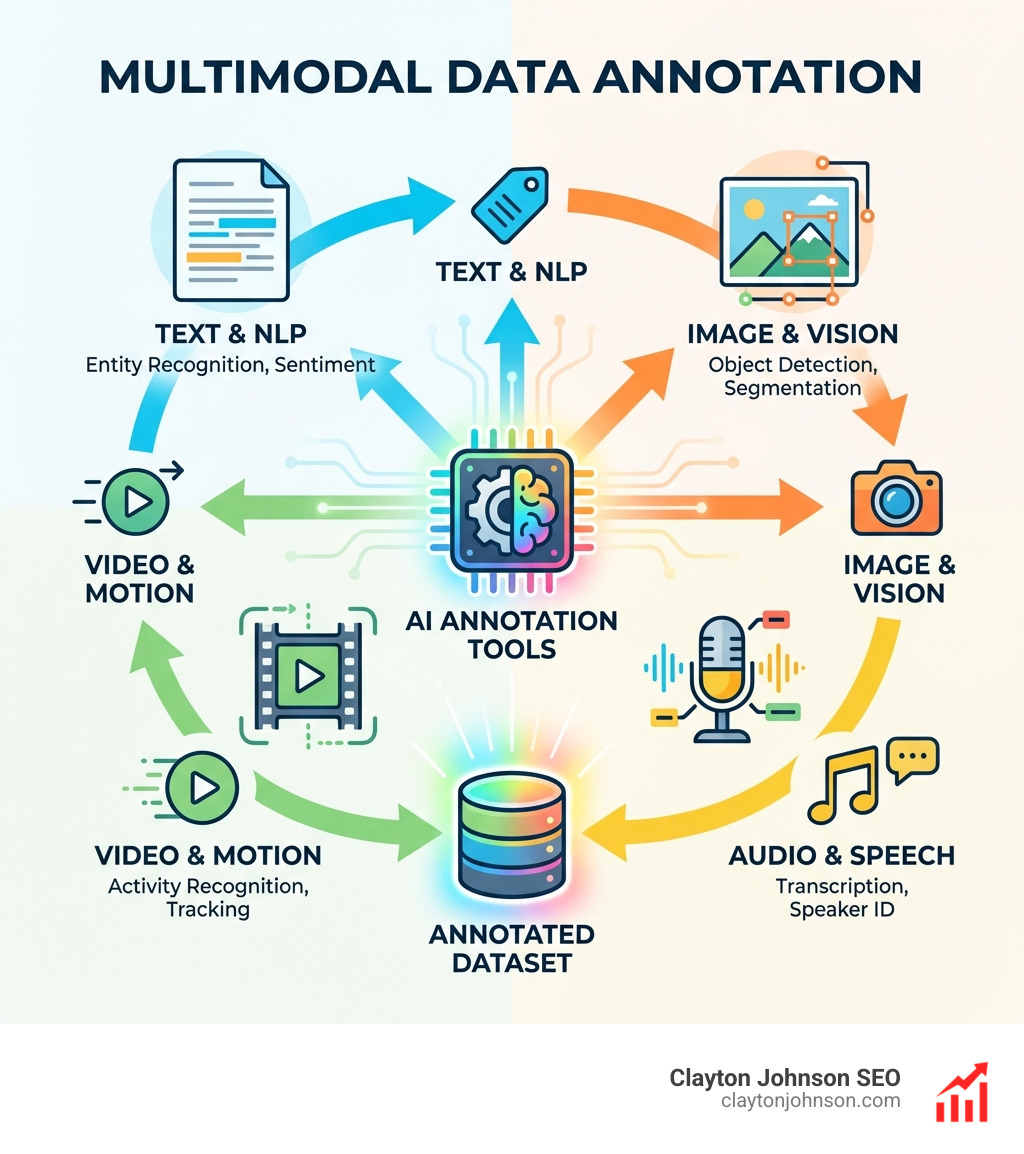
AI annotation tools are specialized software solutions designed to label raw data for training artificial intelligence models. They are crucial for creating the high-quality datasets that power effective machine learning.
Here’s why they matter:
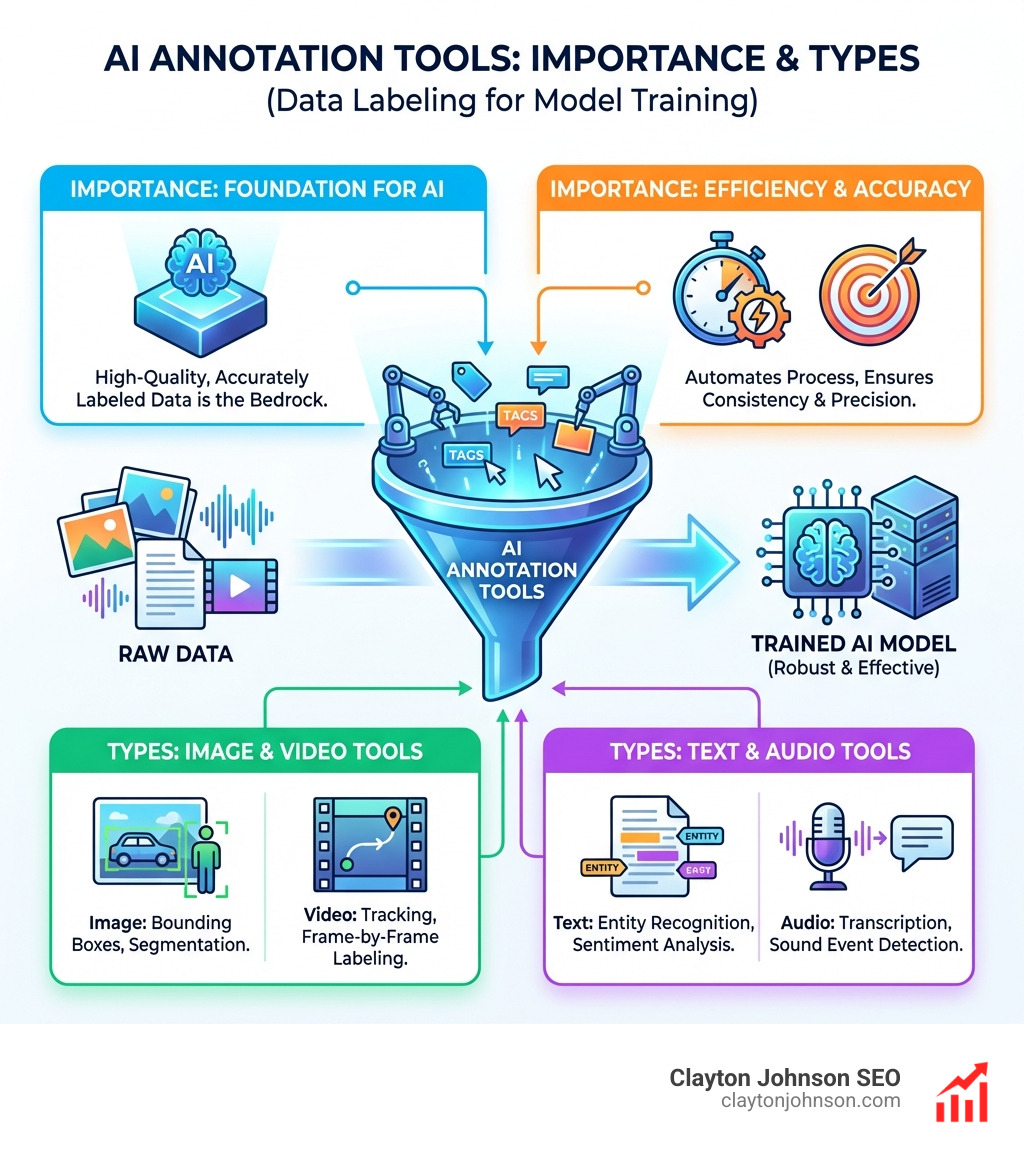
- Foundation for AI: AI models learn from data. High-quality, accurately labeled data is the bedrock of successful AI development.
- Efficiency: They automate and streamline the often-tedious process of labeling, making it faster and more scalable.
- Accuracy: These tools help ensure consistency and precision in annotations, leading to more robust models.
- Multimodal Support: They handle diverse data types – images, videos, text, audio – essential for complex AI systems.
The world of AI is moving fast. From self-driving cars to medical diagnostics, AI relies on mountains of well-labeled data. These tools bridge the gap between raw information and intelligent systems. They empower teams to turn unstructured data into actionable insights for machine learning.
As Clayton Johnson, I’ve spent years architecting AI-augmented marketing workflows and understanding the data pipelines that drive AI systems. My work involves integrating AI annotation tools to reduce execution drag and build scalable content architectures for AI readiness.
Ai annotation tools terminology:
In the early days of machine learning, we mostly talked about simple image classification—telling a computer that a picture contained a cat or a dog. Today, the landscape is far more complex. We are in the era of multimodal AI, where models must process and understand multiple types of data simultaneously.
Multimodal data annotation is the process of labeling diverse data types—including images, videos, text, audio, and specialized formats like DICOM (medical imaging) or LiDAR (3D point clouds)—within a single workflow. This is essential because real-world AI applications rarely rely on just one sense. An autonomous vehicle, for instance, needs to “see” images, “sense” distances via LiDAR, and “hear” sirens through audio sensors.
The multimodal AI market is exploding, projected to grow at a CAGR of 35.8%. To keep up, teams must master various techniques:
- Computer Vision: This includes object detection (drawing bounding boxes or polygons), semantic segmentation (partitioning an image into segments), and video tracking (following an object across frames).
- Natural Language Processing (NLP): This involves text classification, sentiment analysis, and entity recognition to help AI Models understand human language.
- Audio: Techniques here include audio transcription and sound segment labeling to differentiate between speech and background noise.
Without these high-quality “ground truth” labels, even the most sophisticated AI Tools would struggle to perform accurately.
Top 10 AI Annotation Tools for Enterprise Teams
Choosing the right platform is like choosing the foundation for a skyscraper. If the tool can’t scale, your model training will hit a ceiling. Based on our research and industry benchmarks, here is a comparison of the leading ai annotation tools currently available.
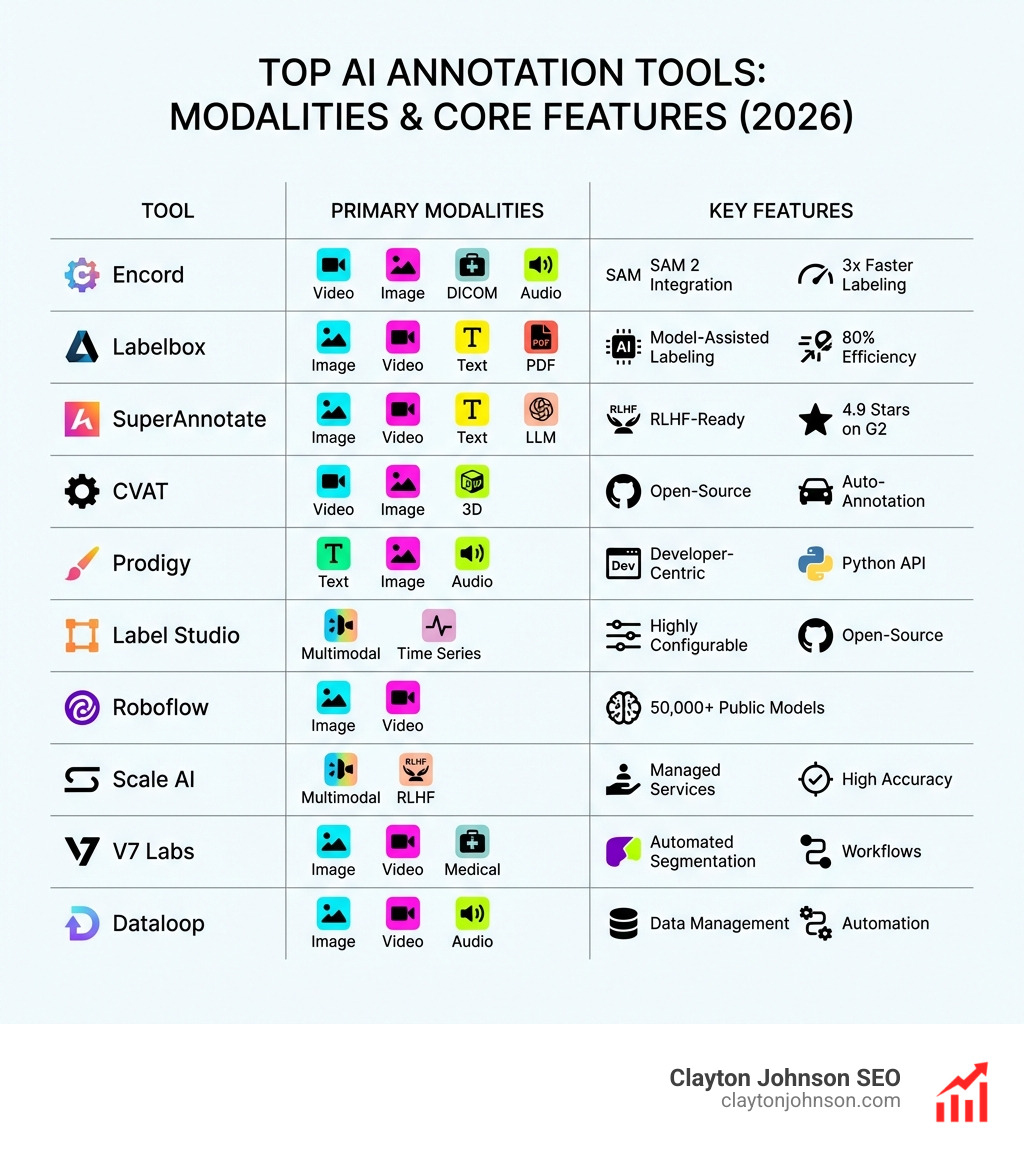
| Tool | Primary Data Types | Key Features | Pricing Model |
|---|---|---|---|
| Encord | Video, Image, DICOM, Audio | SAM 2 integration, 3x faster labeling | Usage-based / Enterprise |
| Labelbox | Image, Video, Text, PDF | Model-assisted labeling, 80% efficiency | Free tier / Paid tiers |
| SuperAnnotate | Image, Video, Text, LLM | RLHF-ready, 4.9 stars on G2 | Custom quote / Free trial |
| CVAT | Video, Image, 3D | Open-source, auto-annotation | Free / $33/mo Solo |
| Prodigy | Text, Image, Audio | Developer-centric, Python API | One-time license |
| Label Studio | Multimodal, Time Series | Highly configurable, Open-source | Free / Enterprise |
| Roboflow | Image, Video | 50,000+ public models | Free / Usage-based |
| Scale AI | Multimodal, RLHF | Managed services, high accuracy | Custom Enterprise |
| V7 Labs | Image, Video, Medical | Automated segmentation, workflows | Paid tiers |
| Dataloop | Image, Video, Audio | Data management, automation | Starts ~$85/mo |
1. Encord Annotate
Encord is a powerhouse for teams dealing with complex data. It can automate up to 97% of image annotations with 99% accuracy using models like Meta AI’s Segment Anything Model (SAM). We’ve seen users achieve 5x faster data throughput, making it a top choice for healthcare and autonomous driving.
2. Labelbox
Labelbox is often cited as the most complete data labeling solution. It focuses on Enterprise AI needs, offering a unified platform for labeling, curation, and model diagnostics. Their model-assisted labeling can improve efficiency by up to 80%.
3. SuperAnnotate
Rated #1 on G2, SuperAnnotate is the cornerstone for feedback-driven data pipelines. It provides specialized tools for LLM fine-tuning, including RLHF (Reinforcement Learning from Human Feedback) and quality assurance workflows.
4. CVAT (Computer Vision Annotation Tool)
Originally developed by Intel, CVAT is a favorite among developers. Over 200,000 users trust it daily. Its CVAT Interface supports 19 different annotation formats, making it incredibly versatile for computer vision tasks.
5. Prodigy
Prodigy is a downloadable developer tool that puts privacy first. It runs entirely on your local machine or an air-gapped environment. It’s built on Python, allowing for deep customization of “recipes” for specific annotation tasks.
Advanced Features: Auto-Annotation and Active Learning
The “secret sauce” of modern ai annotation tools is their ability to help you label data without you actually having to draw every single line. This is achieved through AI-assisted features.
Auto-Labeling and SAM
Tools like Encord and CVAT integrate the Segment Anything Model (SAM). This allows an annotator to click on an object once, and the AI automatically wraps a precise polygon around it. This single feature can accelerate labeling by up to 10x.
Active Learning
Active learning is a strategy where the tool identifies which data samples are most “confusing” to the current model. Instead of labeling 1,000 random images, you only label the 100 images the model is struggling with. Lightly AI, for example, can help achieve a 90% reduction in labeling costs through this type of data curation.
Sophisticated Labeling Ontologies
For complex projects, you need more than just a label. You need sophisticated labeling ontologies. These are structured frameworks that allow for nested classifications—for example, labeling a “Vehicle” and then having a sub-category for “Truck” and a further sub-category for “Damage Type.”
Selecting AI Annotation Tools: Paid vs. Open-Source
When we help clients build AI Governance frameworks, the “Build vs. Buy” (or Open-Source vs. Paid) question always comes up.
Paid Enterprise Tools
Pros:
- Security: Most offer SOC2, HIPAA, and GDPR compliance out of the box.
- Support: Dedicated account managers and technical help.
- Scalability: Built-in collaboration features for teams of hundreds.
- Integrations: Seamlessly connect to AWS, Google Cloud, or Azure.
Cons:
- Cost: Can be expensive for small startups.
- Vendor Lock-in: Moving data between platforms can be tricky.
Open-Source Tools
Pros:
- Cost: Free to use (though you pay for hosting).
- Transparency: You can inspect the codebase.
- Customization: If you have the engineering talent, you can modify the tool.
Cons:
- Maintenance: Your team is responsible for updates and security.
- Limited Collaboration: Often lack the advanced project management features of paid versions.
What are the best free ai annotation tools?
If you’re on a budget, start with the CVAT Community edition or Label Studio. Other great options include LabelMe (created by MIT) and COCO Annotator, which is a web-based tool built with Vue.js specifically for image segmentation.
How do ai annotation tools improve labeling efficiency?
Efficiency gains come from pre-labeling. This is where you run an existing model over your dataset to generate “best guess” labels. Human annotators then simply “accept” or “tweak” the labels rather than starting from scratch. Labelbox and Encord both report that this can cut labeling time by up to 80%.
Which tools support medical DICOM and LiDAR data?
Not all tools can handle 3D or medical data. Encord and SuperAnnotate have robust support for DICOM and NIfTI formats. For 3D point clouds and LiDAR (essential for robotics), Basic.ai and CVAT are industry leaders. MONAI Label is a specialized open-source choice specifically designed for medical imaging.
Conclusion
The global data annotation market is projected to grow to USD 14 billion. As data volumes explode, the ability to rapidly transform raw information into high-quality training data will be the primary differentiator for successful AI companies.
At Clayton Johnson, we believe that tactics without structure lead to wasted effort. Whether you are choosing ai annotation tools or building a SEO Content Marketing engine, success requires a “structured growth architecture.”
If you are looking to scale your AI initiatives or need a partner to build your authority-building ecosystem, we are here to help. Our focus is on clarity, structure, and leverage to create compounding growth for your brand.
Why SEO Still Matters — Especially in the Age of AI
Search has changed. Google now delivers AI-generated answers, AI Overviews, and conversational search results directly in the SERPs. If your business isn’t visible in traditional organic rankings or Google AI Overviews, you are invisible where decisions are being made.
Clayton Johnson SEO Scalable Authority Retainer Framework:
- Foundation Authority ($1,997/mo): 1 DR45+ PR link + 2 DFY articles.
- Growth Authority ($2,997/mo): 2 DR45+ PR links + 4 DFY articles.
- Competitive Authority ($3,997/mo): 3 DR45+ PR links + 6 DFY articles.
- Scale Authority ($6,997/mo): 7 DR45+ PR links + 14 DFY articles.
SEO today is not just ranking; it is search visibility across AI and organic ecosystems. Our strategy ensures your content is both search-optimized and AI-readable, increasing your citation probability in generative search engines.
Ready to build a durable market dominance? Let’s architect your growth.