Beginner’s Guide to AI for Debt Management Consultants

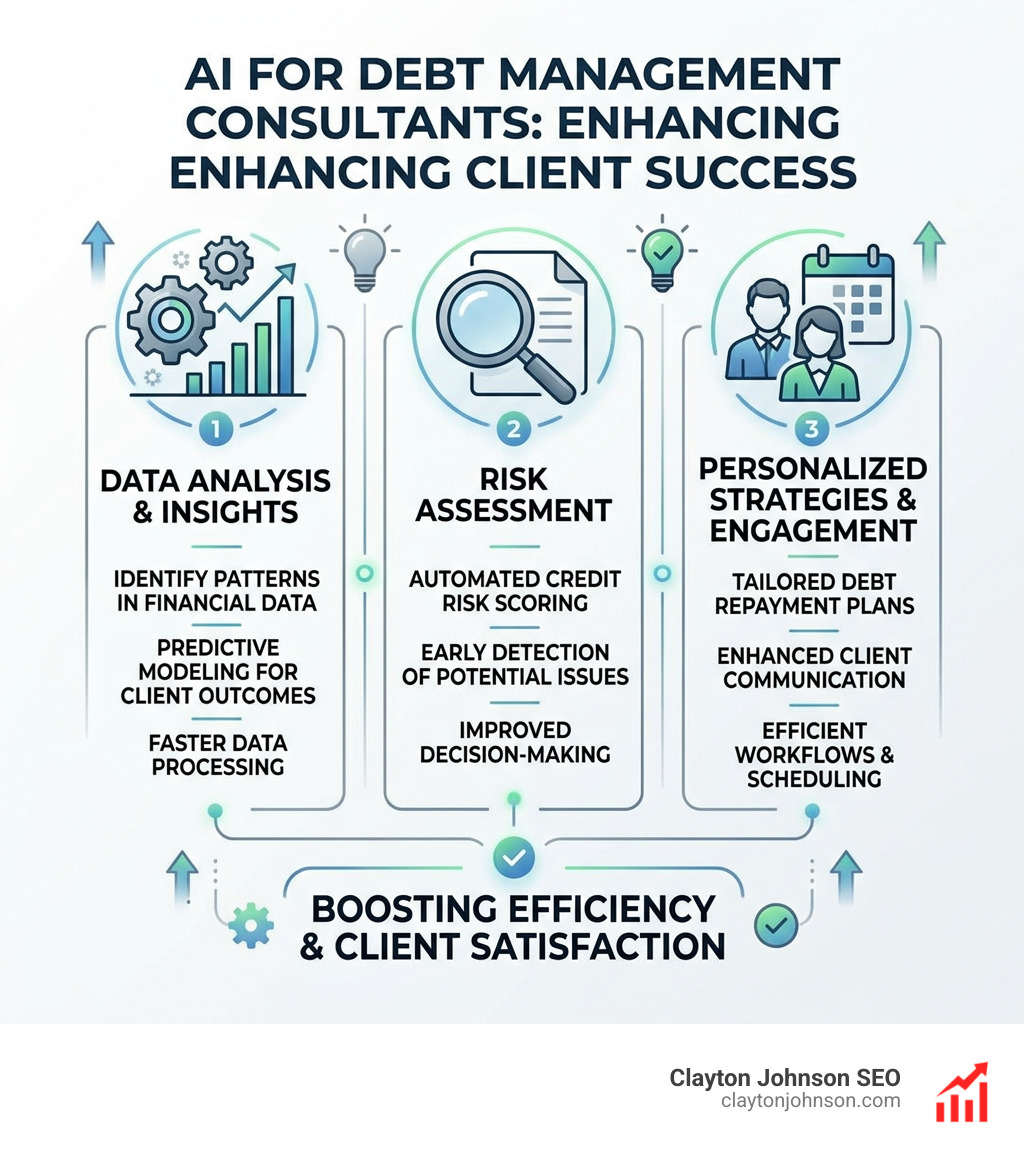
The transformation of the debt management industry isn’t just about replacing paper with digital files; it’s about moving from reactive to proactive strategies. Traditionally, consultants and collection agents worked through lists linearly, calling debtors in the order they appeared. AI for debt management consultants flips this model by using data to dictate the strategy before the first phone call is even made.
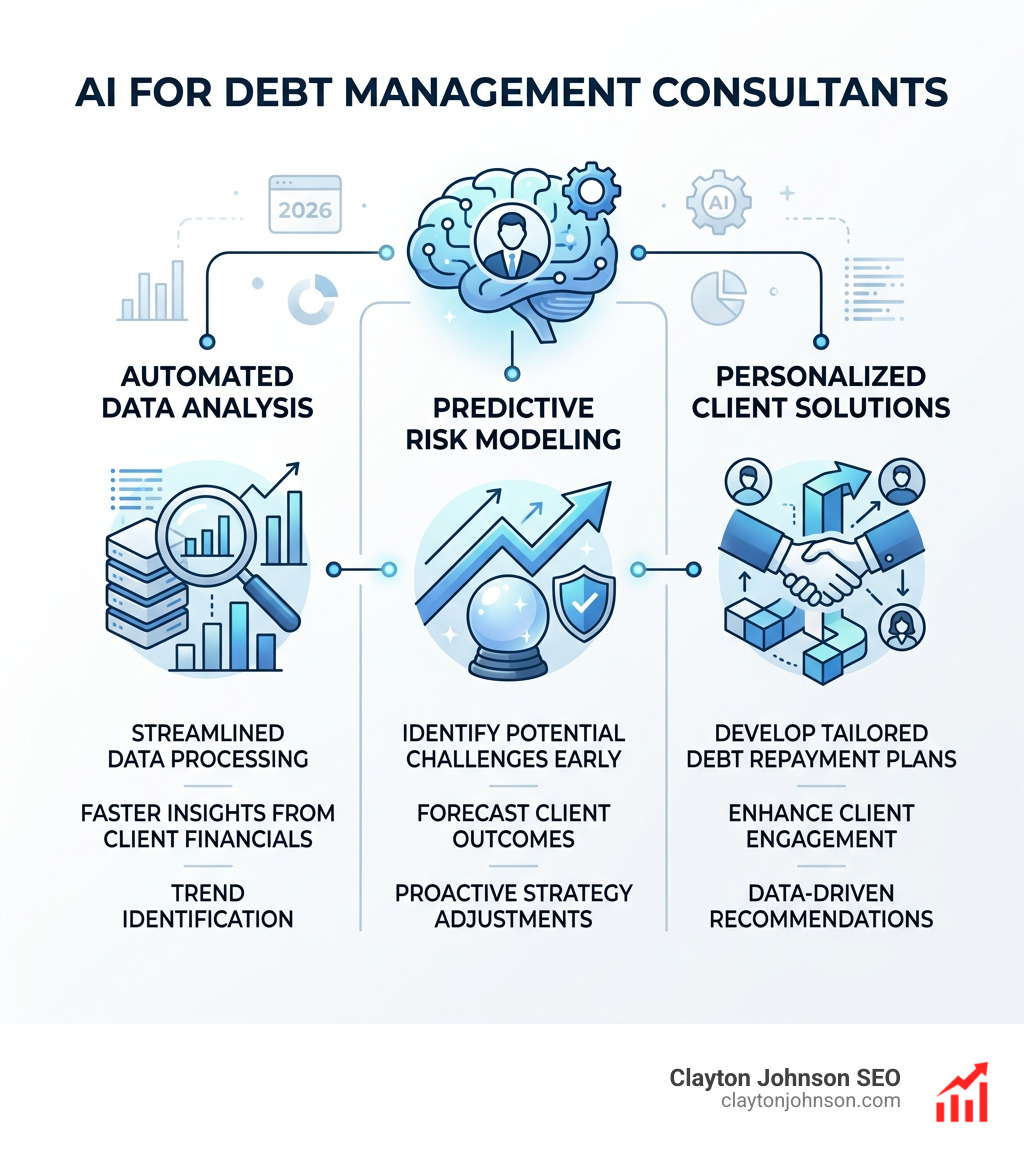
At the heart of this shift is predictive analytics. By analyzing thousands of data points—including payment history, communication preferences, and even macroeconomic trends—AI can forecast which debtors are most likely to settle their obligations. This is often called “propensity modeling.” Instead of wasting hours on “uncollectible” accounts, consultants can focus their human talent on accounts where a personalized touch will actually move the needle.
According to Kaplan Group research on AI recovery rates, these predictive scoring models can improve recovery rates by an average of 25%. This is critical because, as Federal Reserve data on credit balances shows, credit card balances have surged by $50 billion to reach a staggering $1.13 trillion. With more debt entering the system, efficiency is the only way to stay afloat.
Furthermore, AI enables sophisticated debtor segmentation. Rather than treating every borrower the same, AI categorizes them based on risk assessment and behavioral patterns. This allows for:
- Automated borrower follow-ups: Sending reminders via the debtor’s preferred channel at the exact time they are most likely to engage.
- Loan restructuring: Identifying at-risk borrowers early and offering automated restructuring options before they default.
- Data-driven decisions: Moving away from “gut feelings” to strategies backed by hard evidence.
For those in Financial Services, integrating these systems isn’t just a luxury; it’s a requirement for maintaining competitive liquidation rates.
Leveraging AI for Debt Management Consultants to Improve Recovery Rates
The primary goal for any consultant is the “recovery lift.” When we implement AI, we aren’t just sending more emails; we are sending smarter ones. AI-driven systems empower agents by providing them with a “probability of payment” score for every account. This allows them to prioritize their daily workflow effectively.
A Zipdo analysis found that agencies using AI saw a 10% lift in debtor satisfaction. Why? Because AI reduces “harassment” by optimizing contact frequency. If a debtor always pays after a single SMS reminder, the AI won’t trigger a series of intrusive phone calls. This respectful, personalized outreach leads to better engagement and fewer complaints.
To truly understand the impact, consultants should look at 13 Financial Performance Measures Every Manager Should Monitor. By tracking metrics like “Promise to Pay” (PTP) rates and “Right Party Contact” (RPC) rates, it becomes clear that AI-augmented teams outperform traditional ones across the board.
Core Benefits of AI in Debt Consulting
The benefits of moving toward an AI-enhanced model are multi-faceted, affecting everything from the bottom line to the daily stress levels of staff.
| Feature | Traditional Debt Collection | AI-Enhanced Collection |
|---|---|---|
| Reach | Limited by manual dialer capacity | Unlimited via omnichannel automation |
| Availability | Standard business hours | 24/7 via chatbots and portals |
| Decisioning | Rules-based or “gut feeling” | Data-driven predictive modeling |
| Cost | High (labor-intensive) | Low (scalable software) |
| Compliance | Manual monitoring (high error risk) | Automated real-time guardrails |
Zipdo research highlights that 77% of financial institutions report significant productivity gains. By minimizing manual errors and providing real-time reporting, AI allows firms to scale their operations without a linear increase in headcount.
Technical Architecture and the Software Ecosystem
To the uninitiated, AI can feel like “magic,” but it actually relies on a very structured technical architecture. For ai for debt management consultants to work effectively, it needs a solid foundation of data.
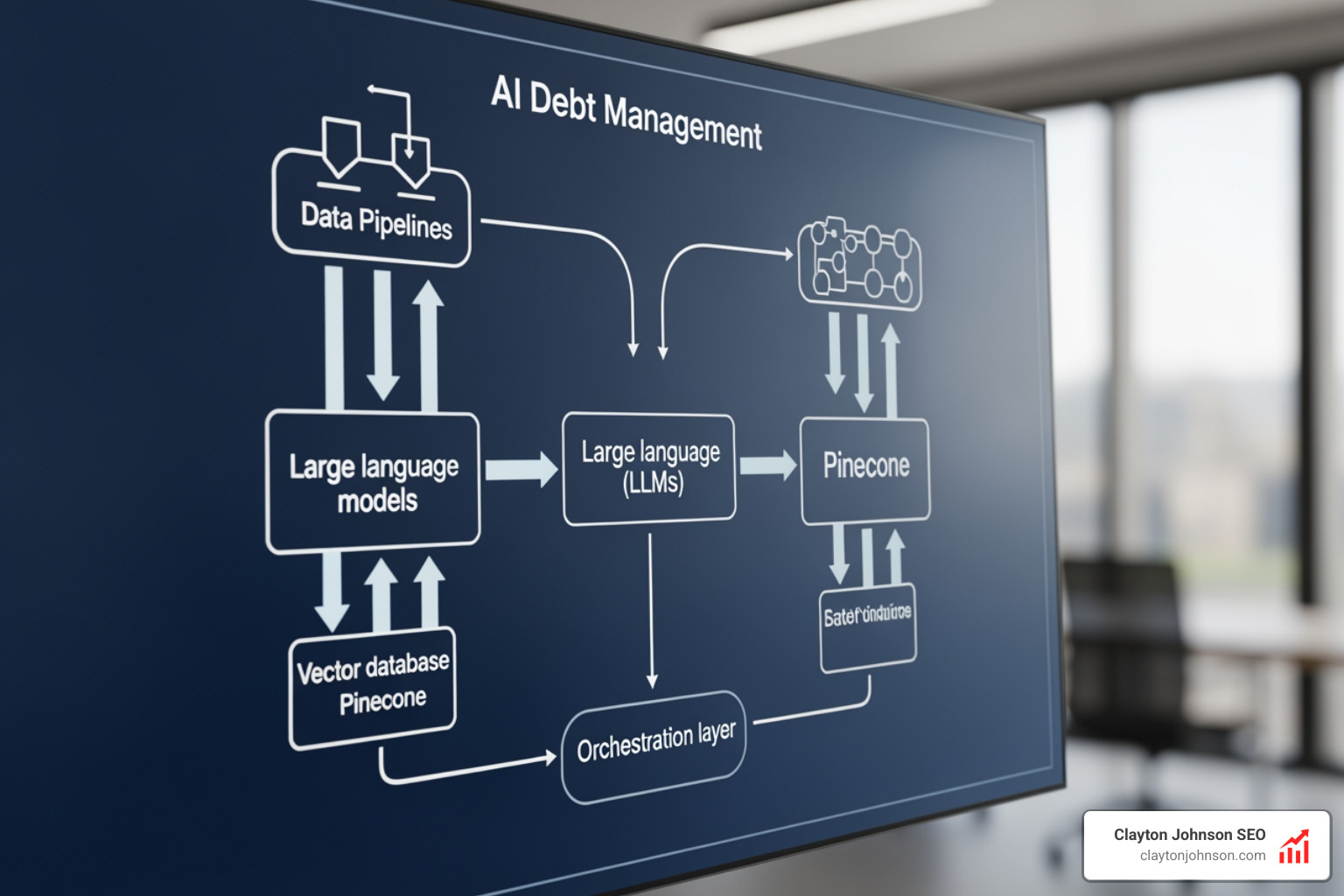
The modern AI stack for debt management typically includes:
- Data Pipelines: These ingest data from various sources—bank records, credit bureaus, and communication logs—cleaning it for analysis.
- Large Language Models (LLMs): These “read” and “understand” debtor communications, allowing for empathetic and context-aware responses.
- Vector Databases (like Pinecone): These store data in a way that allows the AI to quickly find “similar” cases. For example, “What did we do last time a debtor with this specific income-to-debt ratio asked for a 30-day extension?”
- Orchestration Layers: Tools like the ZBrain orchestration layer manage the workflow, determining when the AI should send a text, when it should call an API to update a balance, and when it should escalate to a human.
By understanding The Ultimate Guide to AI Content Systems, consultants can see how “prompt chaining” allows an AI to handle a complex negotiation from start to finish while maintaining a consistent “voice.”
Top AI Tools for Debt Management Consultants
There is no shortage of tools available in the market. Depending on your specific niche—whether you are working with banks, B2B firms, or individual consumers—different platforms will serve you better.
- TLR DebtXpert: Known for its high level of automation and ease of use for B2B collections.
- Kolleno & HighRadius: Excellent for accounts receivable (AR) automation and predictive cash flow modeling.
- Katabat & Debtrak: Robust platforms designed for large-scale enterprise debt recovery.
- DebtZero: A fully automated solution that uses a proprietary “Debt Relief Score” to predict repayment capacity.
- Otto: A consumer-facing tool that helps individuals automate their debt payments, which consultants can recommend to clients.
- FICO Solutions: As seen in FICO solutions for debt collection strategies, FICO offers world-class analytics and decisioning engines.
- Observe.AI & Prodigal: These tools focus on “Speech Analytics,” listening to calls in real-time to ensure agents are being both effective and compliant.
- Debt Relief Bot: A specialized AI-Powered Debt Relief tool that analyzes income and expenses to time extra payments perfectly.
Omnichannel Communication and Chatbots
One of the biggest failures in traditional debt management is the reliance on phone calls. Right-party contact rates for cold calls are often as low as 8-10%. Modern debtors prefer digital channels.
AI allows for a seamless omnichannel strategy. This means a debtor might receive a push notification, reply via an SMS chatbot, and then finalize a payment plan on a self-service portal—all without ever talking to a human.
As highlighted in a FICO presentation on omnichannel communication, the key is “intelligent sequencing.” If a debtor responds better to emails in the evening, the AI learns that pattern and stops calling them during their work hours. This hyper-personalization isn’t just “nice to have”—it’s what drives modern recovery rates.
Implementing AI: Strategy, Compliance, and Integration
We always tell our clients: “Don’t just buy AI, plan it.” Implementation is where many consultants stumble, often because they focus on the “cool” features rather than the boring (but vital) infrastructure.

The first step is ensuring your strategy aligns with the NIST AI Risk Management Framework. This framework helps you build governance that regulators—and your clients—will respect. In debt, compliance is non-negotiable. Your AI must be programmed with “hard guardrails” to ensure it never violates the Fair Debt Collection Practices Act (FDCPA) or Consumer Financial Protection Bureau (CFPB) regulations.
When you begin your journey, refer to our guide on AI Strategy 101: Don’t Just Buy It, Plan It. You need a target operating model that balances innovation with safety.
Steps for Assessing Readiness and Vendor Selection
Before signing a contract with a vendor, we recommend a thorough gap analysis. Are your current data sets clean enough for an AI to learn from? Do you have the internal “buy-in” from your IT and legal teams?
- Identify High-Impact Use Cases: Don’t try to automate everything at once. Start with something measurable, like “Automated SMS Reminders for 30-day Delinquencies.”
- Conduct a Proof of Concept (POC): Test the software on a small subset of your accounts to see if the promised “recovery lift” actually happens.
- Vendor Due Diligence: Use the principles in The Non-Robotic Guide to Implementing AI in Business to vet vendors. Ask about data privacy, their “fallback” procedures if the AI fails, and how they handle bias in their algorithms.
- Staff Training: AI doesn’t replace your team; it upgrades them. Ensure your consultants know how to interpret AI insights so they can have better conversations with debtors.
Automated Compliance and Intelligent Document Processing
Compliance used to mean a manager listening to 2% of recorded calls and hoping they didn’t miss anything. With AI, you can monitor 100% of interactions.
Speech analytics tools can flag specific keywords or “tones” that indicate a compliance risk. If an agent (or a bot) sounds overly aggressive or forgets to give the “mini-Miranda” warning, the system flags it instantly.
Furthermore, Intelligent Document Processing (IDP) uses OCR technology to extract data from bank statements, hardship letters, and legal documents. This eliminates hours of manual data entry and ensures that the information used for regulatory reporting is 100% accurate.
Measuring Success: KPIs and Future Trends
If you can’t measure it, you can’t manage it. When implementing ai for debt management consultants, you need to track specific Key Performance Indicators (KPIs) to justify the investment.
Key metrics to watch include:
- Liquidation Rate: The percentage of total debt successfully recovered.
- Days Sales Outstanding (DSO): How long, on average, it takes to collect a debt.
- Cost to Collect: The total overhead (labor + software) divided by the amount recovered.
- Agent Productivity: The number of accounts handled per agent per day.
For a deeper dive into how these impact the broader business, check out Enterprise Financial Metrics and our guide on Financial Value Metrics Terms Demystified.
Future Trends in AI for Debt Management Consultants
The future of debt management is “autonomous.” We are moving toward a world where AI agents can handle entire negotiations from start to finish, only involving a human for final approval or complex emotional cases.
We are also seeing a shift toward predictive settlement. Instead of waiting for a debtor to ask for a deal, AI will analyze New York Fed data on interest trends and proactively offer a settlement that fits the debtor’s current financial health.
This leads to a “Growth System” for your consultancy. As you collect more data, your AI gets smarter, your recovery rates go up, and your costs go down. This is the “compounding growth” we talk about in Why Your Business Needs a Growth System to Survive.
Frequently Asked Questions about AI in Debt Management
How does AI improve debtor engagement?
AI uses behavioral analysis to determine the “Path of Least Resistance” for a debtor. By reaching out on their preferred channel (like WhatsApp or SMS) at the optimal time (perhaps right after payday), AI reduces the friction of making a payment. Empathetic AI messaging also helps reduce the “shame” associated with debt, making borrowers more likely to engage with self-service options.
Is AI compliant with debt collection regulations?
Yes, provided it is implemented with the right guardrails. AI systems provide an immutable “audit trail” of every interaction. They can be programmed to never call outside of legal hours, to automatically stop contact if a “cease and desist” is detected, and to monitor agent speech for FDCPA violations in real-time.
What is the typical ROI for AI implementation in consulting?
While results vary, most firms see an ROI within 6 to 12 months. This comes from a combination of a 20-30% increase in recovery rates, a 60-80% reduction in manual workload for agents, and a significant decrease in regulatory fines due to improved compliance monitoring.
Conclusion
The rise of ai for debt management consultants represents a fundamental shift in how we handle financial recovery. It’s no longer about who can make the most phone calls; it’s about who has the best data and the most efficient systems to act on it.
At Clayton Johnson, we focus on building these types of durable systems. We believe that by combining technical SEO depth with AI-augmented workflows, founders and operators can turn fragmented efforts into coherent growth engines. Whether you are looking for more info about financial services SEO or need a structured strategy to implement AI in your firm, the goal remains the same: Clarity, Structure, and Leverage.
The debt landscape is getting more complex, but with the right AI tools and a system-level approach, you can turn that complexity into a competitive advantage.