Beginner’s Guide to Medical Practice SEO

Why Medical Practice SEO Strategies Determine Who Patients Choose
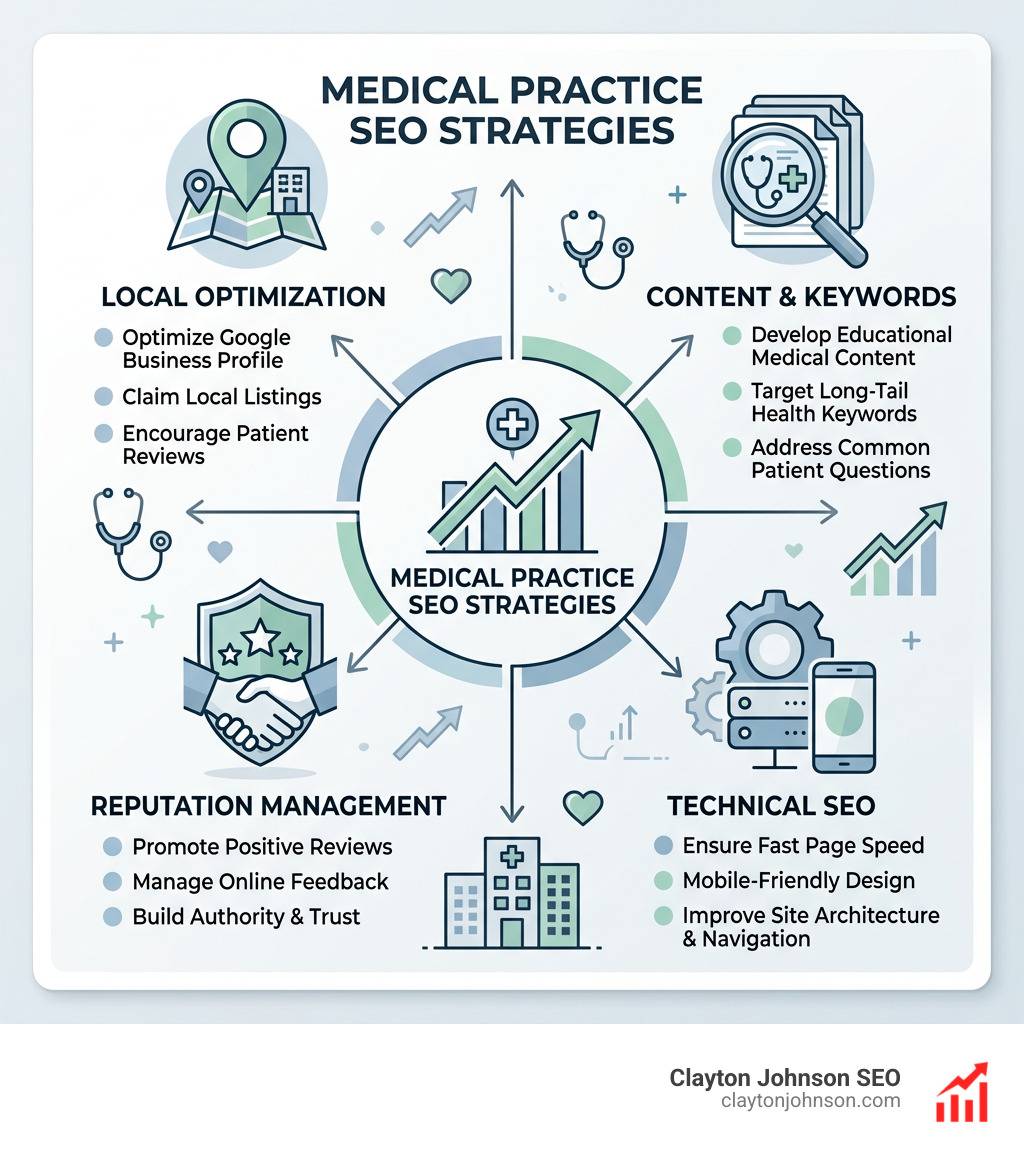
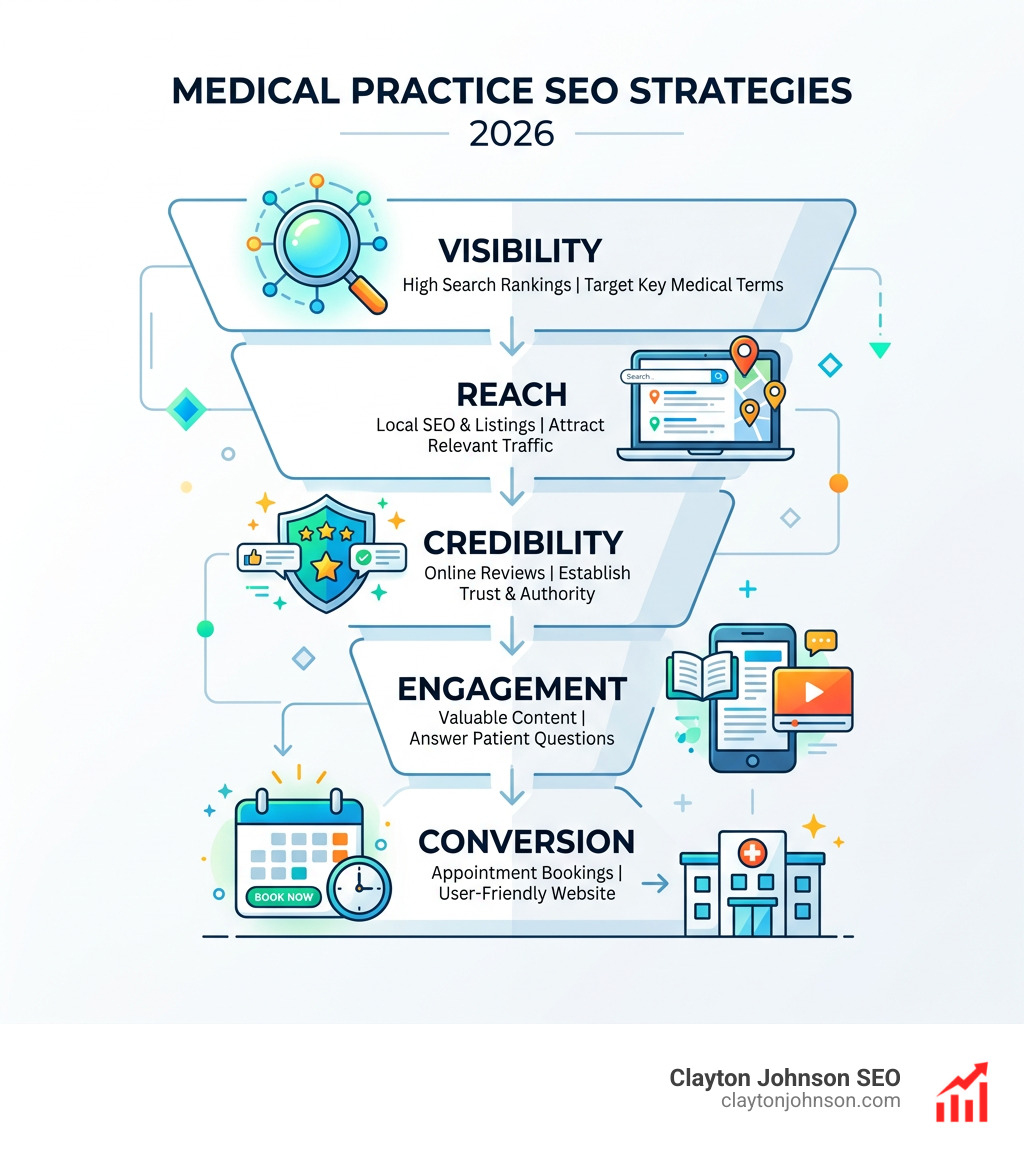
Medical practice SEO strategies are the specific tactics you use to make your practice show up when patients search for care online — covering local SEO, keyword research, content, technical optimization, and reputation management.
Here’s a quick overview of the core strategies:
- Optimize your Google Business Profile — Show up in the local map pack for “near me” searches
- Target local, long-tail keywords — Phrases like “pediatrician in Austin” convert better than broad terms
- Build E-E-A-T content — Publish accurate, expert-authored content that earns Google’s trust
- Fix technical SEO fundamentals — Fast load times, mobile optimization, HTTPS, and schema markup
- Collect patient reviews — More reviews mean higher local rankings and more patient inquiries
- Build ethical backlinks — Citations from trusted healthcare directories signal authority
- Track meaningful metrics — Measure calls, appointment requests, and organic traffic growth
Over 77% of patients begin their healthcare journey with a search engine. They’re not asking friends first. They’re typing “dermatologist near me” or “back pain specialist in [city]” into Google — and choosing from the first few results.
If your practice isn’t showing up, a competitor’s is.
The stakes are high. The #1 spot on Google captures 27.6% of all clicks, and 75% of users never scroll past page one. That’s not just a stat — it’s your waiting room filling up or sitting empty.
But healthcare SEO isn’t like SEO for a coffee shop or e-commerce store. Google treats medical content as YMYL (Your Money or Your Life), meaning it holds your content to a much higher standard. Accuracy, credentials, and trustworthiness aren’t optional — they’re ranking factors.
This guide walks you through exactly what works.
Core Pillars of Medical Practice SEO Strategies
When we talk about medical practice SEO strategies, we aren’t just talking about “tricks” to fool a search engine. We are talking about building a digital infrastructure that proves to Google—and to your patients—that you are the most qualified provider in your area.
Google uses a specific framework called E-E-A-T (Experience, Expertise, Authoritativeness, and Trustworthiness) to evaluate websites. In the medical world, this is critical because your site falls under the “Your Money or Your Life” (YMYL) category. Google knows that bad medical advice can have real-world consequences, so it sets the bar incredibly high.
The 81% of clicks that go to the first five organic results don’t get there by accident. They get there by mastering the SEO 101 fundamentals that balance user experience with search engine requirements. If your website is slow, confusing, or lacks clear provider credentials, you’ll struggle to climb the rankings.
Mastering Keyword Research for Medical Practice SEO Strategies
Keyword research is the diagnostic test of the digital world. Just as you wouldn’t treat a patient without a diagnosis, we don’t build content without knowing what patients are actually searching for.
Many practices make the mistake of targeting broad terms like “doctor” or “surgeon.” The problem? These are high-competition and low-intent. Instead, we focus on long-tail keywords—phrases that are 3-4 words long and highly specific. For example, “best pediatrician for newborns in Chicago” is much more valuable than just “pediatrician.”
To build a winning keyword strategy, you need to consider:
- Patient Intent: Are they looking for information (“symptoms of strep throat”) or are they ready to book (“urgent care near me”)?
- Location Tagging: Patients search geographically. Including your city, neighborhood, or “near me” tags is essential for local relevance.
- Semantic Search: Google is smart enough to understand related terms. If you talk about “heart health,” Google knows you’re also relevant for “cardiovascular wellness.”
Technical Foundations and Core Web Vitals
You could have the best medical advice in the world, but if your website takes five seconds to load, patients will leave before they read a single word. In fact, 40% of mobile visitors will abandon a site if it takes longer than three seconds to load.
Google prioritizes Core Web Vitals, which are specific metrics related to speed, responsiveness, and visual stability. We recommend using tools like Google PageSpeed Insights to audit your site regularly.
Key technical elements for medical practice SEO strategies include:
- Mobile-First Indexing: Over 60% of Google searches now come from mobile devices. Your site must look and function perfectly on a smartphone.
- HTTPS Security: This is non-negotiable for healthcare. Patients need to know their data is secure.
- Schema Markup: This is a snippet of code that helps search engines understand your clinic’s details, such as your address, phone number, and services. You can use Google’s Structured Data Markup Helper to get started.
- Crawlability: Ensuring your site architecture is logical so Google can easily find and index your pages. This is a core part of winning at technical SEO.
Dominating Local Search and Google Business Profile
For most medical practices, your “backyard” is your primary market. Local SEO is the process of ensuring that when someone within five miles of your office searches for your specialty, you appear at the top.
The holy grail of local search is the Google Local ‘3-Pack’, which captures 42% of all local search clicks. To get there, you need NAP consistency—ensuring your Name, Address, and Phone number are identical across every directory, from Yelp to Healthgrades. Even a small discrepancy like “Suite 100” vs. “Ste 100” can confuse search engines and hurt your digital authority.
Optimizing Your Google Business Profile for Maximum Reach
Your Google Business Profile (GBP) is often the first interaction a patient has with your practice. It’s your digital front door.
To maximize your reach, ensure you:
- Choose the Right Categories: Be specific. Don’t just pick “Medical Clinic” if “Orthopedic Surgeon” is more accurate.
- Add Appointment Links: Make it easy for patients to book directly from the search results.
- Upload High-Quality Photos: Show your office, your staff, and your smiling face. It humanizes the practice.
- Manage Reviews Ethically: Patient reviews are a massive ranking factor. Listings with 10+ reviews generate twice the patient inquiries. However, you must stay HIPAA-compliant when responding. Never acknowledge that a reviewer is a patient or disclose any health information in your reply. A simple, “Thank you for your feedback, we strive to provide excellent care to everyone we see,” is often the safest route.
Content Strategy and E-E-A-T for Healthcare
In medical practice SEO strategies, content is more than just blog posts; it’s a trust-building machine. When patients search for health information, they are often in a state of vulnerability or urgency. Providing clear, accurate, and expert-backed answers establishes you as the authority before they even pick up the phone.
To satisfy Google’s E-E-A-T requirements, your content should include:
- Provider Bios: Detailed pages for every doctor, highlighting their education, certifications, and experience.
- Patient FAQs: Answering common questions like “What should I expect during my first visit?” or “Does insurance cover this procedure?”
- Medical Accuracy: Ensure every claim is backed by science and, ideally, reviewed by a medical professional.
- Search Intent Alignment: Don’t just write for keywords; write for the person behind the search. Our guide to mastering search intent explains how to match your content to what the user actually wants to achieve.
Building Authority with Medical Practice SEO Strategies
Authority isn’t just about what you say on your own site; it’s about what the rest of the web says about you. This is where link building comes in. A backlink from a reputable source—like a local news outlet, a medical university, or a well-known healthcare directory—acts as a “vote of confidence” for your site.
| Content Type | Goal | Example |
|---|---|---|
| Informational | Build trust & educate | “5 Ways to Manage Seasonal Allergies” |
| Transactional | Drive appointments | “Schedule a Consultation for LASIK” |
| Navigational | Help patients find you | “Directions to our Downtown Clinic” |
| Commercial | Compare options | “Best Physical Therapy for Sports Injuries” |
Building authority ethically means avoiding “black hat” tactics like buying links or article spinning. Instead, focus on digital PR, guest posting on health blogs, and ensuring your practice is cited in all major medical directories.
Measuring Success and Avoiding Common Pitfalls
SEO is not a “set it and forget it” strategy. It requires constant monitoring and adjustment. We recommend using a combination of Google Analytics 4 and Google Search Console to track your progress.
Don’t get distracted by “vanity metrics” like total page views. Instead, focus on:
- Conversion Rate: How many people who visited your site actually booked an appointment?
- Organic Search Traffic: Are you reaching more people through search engines over time?
- Bounce Rate: Are people leaving your site immediately? This might indicate your content isn’t matching their search intent.
- Keyword Rankings: Are you moving up for your target long-tail phrases?
To help you stay organized, you can download our SEO template to track your technical audits and content calendar.
Avoid common mistakes like keyword stuffing (cramming your city name into every sentence) or neglecting your mobile experience. These tactics might have worked a decade ago, but today, they will only result in Google penalties and lost patients.
Frequently Asked Questions about Medical SEO
How long does it take to see results from medical SEO?
SEO is a long-term play. While you might see some quick wins by optimizing your Google Business Profile, most practices should expect to see significant organic growth within 6 to 12 months. It takes time for Google to crawl your new content and for your authority to build.
Is SEO better than paid advertising for doctors?
They serve different purposes. Paid ads (PPC) are great for immediate visibility, but the traffic stops the moment you stop paying. SEO builds a durable, compounding growth engine. Over time, organic traffic is much more cost-effective and often converts at a higher rate because patients trust organic results more than “Sponsored” links.
How do HIPAA regulations affect my SEO strategy?
HIPAA impacts how you handle patient data and reviews. You cannot use patient names or health details in your marketing without explicit consent. When responding to reviews, never confirm the person is a patient. Additionally, ensure any contact forms on your website are secure and HIPAA-compliant to protect patient privacy.
Conclusion
Building an effective online presence for a medical practice is no longer a luxury—it’s a necessity. By implementing these medical practice SEO strategies, you move from being “invisible” to becoming the clear choice for patients in your community.
At Clayton Johnson SEO, we specialize in turning fragmented marketing efforts into coherent growth engines. We don’t just chase clicks; we build scalable traffic systems that result in real-world appointments and measurable growth. Whether it’s through AI-augmented workflows or structured strategy frameworks, our goal is to provide the clarity and leverage your practice needs to thrive in a digital-first world.
Ready to dominate your local market? Explore our medical practice growth systems and let’s start building your practice’s future today.