Diagnose Your Site Health with AI SEO Growth Diagnostics

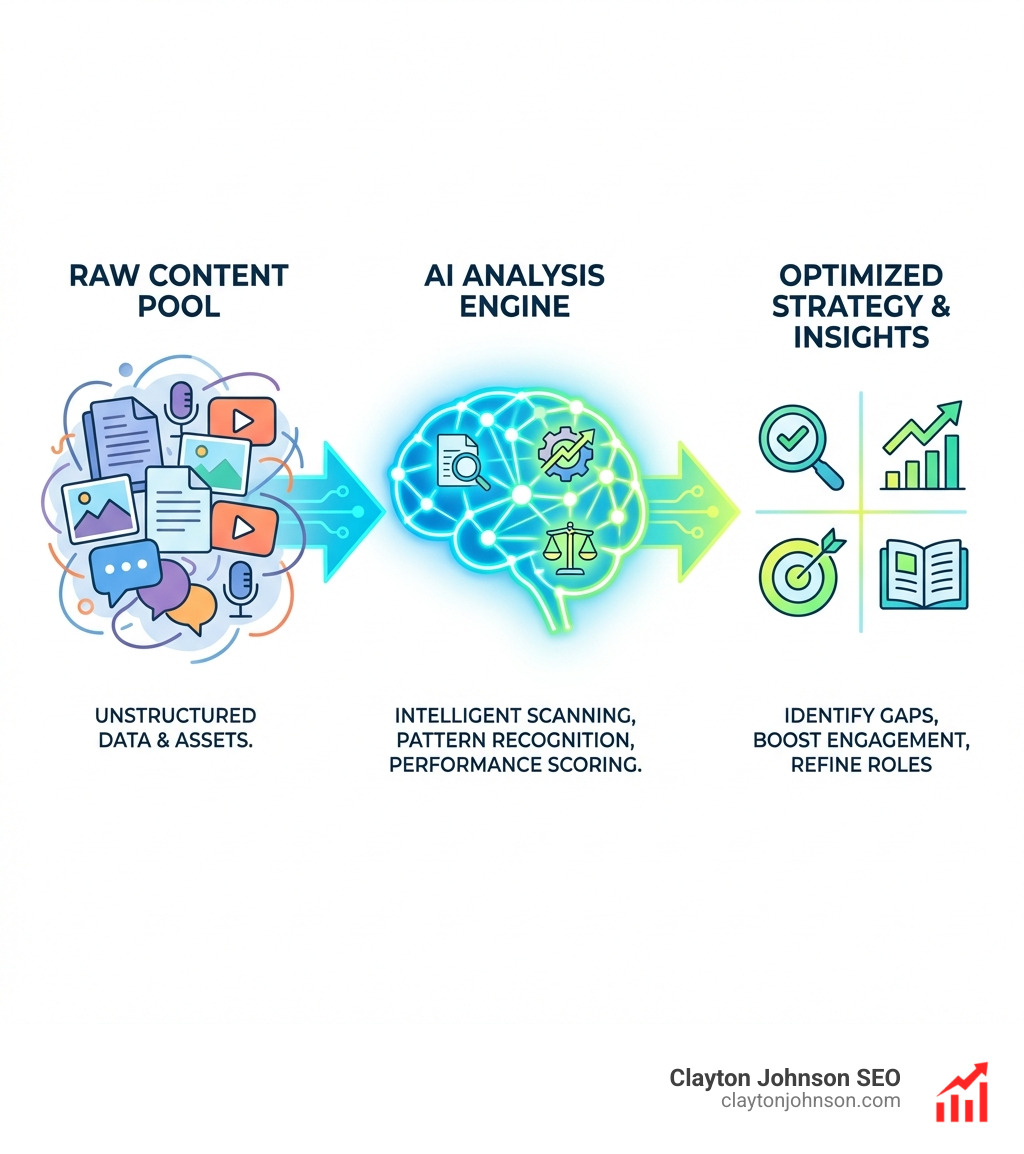
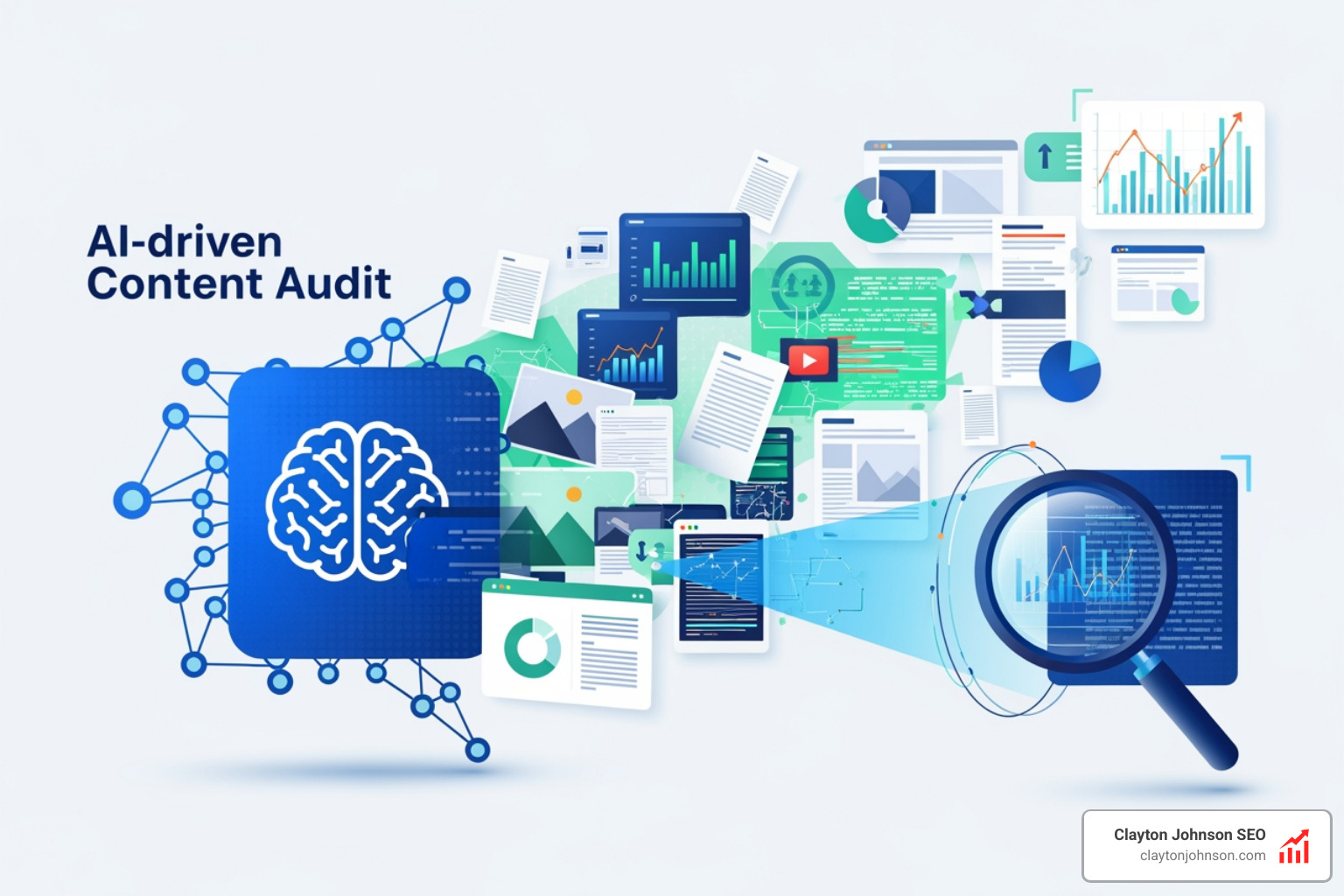
AI-driven content audits use machine learning and large language models (LLMs) to automatically analyze your entire content library — flagging what’s performing, what’s decaying, and what’s costing you rankings and conversions.
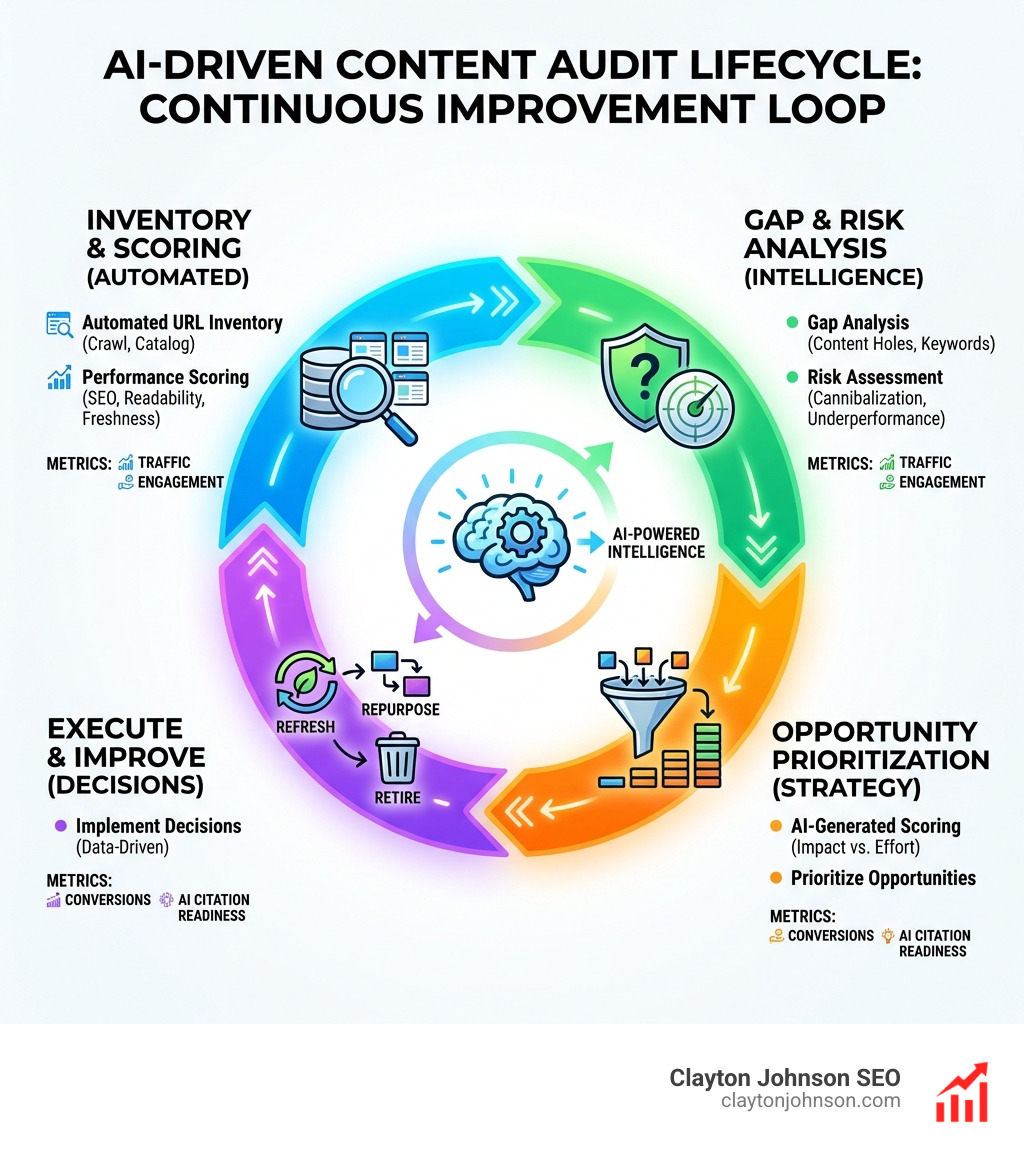
Here’s how the process works at a glance:
- Inventory — Crawl and catalog every URL, title, meta, and heading across your site
- Analyze — Score pages on SEO performance, readability, freshness, and engagement signals
- Identify gaps — Surface content holes, keyword cannibalization, and underperforming assets
- Prioritize — Rank opportunities by impact vs. effort using AI-generated scoring
- Execute — Refresh, repurpose, or retire content based on data — not guesswork
The result? Faster decisions, less manual work, and a content library that actually drives growth.
Most marketing teams are sitting on hundreds — sometimes thousands — of pages. Some are quietly driving the majority of conversions. Others are dragging down domain authority.
The problem? Manual audits can take weeks. By the time you finish, the data is already stale.
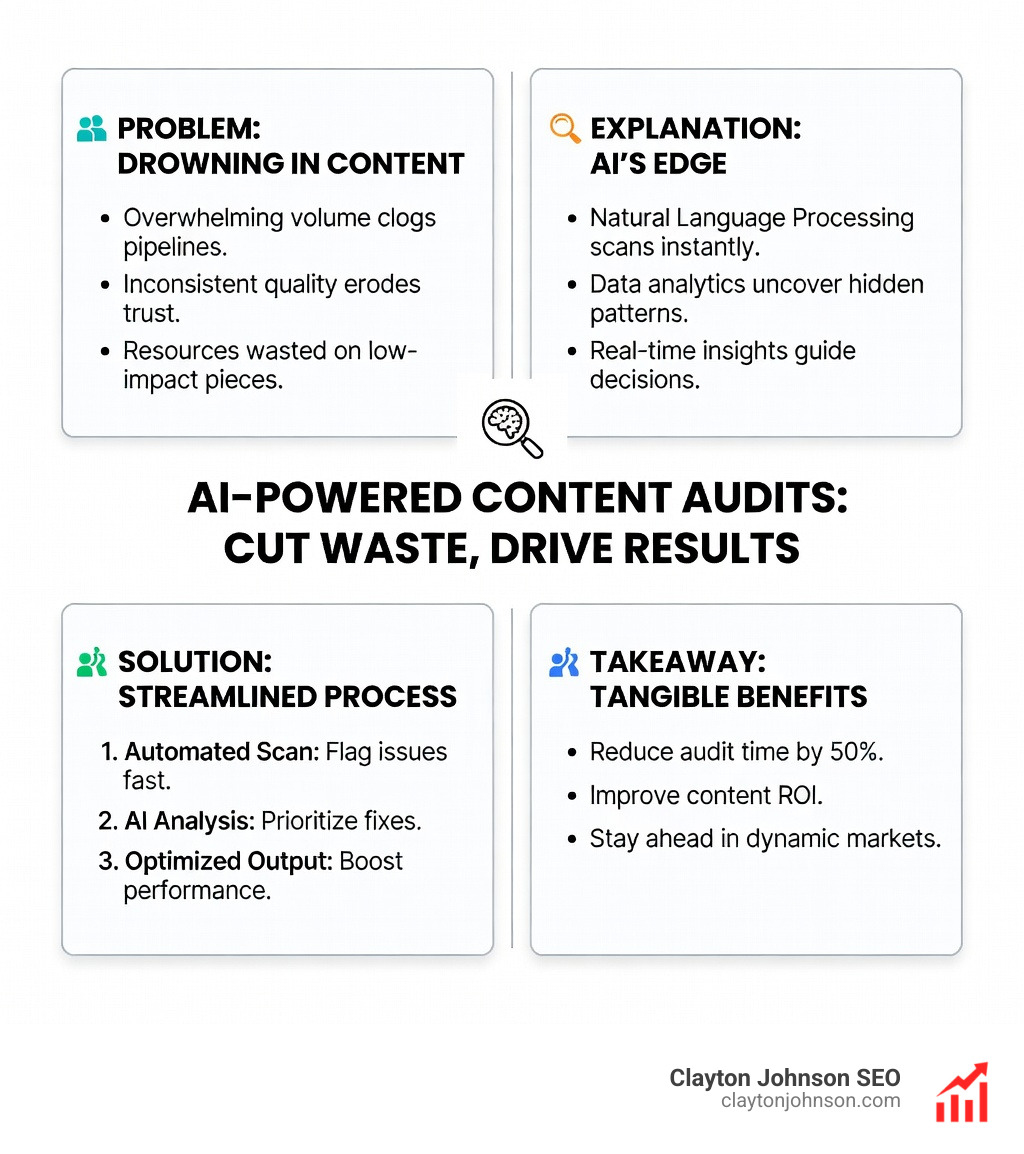
That’s exactly where AI changes the game. Research from large-scale audits shows that pruning over 3,000 underperforming pages produced a sustained 50% increase in organic traffic. Another analysis of 12,000+ content pieces revealed that 23% of top-traffic content wasn’t driving a single conversion. These aren’t insights you find by scrolling through a spreadsheet — they’re patterns that AI surfaces in minutes.
AI doesn’t just speed up the audit. It changes what you can see.
I’m Clayton Johnson — an SEO strategist and growth architect who specializes in building AI-augmented marketing systems that turn fragmented content into compounding authority engines. My work with AI-driven content audits spans technical SEO, taxonomy architecture, and structured content frameworks designed to scale — not spike.
Ai driven content audits terms simplified:
Why AI driven content audits are Essential for Modern SEO
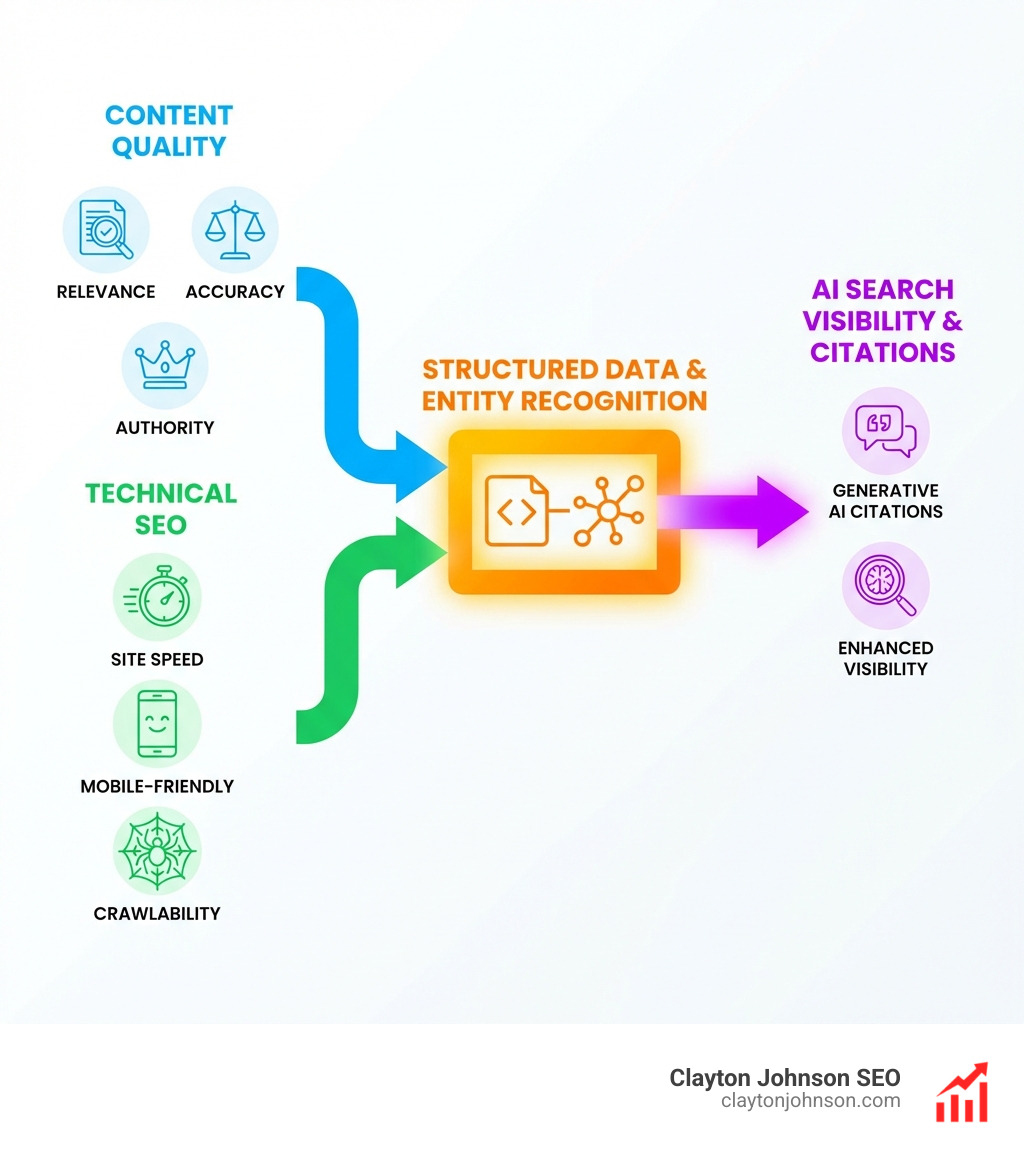
In the current search landscape, simply hitting “publish” and moving on is a recipe for invisibility. We are operating in an era where Google AI Overviews and generative engines like ChatGPT and Perplexity are redefining how users consume information. If your content is stale, unstructured, or redundant, it won’t just drop in rankings—it will be ignored by the very algorithms designed to cite authoritative sources.
Combatting Content Decay
Content decay is the silent killer of SEO. Over time, even high-performing articles lose relevance as facts change, competitors publish deeper research, and search intent shifts. Traditional audits often miss the early signs of decay because they rely on trailing metrics. Ai driven content audits use predictive pattern recognition to identify pages that are losing “freshness” or topical authority before the traffic cliff occurs.
Data Precision and Pattern Recognition
Human eyes are great at reading, but they are terrible at processing 5,000 rows of Google Analytics data simultaneously. AI excels at finding the “hidden gems”—those low-traffic pages with exceptionally high engagement times that are prime candidates for a refresh. For example, Fractional CMOs are increasingly using AI to gain a bird’s-eye view of content strategy, identifying overarching themes and overlooked insights that manual reviews miss.
Scalability and Competitive Positioning
If you have a site with 10,000 SKUs or blog posts, a manual audit is impossible. AI scales the process, scanning for technical errors, tone inconsistencies, and jargon in seconds. This allows us to move from “defensive” SEO (fixing errors) to “offensive” SEO (identifying gaps where competitors are outranking us). Research shows that competitor benchmarking can lead to a 31% boost in project completion rates after rewriting underperforming assets.

To stay ahead, you need more than just a list of keywords; you need a structured SEO content marketing strategy that treats your content library as a living investment portfolio.
Building a Structured Growth Framework
At Clayton Johnson SEO, we believe clarity leads to structure, and structure leads to leverage. We don’t just “check” your site; we build a growth architecture. This starts with moving away from the “spreadsheet of doom” and toward a taxonomy-driven system where every piece of content has a specific job to do.
Manual vs. AI Content Audits: The Comparison
| Feature | Manual Audit | AI-Driven Content Audit |
|---|---|---|
| Speed | Weeks to Months | Hours to Days |
| Depth | Surface-level metrics | Deep semantic & intent analysis |
| Accuracy | High risk of human error | Data-backed precision |
| Actionability | Vague suggestions | Prioritized “Fix-First” plans |
| Scalability | Limited to small sites | Unlimited (Enterprise-ready) |
The 6-Phase Framework for AI driven content audits
To turn raw data into compounding growth, we follow a rigorous 6-phase model:
- Phase 1: Goal Setting – Define what “success” looks like. Are we looking for conversion lift, AI citation readiness, or technical cleanup?
- Phase 2: Automated Inventory – We use tools like Screaming Frog to catalog every URL, meta tag, and status code.
- Phase 3: Quality & Performance Scoring – AI models evaluate your content against a 100-point rubric, looking at factors like readability, E-E-A-T (Experience, Expertise, Authoritativeness, and Trust), and semantic richness.
- Phase 4: Gap & Risk Analysis – We identify keyword cannibalization and “content ghosts”—pages that exist but provide no value.
- Phase 5: Opportunity Prioritization – Using an impact-effort matrix, we decide which pages get a rewrite and which get the axe.
- Phase 6: Execution & Monitoring – We implement changes and set up automated alerts to monitor “drift” in rankings and AI visibility.
Leveraging LLMs for AI driven content audits
Modern audits leverage the power of LLMs like ChatGPT, Gemini, and Claude. These tools aren’t just for writing; they are world-class analysts. By feeding summarized Google Analytics data into an LLM, we can ask complex questions: “Which 15 pages are responsible for 80% of our conversions?” or “Summarize the top 10 competitor pages and tell me what subtopics we are missing.”
Practical prompting techniques allow us to perform readability checks and sentiment analysis at scale, ensuring your brand voice remains consistent across every touchpoint.
Executing the Audit: Refresh, Repurpose, or Retire
Once the data is in, the real work begins. We categorize every page into one of three buckets:
1. Refresh (The Rockstars)
These are your high-performers or “near-miss” pages (ranking on page 2). We use AI to expand sections, update outdated statistics, and add structured data to help them qualify for AI Overviews. Research indicates that adding clarity and summarization can boost AI citation probability by over 32%.
2. Repurpose (The Hidden Gems)
A high-performing blog post shouldn’t just live as a URL. We prompt AI to transform these assets into Twitter threads, video scripts, or infographics. This maximizes the ROI of your original research without requiring a new production budget.
3. Retire (The Dead Weight)
Pruning is often more effective than publishing. If a page has zero traffic and no backlinks, it may be diluting your “crawl budget.” We use 301 redirects to pass any residual authority to more relevant, high-performing pages. This is a critical step in conversion optimization, as it ensures users only land on your best content.
Answer Engine Optimization (AEO)
A key part of our audit is ensuring your content is “citable” by AI. This involves using question-led headers (H2s and H3s) and concise, factual summaries. Tools like specialized AI content assessors can score your pages on how easily an AI model can “chunk” and retrieve your information.
Frequently Asked Questions about AI Content Auditing
How often should I conduct an AI content audit?
We recommend a full-scale ai driven content audit quarterly. However, for high-growth brands or those in volatile markets (like SaaS or Finance), monthly mini-audits of your top-tier clusters are essential. This helps you catch “ranking drift” before it impacts your bottom line.
Can AI replace human editorial judgment?
No. AI is your “super-assistant,” but it lacks strategic context and brand soul. While AI can flag that a page is “too complex,” a human editor must decide if that complexity is necessary for a technical audience. Human oversight is mandatory to prevent hallucinations and ensure that the content aligns with your unique competitive positioning.
What are the best tools for auditing ecommerce content?
For sites with thousands of SKUs, we look at specialized platforms like Content Status, which tracks product-level metrics and identifies missing attributes. We also integrate data from Ahrefs and Moz to monitor backlink health and competitor moves in real-time.
Conclusion
The era of “guessing” what content works is over. By implementing ai driven content audits, you move from a chaotic content treadmill to a structured growth architecture. This approach doesn’t just save time; it creates leverage. When you prune the dead weight and double down on your high-performers, your site’s authority begins to compound.
Most companies don’t lack content; they lack the structure to make that content perform. We are here to provide that infrastructure.
Ready to stop guessing and start growing? Start your AI SEO journey with us today and see what your data is actually trying to tell you.