Don’t Let Your Marketing Go Cold with AI for Supper Clubs

Why Supper Clubs Are Leaving Money on the Table Without AI Marketing
AI marketing for supper clubs companies is the practice of using artificial intelligence tools to automate guest outreach, personalize dining experiences, optimize local search visibility, and fill seats faster — all at a fraction of the cost of traditional marketing agencies.
Here’s a quick snapshot of what AI marketing can do for your supper club:
| Goal | How AI Helps |
|---|---|
| Fill tables faster | Automated campaigns target high-intent local diners |
| Personalize guest experiences | Predictive analytics anticipate preferences and cravings |
| Manage reviews | AI responds to feedback and tracks sentiment automatically |
| Boost local visibility | Optimizes Google Business Profile and local SEO signals |
| Reduce marketing costs | Replaces agency retainers at 75% lower cost |
| Drive repeat visits | Automated loyalty, win-back, and VIP campaigns |
Supper clubs operate in a uniquely competitive space. You’re not just selling dinner — you’re selling an experience. An intimate atmosphere. A curated evening. Something guests talk about for weeks.
But here’s the problem: most supper clubs market like it’s still word-of-mouth era. No consistent online presence. No automated guest follow-up. No local SEO strategy. And the diners who would love your experience? They’re finding someone else on Google first.
Consider this: 90% of diners now choose a restaurant online before ever stepping through the door. They search, compare menus, read reviews, and decide — all before you get a chance to impress them. If your supper club isn’t showing up in those moments, you’re invisible to your best potential guests.
The good news is that AI has made sophisticated, data-driven marketing accessible — even for small, intimate dining operations that don’t have a full marketing team.
I’m Clayton Johnson, an award-winning SEO strategist and founder of Clayton Johnson SEO, with nearly two decades of experience helping businesses build scalable, AI-powered marketing systems — including applying ai marketing for supper clubs companies to drive measurable growth in organic visibility and guest acquisition. In the sections ahead, I’ll show you exactly how to put these tools to work for your supper club.
Why AI Marketing for Supper Clubs Companies is the Secret Ingredient for Growth
In the current dining landscape, staying relevant isn’t just about the quality of your soufflé; it’s about how visible you are when a local foodie picks up their phone. We are seeing a massive shift in how hospitality operators approach growth. In fact, research shows that 86% of restaurant operators are already comfortable using AI to streamline their business.
For supper clubs, the challenge is often manual overhead. You are likely juggling guest lists, menu planning, and wine pairings. Marketing usually falls to the bottom of the to-do list. This is where AI for restaurants and hospitality changes the game. It acts as a digital “sous-chef” for your brand, handling the repetitive tasks of discovery and engagement so you can focus on the kitchen.
The primary benefits of ai marketing for supper clubs companies include:
- Precision Personalization: AI doesn’t just send a generic email; it knows that Guest A loves natural wines while Guest B always asks for the vegetarian option.
- Cost Efficiency: Traditional marketing agencies can cost anywhere from $1,500 to $25,000 per month. AI-driven systems provide similar (or better) local reach at a 75% lower cost.
- Optimized Table Fill Rates: AI can identify “slow” nights and automatically launch a localized SMS or email campaign to your most loyal guests to fill those last-minute gaps.
| Feature | Traditional Marketing Agency | AI-Powered Marketing Systems |
|---|---|---|
| Monthly Cost | $2,500 – $10,000+ | $100 – $500 |
| Speed of Execution | Weeks (due to back-and-forth) | Minutes (automated agents) |
| Data Usage | General market trends | Real-time POS & guest data |
| Availability | 9-to-5 business hours | 24/7 autonomous monitoring |
Leveraging AI Marketing for Supper Clubs Companies to Personalize Guest Journeys
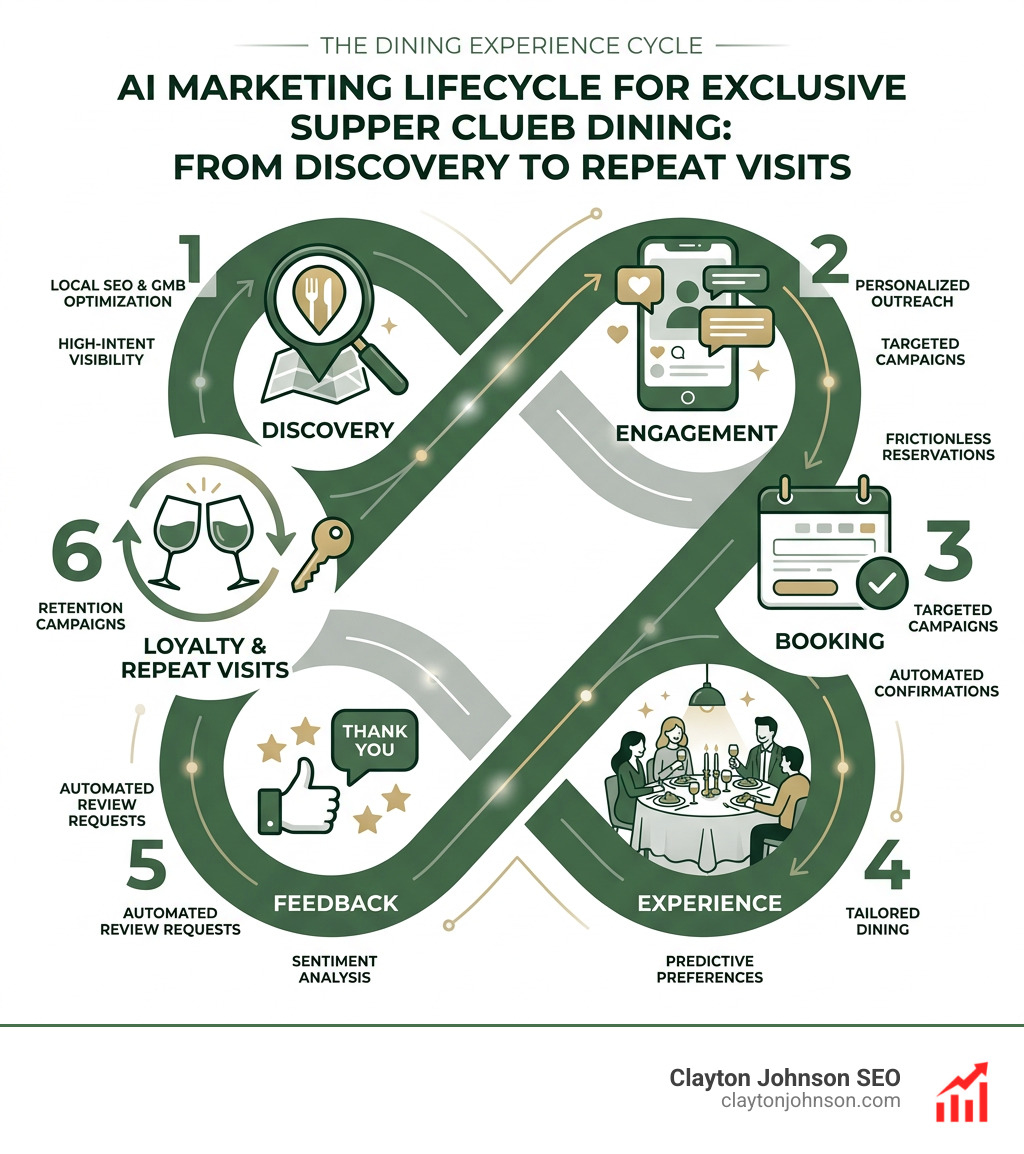
The magic of a supper club is the feeling of exclusivity. AI allows you to scale that “inner circle” feeling without spending hours on individual emails. By using predictive analytics, we can anticipate a guest’s cravings before they even realize they’re hungry.
Imagine a system that tracks a guest’s past visits and realizes they haven’t been in for three months. Instead of a generic “We miss you” note, the AI sends a personalized invitation: “We’re serving that truffle risotto you loved last time—want to grab one of the 4 remaining seats this Saturday?” This level of smart spices and AI marketing for ethnic or niche dining creates a deep emotional connection.
Tactics for Personalizing Exclusive Dining:
- Cravings Anticipation: Analyze past order data to suggest menu items in marketing content.
- Custom Menus: Use AI to generate digital menus that highlight items based on a guest’s known dietary preferences (e.g., gluten-free or vegan).
- VIP Targeting: Automatically tag “High-Value” guests who attend frequently and offer them first-look access to new event dates.
- Birthday/Anniversary Automation: Set up autonomous agents to send a personalized gift or reservation link two weeks before a guest’s special date.
Top AI Marketing Software Categories for Supper Clubs Companies
Choosing the right tech stack is critical. You don’t need a dozen tools; you need a unified ecosystem where data flows freely. High-performing hospitality groups are now prioritizing AI marketing software over traditional paid media because the ROI is more measurable.
Here are the categories every supper club should consider:
- AI-Powered CRM & Personalization: Platforms like Popmenu or Bikky consolidate guest data from your POS and reservation systems to build a “Unified Guest View.”
- Automated Social Media Management: Tools like Canva’s Magic Studio or MarketEngine can generate high-quality social posts and captions that maintain your brand’s “vibe” without you having to be an influencer.
- Predictive Analytics & Demand Forecasting: AI agents can look at historical data, local events, and even weather patterns to predict how many guests will show up, helping you optimize inventory and staffing.
- Content Optimization Tools: Using AI to ensure your website and blog posts are optimized for “near me” searches is essential for local discovery.

Mastering Local SEO and Review Management with AI Agents
For a supper club, “Local Discovery” is your lifeblood. When someone searches for “unique dining experiences near me” or “best secret restaurants,” you need to be at the top. This involves more than just having a website; it requires a deep understanding of AI search and core SEO.
AI agents can now manage your Google Business Profile (GBP) autonomously. They can:
- Automate Review Responses: AI can draft personalized, thoughtful responses to every review within minutes. This is vital, as a 72-hour response SLA (Service Level Agreement) significantly boosts your local ranking.
- Sentiment Analysis: AI scans your reviews to find patterns. If three guests in a row mention the room was too loud, the AI flags this as an operational trend before it affects your star rating.
- Local Keyword Targeting: AI tools identify high-intent keywords like “romantic dinner in your city” or “private chef table in your area” and help you weave them into your digital content.
Balancing Automation with Authentic Human-Touch Branding
One of the biggest fears we hear from supper club owners is that AI will make their brand feel “robotic.” In an industry built on intimacy, that’s a valid concern. However, the goal of ai marketing for supper clubs companies isn’t to replace the human touch—it’s to free up your time so you can provide more of it.
The best restaurant social media strategies use AI to handle the “plumbing” (scheduling, tagging, basic captions) while the owner focuses on the “poetry” (the behind-the-scenes stories, the chef’s inspiration, the guest interactions).
By putting AI agents to work for your marketing team, you ensure that your brand stays consistent. An AI agent can be trained on your specific “Brand Voice”—whether that’s witty and irreverent or sophisticated and formal—to ensure every text, email, and post sounds exactly like you.
Implementing AI Systems for Long-Term Supper Club Success
Implementation doesn’t have to happen overnight. We recommend a “Clarity -> Structure -> Leverage” approach. First, identify your biggest bottleneck. Is it an empty Tuesday night? Is it a lack of reviews? Once you have clarity, you can build the AI marketing workflows to solve it.
At Clayton Johnson SEO, we focus on building these durable systems. Instead of chasing temporary social media trends, we help you build a content architecture that compounds over time. By aligning your strategy with our professional SEO services, you create a growth engine that works even when you’re in the middle of a busy service.
The ROI expectations for these systems are significant. Real-world data shows that businesses that centralize their digital ecosystem record a +74% increase in organic traffic within just three months. This isn’t just vanity traffic; it’s high-intent diners looking for exactly what you offer. For example, look at how Maine Lobster Now doubled their revenue by focusing on digital visibility and search-driven growth.
Future Trends: Agentic AI and Predictive Analytics
In the near future, the way diners find you will change again. We are moving toward “Agentic AI”—where a user’s AI assistant (like ChatGPT or Gemini) will actually handle the booking for them. If your supper club’s data isn’t structured correctly for these AI models for business, these assistants won’t even know you exist.
Other upcoming trends include:
- Predictive Ordering: AI will help you predict exactly how much of a specific ingredient to buy based on the guest profiles of those who have already booked.
- Cross-Promotions: AI can identify local partners (like a boutique hotel or a high-end florist) whose customers match your guest profile for automated co-marketing.
- Hyper-Loyalty Programs: Moving beyond “buy 10 get 1 free” to AI-driven rewards that offer guests experiences they actually value, like a kitchen tour or a private wine tasting.
To stay ahead, you need to be exploring the latest AI tools for growth today.
Measuring Success and Tracking KPIs with AI Tools
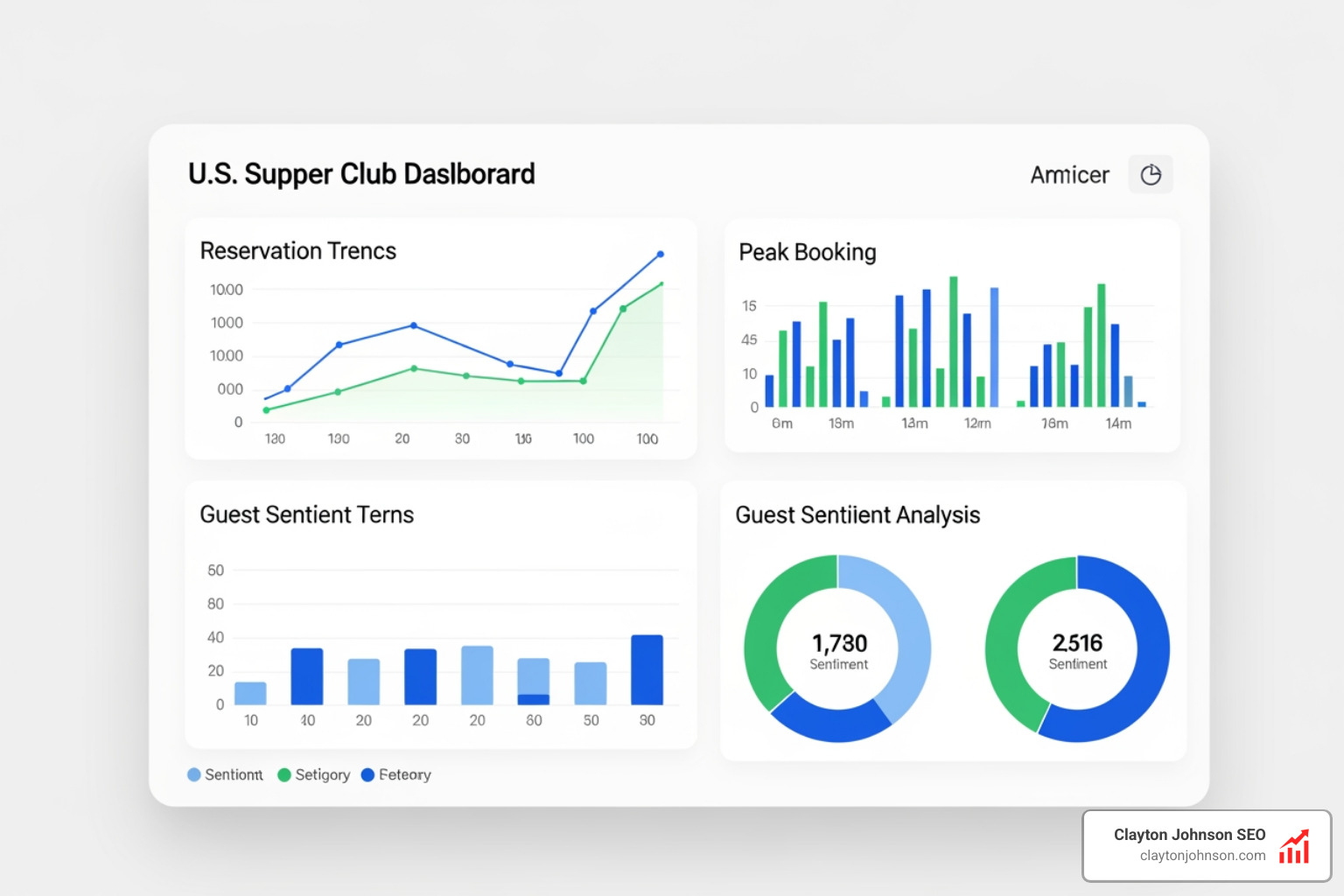
You can’t manage what you don’t measure. AI makes tracking your growth systems incredibly simple. Instead of guessing if your marketing is working, you can look at hard data.
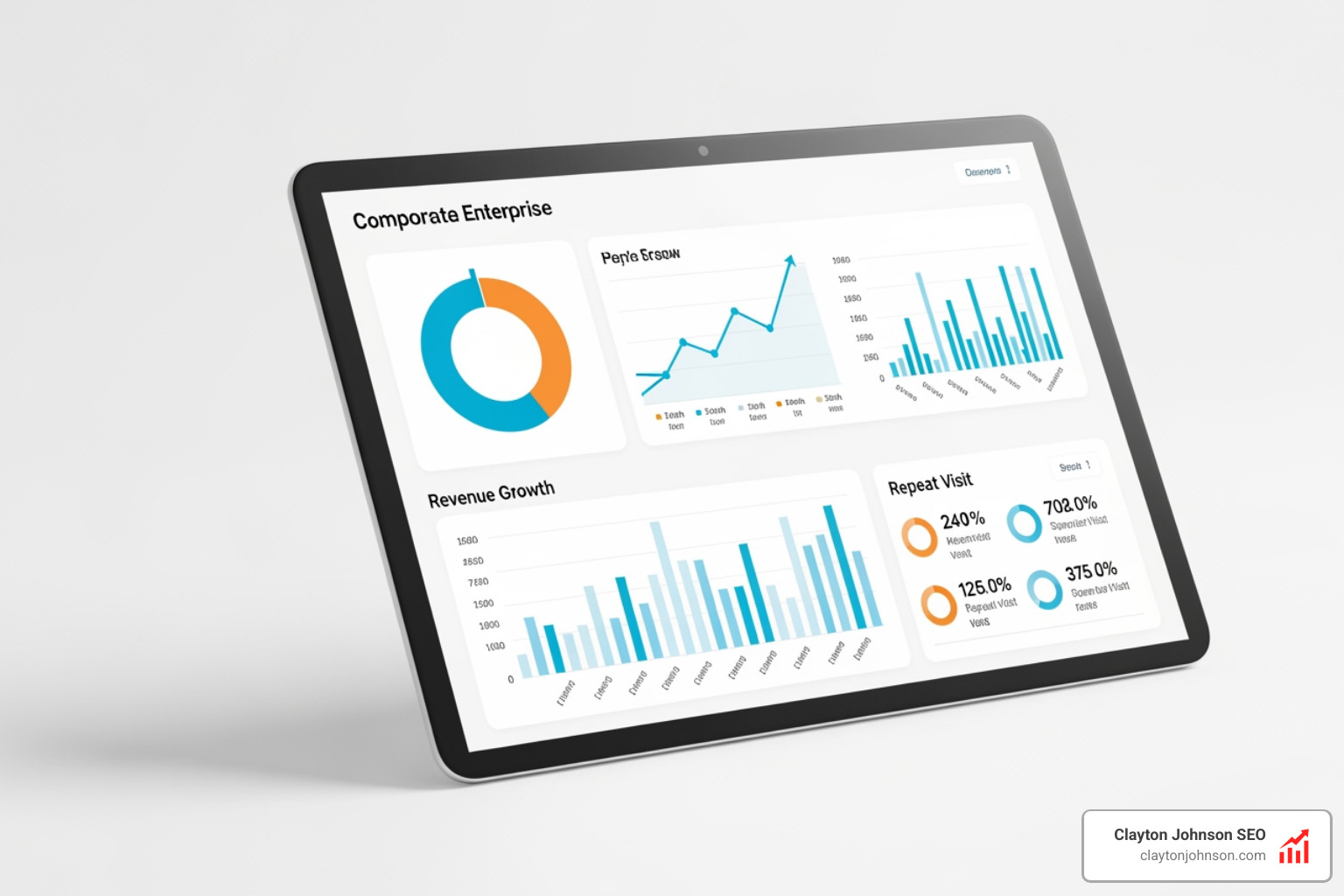
Key KPIs to Track via AI Dashboards:
- Table Fill Rate: The percentage of available seats occupied per event.
- Repeat Visit Rate: How many guests return within a six-month window.
- Review Velocity: The number of new reviews you receive weekly (AI helps keep this high).
- Customer Acquisition Cost (CAC): How much you’re spending to get a new guest in the door (AI usually slashes this by 75%).
Ai marketing for supper clubs companies is about leverage. It’s about using modern tools to protect the most traditional part of your business: the art of hospitality. By automating the digital noise, you give yourself the space to be the host your guests deserve.
Ready to turn your fragmented marketing into a coherent growth engine? Let’s build a system that fills your tables and keeps your brand hot. Reach out to us at Clayton Johnson SEO to start building your custom AI-augmented roadmap today.