Why Internal Link Equity Flow Makes or Breaks Your SEO
A solid internal link optimization guide helps you move authority from your strongest pages to the ones that need a rankings boost — without building a single new backlink.
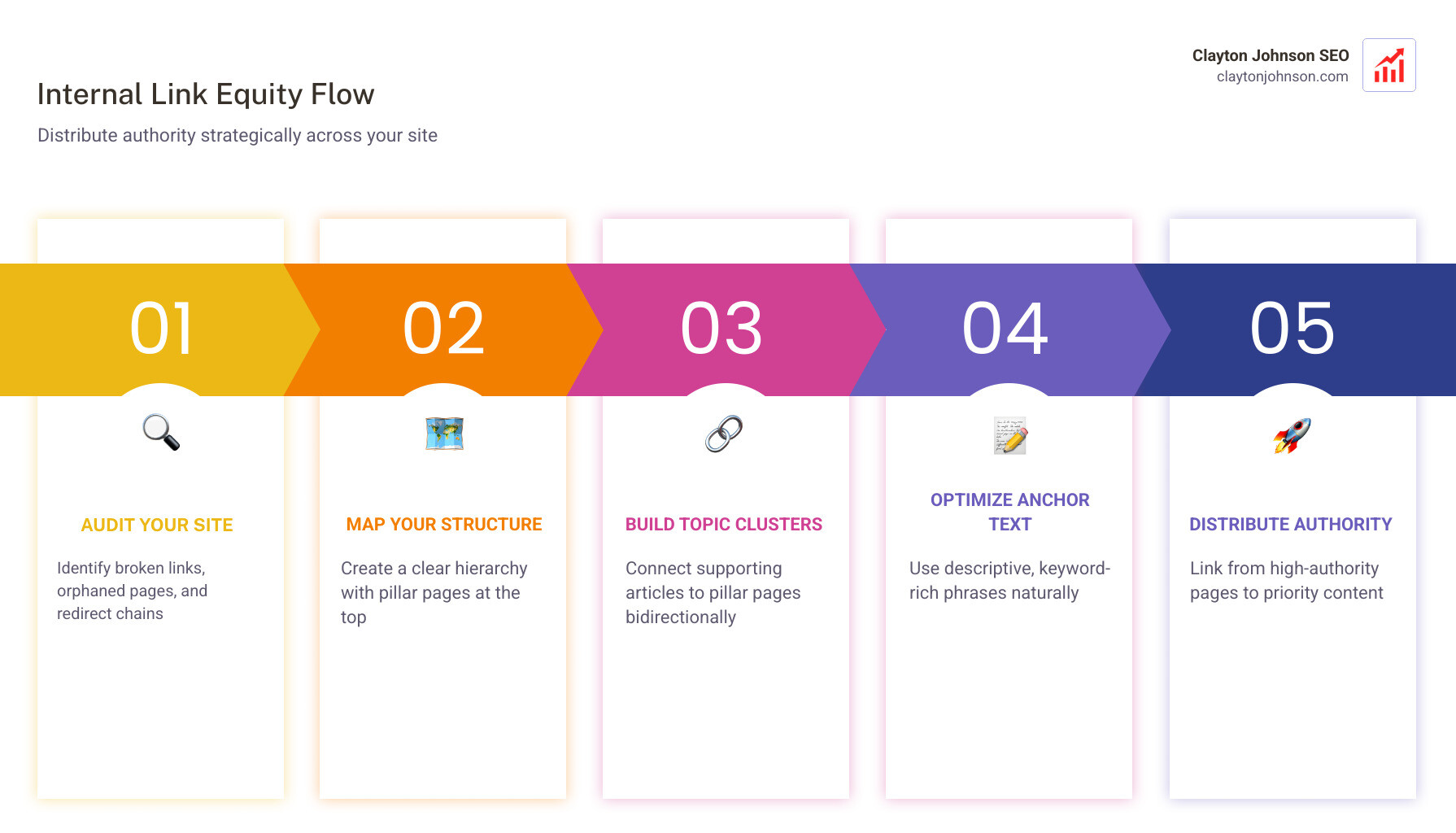
Here’s what good internal link equity flow looks like in practice:
- Audit your site – Find broken links, orphaned pages, and redirect chains
- Map your structure – Build a clear hierarchy with pillar pages at the top
- Create topic clusters – Link supporting articles to and from your pillar pages
- Optimize anchor text – Use descriptive, keyword-relevant phrases (not “click here”)
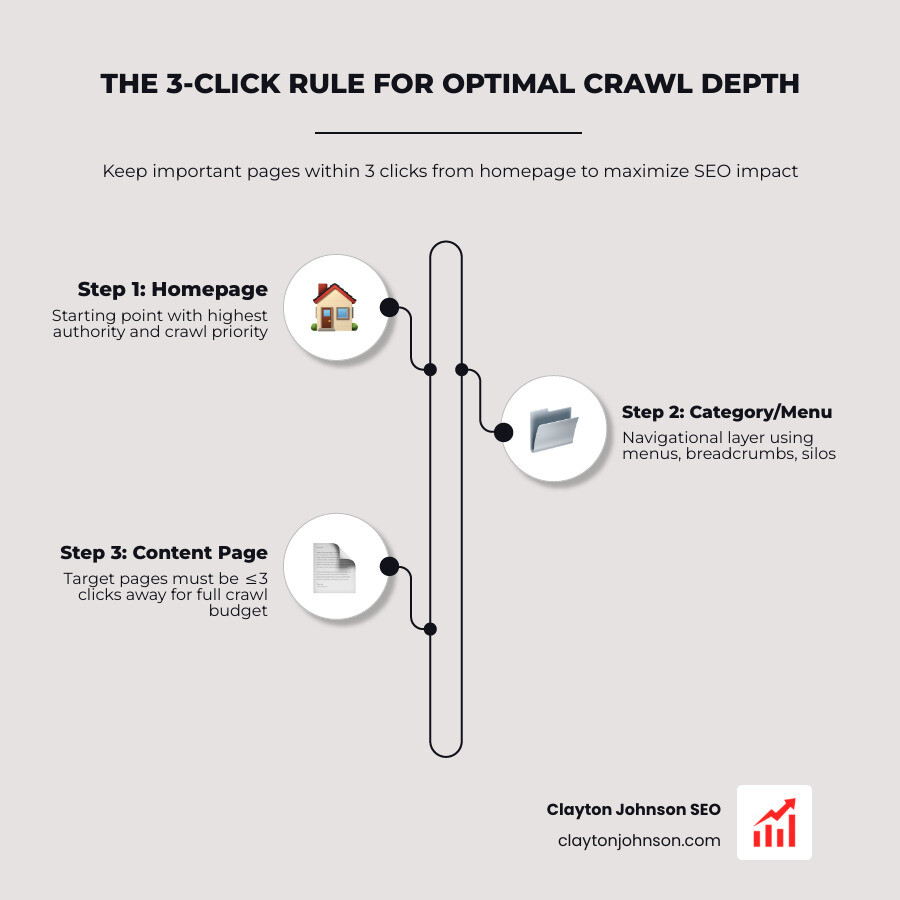
- Fix crawl depth – Keep every important page within 3 clicks of your homepage
- Distribute authority – Link from high-authority pages to pages you want to rank
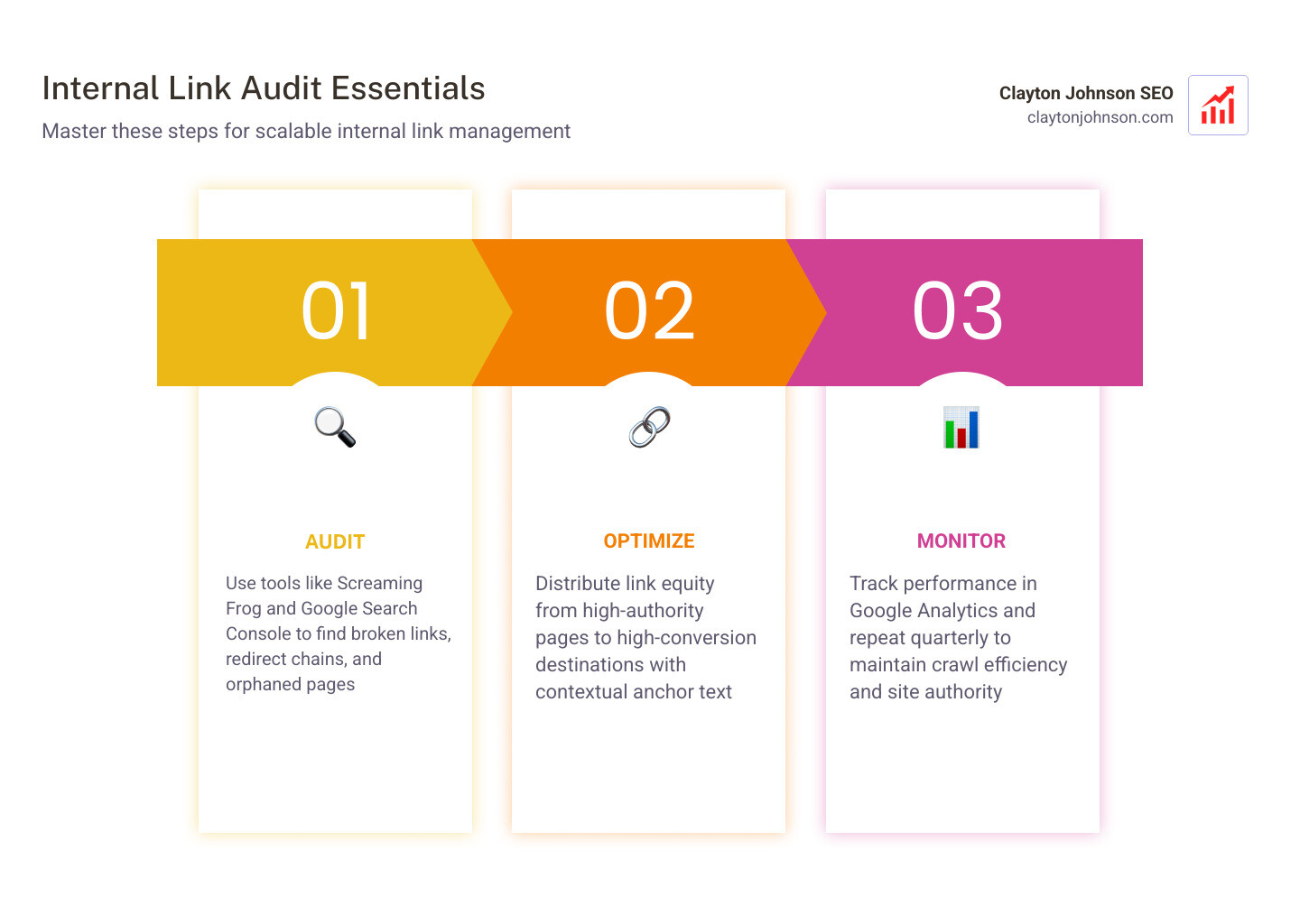
- Audit quarterly – Catch new issues before they compound
Think of your website like a building under construction. Every page is a room, and internal links are the hallways connecting them. Without those hallways, some rooms stay hidden — visitors can’t find them, and neither can Google.
Here’s the uncomfortable truth: studies analyzing over 5,000 websites found that 95% have suboptimal internal linking structures. That means most of your competitors are leaving ranking potential sitting on the table.
Internal links do three critical things at once:
- They guide users to the content most relevant to their needs
- They help search engines discover, crawl, and understand your pages
- They distribute link equity (the authority Google associates with your site) from strong pages to weaker ones
The result? Pages that were invisible start ranking. Pages that were ranking start climbing.
This guide walks you through exactly how to build, audit, and scale an internal linking system that moves the needle.
The Strategic Framework for an Internal Link Optimization Guide
To truly master internal links, we must first distinguish them from their famous cousins, external links. While external links (backlinks) are votes of confidence from other websites, internal links are the connective tissue within our own domain. They are the only part of the “link graph” where we have 100% control.
Imagine trying to build a house without nails because you didn’t feel like using your hammer. That is exactly what it is like to ignore internal linking. It is a fundamental tool that, when used with precision, dictates how search engines perceive your site’s importance.
Link Equity and the Power of PageRank
At the heart of this strategy is “link equity,” often referred to as PageRank. This is a mathematical value search engines assign to pages based on the quantity and quality of links pointing to them. When a high-authority page (like your homepage) links to a deeper blog post, it is “passing link equity” or PageRank.
Research published in the Journal of the American Society for Information Science and Technology suggests that Wikipedia’s dominant search performance is largely due to its massive, interconnected internal linking structure. By mimicking this “web graph” approach, we can ensure that link value isn’t trapped on a few popular pages but flows to our most important conversion assets.
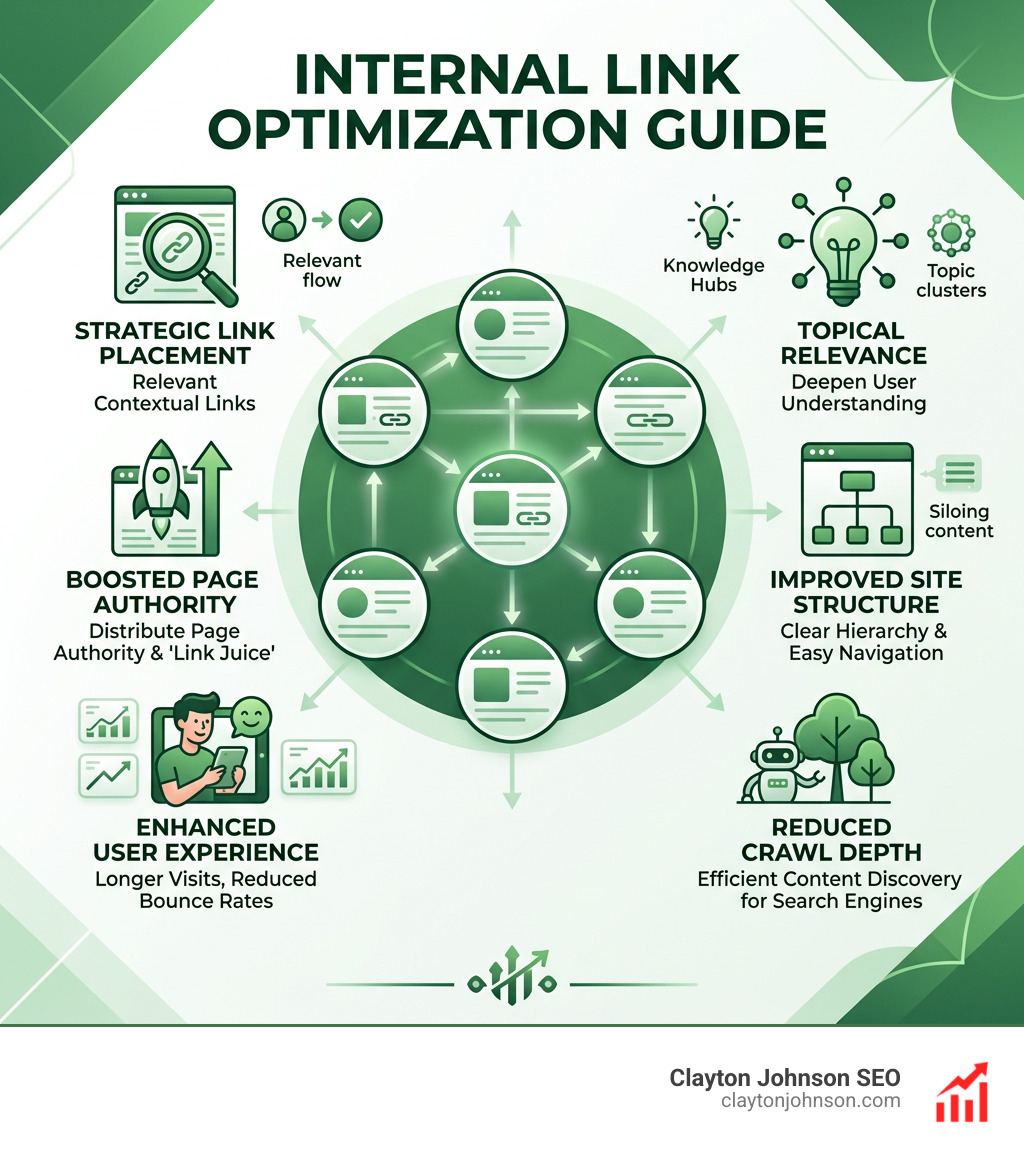
Building Topic Clusters for an Internal Link Optimization Guide
The most effective way to organize this flow is through the pillar-cluster model. In this framework, we create a “Pillar Page” that provides a broad overview of a core topic. This page then links to several “Cluster Pages” (supporting articles) that dive deep into specific sub-topics.
Crucially, these cluster pages must link back to the pillar page and to each other. This creates a semantic loop that signals to Google that you have deep topical authority. For a deeper dive into this architecture, check out our guide on pillar pages and topic clusters explained for mere mortals.
When we build these clusters, we aren’t just adding links for the sake of it. We are creating a linking strategy that reinforces relationships between entities. To do this effectively, you need to understand how to build a content taxonomy that doesn’t suck, ensuring your categories and tags support a logical content hierarchy.
Anchor Text Best Practices for an Internal Link Optimization Guide
Anchor text is the clickable text in a hyperlink. For internal links, this text is a massive relevancy signal. While we must be careful with manipulating external anchor text to avoid penalties, internal links are much more flexible.
Industry research has conducted tests showing that using exact-match anchor text for internal links can significantly boost rankings for that specific keyword. However, we always recommend a natural approach.
Our Anchor Text Rules of Thumb:
- Be Descriptive: Tell the user (and Google) exactly what is on the other side of the link.
- Avoid “Click Here”: This provides zero context.
- Use Keyword Variations: Instead of using “SEO services” every time, try “search engine optimization solutions” or “expert SEO help.”
- Keep it Brief: Ideally, aim for five words or fewer.
For more on choosing the right terms, see the ultimate guide to keyword strategy. As Google recommends, your anchor text should be at least as descriptive as the page it’s pointing to.
Optimizing Site Structure and Crawl Depth
Crawl depth is the number of clicks it takes to get from your homepage to a specific page. According to Google, pages that are closer to the homepage are generally perceived as more important.
If a page is more than three clicks away, it might as well be on the moon. Search engine spiders have a limited “crawl budget,” and they won’t waste it digging through ten layers of folders. This is why a “flat” silo model is vital. You want your most important content to be easily discoverable via navigational menus, breadcrumbs, and footer links.
Be careful not to overcomplicate things with automated tools; you should stop messing up your site structure with AI taxonomy tools that don’t understand your specific business goals. Instead, focus on a site architecture and hierarchy that prioritizes user intent.
Auditing and Scaling Your Internal Link Equity Flow
Building a strategy is only half the battle. Sites are living organisms; pages are added, deleted, and moved constantly. This leads to “link rot.” To maintain a high-performing site, you must regularly audit for redirects and other technical hiccups.
Eliminating Orphaned Pages and Redirect Loops
Orphaned pages are pages that have no internal links pointing to them. Since Google explains that it discovers new content primarily by following links, these orphaned pages often go unindexed. If they aren’t indexed, they can’t rank, and they certainly can’t convert.
During your audit, you should also look for:
- Broken Links: These lead to 404 errors, which frustrate users and stop crawlers in their tracks. Use an audit tool to fix broken internal links immediately.
- Redirect Chains: If Page A links to Page B, which redirects to Page C, you are diluting your link equity. Link directly to the final destination.
- HTTPS Issues: Ensure all internal links point to the secure HTTPS for a secure site version of your pages to avoid security warnings and unnecessary redirects.
Leveraging AI-driven SEO audits can help you identify these patterns at scale, but you still need a human eye to ensure the internal link value is being directed toward the right business objectives. If this sounds overwhelming, you can always how to audit SEO with AI to get a head start.

Distributing Authority to High-Conversion Pages
Not all pages are created equal. Some pages are “authority magnets” (like a viral blog post with hundreds of backlinks), while others are “conversion engines” (like a service page or product checkout).
A key part of our internal link optimization guide is the “Bridge Strategy.” You should identify your pages with the most link equity using Backlink Analytics and place contextual links from those pages to your high-value conversion pages.
This does two things:
- It passes ranking power to the pages that make you money.
- It improves user engagement by guiding visitors from informational content to transactional solutions.
In the era of Generative Search Experience (SGE), winning the AI search era with intent-based keyword research means ensuring your internal links reflect the user’s journey from “just looking” to “ready to buy.” If you’re looking for professional help with this, explore our SEO services.
Tools for Scalable Internal Link Management
You cannot manage thousands of links manually. To implement a world-class internal linking strategy for SEO, you need a tech stack that does the heavy lifting.
- Google Search Console: Use the “Links” report to see which pages Google thinks are your most important based on internal link count.
- Screaming Frog: The gold standard for crawling your site to find broken links, redirect chains, and crawl depth issues.
- Google Analytics: Identify high-traffic pages that have high bounce rates — these are prime candidates for better internal linking to keep users on-site.
- InLinks: An excellent tool for automating entity-based internal linking.
To help you stay organized, we’ve created an SEO template download that includes a checklist for your quarterly internal link audits.
Final Thoughts on Internal Link Optimization
Internal linking is one of the most underrated levers in SEO. It doesn’t require a massive outreach budget or a PR team; it just requires a bit of strategy and a commitment to site architecture and hierarchy.
By following this internal link optimization guide, you are essentially giving Google a roadmap to your most valuable content. You are ensuring that no page is left behind and that every bit of authority you earn from external sources is distributed efficiently across your entire domain.
Remember the words of John Mueller from Google: internal linking is one of the biggest things you can do to tell search engines what you think is important. Don’t leave that to chance.
If you’re ready to turn your fragmented content into a high-powered growth engine, contact us for expert SEO services. We don’t just give advice; we build the systems that make compounding growth a reality.