From Chaos to Code: Your Enterprise AI Roadmap Strategy


Why Most AI Investments Fail — and How a Roadmap Fixes That
An AI enterprise strategy roadmap is a structured plan that connects your AI initiatives to real business goals — covering use cases, data readiness, governance, timelines, and ROI measurement in one cohesive blueprint.
Here’s what a strong AI enterprise strategy roadmap covers:
- Assess AI maturity — evaluate your data, infrastructure, team skills, and governance readiness
- Define business objectives — tie every AI initiative to measurable P&L outcomes
- Prioritize use cases — score candidates by business value, feasibility, and data readiness
- Build governance foundations — embed ethics, compliance, and audit trails from day one
- Execute in phases — move from pilot to production with MLOps and cross-functional teams
- Measure and iterate — track business, operational, and risk KPIs continuously
The numbers are stark. Around 60% of companies investing heavily in AI fail to generate meaningful value from it. Organizations without a structured roadmap face AI project failure rates between 70% and 85%. With a structured roadmap, that failure rate drops to under 10%.
That gap is not about technology. It’s about planning.
Most enterprises have some AI running — adoption rates are high. But fewer than a quarter have successfully scaled AI beyond isolated pilots. The difference between organizations that create real value and those stuck in “pilot purgatory” almost always comes down to one thing: a clear, phased roadmap anchored to business outcomes.
Without it, teams chase shiny tools, data problems go unresolved, and initiatives die before they reach production.
This guide walks you through exactly how to build an AI enterprise strategy roadmap that delivers — from assessing your readiness, to scaling responsibly, to measuring ROI that leadership actually cares about.
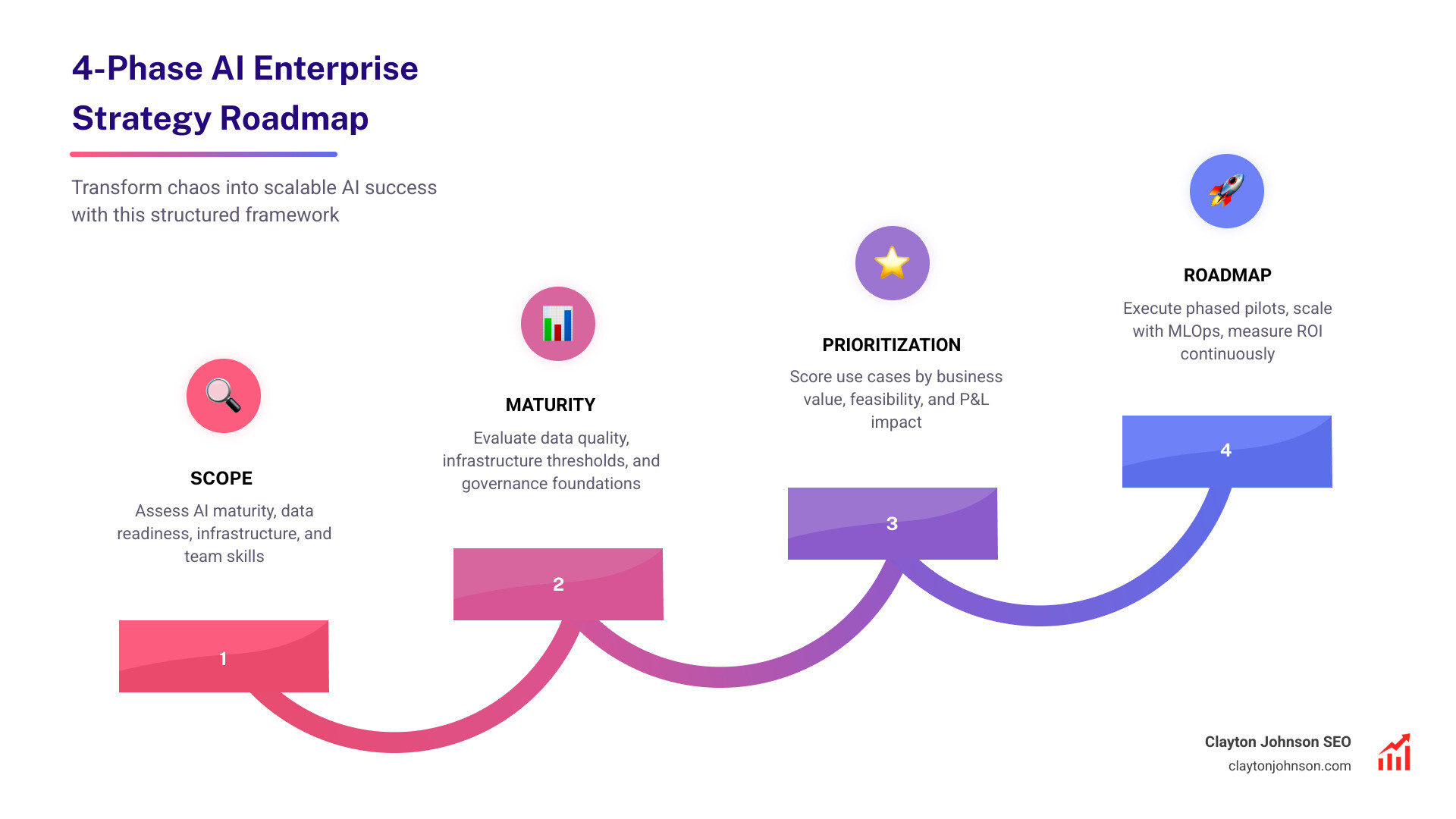
Building a Scalable AI Enterprise Strategy Roadmap
Building a roadmap isn’t just about picking the coolest large language model (LLM) or buying a fleet of GPUs. It’s about strategic alignment. We’ve seen too many organizations treat AI as an IT project rather than a business transformation. If your AI initiatives aren’t solving a core business problem—like reducing churn, optimizing supply chains, or accelerating R&D—they are essentially expensive science experiments.
A successful ai enterprise strategy roadmap starts with identifying your business drivers. Are you looking to cut costs, drive revenue, or mitigate risk? By anchoring your strategy in these pillars, you ensure that every dollar spent has a clear path to value. We believe in a “business-first” approach: find the problem, then apply the code.
For those just starting, it’s helpful to look at enterprise AI strategy 101 to understand the foundational layers. You need a unified vision that spans from the C-suite to the front-line operators. Without executive sponsorship, even the best technical roadmaps stall when they hit budget season or departmental silos.

Assessing Maturity and Data Readiness
Before you can run, you have to check if your shoes are tied. In AI, that means assessing your data readiness. Research shows that 70% of AI failures originate from unresolved data issues. If your data is fragmented, inconsistent, or inaccessible, your AI will be too.
We evaluate maturity across five key dimensions:
- Data Quality: Is your data accurate, timely, and secure?
- Infrastructure: Do you have the compute power and cloud architecture to scale?
- Governance: Are there clear rules for how data is used and protected?
- People: Does your team have the skills to manage and iterate on these models?
- Technology Stack: Is your current software ecosystem ready for AI integration?
According to scientific research on data readiness, many organizations struggle because they over-focus on the models and under-focus on the foundational architecture. You cannot scale agentic AI or complex automation on a brittle data foundation. This is also where mastering AI governance becomes critical; you need to ensure your data handling meets regulatory standards like GDPR or the EU AI Act from the very beginning.
Prioritizing Use Cases for the AI Enterprise Strategy Roadmap
One of the biggest pitfalls in roadmap development is “shiny object syndrome”—trying to do everything at once. To avoid this, we use a feasibility and value scoring matrix. We look at every potential use case and ask:
- What is the P&L impact? (Will this save money or make money?)
- How feasible is it? (Do we have the data and the talent to build this now?)
- What is the time-to-value? (Can we see results in 3-6 months?)
Insights from the McKinsey State of AI insights suggest that while 72% of organizations have adopted AI, only a small fraction report measurable financial impact. The winners are those who prioritize high-value, high-feasibility “lighthouse” projects that prove the concept before moving to more complex transformations.
For a deeper dive into this selection process, check out our guide on winning implementation roadmaps. By T-shirt sizing your projects (Small, Medium, Large) based on complexity and impact, you can build a balanced portfolio of “quick wins” and long-term strategic bets.
Governance, Ethics, and Regulatory Compliance
Governance is no longer a “nice-to-have” checkbox; it is a competitive advantage. If your AI makes a biased decision or leaks sensitive customer data, the cost isn’t just a fine—it’s a total loss of stakeholder trust.
A robust ai enterprise strategy roadmap must include a framework for Responsible AI. This involves:
- Explainability: Can you explain why the AI made a specific recommendation?
- Audit Trails: Is every decision documented and trackable?
- Bias Mitigation: Are you actively testing for and correcting unfair outcomes?
- Compliance: Does your system align with evolving global regulations?
Only about 20% of enterprises currently have mature governance frameworks in place. By building these guardrails early, you prevent “agent sprawl” and ensure your autonomous systems operate within ethical boundaries. For more details, refer to our comprehensive guide to AI governance.
Implementation Phases and Scaling for Success
Once the strategy is set, it’s time to move into the execution phases. We typically see a successful transformation happen across four distinct stages:
- Foundation (Weeks 1-4): Establishing the vision, securing sponsorship, and setting up the initial data environment.
- Expansion (Weeks 5-12): Launching the first pilots and validating use cases with real-world data.
- Optimization (Weeks 13-24): Refining models using MLOps (Machine Learning Operations) to ensure they perform consistently in production.
- Innovation (Month 6+): Scaling successful pilots across the entire enterprise and exploring advanced “Agent Web” architectures where multiple AI agents collaborate autonomously.
scaling AI strategy.
The Build vs. Buy Decision Matrix
One of the most frequent questions we get is: “Should we build our own models or buy off-the-shelf solutions?” The answer depends on your Total Cost of Ownership (TCO) and your need for data sovereignty.
| Feature | Build (Custom) | Buy (SaaS/API) |
|---|---|---|
| Upfront Cost | High (Talent + Infrastructure) | Low (Subscription/Token fees) |
| Customization | Full control over logic and data | Limited to vendor features |
| Speed to Market | Slow (6-12 months) | Fast (Days/Weeks) |
| Maintenance | High (Internal MLOps team) | Low (Handled by vendor) |
| Data Privacy | Maximum (On-prem/Private cloud) | Variable (Depends on provider) |
Generally, we recommend buying for non-core functions (like a general-purpose HR chatbot) and building for areas that provide a unique competitive advantage or require high levels of data security. For a more detailed breakdown, see AI strategy planning.
Managing Change and Upskilling Teams
The “code” part of the roadmap is often easier than the “people” part. AI transformation is, at its heart, a change management project. Employees often fear that AI will replace them, which leads to resistance and poor adoption.
To succeed, you must:
- Address Skill Gaps: 38% of IT leaders cite skill gaps as the top barrier to scaling AI.
- Foster a Culture of Learning: Move from “AI will replace you” to “AI will empower you.”
- Secure Executive Buy-in: Leaders must model the use of AI tools to drive adoption.
- Redesign Workflows: AI isn’t just a tool you “add” to a process; it often requires redesigning the process entirely to see real ROI.
Without organizational alignment, even the most advanced AI systems will sit on the shelf. We suggest creating “Workforce Empowerment Workbooks” to help teams understand how their roles will evolve.
Measuring ROI within the AI Enterprise Strategy Roadmap
Finally, how do you know if it’s working? You need a three-tier ROI framework that tracks:
- Business Outcomes: Hard metrics like revenue growth, cost savings, and cycle time reduction.
- AI Performance: Technical metrics like model accuracy, latency, and drift detection.
- Adoption Metrics: How many people are actually using the tools, and what is the internal sentiment?
Only 34% of enterprises currently report a measurable financial impact from AI. This is usually because they fail to tie their KPIs back to the P&L. At Clayton Johnson SEO, we specialize in helping organizations bridge this gap—turning fragmented AI efforts into coherent growth engines. We don’t just advise on the roadmap; we help you build the systems that operationalize it.
Whether you are just starting your journey or looking to scale beyond your first few pilots, having a structured ai enterprise strategy roadmap is the only way to ensure your investment pays off.
Ready to build an AI roadmap that actually delivers? Contact for AI strategy and let’s turn your chaos into code.