Why You Need an Open Source AI Platform


What is an Open Source AI Platform?
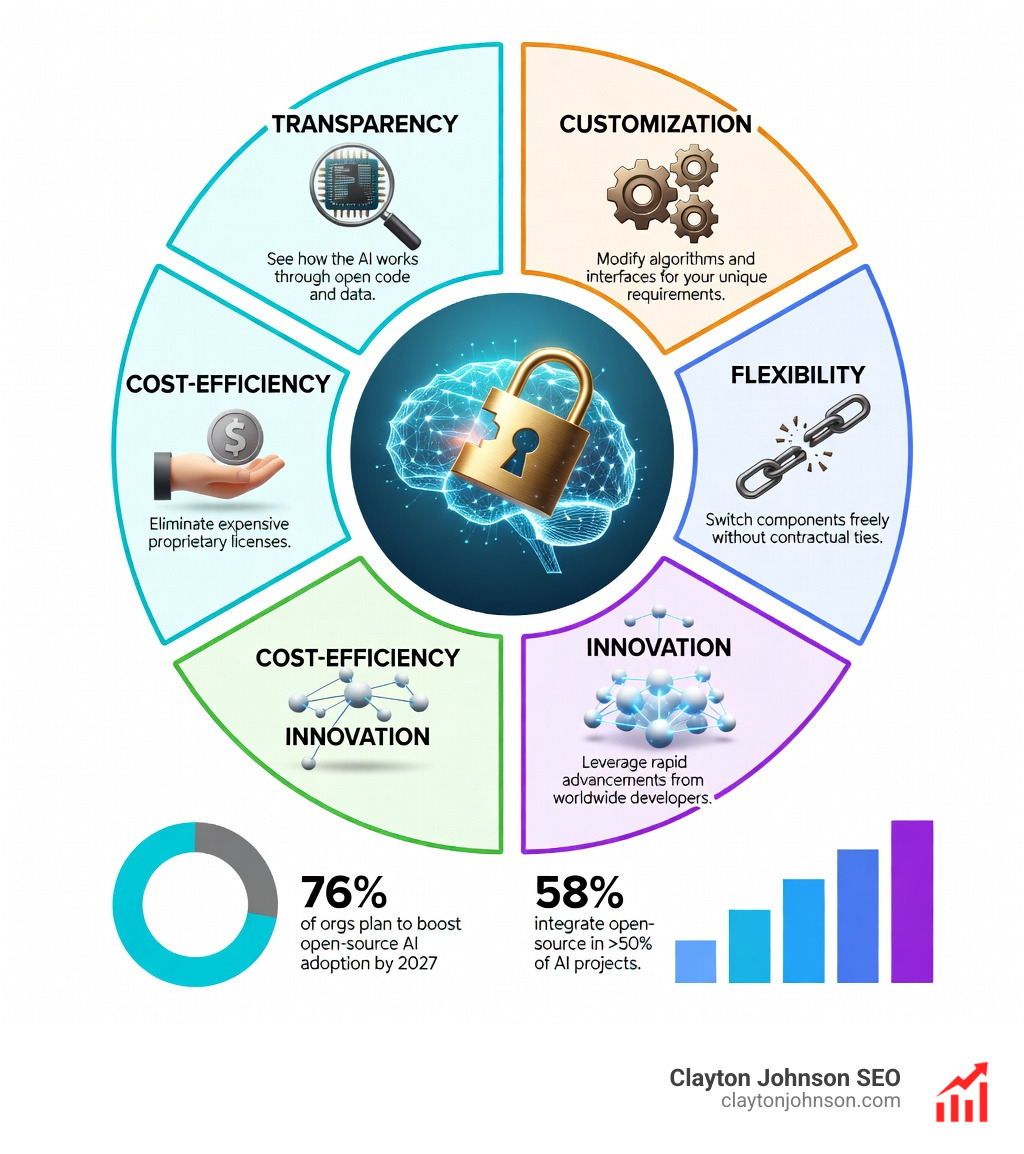
An open source AI platform is a collection of frameworks, models, and tools with freely available code and training resources. It allows users to use, study, modify, and distribute AI systems without restrictions. These platforms offer:
- Transparency: You can see how the AI works.
- Customization: Adapt tools to your exact needs.
- Cost-Efficiency: Reduce licensing fees.
- Innovation: Benefit from global community contributions.
- Flexibility: Avoid vendor lock-in.
Open-source AI platforms are changing how machine learning and large language models (LLMs) are built and used. They are transforming the landscape, making advanced AI more accessible and adaptable. In fact, 76% of organizations expect to increase their use of open-source AI soon, and 58% already use open-source components in most of their AI/ML projects. This is because open-source innovation often accelerates faster than proprietary solutions, thanks to massive community collaboration.
As Clayton Johnson, I’ve seen how open source AI platforms drive innovation in SEO and growth strategies. My work focuses on architecting scalable systems that leverage these powerful tools for measurable business outcomes.
Simple open source ai platform word guide:
When we talk about an open source AI platform, we are referring to a ecosystem where the underlying technology isn’t locked behind a corporate vault. According to the open source software definition, a system is truly “open” when it grants users four essential freedoms: the freedom to use the system for any purpose, study how it works, modify it to change its output, and share it with others.
In artificial intelligence, this means having access to the source code, the model weights, and often the training data. This is a massive shift from “black-box” proprietary systems where you send data into a cloud and receive an answer without knowing exactly how the model arrived at that conclusion.
| Feature | Open Source AI | Closed Source (Proprietary) AI |
|---|---|---|
| Transparency | Full access to code and architecture | Hidden internals (Black Box) |
| Cost | Minimal to no licensing fees | Per-token or subscription fees |
| Customization | Deep fine-tuning and modification | Limited to API parameters |
| Vendor Neutrality | Not bound to any specific vendor | High risk of vendor lock-in |
| Security | Community-audited codebases | Security through obscurity |
By choosing an open source AI platform, we ensure our tech stack remains flexible. We aren’t forced to follow a single provider’s roadmap or pricing hikes. Most of these tools are released under permissive licenses like Apache 2.0 or MIT, which allow for commercial use and modification without the “copyleft” risks associated with older licenses.
The Core Components of the Open Source Stack
To build a complete AI solution, we need more than just a single tool. The open-source stack consists of several layers:
- Frameworks: The foundational libraries like PyTorch and TensorFlow that provide the building blocks for creating neural networks.
- Models: Pre-trained weights for Large Language Models (LLMs) or computer vision, such as LLaMA or Mistral.
- Datasets: The fuel for the models. Projects like Common Crawl, Red Pajama, and Starcoder Data provide massive, transparent datasets for training.
- Infrastructure Tools: Software that manages how these models run, scale, and track experiments.

Key Benefits of Adopting Open Source AI
Why are we seeing such a massive shift toward open source? The data tells a clear story. According to McKinsey, 76% of organizations expect to increase use of open-source AI. Furthermore, Anaconda reports that 58% of organizations already use open-source components in at least half of their AI/ML projects.
The primary driver is customization. Proprietary models are generalists; they are designed to work for everyone. But for specific business needs—like domain-specific SEO or medical analysis—we need models that understand niche context. Open source allows us to perform “pruning” or “tuning” that proprietary systems simply disallow.
Another critical factor is trust. Transparent codebases allow our teams and auditors to inspect model internals, detect biases, and validate safety protocols. In an era of increasing regulation, being able to explain why an AI made a decision is a competitive advantage. This aligns with AI infrastructure best practices, where we prioritize control over our data and model outputs.
Choosing the Right Open Source AI Platform for Your Needs
Selecting a platform isn’t just about the code; it’s about the community. A platform with a vibrant community means faster bug fixes, more tutorials, and better integrations. The Linux Foundation’s report on the Economic and Workforce Impacts of Open Source AI notes that 89% of organizations that have adopted AI use open-source AI in some form for their infrastructure.
When evaluating a platform, we look for:
- Scalability: Can it handle our growth?
- Interoperability: Does it play well with our existing data stack?
- Support: Are there technical working groups or enterprise support options available?
Top Open Source AI Platforms for Enterprise Growth
If you are looking to implement an open source AI platform, several heavy hitters dominate the landscape today. Each serves a specific purpose in the machine learning lifecycle.
- Hugging Face: Often called the “GitHub of AI,” this is where the world shares models. With over 63,000 transformers available, it is the go-to hub for discovering and deploying pre-trained models.
- Kubeflow: If you are running on Kubernetes, Kubeflow is the standard for managing the full ML lifecycle. It excels at building scalable pipelines for training and deployment.
- MLflow: Created by Databricks, this platform focuses on experiment tracking and model versioning. It’s a lightweight way to ensure your data science team isn’t losing work.
- Ray: For those dealing with massive, distributed workloads, Ray is the compute engine of choice. It powers large-scale inference and reinforcement learning.
- ONNX Runtime: This is essential for interoperability. It allows models trained in PyTorch to run efficiently on diverse hardware, from cloud GPUs to edge devices.
For smaller, more focused tasks, libraries like Scikit-learn for predictive data analysis and OpenCV for computer vision remain industry staples. If you’re just getting started with deployment, our Replicate 101 guide can show you how to run these models without managing your own servers.
Leading Open Weight Models and LLMs
The “brain” of your open source AI platform is the model itself. We have seen an explosion in “open-weight” models that rival the performance of GPT-4.
Mistral Large 3 is a prime example. It’s a sparse mixture-of-experts model that delivers frontier-level performance while remaining accessible to the community. Similarly, OpenAI has entered the fray with open models like gpt-oss, designed for local execution and deep customization.
The real magic happens with Parameter-Efficient Fine-Tuning (PEFT) and LoRA. These methods allow us to take a massive model and “teach” it our specific business data without needing a multi-million dollar compute budget. To understand how to connect these models to your applications, check out our ultimate guide to running AI models via API.

Critical Considerations: Data, Security, and Compliance
While the benefits are clear, we must address the risks. Data quality is the silent killer of AI projects. In fact, 45% of scaling efforts derail due to data quality issues. If the data you feed into your open source AI platform is biased or messy, the output will be equally flawed.
Security is another major pillar. Because the code is open, vulnerabilities can be spotted by anyone—including bad actors. This is why we use tools like Giskard for model testing and validation. We also leverage research tools like Perplexity to stay updated on the latest security patches and community-reported bugs.
Finally, there is the rise of Sovereign AI. Many organizations (and even nations) are now building localized models to ensure that sensitive data never leaves their jurisdiction. This is only possible through open-source foundations that allow for completely air-gapped deployments.
Is an Open Source AI Platform Safe for Production?
The short answer is yes, provided you have the right governance. Organizations like the LF AI & Data Foundation host 67 projects with over 200 million lines of code and 100,000 contributors. This level of scrutiny often makes open-source tools more secure than proprietary ones over time because there are more eyes on the code.
For production safety, we recommend:
- Regular Audits: Conduct internal reviews of licenses and model weights.
- MLOps Transparency: Use platforms like MLflow to document every step of the model’s training.
- Vulnerability Patching: Stay active in the community to receive and apply security updates immediately.
The Future of Open Source AI and Innovation
We are moving toward a future of “distributed intelligence.” Instead of one giant model in the cloud, we will see thousands of specialized models running on the edge. The Ministral 3 series is already showing us how high-performance AI can run on local devices like laptops or even phones.
We are also seeing the rise of autonomous agents. Platforms like the LocalAI ecosystem allow developers to build agents that can perform tasks, conduct semantic searches, and even teach themselves new abilities. If you want to build these systems yourself, our OpenClaw manual setup guide is a great place to start.
For builders looking to feed these models with real-time web data, tools like Firecrawl are becoming essential for creating the data pipelines that power next-generation agents.
Frequently Asked Questions about Open Source AI
How do companies monetize open source AI?
Most companies use an “open-core” or “managed service” model. For example, Rasa-as-a-Service offers a managed version of their open-source conversational AI platform. Others, like H2O.ai, provide enterprise support, training, and specialized deployment tools (like Sparkling Water) for mission-critical environments.
Can open source AI compete with proprietary models?
Absolutely. On the LMArena leaderboard, open-source models like Mistral and LLaMA frequently rank alongside or even above proprietary models from tech giants. The “collective intelligence” of the global community often outpaces the R&D departments of single corporations.
When should I prefer a proprietary solution over open source?
Proprietary solutions are often better if you have limited engineering resources and need something that works “out-of-the-box” with zero maintenance. If your team doesn’t have the bandwidth to manage infrastructure, a closed-source API might be the faster path to deployment.
Conclusion
The shift toward the open source AI platform is not just a technical trend; it is a strategic necessity for businesses that want to own their future. By embracing these tools, we move from being “renters” of technology to “owners.” This ownership allows for the kind of structured growth architecture we build at Demandflow.ai.
At Clayton Johnson SEO, we help founders and marketing leaders turn these complex AI systems into measurable leverage. Whether it’s through AI-augmented marketing workflows or competitive positioning models, our goal is to help you achieve compounding growth.
If you’re ready to take control of your AI strategy, explore our AI tools and frameworks to see how we can help you build a more transparent, scalable, and powerful future.