What is Informational Intent Anyway?

Demystifying Keyword Intent
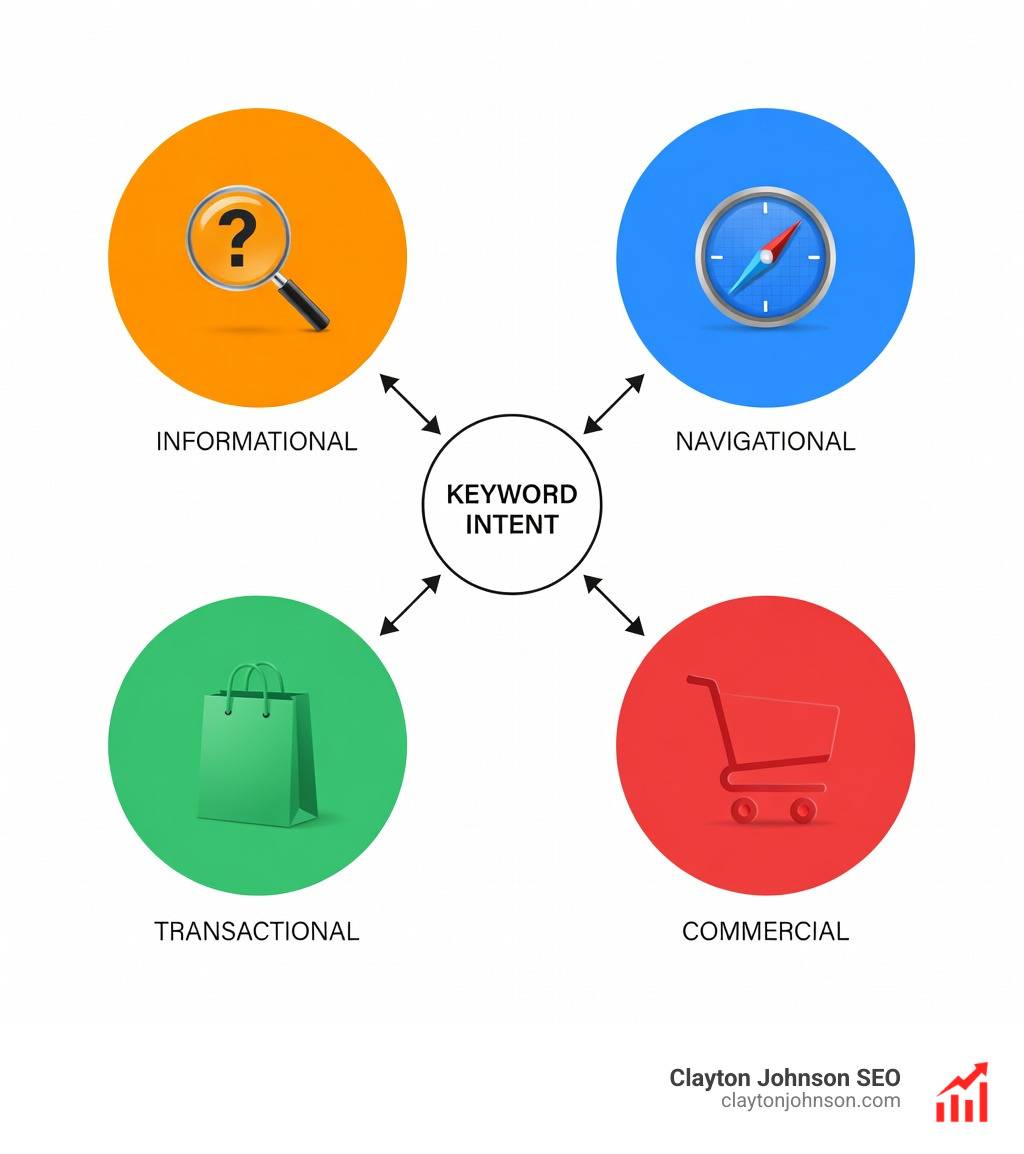
Understanding the types of keyword intent is fundamental to successful SEO. It’s about knowing why someone types a query into a search engine. Are they looking to learn something new? Find a specific website? Research a product? Or are they ready to buy right now?
Here are the four main types of keyword intent:
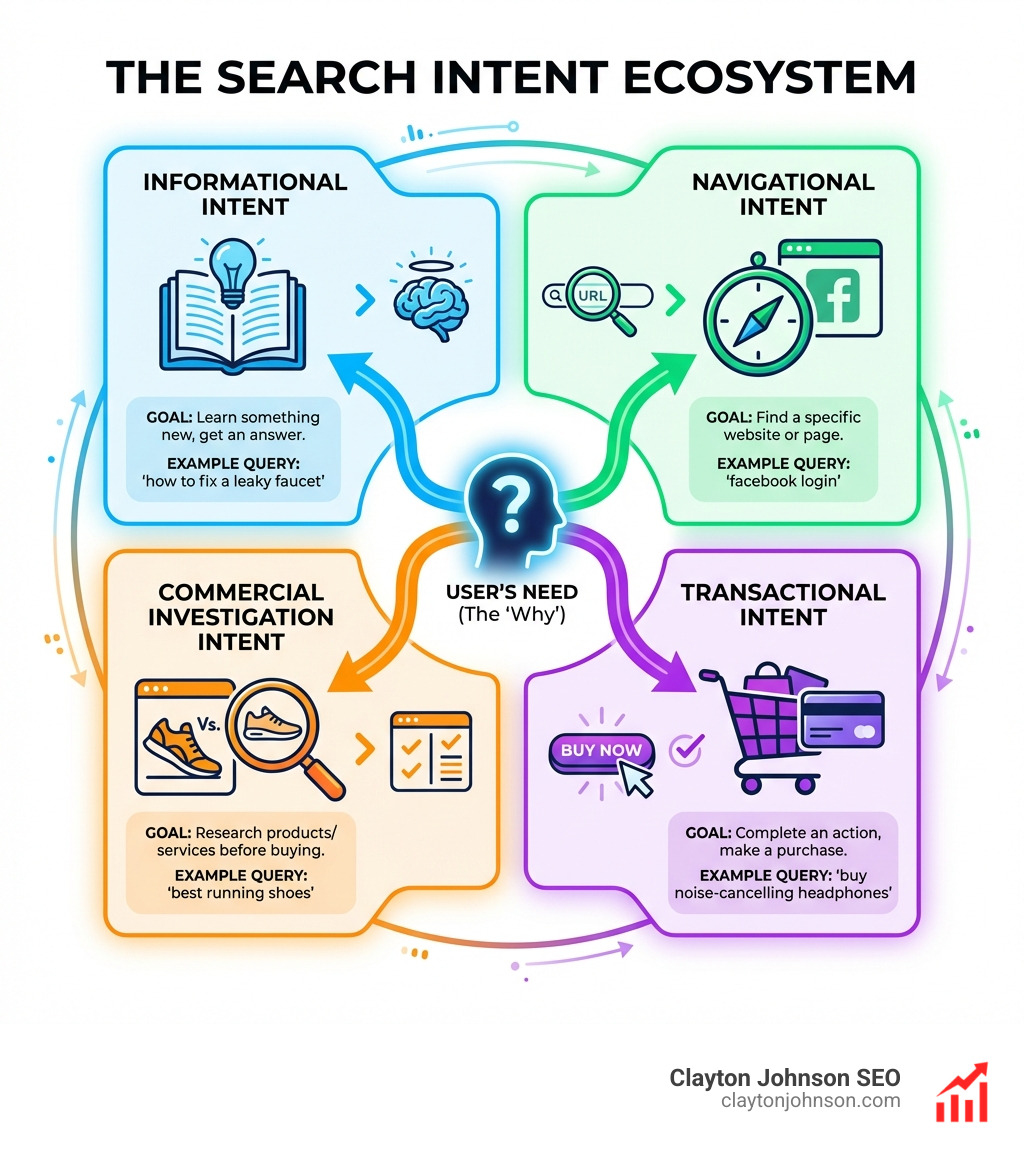
- Informational Intent: The user wants to learn something or get an answer to a question (e.g., “how to fix a leaky faucet”).
- Navigational Intent: The user is looking for a specific website or page (e.g., “facebook login”).
- Commercial Investigation Intent: The user is researching products or services before making a purchase (e.g., “best running shoes”).
- Transactional Intent: The user is ready to complete an action, like making a purchase or signing up (e.g., “buy noise-cancelling headphones”).
Every search query tells a story about what the user needs. As Rand Fishkin once put it, “There is a true story in the life of every visitor to every webpage. When the visitor comes from search, we get some big clues into that story. We know a lot about what they need because they just typed it into a little box.” This insight is the bedrock of crafting content that truly connects.
As Clayton Johnson, I specialize in engineering scalable traffic systems and AI-augmented marketing workflows, often built on a deep understanding of the types of keyword intent to create demand engines. My work transforms fragmented efforts into cohesive growth powered by search intent and structured content.
Understanding the 4 Primary Types of Keyword Intent
To build a structured strategy, we must first categorize the landscape of search. Google doesn’t just match strings of text anymore; it uses complex semantic algorithms to determine the “why” behind the query. This is reflected in the Search Quality Evaluator Guidelines, where Google uses a “Needs Met” rating scale ranging from “Fails to Meet” to “Fully Meets.”
When we align our content with these goals, we aren’t just “doing SEO”—we are providing a superior user experience.
| Intent Type | User Goal | Funnel Stage | Typical Modifiers |
|---|---|---|---|
| Informational | Knowledge/Answers | Awareness | What, How, Guide, Tips |
| Navigational | Specific Site/Page | Retention/Interest | Brand Name, Login, Support |
| Commercial | Research/Compare | Consideration | Best, VS, Review, Top |
| Transactional | Action/Purchase | Decision | Buy, Order, Discount, Near me |
Informational Intent: The Foundation of Authority
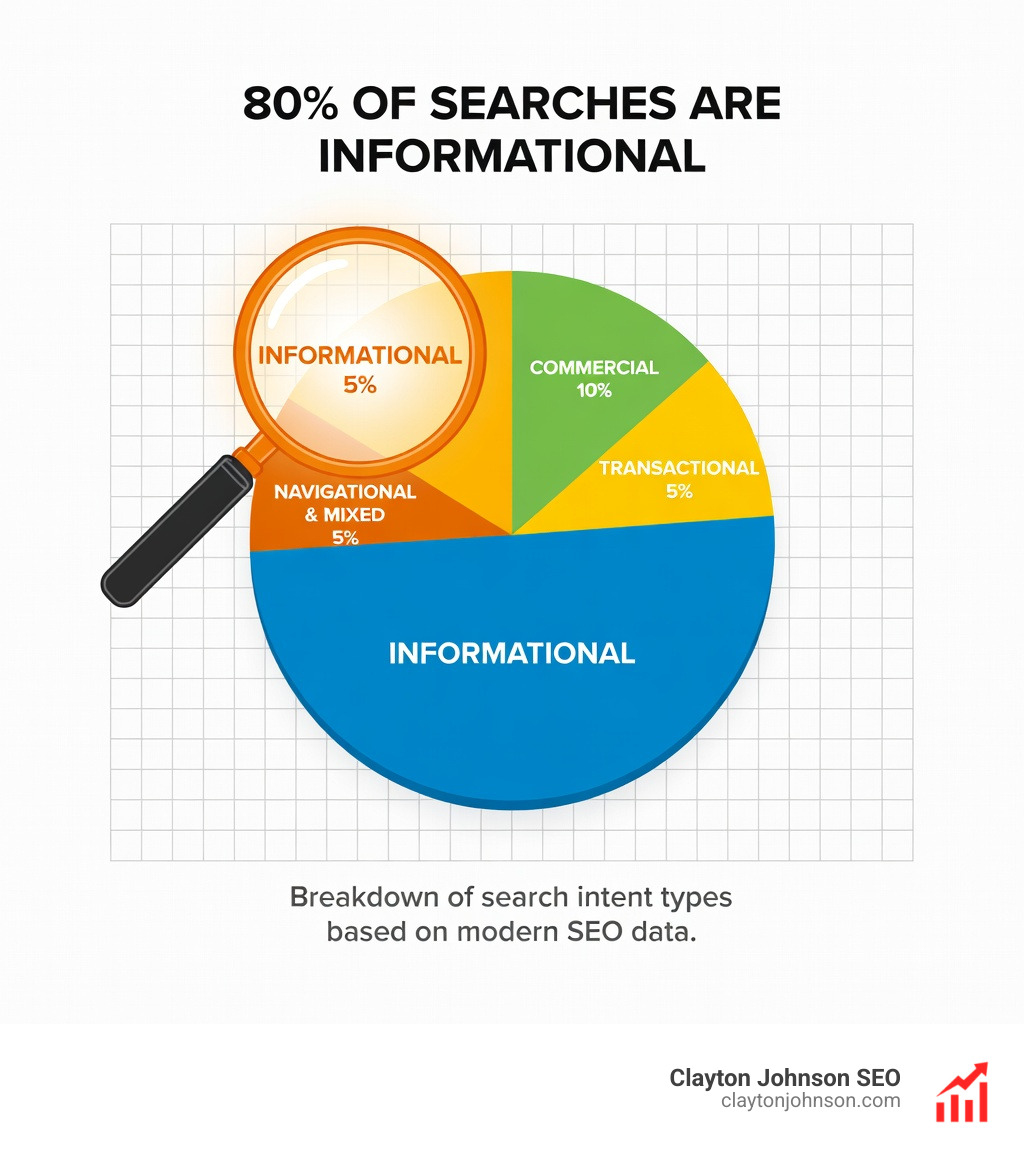
Often referred to as “Know” queries, informational intent dominates the search landscape. Research shows that roughly 80% of all searches fall into this category. These users are in the “Awareness” stage; they have a problem or a curiosity, but they aren’t necessarily ready to hand over their credit card details yet.
Why should we care about traffic that doesn’t convert immediately? Because informational content is the “structured growth infrastructure” of your brand. By answering questions like “how to replace a microscope bulb” or “benefits of a standing desk,” we establish authority. This builds trust so that when the user is ready to buy, our brand is the first one they think of.
If you want to help a lot of people (and eventually get a lot of leads), you need to satisfy these information seekers through SEO content marketing services.
Navigational Intent: Finding the Digital Front Door
Navigational intent, or “Go” queries, occurs when a user already knows where they want to go but uses Google as a shortcut. Examples include “Twitter sign up” or “LinkedIn.”
While these might seem low-value because the user is already aware of the brand, they are critical for user retention. According to branded query click-through research, branded queries have a 2x click-through rate compared to non-branded terms. If your “digital front door” is messy—meaning your homepage or login pages aren’t optimized—you risk losing that user to a competitor who is bidding on your brand name.
Commercial and Transactional: Moving Toward the Conversion

As we move down the marketing funnel, the intent shifts from learning to doing. This is where the revenue is generated. Understanding these types of keyword intent allows us to stop guessing and start engineering conversions through targeted conversion optimization services.
Commercial Investigation: Comparing the Best Options
Commercial intent is the bridge between “I have a problem” and “I’m buying this specific solution.” These users are in the consideration stage. They are looking for “best,” “reviews,” or “product A vs product B.”
At this stage, users want honest evaluations. They aren’t looking for a sales pitch; they are looking for a guide to help them make an informed decision. Listicles and comparison tables are the gold standard here. For example, a query like “best running shoes” shows that the user has the intent to buy, but they need help narrowing down the choices.
Transactional Intent: The Final Step in the Types of Keyword Intent
This is the “Buy” stage. The user has finished their research and is ready to act. Transactional keywords often include modifiers like “buy,” “coupon,” “shipping,” or “price.”
According to Semrush data, transactional keywords boast the highest conversion rates. While informational queries might convert at less than 1%, landing pages targeting transactional intent can see rates of 2-5% or higher. To win here, your pages need action-driven copy and a frictionless checkout process. You can find more conversion rate optimization insights to help turn these high-intent visitors into paying customers.
Beyond the Basics: Mixed, Local, and Generative AI Intent

The world of search isn’t always black and white. Sometimes, a keyword has “Mixed Intent.” Take the query “Mercury.” Is the user looking for the planet, the element, or the car brand? Google handles this by showing a variety of results until it learns what the majority of users prefer.
Local intent is another critical hybrid. When someone searches “restaurants near me,” they have both informational intent (what are the hours?) and transactional intent (I want to eat now). For businesses in Minneapolis, Minnesota, maintaining NAP (Name, Address, Phone) consistency is vital for appearing in these local Map Packs.
How Generative AI is Reshaping the Types of Keyword Intent
The rise of AI tools like ChatGPT and Google’s AI Overviews has introduced a new category: Generative Search Intent. According to research on generative search intent, this accounts for about 37.5% of queries in ChatGPT.
Users aren’t just looking for a link; they want the AI to do something. They might ask, “Write a 200-word LinkedIn post about sustainable fashion” or “Generate a table comparing electric cars.” This “Prompt Intent” focuses on concrete outputs rather than just information synthesis. For SEOs, this means optimizing for “zero-click searches,” where the user gets their answer directly on the search results page.
How to Identify and Optimize for Search Intent

Identifying intent isn’t guesswork; it’s a process of manual review and tool-based analysis. We recommend using the “3Cs of Search Intent”:
- Content Type: Is the SERP dominated by blog posts, product pages, or videos?
- Content Format: Are the top results how-to guides, listicles, or landing pages?
- Content Angle: What is the unique selling point? (e.g., “for beginners” or “cheap”).
If you’re feeling overwhelmed, an SEO consultant can help you map your existing content to these intent types to ensure you aren’t moving users “backward” in the funnel (e.g., sending a ready-to-buy user to a basic “what is” blog post).
Auditing Your Keyword List for Intent Alignment
A healthy keyword list balances volume with intent. You might have a keyword with 10,000 searches a month, but if it’s “Fact Intent” (something Google answers in a snippet), it won’t drive traffic.
Using tools like Moz Keyword Explorer or Semrush allows you to see “Personal Keyword Difficulty” and intent labels. We suggest auditing your list by asking:
- Is this keyword relevant to my business goals?
- Does the content I have actually satisfy the user’s goal?
- Am I balancing high-volume “Awareness” terms with high-converting “Decision” terms?
Frequently Asked Questions about Keyword Intent
How do you determine the intent of a keyword?
The easiest way is to look at the SERP (Search Engine Results Page). If you see shopping ads and product carousels, it’s transactional. If you see a “People Also Ask” box and long-form articles, it’s informational. You can also look for keyword modifiers like “how to” or “buy.”
What are the most common keyword modifiers?
- Informational: How, what, why, tips, guide, tutorial.
- Navigational: Brand name, login, portal, contact.
- Commercial: Best, review, top, vs, comparison.
- Transactional: Buy, price, discount, coupon, shipping.
- Local: Near me, in [City Name], open now.
Why does Google prioritize search intent over keyword density?
Google’s mission is to provide the most relevant result. A page can mention a keyword 50 times, but if the user wants to buy and the page is just a definition, the user will bounce. Google uses satisfaction metrics (like bounce rate and time on page) to determine if a page actually fulfills the intent.
Conclusion
At the end of the day, SEO isn’t just about ranking; it’s about building a structured growth architecture. Most companies don’t lack tactics; they lack the leverage that comes from a cohesive system. By mastering the types of keyword intent, we move away from “brochureware” websites and toward authority-building ecosystems.
Through Demandflow.ai, we provide the frameworks and AI-augmented workflows necessary to turn these insights into compounding growth. If you are ready to stop chasing “empty” traffic and start building a demand engine, work with me to implement a system that scales.
Clarity leads to structure, and structure leads to leverage. Let’s build your growth infrastructure together.