How to Build a Social Media Content Strategy From Scratch


What Is a Social Media Content Marketing Strategy (And Why It Matters)
A social media content marketing strategy is the structured plan that defines what you post, where you post it, why you post it, and how we measure whether it’s working.
Here is a quick breakdown of what it covers:
| Element | What It Means |
|---|---|
| Goals | Specific, measurable outcomes tied to business objectives |
| Audience | Who you’re targeting and where they spend time online |
| Platforms | Which channels to prioritize based on audience fit |
| Content Plan | Content pillars, formats, and posting cadence |
| Distribution | How content gets published, promoted, and amplified |
| Measurement | KPIs and analytics that track real business impact |
Without a strategy, social media becomes guesswork. With one, it becomes a compounding growth engine.
The numbers back this up. Research shows that 67% of marketers with a custom content strategy for every platform saw an improvement in ROI. And educational or entertaining content drives 66% higher engagement than generic posts. Meanwhile, over 4.74 billion people use social media globally — more than half the human population.
The opportunity is enormous. But so is the noise.
Most brands post inconsistently, spread across too many platforms, and have no clear connection between their social content and actual business outcomes. That is what a real strategy fixes.
We are Clayton Johnson SEO — a team of strategists and growth operators who have built social media content marketing strategy frameworks across 50+ business models, helping founders and marketing leaders turn fragmented content efforts into structured, measurable growth systems. In the guide below, we’ll walk you through every layer of that system — from goal setting and audience research to AI-powered execution and growth modeling.
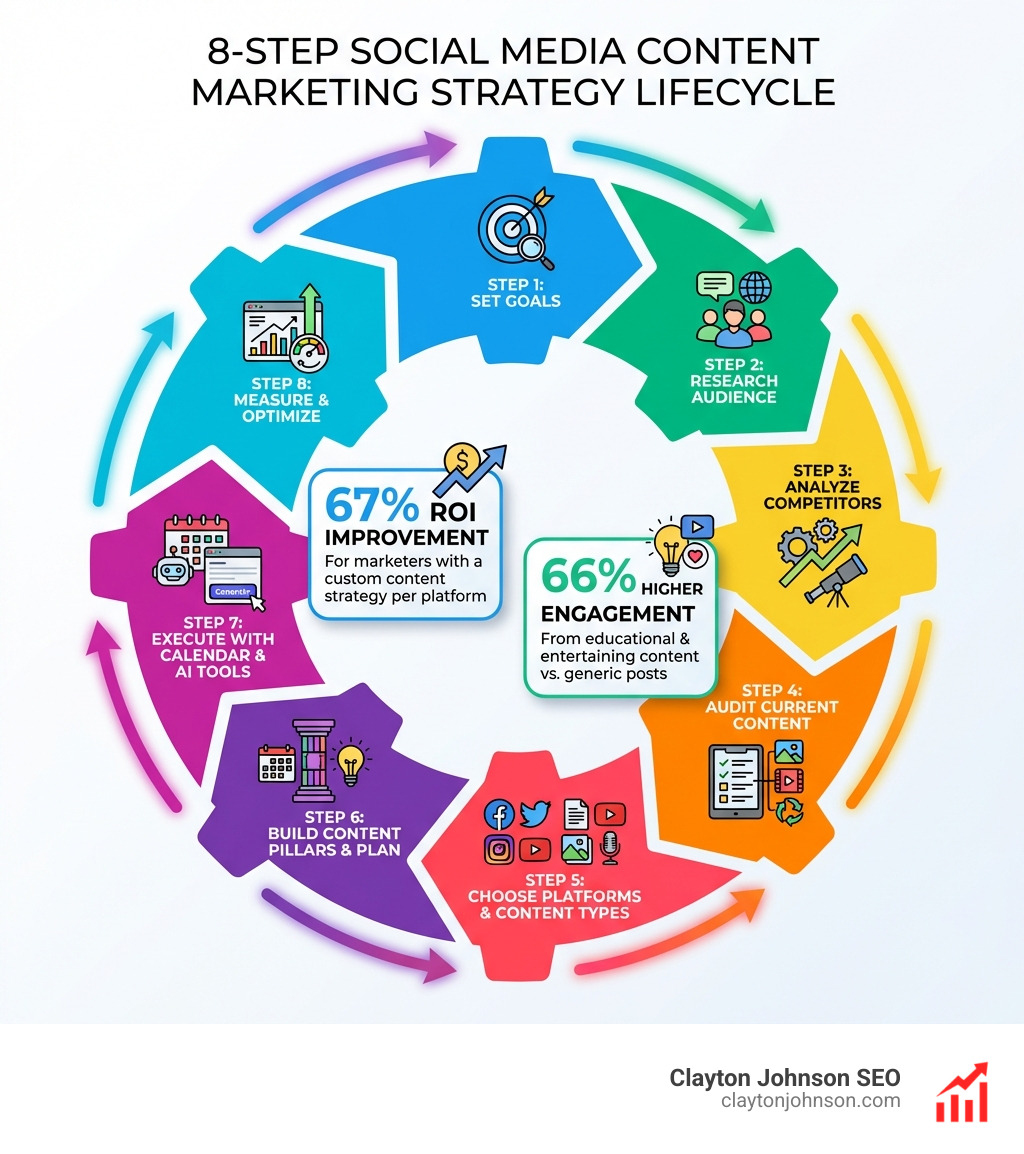
Terms related to social media content marketing strategy:
Defining Your Social Media Content Marketing Strategy
Before we record a single Reel or draft a LinkedIn post, we need a foundation. A great strategy isn’t about being “on social media”; it’s about using social media to drive specific business outcomes.
The SMART Framework for Goal Setting
We don’t set vague goals like “get more followers.” Instead, we use the SMART framework: Specific, Measurable, Achievable, Relevant, and Time-bound.
For example, a SMART goal might be: “Increase website traffic from Instagram by 20% over the next 90 days.” This clarity allows us to tie social media efforts directly to ROI. According to the Sprout Social Index, 65% of leaders want to know exactly how social campaigns tie into business objectives. If we can’t measure it, we shouldn’t be doing it.

Brand Persona and Trust
Your brand persona is the “human” side of your business. Why does this matter? Because 81% of consumers report that trust and credibility are key purchase drivers. Whether your voice is witty and comedic (like the Oklahoma Department of Wildlife Conservation) or professional and authoritative, consistency is key.
To build a watertight strategy, we align these social efforts with our broader digital marketing pillars. This ensures that your social content doesn’t live in a silo but supports your SEO, email, and paid advertising efforts.
The Architecture of Audience and Competitor Research
We cannot create resonant content if we don’t know who we are talking to. At Demandflow, we believe clarity precedes growth.
Deep Audience Research
We start by building detailed buyer personas. This goes beyond basic demographics like age and location. We want to know:
- What are their “Jobs to be Done”?
- What keeps them up at night (pain points)?
- Which influencers do they already trust?
We use tools like SparkToro to see what your audience actually talks about online and where they hang out. We also recommend using this (Worksheet) How to Conduct Social Media Market Research in 90 Minutes or Less to gather insights quickly.
Competitor Benchmarking
Analyzing your competitors isn’t about copying them; it’s about finding the gaps they’ve left wide open. We look at:
- Which platforms are they most active on?
- What types of content get the most engagement for them?
- How do they handle customer service in the comments?
By conducting a competitive analysis, we can identify what “winning” looks like in your niche and then do it better.
Developing Content Pillars and Platform-Specific Tactics
Once we know the who and the why, we move to the what. A successful social media content marketing strategy relies on content pillars—3 to 5 core topics that your brand will consistently cover.
The 70-20-10 Rule
To maintain a healthy mix, we often follow the 70-20-10 rule:
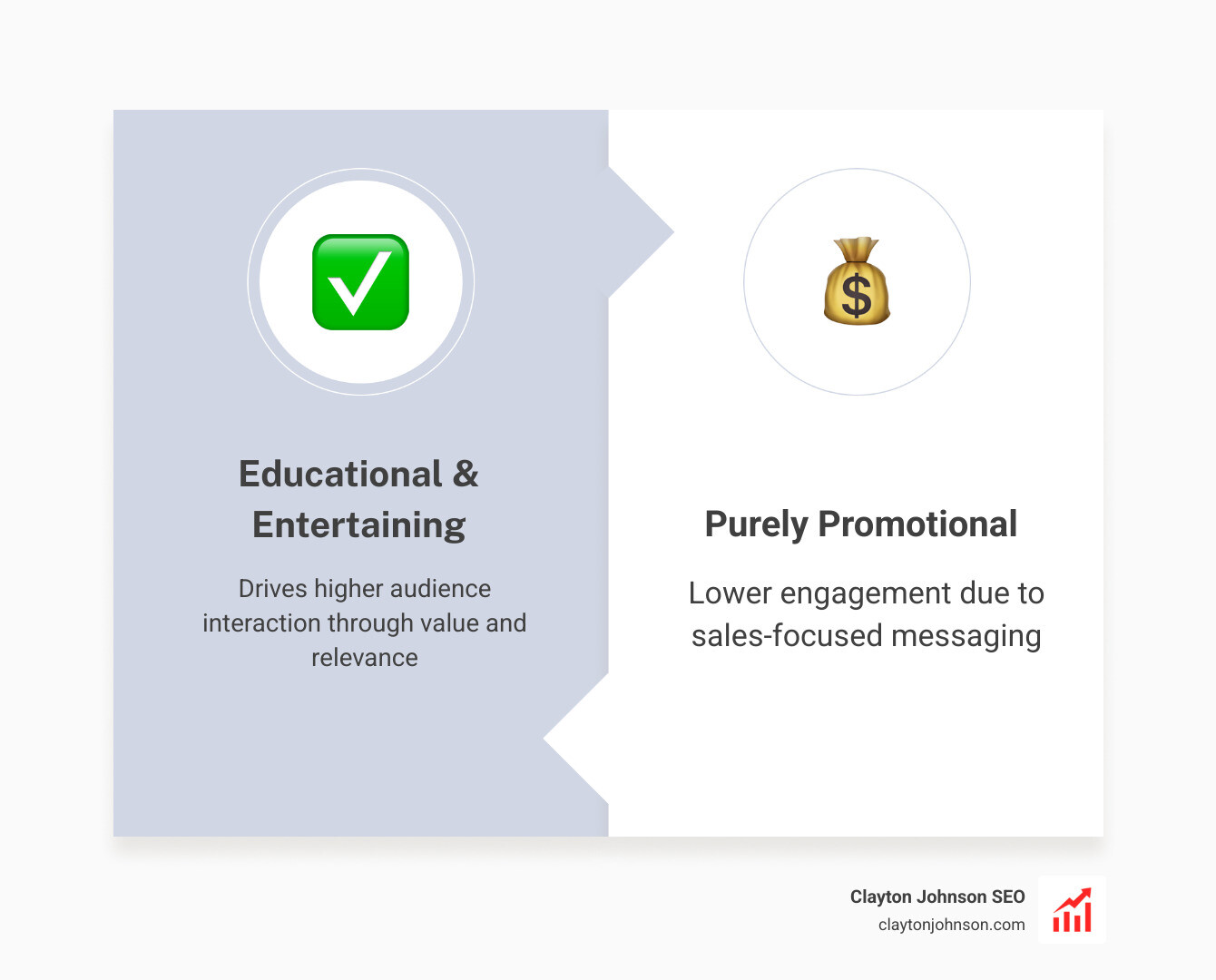
- 70% Value-Based Content: Educational, entertaining, or brand-building posts.
- 20% Shared Content: Reposting industry news or user-generated content (with credit).
- 10% Promotional Content: Direct calls to action, product launches, or sales.
Selecting Platforms for Your Social Media Content Marketing Strategy
Not every platform is right for every brand. Spreading yourself too thin is a recipe for burnout.
| Platform | Best For | Key Statistic |
|---|---|---|
| Visual storytelling, B2C, Influencer collabs | Over 2 billion monthly active users | |
| Community building, older demographics, local ads | Around 3 billion monthly active users | |
| B2B, thought leadership, employee advocacy | Priority for B2B brands | |
| TikTok | Short-form video, Gen Z, viral trends | Most downloaded app worldwide |
| X (Twitter) | Real-time news, customer service, witty banter | High frequency (3-4 posts/day) |
According to global social media usage stats, the average person spends two and a half hours on social media daily. We want to meet them where they are already spending that time.
Content Types for Maximum Engagement
We prioritize high-vividness content. Academic research shows that rich media (video and images) drives significantly more engagement than plain text.
- Video Stories & Reels: Short-form video is currently “driving the most site traffic and audience growth.”
- Infographics: Great for simplifying complex data.
- Live Streams: Perfect for real-time interactivity and building trust.
- Carousel Posts: Excellent for educational “how-to” content on Instagram and LinkedIn.
Execution: Calendars, AI, and Distribution
A strategy is only as good as its execution. We use a social media content calendar to move from big-picture ideas to daily tasks.
Content Batching and Scheduling
We don’t believe in “posting on the fly.” That leads to errors and stress. Instead, we use “content batching”—dedicating specific blocks of time to create a week or month of content at once. Tools like Buffer or Hootsuite then allow us to schedule these posts at optimal times. For example, Netflix posts multiple times a day on X to stay top-of-mind.
Amplifying Your Reach
Organic posting is just the start. We also look at:
- Employee Advocacy: Encouraging your team to share brand content.
- Influencer Partnerships: Sponsoring influential users to reach niche audiences.
- Paid Social: Using paid advertising to get your best-performing content in front of new eyes.
Using AI to Optimize Your Social Media Content Marketing Strategy
AI is no longer a luxury; it’s a core component of modern digital marketing. We use AI to:
- Repurpose Content: Turning one long-form webinar into dozens of LinkedIn posts, Reels, and tweets.
- Predictive Analytics: Identifying which topics are likely to trend before they peak.
- Personalization: Tailoring messaging to different audience segments at scale.
- Creative Enhancement: Using AI-enhanced execution systems to edit videos or generate eye-catching graphics.

Measuring Success and Growth Modeling
At Clayton Johnson SEO, we don’t just look at “vanity metrics” like likes. We look at measurable growth.
Tracking the Right KPIs
We use analytics and data services to track:
- Conversion Rate: How many people actually bought something?
- Click-Through Rate (CTR): Are people moving from social to your website?
- Share of Voice: How much of the online conversation in your niche do you own?
To track this accurately, we use UTM parameters. You can use Google’s UTM builder to tag every link you post, allowing you to see exactly which post drove which sale in your Google Analytics dashboard.
Measurable Growth Modeling
We treat social media as part of a “growth operating system.” By A/B testing different headlines, visuals, and posting times, we continuously refine the strategy. This isn’t just content marketing—it’s structured growth infrastructure.
Frequently Asked Questions about Social Media Strategy
What is the difference between a content calendar and a social media strategy?
A social media strategy is your big-picture roadmap—the why and the goals. A content calendar is the tactical schedule—the what, when, and where of your daily posts. You need the strategy to know what to put on the calendar.
How do I identify the best posting times for my brand?
While there are general benchmarks (like Fridays or early mornings), the best time is unique to your audience. We use platform-specific analytics and tools like Sprout Social or Buffer to find when your followers are most active.
Which metrics are most important for measuring social media ROI?
If your goal is sales, focus on conversion rate and cost per acquisition. If your goal is brand awareness, look at reach and impressions. Always align your metrics with your SMART goals.
Conclusion
Building a social media content marketing strategy from scratch is a journey from clarity to compounding growth. By moving away from random tactics and toward a structured growth architecture, we can turn your social channels into predictable engines for revenue and brand authority.
Whether you are looking for social media marketing services or a complete SEO content marketing overhaul, we are here to help you build the systems that scale.
Ready to stop guessing and start growing? Work with us to implement a strategy that delivers.