SEO Tips for Financial Advisors


Why a Financial Advisor SEO Strategy Is Your Most Efficient Path to New Clients
A financial advisor SEO strategy is the process of optimizing your website so that prospects find you organically on Google — without paying for every click.
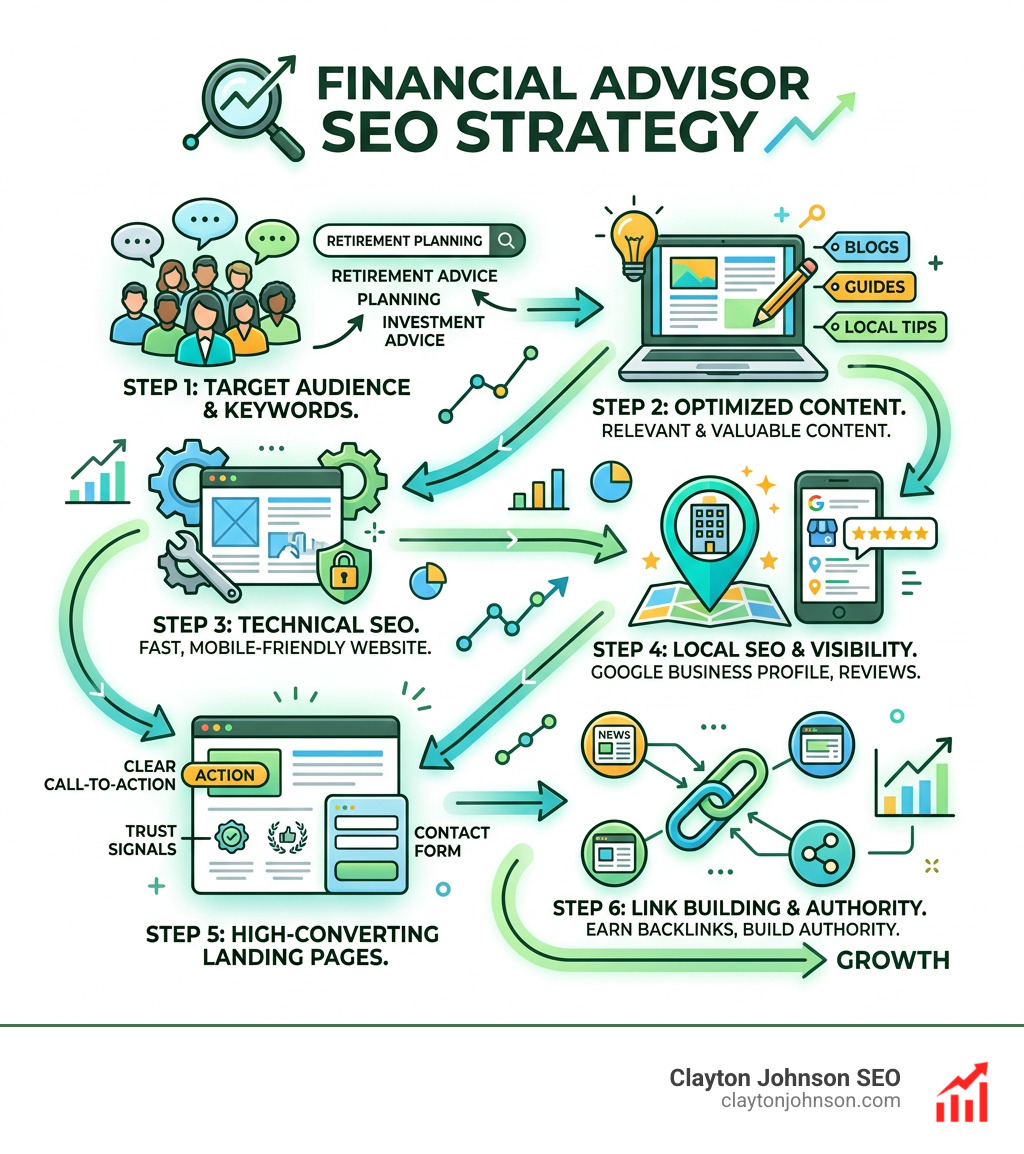
Here’s a quick overview of what a strong financial advisor SEO strategy involves:
- Keyword research — Find terms your ideal clients are already searching
- On-page optimization — Optimize titles, content, and technical elements on your site
- Local SEO — Show up when prospects search “financial advisor near me”
- Content marketing — Publish educational content that builds trust and authority
- Link building — Earn backlinks that signal credibility to search engines
- Conversion optimization — Turn website visitors into booked consultations
- Track and refine — Monitor rankings and adjust your strategy over time
Most financial advisors rely on referrals to grow. That works — until it doesn’t.
Referrals are unpredictable. You can’t scale them. And when they slow down, your pipeline dries up fast.
Here’s what the data says: according to Kitces Research, SEO has the lowest client acquisition cost (CAC) of any marketing tactic studied — ranking second overall in marketing efficiency, just behind client referrals. Yet only 22% of advisors actually use it.
That’s a massive gap between what works and what most advisors are doing.
Think about this: the phrase “financial advisor” is searched 165,000 times per month in the United States alone. “Retirement planning” gets another 40,000 searches per month. These are real people, actively looking for exactly what you offer.
SEO puts you in front of them — before your competitors.
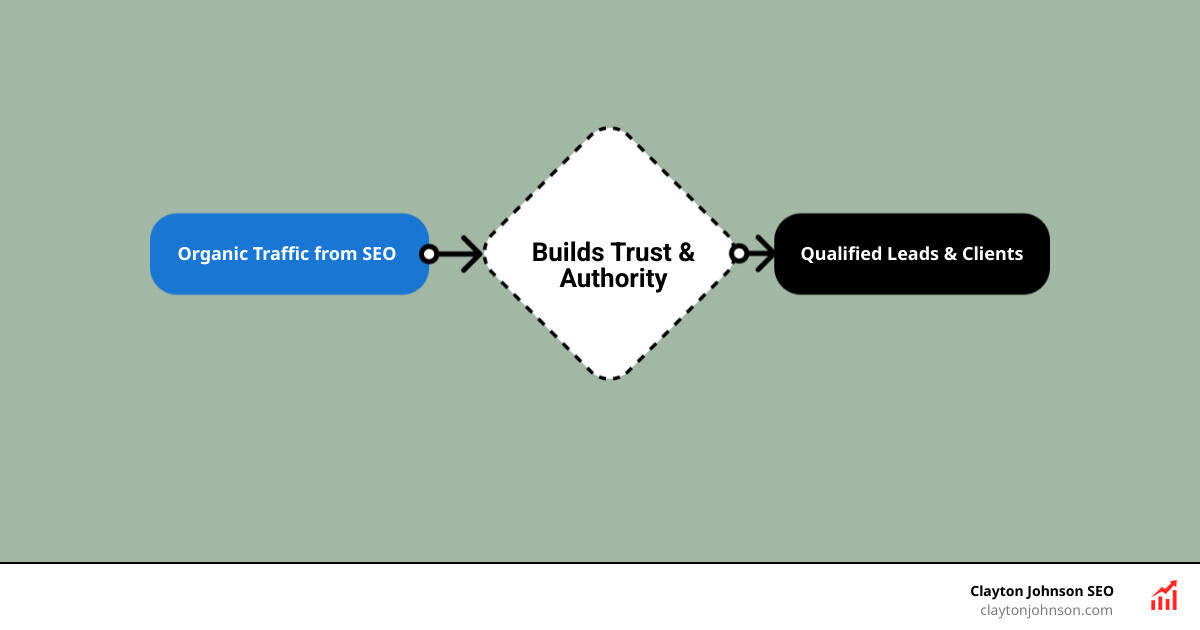
Unlike paid ads, organic traffic doesn’t stop when your budget runs out. It compounds over time. Every optimized page, every quality backlink, every piece of helpful content builds on the last.
This guide walks you through exactly how to build that system.
Building a High-Impact Financial advisor SEO strategy
When we look at the landscape of professional services marketing, many advisors get distracted by “shiny object” syndrome—jumping from one social media platform to another or burning through cash on expensive paid ads. However, if we look at the Client Acquisition Cost (CAC), the data tells a different story.
Paid advertising is like a faucet: the moment you stop paying, the leads stop flowing. SEO, on the other hand, is an investment in a digital asset. Research shows that organic traffic is perceived as more trustworthy by users because it represents a “vote of confidence” from the search engine. While “financial advisor” is a massive term, “financial planner” also sees 33,000 searches a month. Capturing even a fraction of this volume can transform a firm’s bottom line.

The efficiency of a Financial advisor SEO strategy lies in its compounding nature. According to Kitces Research, SEO ranks 2nd for marketing efficiency, trailing only client referrals. This is because SEO targets people with intent. When someone searches for “how to prepare for a liquidity event,” they aren’t just browsing; they are looking for an expert.
Furthermore, technical performance is directly tied to your revenue. Research indicates that even a one-second delay in page load time can lead to a significant drop in conversions. In the high-stakes world of wealth management, a slow site suggests a lack of attention to detail—not the impression you want to give a high-net-worth prospect.
Mastering On-Page Elements for Your Financial advisor SEO strategy
On-page SEO is everything you control directly on your website. We divide this into technical and non-technical categories. Technically, we must satisfy Google’s technical guidelines regarding Core Web Vitals. These are metrics that measure how fast your page loads, how quickly it becomes interactive, and how stable the layout is as it loads.
From a non-technical perspective, your content must adhere to YMYL (Your Money or Your Life) standards. Because you handle people’s finances, Google holds your site to a higher standard of E-E-A-T: Experience, Expertise, Authoritativeness, and Trustworthiness.
Key on-page elements include:
- Title Tags: These should be under 60 characters and include your primary keyword.
- Meta Descriptions: While not a direct ranking factor, these under-155-character snippets act as “ad copy” to encourage clicks from the search results page.
- Content Quality: You aren’t just writing for bots; you’re writing for humans. Use H1, H2, and H3 headers to make your content scannable.
For a deeper dive into these fundamentals, check out our Beginners guide to wealth manager SEO.
Keyword Selection and the Bullets-Then-Cannonballs Approach
One of the biggest mistakes we see advisors make is trying to rank for “financial advisor” on day one. That’s a “cannonball”—a massive, resource-heavy move that might miss the target if you haven’t validated your strategy. Instead, we advocate for Jim Collins’ bullets-then-cannonballs strategy.
Start by firing “bullets”—small, low-risk tests. This might mean running a small paid ad campaign for a specific long-tail keyword to see if it actually leads to consultations. Once you know a keyword converts, you fire the “cannonball” by investing heavily in SEO content for that term.
| Keyword Type | Example | Search Volume | Competition | Intent |
|---|---|---|---|---|
| Short-Tail | Financial Advisor | Very High | Extremely High | General |
| Long-Tail | Fiduciary advisor for physicians in Chicago | Low | Low | High/Specific |
| Cluster Term | Backdoor Roth IRA rules | Medium | Medium | Educational |
We also use “keyword clusters”—groups of related terms that signal to Google that you are an authority on a broad topic. For example, instead of just targeting “retirement,” you create a cluster around “401k rollovers,” “Social Security timing,” and “Medicare enrollment.” This semantic grouping is a core part of how SEO strategies for wealth managers are demystified.
Local SEO and Authority Building for Financial Planners
For most advisors, the local market is their bread and butter. If you aren’t appearing in the “Map Pack” (the top three local results with a map), you are losing clients to the firm down the street. Local SEO relies heavily on your Google Business Profile. You must ensure your NAP (Name, Address, Phone number) is consistent across every directory, from Yelp to the BBB.
Authority building, or off-page SEO, is the digital version of a referral. When highly authoritative sites like the CFP Board or NAPFA link back to your site, it passes “PageRank”—a weighted voting system that tells Google your site is credible.
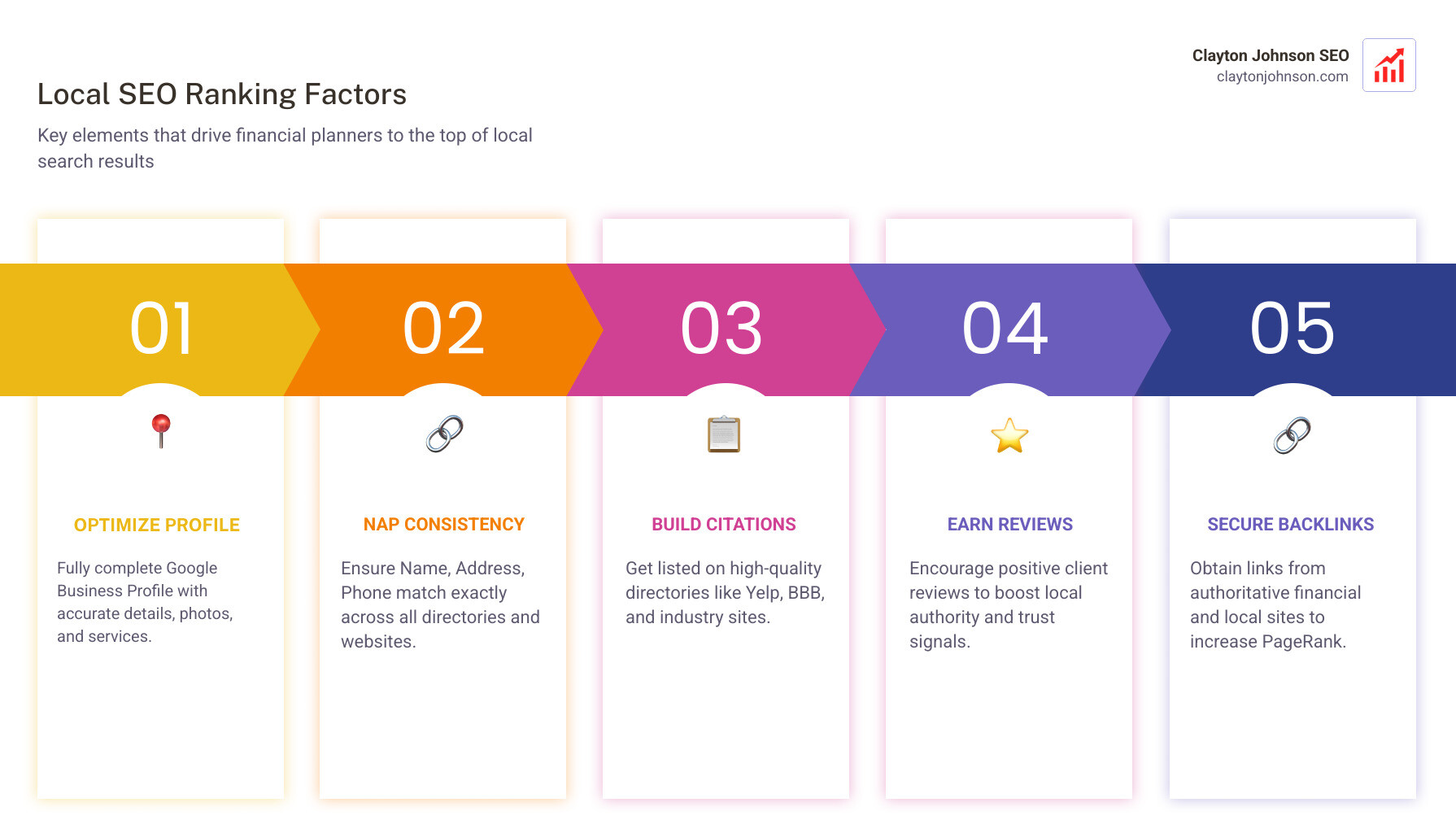
Don’t overlook industry-specific directories. Getting listed on sites like the Financial Planning Association (FPA) or Acuity Scheduling for booking can also provide valuable signals. To see how these pieces fit together to drive actual revenue, read how to rank higher and make your wealth manager SEO pay dividends.
Optimizing for Conversion and Long-Term Growth
Driving traffic is only half the battle. You can have a million visitors, but if your website isn’t configured for conversion, your SEO efforts are wasted. A conversion happens when a visitor takes a specific action that moves them closer to becoming a client—like downloading a guide or booking a call.
At Clayton Johnson SEO, we focus on building “growth engines.” This means your website needs:
- Clear CTAs: “Schedule a Consultation” should be prominent.
- Lead Magnets: Offer a “Retirement Readiness Checklist” in exchange for an email address.
- Trust Signals: Display your CFA or CFP® credentials clearly.
- Engagement Tools: Use tools like Calendly or Kitces Financial AdvisorTech Directory recommended engagement tools to reduce friction.
If you are struggling to turn visitors into leads, our Beginners guide to financial advisor lead generation offers a roadmap for optimization.
Content Marketing and Thought Leadership
Content is the fuel for your Financial advisor SEO strategy. But we aren’t talking about generic, “canned” blog posts. We mean thought leadership. According to industry research, 64% of buyers say thought leadership is a more trustworthy basis for assessing a firm than its marketing materials.
Your content should follow the client journey:
- Awareness: “How much do I need to retire?”
- Consideration: “Roth vs. Traditional IRA: Which is better for high earners?”
- Decision: “What to look for in a fiduciary advisor.”
Repurposing is key here. A single deep-dive webinar can be turned into three blog posts, ten LinkedIn updates, and a video for your YouTube channel. This ensures you are meeting clients where they spend their time—which, for the average user, is 141 minutes (2 hours and 21 minutes) per day on social media. For more specific ideas on how to structure these services, see our page on wealth manager services.
Measuring Success with a Financial advisor SEO strategy
SEO is not a “set it and forget it” tactic. It requires constant monitoring using tools like Google Search Console and Google Analytics. You should be looking at organic sessions, keyword rankings, and, most importantly, conversion rates.

We recommend using premium tools like Semrush, Ahrefs, or SE Ranking to track how you stack up against competitors. SEO takes time. You might see technical improvements in month one, but significant ranking shifts usually take 4 to 6 months.
If you want a professional eye on your data, you can contact Clayton Johnson for a custom SEO roadmap. We specialize in turning these metrics into actionable growth plans.
Compliance and the SEC Marketing Rule
Finally, we must address the elephant in the room: compliance. The financial industry is heavily regulated by FINRA and the SEC. However, the SEC’s Marketing Rule for Investment Advisers-1) has opened new doors.
Advisors can now use testimonials and reviews in their marketing, provided they follow specific disclosure requirements. This is a game-changer for SEO because reviews are a massive local ranking signal. When implementing your Financial advisor SEO strategy, always:
- Include Disclosures: Clearly state if a testimonial was from a client and if they were compensated.
- Avoid Guarantees: Never promise specific investment returns.
- Cite Your Sources: If you mention tax laws, link to the IRS.
By building a system that is both compliant and optimized for search, you create a durable growth engine that works for you 24/7. Clarity leads to structure, and structure leads to compounding growth. That is the Clayton Johnson philosophy.