Why Code Refactoring Is the Secret to Maintainable Software
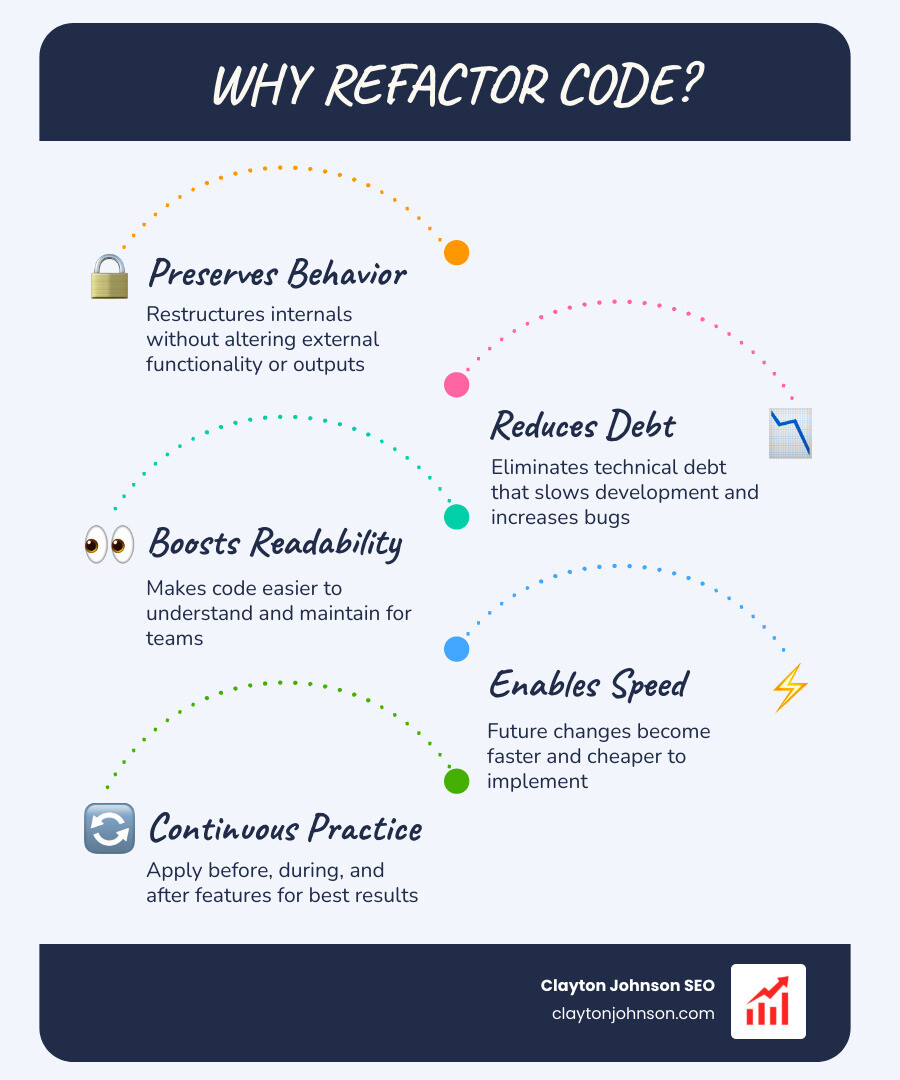
Code refactoring is the process of restructuring existing code to improve its internal design — without changing what the code actually does.
Here’s a quick breakdown of what that means in practice:
- What it is: Cleaning up and reorganizing your code’s structure
- What it doesn’t do: Change the external behavior or functionality
- Why it matters: Reduces technical debt, improves readability, and makes future changes cheaper and faster
- When to do it: Continuously — before, during, and after adding new features
- How to do it safely: In small steps, with automated tests verifying behavior at each stage
Think of it like renovating a house while people still live in it. The layout gets better. The walls stay standing.
Martin Fowler, who literally wrote the book on this topic, defines refactoring as “a change made to the internal structure of software to make it easier to understand and cheaper to modify without changing its observable behavior.”
That last part — without changing observable behavior — is the key. Refactoring is not bug fixing. It’s not adding features. It’s purely about making the code cleaner, simpler, and easier to work with.
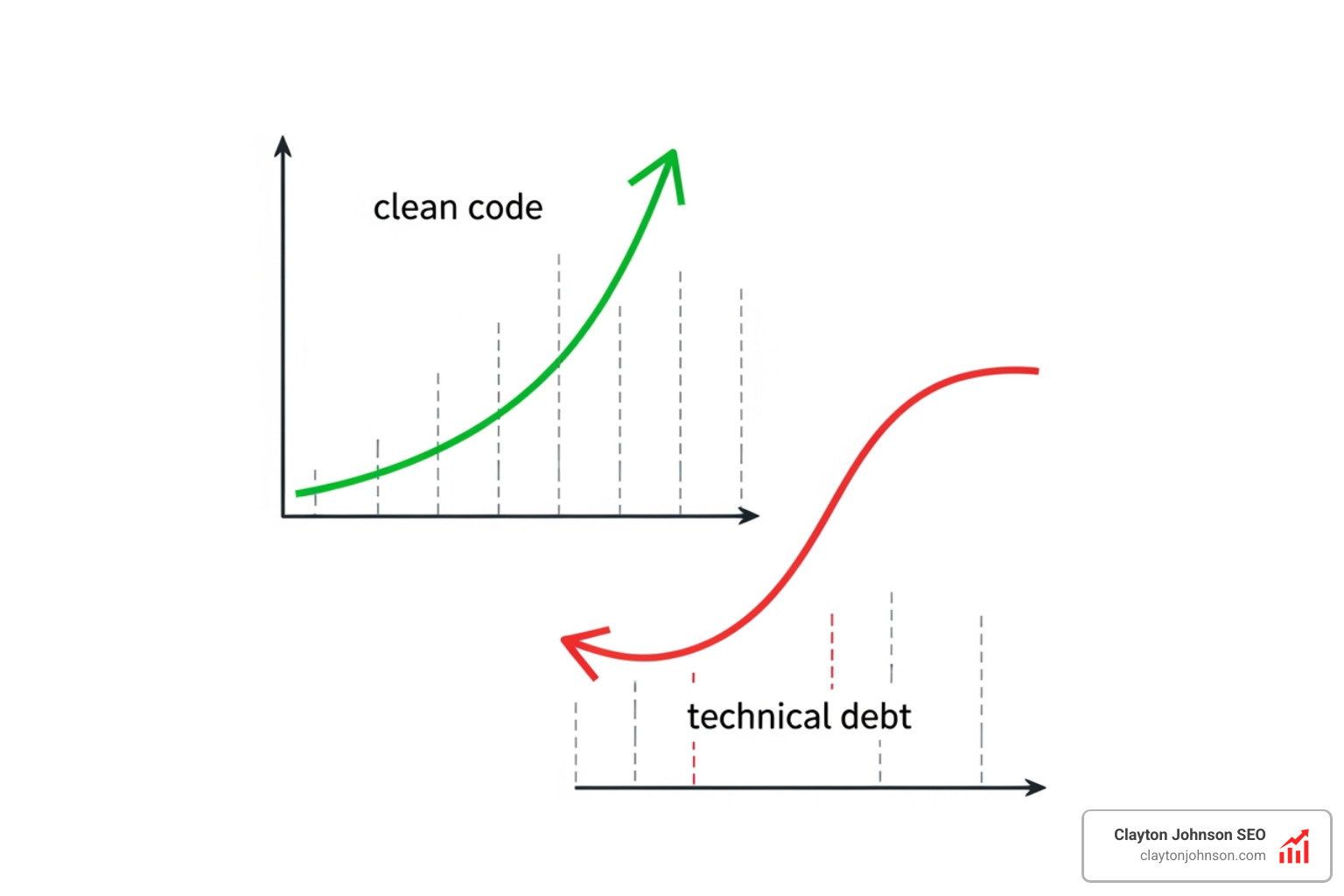
The cost of skipping it adds up fast. Messy code grows messier. Teams slow down. What should take an hour takes a day. That’s technical debt — and it compounds like interest.
The good news? Refactoring is a learnable, repeatable skill. And the earlier you do it, the cheaper it is.
Mastering the Art of Code Refactoring
To truly master code refactoring, we have to embrace a specific mindset. It isn’t just a technical task; it’s a philosophical shift in how we treat our craft. Many developers fall into the trap of “conquering” the code, viewing it as an adversary to be beaten into submission. However, expert practitioners suggest that the best results come when we feel “at one” with the system, treating the code as an extension of our own thought process.
This mindset is often described using the “Two Hats” metaphor. When we are programming, we should only wear one hat at a time:
- The Feature Hat: We are adding new functionality. We might write slightly “dirty” code just to get the logic working.
- The Refactoring Hat: We are strictly improving the internal structure. We do not add features; we only move, rename, and simplify existing logic to improve non-functional attributes like readability and extensibility.
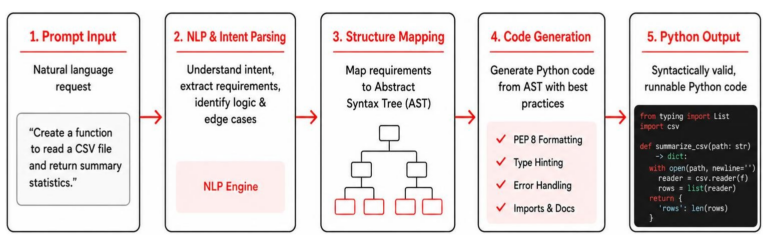
By keeping these activities separate, we preserve behavioral integrity. If we try to change how a function works while we are reorganizing it, we create a recipe for “heisenbugs” that are nearly impossible to track down. For those looking to see how modern technology assists in this transition, check out this guide to AI code generation and review.
What is Code Refactoring?
While the term is used loosely today, code refactoring has a formal academic and professional lineage. The concept was formalized through the work of William Opdyke and Ralph Johnson, eventually reaching the mainstream through Martin Fowler’s seminal book, Refactoring: Improving the Design of Existing Code.
At its core, it is about “factoring” — a term borrowed from mathematics. Just as you factor an equation to make it simpler without changing the result, you factor code to make it cleaner without changing the output. It is a systematic process of design improvement. We aren’t just “cleaning up”; we are applying a catalog of proven techniques to evolve the software.
In the modern era, this process is increasingly supported by AI code review tools that can help identify structural weaknesses that the human eye might miss after a long day of coding.

Identifying Code Smells and Technical Debt
How do we know when it’s time to refactor? We look for “code smells.” A code smell isn’t a bug — the code still works — but it’s a surface indication that there is a deeper problem in the system. If you ignore these smells, you accumulate technical debt.
Technical debt is the “interest” you pay in the form of extra work tomorrow because you took a shortcut today. Research shows that failing to refactor leads to architectural modifications so severe they can eventually require a total system rewrite.
Here are some of the most common smells and how we address them:
| Code Smell | Description | Refactoring Solution |
|---|---|---|
| Bloaters | Methods or classes that have grown to gargantuan proportions. | Extract Method, Extract Class |
| Duplicate Code | The same logic appears in multiple places. | Pull Up Field/Method, Form Template Method |
| Primitive Obsession | Using basic data types (strings, ints) for complex concepts (phone numbers, currency). | Replace Data Value with Object |
| Long Parameter List | A method requires more than 3-4 arguments to function. | Introduce Parameter Object |
| Feature Envy | A method that seems more interested in a different class than the one it’s in. | Move Method |
Identifying these is much easier with the help of free AI coding tools that can highlight complexity scores and repetitive patterns automatically.
The 7-Step Code Refactoring Workflow
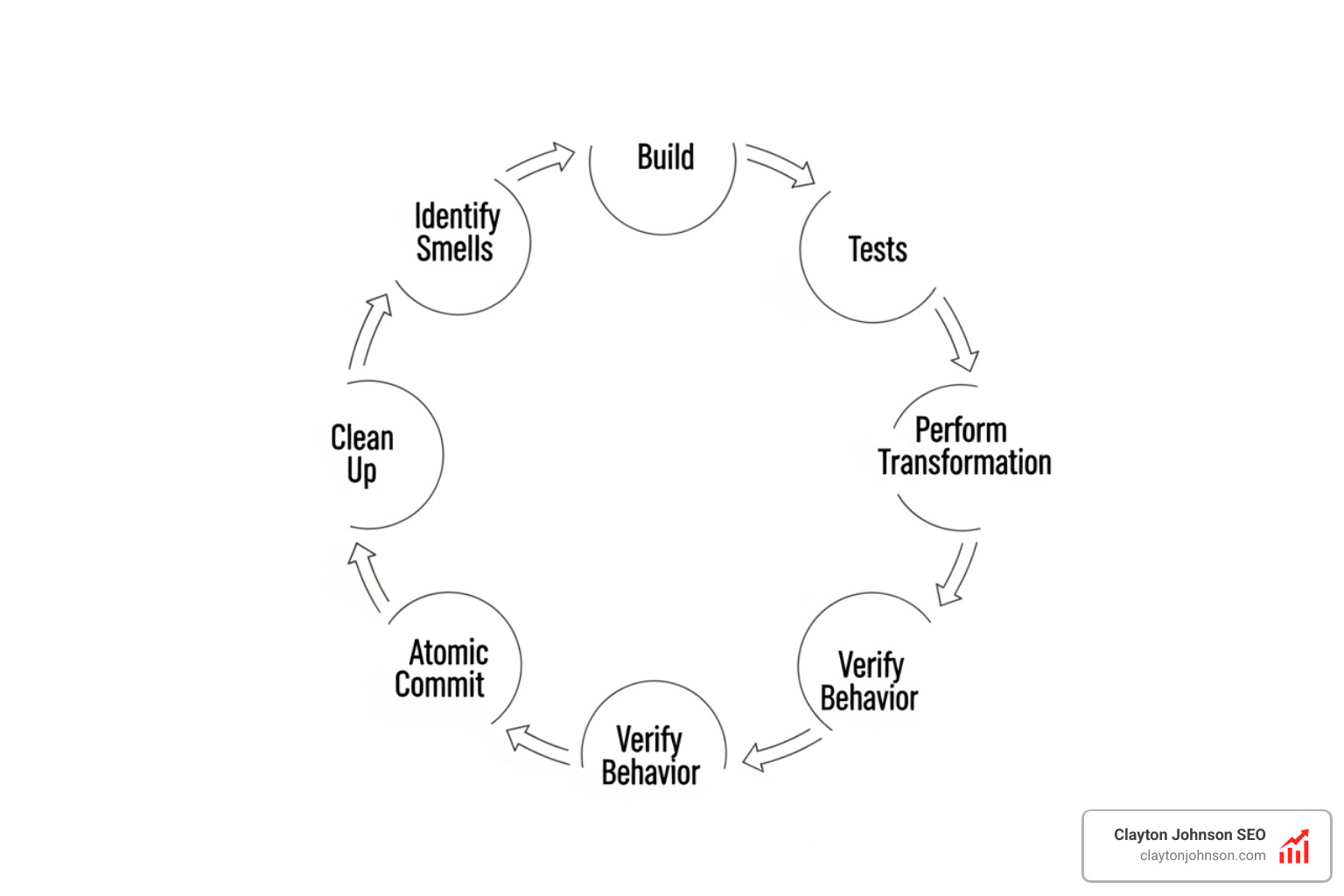
Refactoring should not be a chaotic “search and destroy” mission. To keep the system stable, we follow a disciplined, 7-step circular workflow. This process ensures that we never move too far from a working state.
Step 1: Identify Smells
We begin by scanning the code for the “sniffable” problems mentioned above. Are there methods that require scrolling? Are there variables named x and data2? We pick one specific area to improve.
Step 2: Build (or Verify) Tests
You cannot safely refactor without a safety net. Before touching a single line of production code, we ensure we have automated unit tests that cover the current behavior. If the tests pass now, they must pass after we are done.
Step 3: Perform a Small Transformation
We apply a single “micro-refactoring.” Instead of trying to fix the whole class, we just rename one variable or extract one five-line block into its own method. Small steps are the secret to safety.
Step 4: Verify Behavior
We run our tests. If they turn green, we know our transformation preserved the external behavior. If they turn red, we undo our change immediately. This is the “Red-Green-Refactor” cycle in action.
Step 5: Clean Up
Once the logic is moved and verified, we look for secondary cleanup opportunities. Do we need to update comments? Is there a temporary variable we can now remove?
Step 6: Atomic Commit
We commit this small change to version control. Many experts recommend prefixing these commits with an “R” (e.g., R: Extract printDetails method) to distinguish them from feature changes. This makes the git history much easier to audit.
Step 7: Repeat
We go back to Step 1. We keep iterating until the code is “clean” — meaning it is easy to read, easy to change, and has no obvious smells. For more advanced strategies, you might want to explore mastering AI coding workflows.
Essential Techniques and Micro-Refactorings
While there are dozens of documented refactorings, a few “heavy hitters” do about 90% of the work. Learning these will make you a significantly more efficient developer.
- Extract Method: You have a code fragment that can be grouped together. Turn the fragment into a method whose name explains the purpose of the method.
- Rename Variable/Method: This is the simplest but most powerful refactoring. If a name doesn’t clearly communicate intent, change it.
- Inline Variable: If a variable’s name adds no value over the expression itself (or if it’s just noise), put the expression directly into the code and remove the variable. This is a form of defactoring, which we use to simplify code before we restructure it.
- Encapsulate Field: Make a public field private and provide accessors. This allows you to change how data is stored without breaking every class that uses it.
- Replace Conditional with Polymorphism: If you have a massive
switchstatement orif/elsechain based on an object’s type, use subclasses and overridden methods instead.
If you’re feeling overwhelmed by the manual effort, you can always try code refactoring with Claude AI to handle the tedious parts of the transformation for you.
Tools and AI-Augmented Workflows
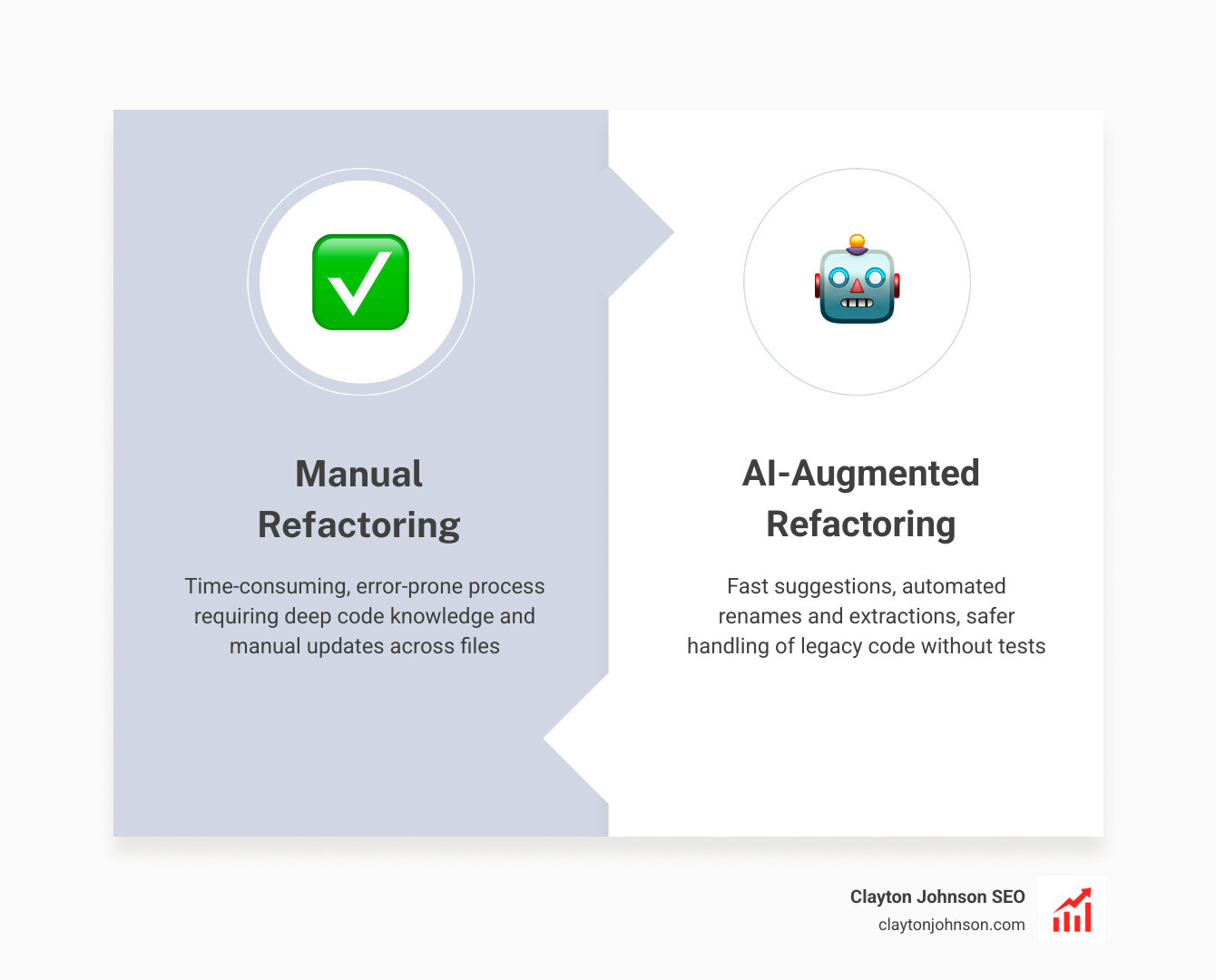
In the past, refactoring was a manual, dangerous process. Today, we have incredible IDE support. Tools like IntelliJ IDEA, Visual Studio, and Eclipse have built-in refactoring engines. You can right-click a method name, select “Rename,” and the IDE will update every single reference across your entire project automatically.
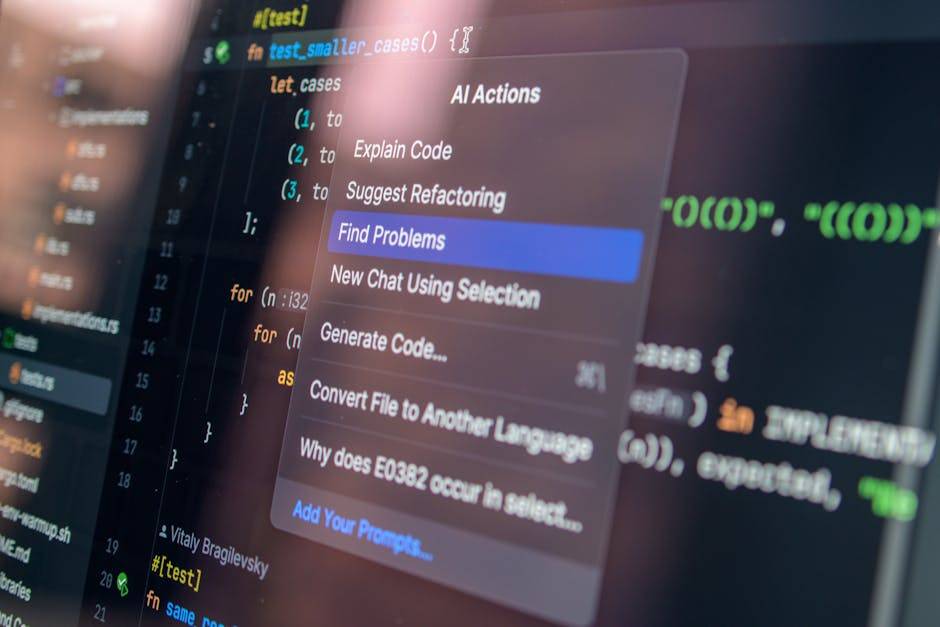
Beyond standard IDEs, we are seeing a massive surge in AI-augmented workflows. Modern developers use generative AI coding tools to suggest refactors during the coding process. These tools act like a pair programmer, pointing out that a block of code could be simplified or that a design pattern could be applied.
Using a Claude AI programming assistant can be particularly effective for “Legacy Code” — code that lacks tests. You can feed the AI a messy function, ask it to explain what it does, and then ask it to generate the unit tests required to refactor it safely.
Risks, Challenges, and the Refactoring Mindset
We must be honest: code refactoring is not without risk. The biggest danger is the introduction of regression bugs. If your test suite is weak, a “cleanup” can easily break a feature that was working perfectly.
Other challenges include:
- Architectural Deterioration: Sometimes, small refactors can lead to a “death by a thousand cuts” where the overall architecture becomes fragmented.
- Team Turnover: When a developer leaves, the “why” behind certain refactors can be lost if they weren’t documented or committed clearly.
- The “If it ain’t broke, don’t fix it” Mentality: Management often views refactoring as a waste of time because it doesn’t result in new features.
To overcome these, we must advocate for a preventive refactoring culture. Instead of waiting for a “Refactoring Sprint” (which rarely happens), we should refactor as a hygienic habit — like washing the dishes while you cook. This keeps the cost of change low and ensures the software remains “soft.”
If your organization is struggling to balance technical debt with growth, exploring professional SEO services can often provide the strategic framework needed to align technical health with business outcomes.
Final Thoughts on Sustainable Code Quality
At Clayton Johnson SEO, we believe that clarity leads to structure, and structure leads to leverage. This philosophy applies just as much to your codebase as it does to your growth strategy. Code refactoring is the “internal linking structure” of your software — it creates the pathways that allow your team to move fast and build authority in your market.
By treating refactoring as a continuous, 7-step process rather than a one-off chore, you turn your technical debt into a compounding growth engine. Your code becomes an asset that accelerates your business, rather than a weight that holds it back.
Whether you are building scalable traffic systems or complex software architectures, the goal is the same: clarity and maintainability.
Ready to build a system that drives measurable impact? We specialize in turning fragmented efforts into coherent growth engines. Contact us for a strategic growth roadmap and let’s start building your durable system today.