What Are Competitive Pressure Examples? (And Why They Matter for Growth)
Competitive pressure examples are real situations where rival businesses force a company to adapt — through lower prices, faster innovation, better service, or all three.
Here are the most common examples you’ll see across industries:
- Netflix vs. Blockbuster — A new entrant disrupted an entire industry by offering a cheaper, more convenient model
- Low-cost airlines vs. legacy carriers — Budget airlines like Ryanair and EasyJet forced incumbents to launch their own budget brands and basic economy fares
- Startups vs. well-funded competitors — Smaller players get undercut on price or see their best features copied by larger rivals
- Generic drugs vs. branded pharmaceuticals — Generics typically enter at 20-40% below branded pricing, forcing incumbents to respond
- Ride-sharing price wars — Uber and Lyft pricing for the same route can vary by more than 50%, driven purely by competitive dynamics
- Mobile telecom new entrants — The arrival of a new mobile operator has been shown to trigger price drops of around 30% across the market
- Nike’s brand differentiation — Facing intense rivalry, Nike competes on identity and innovation rather than price
Competitive pressure isn’t just about price wars. It touches every part of a business — your ability to grow, hold pricing power, and keep customers from switching.
As Michael Porter’s Five Forces model shows, pressure comes from multiple directions at once: existing rivals, new entrants, substitute products, and the bargaining power of buyers and suppliers. Miss one, and you’re reacting instead of leading.
The good news? Companies that understand these forces early can turn pressure into a growth engine — through smarter innovation, sharper positioning, and faster strategic moves than their competitors.
Below, we break down the most instructive competitive pressure examples from real industries, along with what they mean for your business strategy.
Analyzing Competitive Pressure Examples and Market Fundamentals
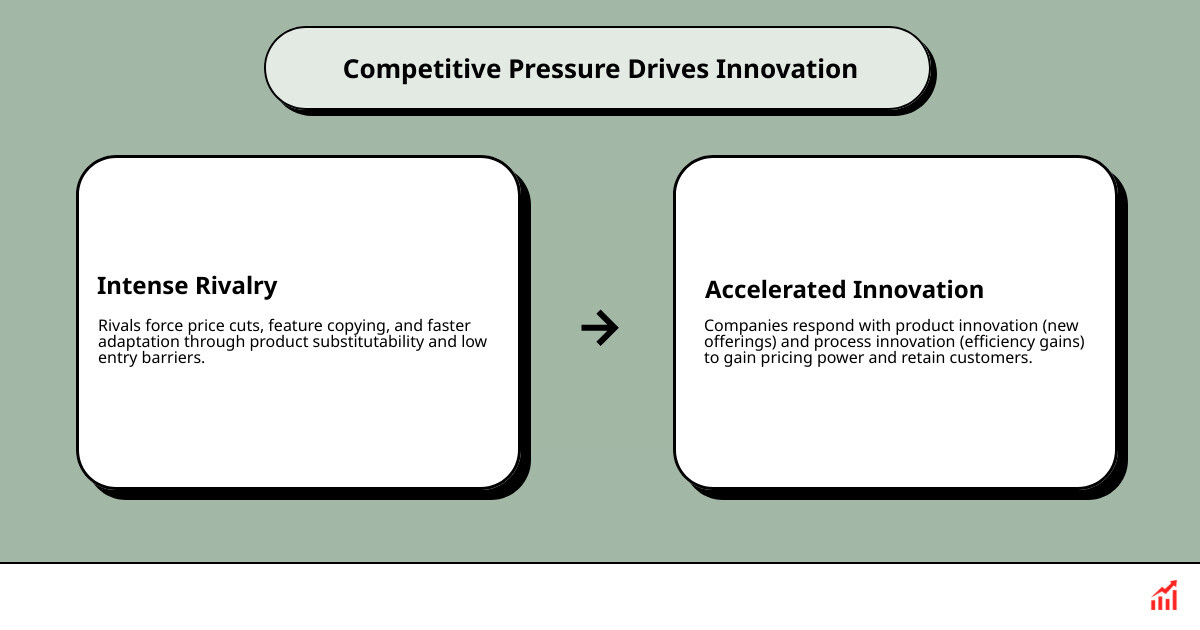
To truly understand how businesses survive, we have to look at the scientific research on the concept of competitive pressure. It isn’t just a vague feeling of “stress” in the boardroom; it’s a measurable economic force driven by specific fundamentals. At its core, competitive pressure is dictated by product substitutability, entry costs, and market size.
When we look at how to think about competitive pressure, we must distinguish between two types of responses: product innovation (creating something new) and process innovation (making the same thing more efficiently).
The Spanish Manufacturing Lesson
Extensive data from Spanish manufacturing firms provides a goldmine of insights into these dynamics. Research covering thousands of firms found a stark contrast in how different sized companies handle pressure:
- Product Innovation: Only 32.2% of small firms (under 200 employees) introduced new products, compared to 57.3% of large firms.
- Process Innovation: This was more common across the board, with 23.6% of small firms and 48.5% of large firms optimizing their internal systems.
Efficiency and Asymmetric Costs
The way a firm responds often depends on its “asymmetric cost structure.” In plain English, if you are an efficient firm with lower marginal costs than your rivals, competitive pressure—specifically high product substitutability—actually gives you a higher incentive to invest in process innovation. You want to widen that lead. Inefficient firms, however, often struggle to keep up with R&D expenditure when margins are squeezed, leading to a “rich get richer” scenario in highly competitive niches.
Real-World Competitive Pressure Examples in Global Industries

The airline industry is perhaps the most famous of all competitive pressure examples. According to scientific research on airline industry price wars, the emergence of low-cost carriers (LCCs) didn’t just lower prices; it fundamentally re-architected the business models of legacy giants.
- Low-Cost Carriers: Airlines like Ryanair and Southwest stripped away every “extra” to lower the entry cost for travelers.
- Legacy Response: Major carriers didn’t just sit back. They introduced “basic economy” fares—a direct process innovation designed to compete on price while maintaining their premium brand for business travelers.
- Industry Consolidation: Often, when the pressure becomes too great, firms merge. We see this in airlines and retail as a way to gain market power and alleviate the relentless downward pressure on fares.
Another classic example is Netflix vs. Blockbuster. Blockbuster faced the “Threat of Substitutes” (one of Porter’s Five Forces). Netflix offered a substitute that eliminated the physical distance factor and late fees. Blockbuster’s failure to adapt to this specific competitive pressure remains the ultimate cautionary tale for incumbents.
In the tech space, consider a hypothetical “Quantum Phones” entering a market dominated by Apple and Samsung. To survive, the new entrant must either undercut on price (leading to market saturation) or offer a radical product innovation that the giants can’t easily replicate.
How Startups Navigate Competitive Pressure Examples
Startups live in a permanent state of high pressure. Unlike established firms, they often face “well-funded competitors” who can afford to lose money just to win market share.
| Response Factor | Efficient Firm (Leader) | Inefficient Firm (Laggard) |
|---|---|---|
| Product Innovation | High incentive to differentiate | Low incentive; focus on survival |
| Process Innovation | High incentive to cut costs further | Struggling to maintain current costs |
| Price Wars | Can sustain longer | Forced to exit or pivot |
| Feature Copying | Rapidly iterates | Reactive and slow |
When a larger company copies a startup’s features—a common occurrence in the SaaS world—the startup must maintain an incredible innovation pace. We’ve seen this with founders like Dwayne Caldwell and Jenn Knight, who emphasize that strategic frameworks for competitive analysis are vital for survival.
Startups like Shiftkey demonstrate that navigating pressure requires focusing on customer acquisition and retention strategies that big players overlook. While a giant might have the funding, the startup often has the “marginal incentive” to provide better niche service.
Measuring Pressure Beyond Price-Cost Margins

How do you actually measure if the pressure is rising? Many managers look at price-cost margins, but these can be misleading. If a firm is highly innovative and lowers its costs, its margin might stay high even though competition is fierce.
Instead, we use more sophisticated tools:
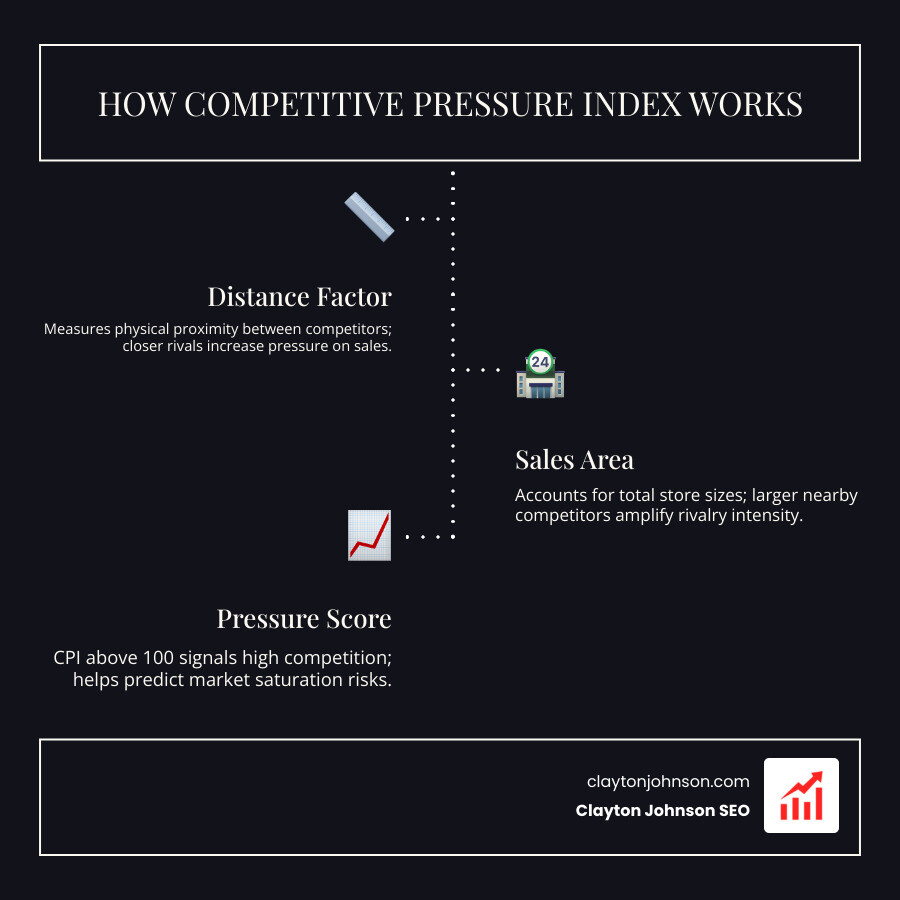
- Competitive Pressure Index (CPI): Especially useful in retail, the CPI looks at the competitive pressure index by factoring in the physical distance between competitors and their total sales area. A CPI above 100 indicates higher-than-average pressure.
- Herfindahl-Hirschman Index (HHI): This measures market concentration. A high HHI means a few firms dominate, while a low HHI suggests many small players are fighting for scraps.
- Porter’s Five Forces: This remains the gold standard for market analysis and Porter’s Five Forces. It helps you see pressure from suppliers and buyers, not just direct rivals.
Strategic Frameworks for Overcoming Market Rivalry
If you’re feeling the heat, you need a system. At Clayton Johnson, we focus on building durable growth engines that don’t just react to the market but shape it. You can contact Clayton Johnson for a strategic roadmap to see how these frameworks apply to your specific industry.
The Three Pillars of Competitive Strategy
According to Michael Porter, there are three generic ways to handle competitive pressure examples:
- Cost Leadership: Being the low-cost producer (think Walmart or Amazon). This requires relentless process innovation.
- Differentiation: Creating a product that is perceived as unique (think Apple or Nike). This protects you from price undercutting because customers want your specific brand.
- Focus Strategy: Zeroing in on a narrow niche where you can serve customers better than the generalists.
We believe in building competitive analysis strategies that leverage AI-augmented workflows to spot competitor moves before they happen.
The Impact of Product Substitutability on Innovation
One of the most counter-intuitive findings in scientific research on competitive pressure and innovation is that high product substitutability (when customers can easily switch to a rival) actually decreases the likelihood of product innovation by about 17.2%.
Why? Because if your new product will just be copied or substituted immediately, the “prize” for innovating is smaller. However, this same pressure increases the incentive for process innovation among efficient firms. They realize they can’t easily win on “newness,” so they win on “cheapness” and “efficiency.”
Market Enlargement as a Catalyst for Growth
On the flip side, when a market expands, everyone wins. Scientific research on market expansion effects shows that firms in “expansive” markets are 4.3% more likely to introduce new products and 8.8% more likely to improve their processes.
Lowering export tariffs is a classic example of market enlargement. When tariffs fall, non-exporters often rush to innovate so they can enter the new, larger market. This creates a virtuous circle of economic growth.
Building Durable Systems Against Feature Replication

How do you stop a giant from eating your lunch? You build an ecosystem.
- Nvidia: They don’t just sell chips; they sell a software ecosystem (CUDA) that makes it very hard for customers to switch to a competitor. This is a “strategic asset” that creates a durable barrier.
- Patagonia: By focusing on “responsible consumption” and campaigns like “Don’t Buy This Jacket,” they built a brand reputation that is almost impossible to replicate. Even if a rival makes a better jacket, they don’t have the Patagonia “soul.”
- Basecamp: They target the “Fortune 5,000,000″—small businesses that don’t want the complexity of enterprise tools. By staying focused on this niche, they avoid the direct pressure of giants like Microsoft.
- Beauty Pie: They disrupted the cosmetics industry by cutting out middlemen, offering premium products at 70% lower prices through a membership model. This is a radical process innovation that established players struggle to copy without destroying their own retail relationships.
Conclusion: Turning Pressure into Leverage
Competitive pressure is the “gravity” of the business world—it’s always there, and it’s always pulling you down. But just as engineers use gravity to create energy, smart operators use competitive pressure examples to fuel their own innovation.
Whether you are a startup facing price undercutting or a large firm dealing with market saturation, the key is to move from a reactive posture to a systematic one. By understanding the fundamentals of substitutability, entry costs, and market size, you can choose the right path—whether that’s a focus on cost leadership or a doubling down on brand differentiation.
At the end of the day, the firms that thrive aren’t the ones that avoid pressure; they are the ones that build systems to handle it better than anyone else. Clarity, structure, and leverage are the tools that turn market rivalry into compounding growth.