How to Make Your Psychiatry Practice the Top Result Near Me

Why Most Psychiatrists Are Invisible Online — And How to Fix It
SEO for psychiatrists near me is the process of optimizing your practice’s online presence so that patients searching locally can find you first on Google.
Here’s a quick overview of what it involves:
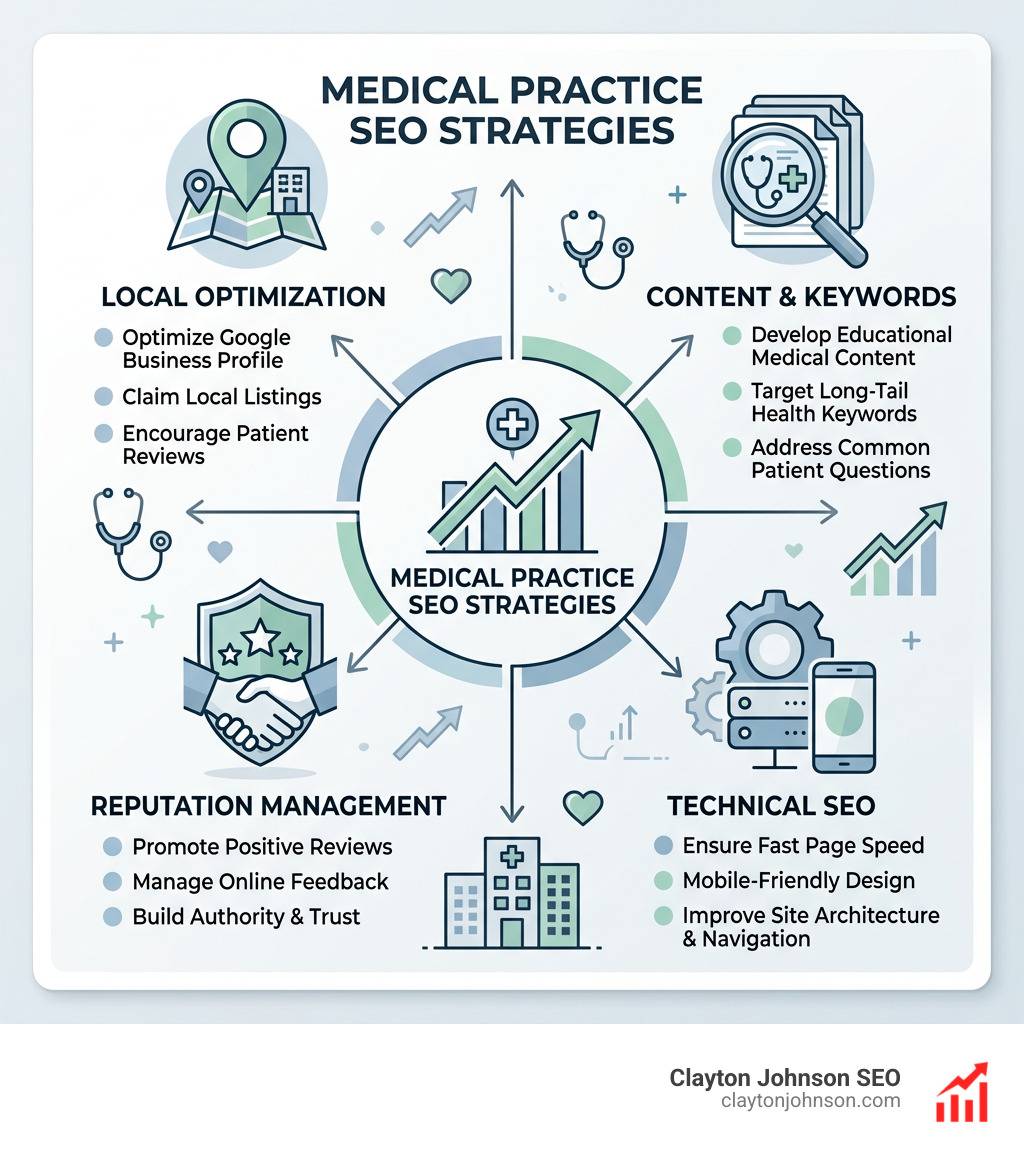
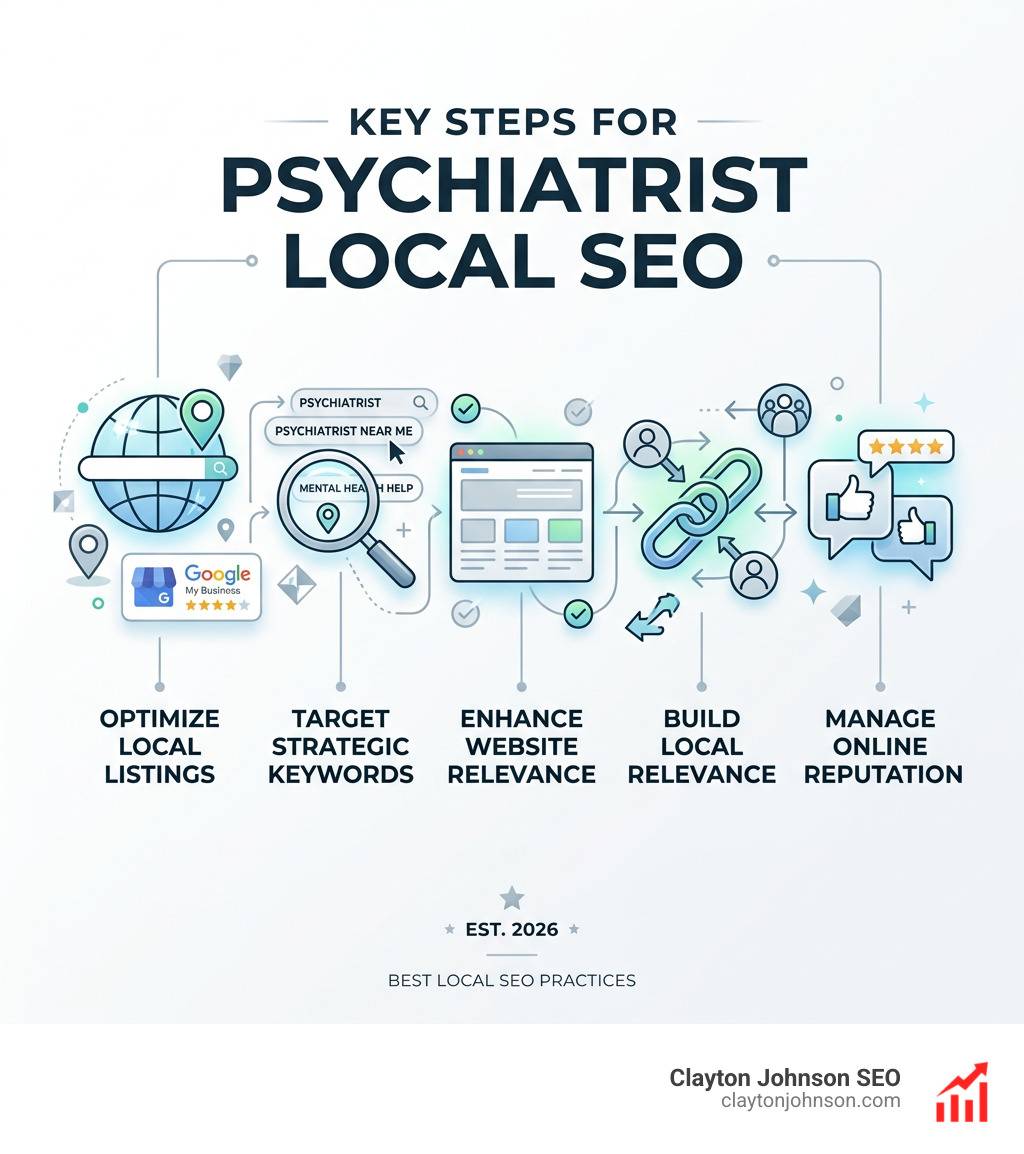
- Optimize your Google Business Profile — correct category, accurate address, photos, and regular updates
- Target local keywords — like “psychiatrist near me” or “anxiety medication management in your city”
- Build local citations — consistent name, address, and phone number across directories like Psychology Today and Healthgrades
- Earn patient reviews — ethically and consistently
- Create helpful content — blog posts and service pages that answer patient questions
- Fix technical issues — mobile speed, SSL security, and clean site structure
Every minute, 70,000 healthcare searches happen on Google. People are actively searching for help right now — often in a vulnerable moment, from their phone, looking for someone nearby they can trust.
The problem? 92% of all clicks go to results on the first page. If your practice isn’t there, those patients are booking with someone else.
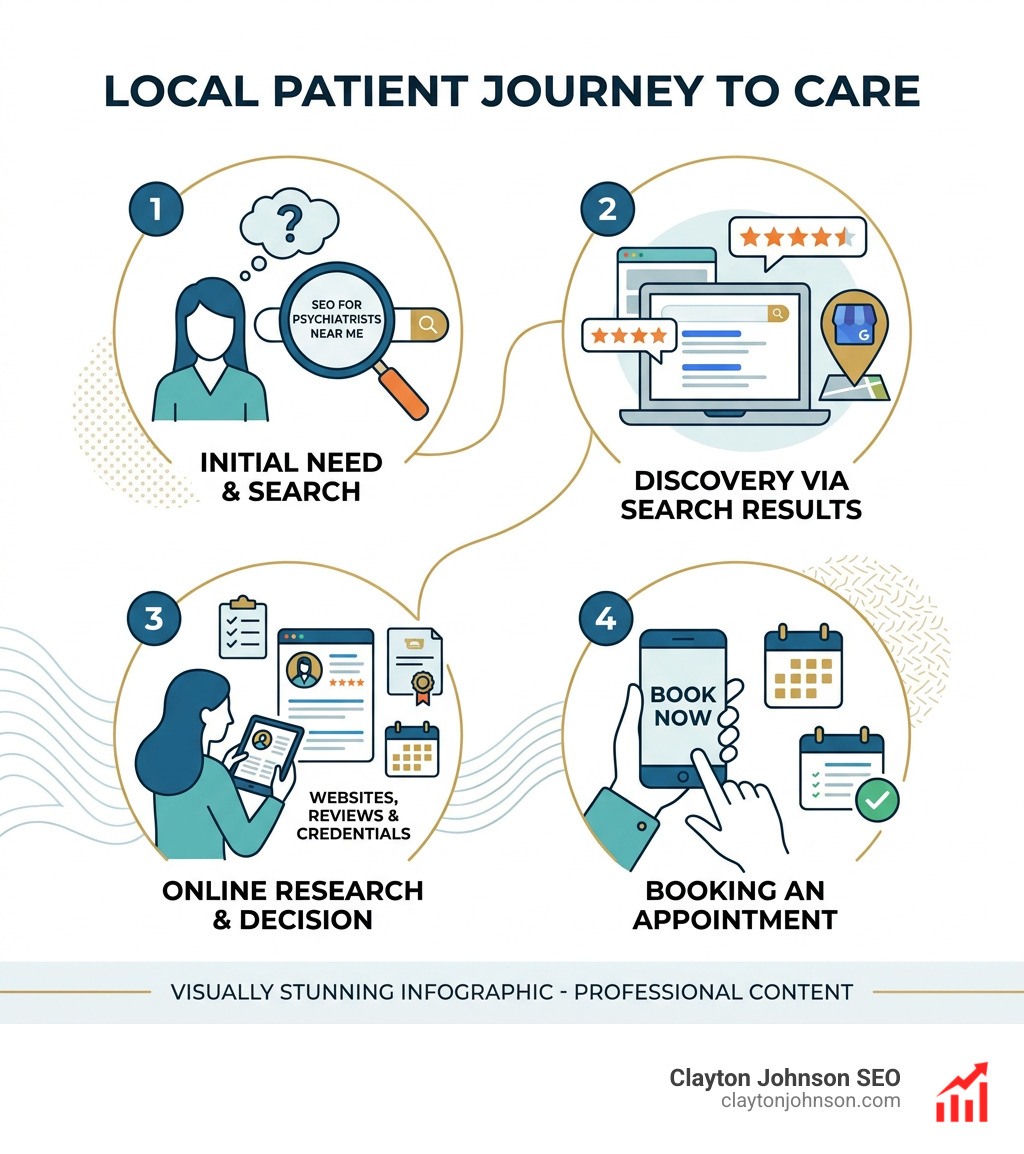
Most psychiatrists still rely on referrals and word-of-mouth. That’s not enough to grow. The patient journey now starts with a Google search — not a phone call to a primary care doctor.
The good news: local SEO is one of the most reliable ways to change this. Done right, it builds a steady stream of high-intent leads — people who are already looking for exactly what you offer.
Why Local SEO is the Foundation of Modern Psychiatric Practice Growth
In the past, a psychiatrist might have stayed busy purely through hospital referrals or a listing in the Yellow Pages. Today, the landscape has shifted entirely. With 70,000 healthcare searches performed every minute, the internet is the new front door to your clinic.
Local SEO isn’t just about being “online”; it’s about being visible at the exact moment a patient needs help. When someone types a query into Google, they are expressing high intent. If they search for a specialist in their city, they aren’t just browsing—they are looking to book an appointment.
We know that 92% of all clicks happen on the first page of search results. If you aren’t in those top ten spots, you are effectively invisible to the vast majority of your potential patient base. By mastering SEO 101 basics, we can move your practice from the shadows into the spotlight. This isn’t just about traffic; it’s about building digital authority so that when a patient sees your name, they see a trusted medical professional.
The Difference Between SEO for Psychiatrists vs. Therapists
While the terms are often used interchangeably by the public, Google treats “psychiatrist” and “therapist” differently. As a psychiatrist, your SEO strategy must reflect your medical credentials. Google places medical websites into a category called “Your Money or Your Life” (YMYL), meaning it holds your content to much higher E-E-A-T standards (Experience, Expertise, Authoritativeness, and Trustworthiness).
Your website needs to highlight your ability to provide medication management and medical diagnoses. Including resources like Psychiatric Practice Forms and clear information on insurance verification helps signal to both Google and patients that you are a legitimate clinical authority. Unlike general counseling, psychiatric SEO focuses heavily on specific medical conditions and the biological side of mental health.
Understanding the “Near Me” Search Intent for Mental Health
The phrase “near me” has exploded in search volume. This is driven by mobile-first indexing—Google knows exactly where the user is located and prioritizes the closest, most relevant options. For mental health, this often signals an urgent need or a desire for a long-term local provider.
To capture this traffic, we use Minneapolis SEO strategies (or strategies tailored to your specific city) to ensure you appear in the “Local 3-Pack”—the map results that appear at the top of the page. Geographic relevance is the primary ranking factor here. If your practice is five miles away but your digital presence is weak, Google might show a practice ten miles away that has better-optimized local signals.
Optimizing Your Google Business Profile for SEO for psychiatrists near me
Your Google Business Profile (GBP) is arguably the most important asset for SEO for psychiatrists near me. It is the digital version of your office sign. If this profile is incomplete or inaccurate, you are losing patients before they even click on your website.
To dominate local search, we must ensure NAP consistency—your Name, Address, and Phone number must be identical across the entire web. Even a small discrepancy (like “Suite 100” vs. “#100”) can confuse Google’s crawlers. Selecting the correct primary category—”Psychiatrist”—is non-negotiable. From there, we optimize your service area and business description to include local modifiers that signal your presence to people within a 5-mile radius. For those looking for comprehensive SEO services for growth, the GBP is always the starting line.
Leveraging Reviews and Reputation Management
Reputation is everything in medicine. Research shows that 71% of patients research reviews online before choosing a new provider. For a psychiatrist, reviews serve as powerful trust signals.
However, reputation management in mental health requires a delicate touch. You must remain HIPAA-compliant at all times. This means you should never confirm that a reviewer is a patient in your public responses. Instead, respond with a professional, generalized statement. We recommend an ethical review acquisition strategy—encouraging satisfied patients to share their experiences without coercion. A practice with a 4.8-star rating and 50 reviews will almost always outrank a practice with a 5.0 rating and only two reviews.
Strategic Keyword Placement for SEO for psychiatrists near me
Keywords are the bridge between a patient’s problem and your solution. We don’t just target “psychiatrist.” We look for long-tail keywords that reflect specific patient needs. For example, someone might search for “best psychiatrist for anxiety in your city” or “child psychiatrist near me.”
By integrating terms related to specific treatments, such as Anxiety Worksheets or medication management, we match the user’s specific search intent. This approach is a core part of mastering core SEO, as it targets lower-competition, high-conversion phrases rather than just broad, expensive terms.
On-Page and Technical SEO Systems for Psychiatric Websites
Your website needs to be more than just a digital brochure; it needs to be a high-performance engine. Technical SEO ensures that search engines can read your site, while on-page SEO ensures that humans want to stay on it.
| Factor | On-Page SEO | Technical SEO |
|---|---|---|
| Focus | Content, Keywords, Meta Tags | Site Speed, Indexing, Security |
| Goal | User Relevance & Engagement | Search Engine Crawlability |
| Examples | Blog posts, Service pages | SSL, Mobile-friendliness |
We prioritize mobile responsiveness because the majority of “near me” searches happen on smartphones. If your site takes more than three seconds to load, you’ve likely lost the patient. Using tools like Google PageSpeed Insights allows us to identify and fix bottlenecks. Furthermore, because you handle sensitive data, HIPAA-compliant hosting and secure SSL certificates are mandatory for building trust with both users and Google. Our AI-driven SEO systems help automate the monitoring of these technical factors so your site never falls behind.
Content Marketing and Blogging for SEO for psychiatrists near me
Blogging is one of the most underutilized tools in psychiatric marketing. By creating educational content—such as articles on “How to know if you need medication” or providing Depression Worksheets—you answer the questions patients are asking before they even decide to book.
This strategy helps you rank in the AI overview by providing clear, authoritative answers to complex medical questions. We use topic clusters—grouping related articles around a main service page—to build deep topical authority. This internal linking structure tells Google that you aren’t just a local business, but a subject matter expert.
Building Backlinks and Local Citations
Backlinks are like “votes” from other websites. For psychiatrists, the most valuable links come from trusted healthcare directories. Being listed on the Psychology Today directory, Healthgrades, and Zencare provides a massive boost to your domain authority.
Beyond directories, we look for local media outreach opportunities and citations in local business organizations. These signals confirm to Google that you are a prominent member of your local community. Additionally, integrating social media SEO systems helps distribute your content and generate secondary traffic signals that support your primary search rankings.
Measuring Success and Avoiding Common Local SEO Mistakes
You cannot manage what you do not measure. We use data to turn fragmented marketing into a coherent growth engine.
The ultimate metric isn’t just “traffic”—it’s conversions. Since 64% of patients book via a provider’s website, we track how many visitors actually click your “Book Appointment” button. We also watch for common mistakes like keyword stuffing (overloading your text with keywords until it sounds robotic) or neglecting your mobile user experience. By auditing SEO with AI, we can quickly spot these errors and pivot our strategy to ensure a high ROI.
Frequently Asked Questions about SEO for psychiatrists near me
How long does it take to see results from local SEO?
SEO is a marathon, not a sprint. Typically, you will see initial movement in your rankings within 3 to 6 months. However, the real “compounding growth” usually kicks in between 6 and 12 months. The competitive landscape of your specific city will dictate the exact timeline. For a faster understanding of the modern landscape, check out our no-nonsense guide to AI SEO.
Can I manage my own SEO or should I hire an agency?
While a solo practitioner can manage basic tasks like updating a Google Business Profile or writing an occasional blog post, scaling a practice requires technical depth. Agencies provide the systems and tools needed to handle technical architecture, backlink building, and data analysis at scale. It comes down to resource allocation: is your time better spent treating patients or debugging site code?
Is SEO ethical for psychiatric practices?
Absolutely. SEO is simply a way to ensure that people in need of help can find a qualified professional. As long as you maintain patient privacy, adhere to HIPAA regulations, and provide honest, helpful content, SEO is a vital service to your community. It bridges the gap between a person in crisis and the care they deserve.
Conclusion
Building a top-ranking psychiatry practice isn’t about “tricking” Google; it’s about building a durable system of clarity and structure. At Clayton Johnson SEO, we focus on the intersection of technical architecture and search intent to create compounding growth for medical professionals.
By optimizing your local presence and providing high-value content, you stop chasing leads and start building an authority-driven practice. If you are ready to turn your marketing efforts into a coherent growth engine, it’s time to scale your medical practice with a strategy built for the long term. Let’s make sure that when a patient searches for help, your practice is the first hand they reach for.