Why AI-Powered Competitive Analysis Is Reshaping SEO Strategy
SEO AI competitive analysis transforms how brands discover ranking opportunities, close content gaps, and win visibility in both traditional search and AI-generated answers. Instead of manual spreadsheets and guesswork, AI tools now process millions of data points—from keyword gaps to backlink profiles to brand mentions in ChatGPT responses—and surface actionable insights in minutes.
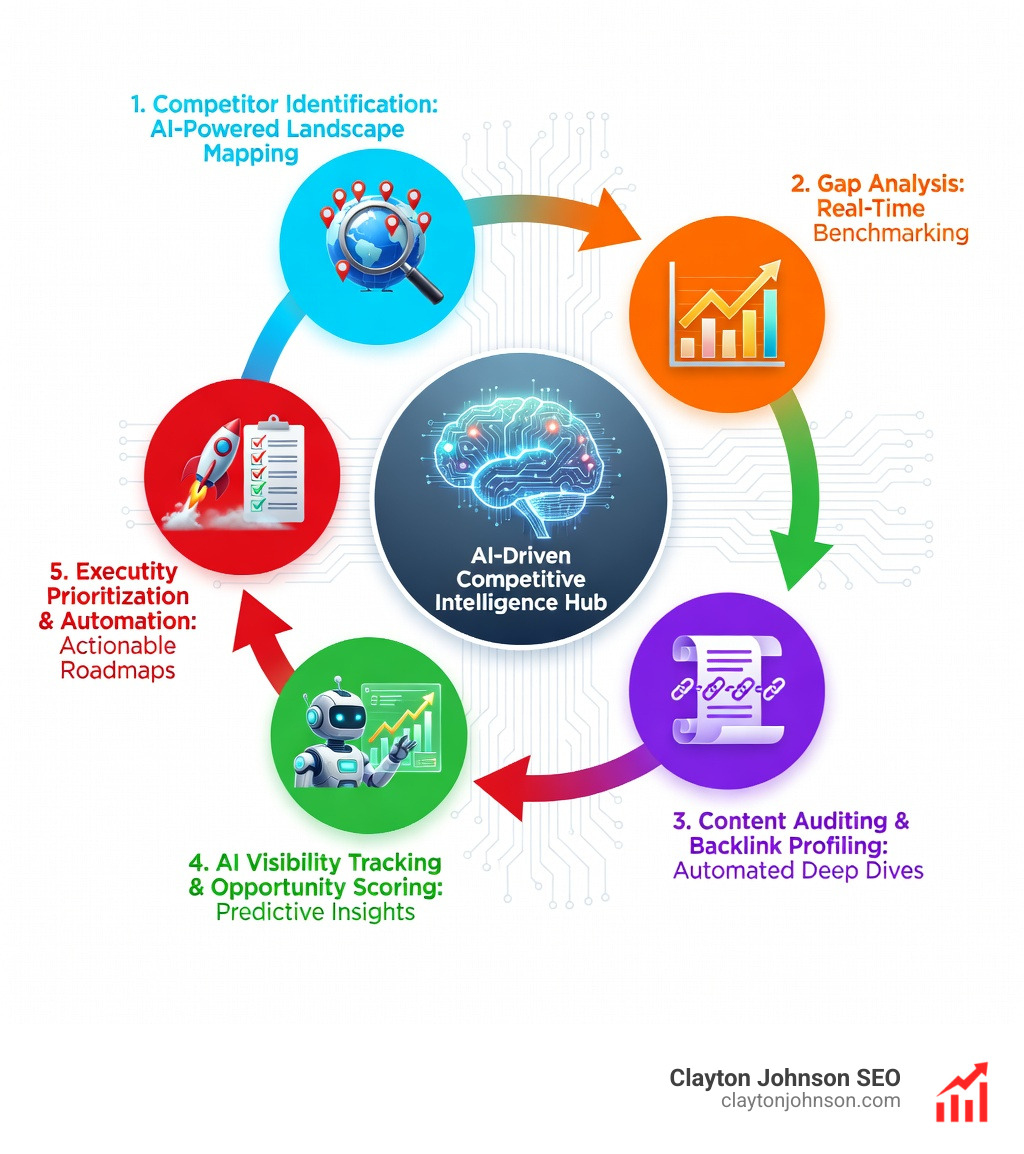
Quick Answer: How to Conduct SEO AI Competitive Analysis
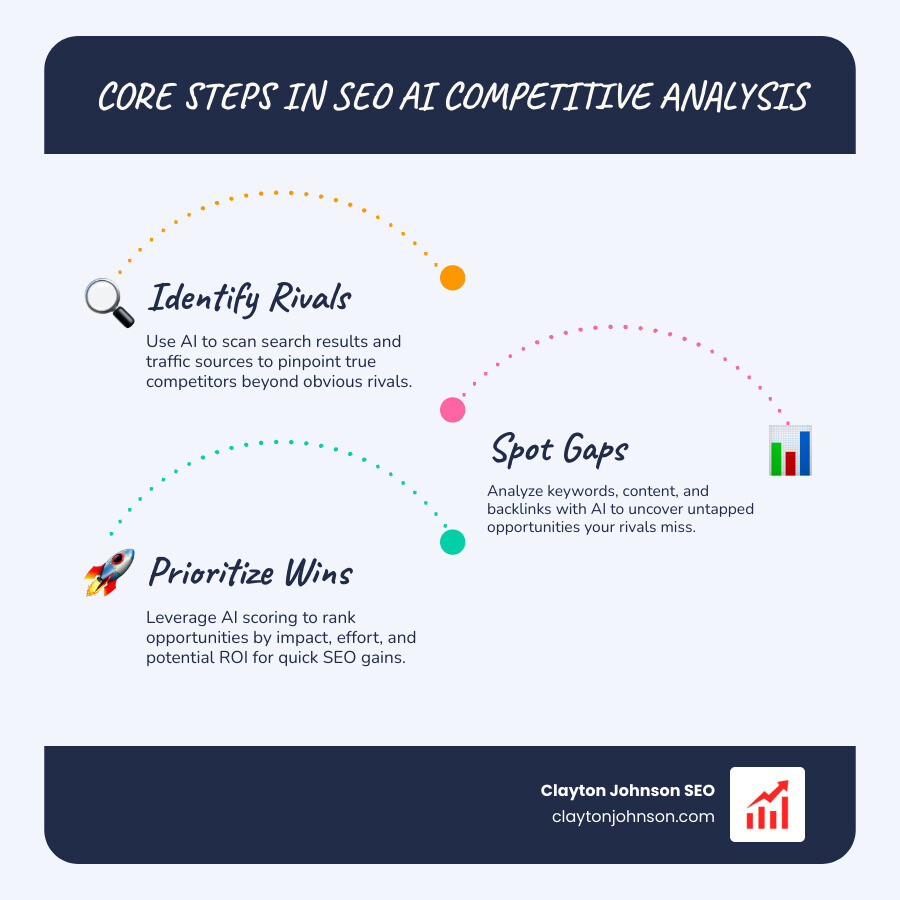
- Identify true SEO competitors using SERP analysis and AI tools (not just business rivals)
- Run keyword gap analysis to find missing, underperforming, and quick-win opportunities
- Analyze competitor content using quality scorecards and reverse-engineered briefs
- Audit backlink profiles to discover link-building targets and broken link opportunities
- Track AI visibility across platforms like Google SGE, ChatGPT, and Perplexity
- Score opportunities using impact, competitive advantage, and effort frameworks
- Execute with priority on 30-day quick wins and 90-day strategic initiatives
The competitive landscape has shifted dramatically. With 92% of global traffic coming from Google and AI-generated answers now appearing above traditional results, brands must compete on two fronts simultaneously. Traditional rank tracking misses half the picture—you need to know where competitors earn citations in AI responses, which topics they own, and how their content strategies create compounding advantages.
Yet most teams still rely on quarterly manual audits that are outdated before the first insight lands. Only 2.2% of content published online generates more than one unique backlink, and 75% of users never scroll past the first page—which means every ranking gap represents lost revenue, and every delayed response to a competitor’s move compounds that loss.
The research is clear: businesses using AI-driven competitive analysis identify opportunities faster, prioritize better, and execute with measurable results. They don’t just track what competitors rank for—they understand why, reverse-engineer the playbook, and build something demonstrably better.
I’m Clayton Johnson, and I’ve spent years building SEO systems that turn fragmented competitive intelligence into structured growth engines, leveraging SEO AI competitive analysis to help brands move from reactive monitoring to proactive market advantage. This guide will show you exactly how to do the same.
SEO AI competitive analysis terms at a glance:
Why SEO AI Competitive Analysis Is Essential in the Modern Era
In the early days of search, we could get away with checking a few keywords once a month. Today, search results shift hourly. AI answer engines compress vast amounts of information into single paragraphs, often bypassing the traditional “blue links” entirely. If we aren’t using SEO AI competitive analysis, we’re essentially flying blind in a storm.
The stakes are high. Consider these realities of the modern search landscape:
- Organic search accounts for 53% of website traffic, making it the second-highest channel after direct visits.
- 75% of users never scroll past the first page, so if a competitor takes your spot, they aren’t just winning—they’re making you invisible.
- 90% of web pages get no search traffic from Google at all. Without a data-driven strategy to break into the top 10%, your content is likely shouting into a void.
AI revolutionizes this process by moving beyond static reports. It allows us to understand the truth about ai seo and why it matters by analyzing user intent at scale. Instead of just seeing that a competitor ranks, AI helps us understand the intent clusters they are dominating and predicts their next moves.
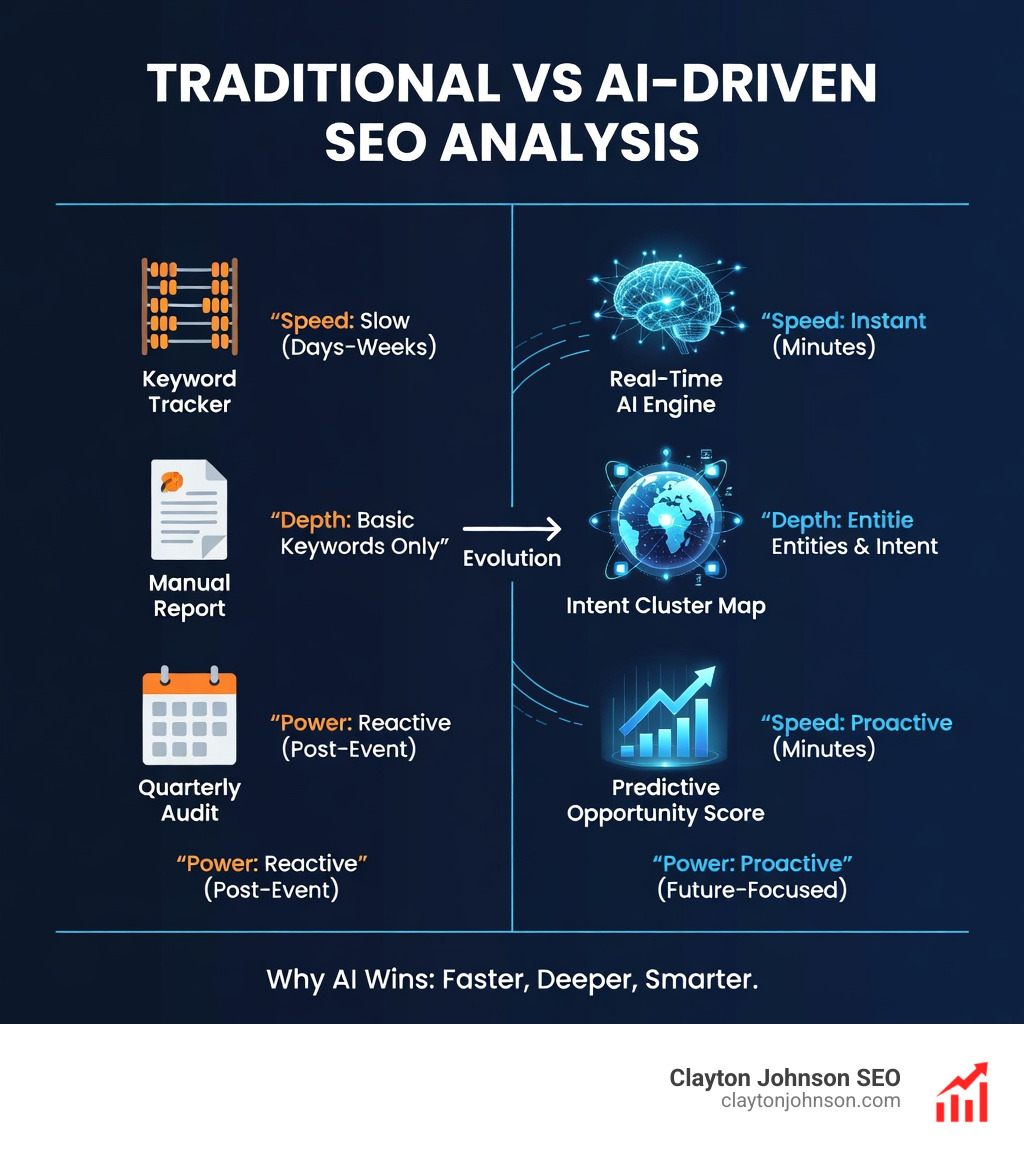
| Feature | Traditional Analysis | AI-Driven Analysis |
|---|---|---|
| Speed | Manual, takes days/weeks | Real-time, takes minutes |
| Data Depth | Surface-level keywords | Entity mapping & intent clusters |
| Predictive Power | Reactive (what happened) | Proactive (what will happen) |
| Content Insight | Word count & keyword density | Semantic richness & E-E-A-T signals |
| Visibility | SERP rankings only | LLM mentions & SGE citations |
Identifying Your True Rivals with SEO AI Competitive Analysis
A common mistake we see is brands focusing only on their business rivals. If you’re a local bakery in Minneapolis, your business competitor is the shop down the street. However, your SEO competitor for “how to make sourdough bread” might be a massive food blog, a yeast manufacturer, or even Wikipedia.
To win, we must identify our true SEO rivals—the domains currently capturing the attention of our target audience. AI makes this identification process seamless by using ai competitive insights to outsmart your rivals.
How to Find Your Real Rivals
- Manual SERP Deep Dives: Search for your top 10-15 keywords in incognito mode. Note which domains appear consistently.
- Domain Authority & Audience Overlap: Use tools like Semrush or Ahrefs to find domains that share the highest percentage of your keyword universe.
- Entity Mapping: AI can identify which brands are “entities” that Google associates with your niche. If Google thinks a certain brand is an authority on “SEO services,” you need to know why.
By categorizing competitors into groups—Direct Business, Authority Publications, Niche Specialists, and Emerging Players—we can tailor our offensive and defensive strategies.
A Step-by-Step Framework for Keyword and Content Gaps
Once we know who we’re fighting, we need to find where they are winning and we are losing. This is where we stop letting your rivals win with a competitive content gap finder.
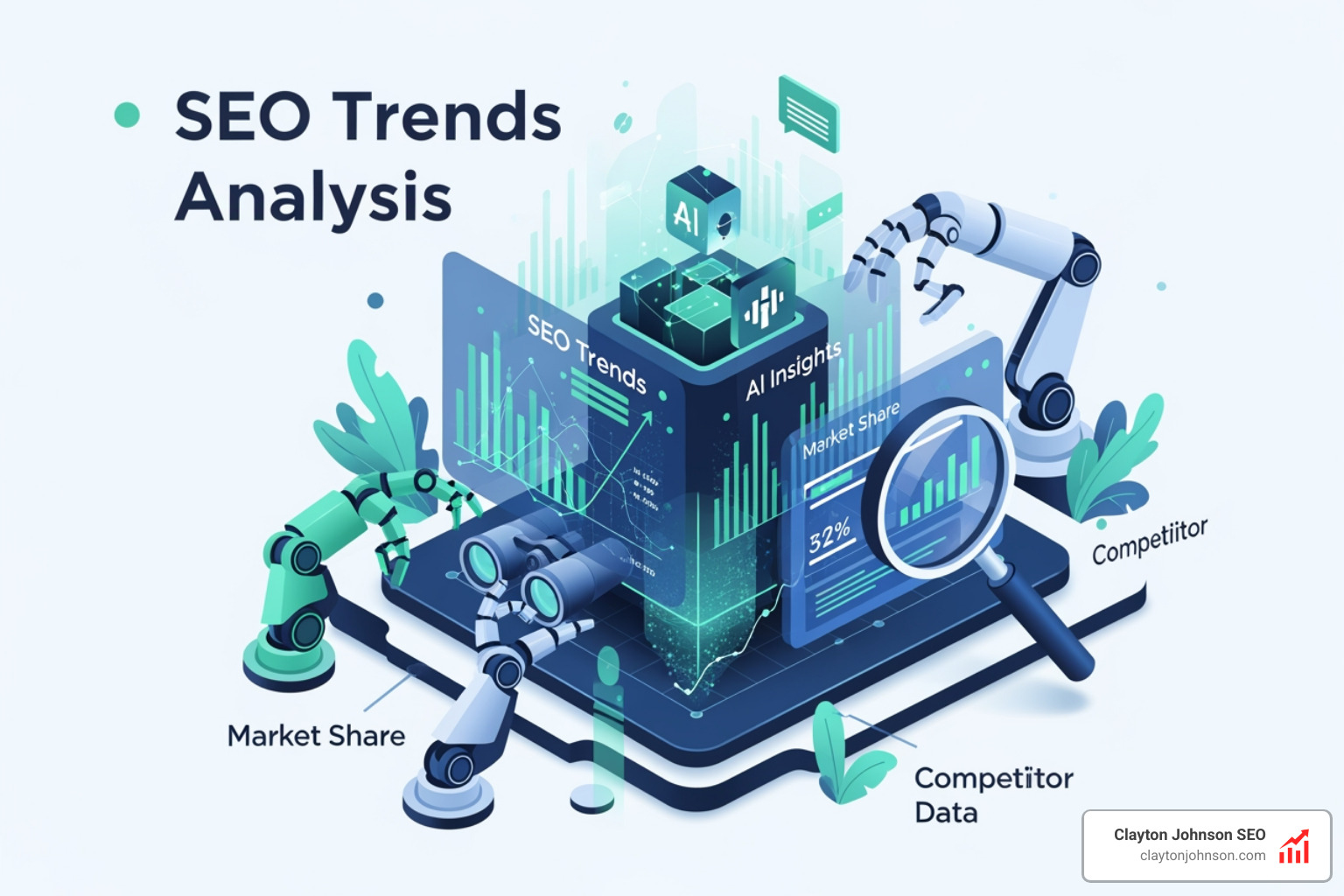
One of the most effective AI-driven tactics is analyzing a competitor’s sitemap.xml. By feeding a sitemap into an LLM, we can instantly categorize their entire content strategy. We can see how many “how-to” guides they have versus “product reviews,” and identify which topical clusters they are aggressively expanding.
Executing a Keyword Gap Analysis with SEO AI Competitive Analysis
We look for three specific types of gaps:
- Missing Keywords: High-volume terms where multiple competitors rank, but we don’t rank at all.
- Underperforming Keywords: Terms where we rank on page 2 or 3, but competitors are in the top 5.
- Quick Wins: Keywords with a Keyword Difficulty (KD) under 40 where we can easily leapfrog a competitor with a content refresh.
Reverse-Engineering Competitor Content with SEO AI Competitive Analysis
Don’t just copy; create something “10x better.” We use AI to reverse-engineer competitor content briefs. By analyzing their heading hierarchy (H1-H4), meta tags, and internal linking structures, we can identify what Google likes about their page.
We then apply a Content Quality Scorecard to evaluate:
- Depth: Does it answer the “People Also Ask” questions?
- Formatting: Is it optimized for featured snippets (lists, tables, concise 40-60 word definitions)?
- Freshness: Is the data current, or are they relying on three-year-old stats?
This approach is critical for Answer Engine Optimization (AEO), ensuring our content is the preferred source for AI-generated summaries.
Analyzing Backlinks and Technical Authority Using AI
Backlinks remain a top three ranking factor. In fact, top-ranking pages have 3.8x more backlinks than positions 2-10. However, it isn’t just about quantity; it’s about the “link velocity” and authority of the referring domains.
Using SEO AI competitive analysis, we can perform a “Link Intersect” analysis. This identifies sites that link to three or four of your competitors but not to you. These are high-probability targets for outreach because they’ve already shown an interest in your niche.
Technical Authority Checks
AI doesn’t just look at links; it audits the foundation. We compare our technical performance against rivals using metrics like:
- Core Web Vitals: Are our pages loading in under 2 seconds? (47% of visitors expect this).
- Mobile-friendliness: With 58% of searches happening on mobile, a clunky mobile experience is a death sentence.
- Schema Markup: Are competitors using advanced Schema (Organization, FAQ, Review) to win more SERP real estate?
We also look for broken link building opportunities. If a competitor has a high-authority link that now points to a 404 page, we can create a superior resource and ask the linking site to point to us instead. 66% of backlinks are broken, making this a goldmine for savvy SEOs.
Optimizing for the Future: SGE and AI Search Visibility
The future of search is the Google Search Generative Experience (SGE). In this new world, “ranking #1” matters less than being cited in the AI-generated overview.
We use an AI Visibility Score (ranging from 0-100) to benchmark how often our brand is mentioned in AI responses compared to our rivals. This requires a shift in strategy. AI models like ChatGPT and Perplexity rely on “brand mentions” across the web—not just on your own site.
To boost AI visibility, we focus on:
- Citations: Getting mentioned on third-party authority sites, Reddit, and niche forums.
- Topic Ownership: Dominating the “Share of Voice” for specific clusters so the AI views us as the primary authority.
- Framing: Analyzing how AI describes us. Are we the “budget option” or the “premium leader”? AI sentiment analysis helps us adjust our messaging to influence these narratives.
Actionable Insights: Scoring and Prioritizing Opportunities
The biggest danger in SEO AI competitive analysis is “analysis paralysis.” You’ll find thousands of gaps, but you can’t fix them all at once. We use an Opportunity Scoring Framework to prioritize:
Priority Score = (Impact × Competitive Advantage) / Effort
High-Impact SEO Triggers
We recommend immediate analysis when:
- A major Google algorithm update is released.
- A competitor launches a new product line.
- You experience a sudden drop in rankings for core terms.
- You are planning a website migration or rebrand.
Your Execution Timeline
- Days 1-30 (Quick Wins): Optimize meta titles for CTR, fix technical errors, and refresh “page 2” content.
- Days 31-90 (Strategic Growth): Launch new content clusters to fill major gaps and execute a targeted link-building campaign.
- Ongoing: Monthly mini-audits to track competitor rank changes and new AI visibility opportunities.
Frequently Asked Questions about SEO AI Competitive Analysis
How often should I conduct an SEO AI competitive analysis?
We recommend a deep-dive analysis quarterly, with monthly “pulse checks” on your top 5 rivals. Immediate analysis should be triggered by major Google updates or significant ranking shifts.
What is the difference between business competitors and SEO competitors?
Business competitors sell the same thing as you. SEO competitors rank for the same keywords as you. Often they overlap, but informational sites (like blogs or news outlets) are often your biggest SEO rivals even if they don’t sell a product.
Can I perform AI-driven competitor analysis without paid tools?
You can do a basic version using Google Search Console, Keyword Planner, and manual SERP reviews. However, to get the scale and predictive insights required to truly dominate, professional tools like Semrush, Ahrefs, or Frase are highly recommended.
Conclusion
Winning in the AI era isn’t about working harder; it’s about being smarter with your data. By leveraging SEO AI competitive analysis, you can stop guessing and start executing with the confidence that your strategy is backed by millions of data points.
At Clayton Johnson SEO, we specialize in building these exact systems. We providefounders and marketing leaders with the actionable frameworks and SEO services needed to diagnose growth problems and execute with measurable results. Whether you’re in Minneapolis or scaling a global brand, your growth depends on how well you understand—and outperform—your competition.
Ready to turn competitive intelligence into compounding growth? Let’s build your moat.